Category Archives: seasonal

Statistik och analyser av trender inom online gambling och deras påverkan

Den nuvarande situationen för spelmarknaden präglas av föränderliga speltrender och en ökning av aktörer inom sektorn. Genom att noggrant analysera marknadsdata kan vi få insikt i hur användarbeteende formas och vad som driver växten inom denna bransch. Med hjälp av omfattande studier kan man identifiera de mest framträdande aktörerna och deras strategier för namngivning av aktörer, vilket styr konsumenternas val.

Dessutom spelar demografi en avgörande roll för att förstå marknadens dynamik. Olika åldersgrupper och socioekonomiska bakgrunder inkomster kan leda till varierande användarbeteende. Dessutom ger framtidsutsikter för industrin en hint om möjliga tillväxtprognoser och kommande trender. Till exempel erbjuder utländska casino utan svensk licens en alternativ väg för spelare i olika segment.

Att kontinuerligt observera branschstandarder och hur de utvecklas med tiden är viktigt för alla aktörer på marknaden. Genom att noggrant följa den nuvarande marknadssituationen kan man fatta informerade beslut, vilket resulterar i mer skräddarsydda och konkurrenskraftiga erbjudanden till kunderna. Det är en spännande tid för spelmarknaden, med betydande möjligheter för tillväxt och innovation.

Tendensanalys av spelande beteenden i Sverige

Under de senaste åren har intäkterna från spelandet i Sverige genomgått signifikanta förändringar. Detta kan delvis tillskrivas den pågående utvecklingen inom marknadsdata och användarbeteende. Speltrender har skiftat, där nya aktörer och innovativa plattformar gör inträde på marknaden. Denna dynamik speglar inte bara en förändring i spelvanor utan också i konsumenternas förväntningar.

Marknadssituationen visar att många svenskar i allt högre grad söker alternativa former av underhållning, vilket har lett till en ökning av digitala speltjänster. Faktorer såsom branschstandarder och regleringar påverkar också hur aktörer kan verka inom sektorn, vilket skapar en mer transparent och säker spelmiljö. Med bättre insyn har regeringen möjlighet att monitorera och granska spelandet noggrant.

Framtidsutsikterna för spelmarknaden i Sverige ser lovande ut. Med kontinuerlig tillväxtprognos och ökad acceptans av nya spelformat finns det potential för aktörer att expandera sina verifierade plattformar. Det är avgörande för företag att anpassa sina erbjudanden i takt med förändringar i användarbeteendet.

Namngivningen av aktörer har också blivit viktigare i denna kontext, där varumärket och dess rykte kan påverka konsumenternas val. Det är intressant att notera hur vissa företag knyter an till lokala traditioner och kulturella referenser för att stärka sin marknadsposition.

Den nuvarande trenden inom spelande beteenden tyder på en ökad efterfrågan på interaktiva och sociala upplevelser. Detta visar att spelare i Sverige inte bara är ute efter vinster, utan även vill ha en meningsfull och engagerande spelupplevelse. Dessutom tillkommer frågor kring ansvarstagande och hur aktörer kan främja mer hållbara sätt att spela.

Kombinationen av förändrade speltrender och marknadsinsikter skapar en intressant miljö för såväl nya som etablerade aktörer. Analyser av användarbeteende ger värdefull information som kan leda till smartare affärsstrategier och förbättrad kundnöjdhet. I takt med att branschen utvecklas, förväntas aktörer att hålla sig uppdaterade och anpassningsbara för att behålla sin konkurrenskraft.

Kunskapsanalys av användardata inom spelmarknaden

Kunskapsanalys av användardata inom spelmarknaden

Analyser av marknadsdata ger insikter i användarbeteende, vilket är avgörande för att förstå hur olika faktorer påverkar spelaktiviteter. Genom att studera demografi kan aktörer inom branschen identifiera mönster och preferenser bland sina kunder, vilket möjliggör en mer skräddarsydd upplevelse.

Intäkter som genereras från olika speltrender visar på förändringar i spelarnas val och vanor. Dessa data kan avslöja nya möjligheter, vilket gör det viktigt att vara medveten om de senaste strömningarna inom sektorn.

Framtidsutsikter för spelmarknaden beror i stor utsträckning på hur väl aktörerna kan anpassa sig till de förändrade preferenserna hos sina användare. Tillväxtprognoser bygger på en grundlig analys av nuvarande och kommande trender, vilket är nödvändigt för att säkerställa fortsatt framgång.

Branschstandarder utvecklas ständigt, och det är avgörande att företag följer dessa riktlinjer för att upprätthålla konkurrenskraft. Genom att integrera användardata kan företag justera sina strategier och erbjudanden, vilket i sin tur ökar lojaliteten bland spelare.

Marknadssituationen påverkas av externa faktorer, inklusive lagstiftning och teknologiska framsteg. Genom att noggrant granska användardata kan företag förutse hur dessa faktorer kan förändra spelmiljön.

Genom att implementera avancerade analysverktyg kan operatörer få djupare förståelse för sina kunders beteenden. Detta gör det möjligt att skapa riktade marknadsföringskampanjer som resulterar i högre konverteringsgrader och ökad engagemang.

Vidare samlar många plattformar in data om användarnas interaktioner, vilket ger ovärderlig information för att optimera spelupplevelsen. Genom att förstå dessa interaktioner kan operatörer ständigt förbättra sin plattform baserat på feedback och användarpreferenser.

Avslutningsvis visar studier av användardata hur avgörande insikter kan dras för att forma framtiden inom spelbranschen. Förmågan att agera på dessa insikter kan ställa aktörer i en stark position när marknaden fortsätter att utvecklas.

Riskbedömning av spelberoende och dess påverkan

Riskbedömning av spelberoende och dess påverkan

Riskhantering inom spelsektorn är en växande nödvändighet, och att förstå spelberoende är avgörande för att skydda konsumenterna och förbättra branschstandarder. Det är viktigt för aktörer att anpassa sina strategier baserat på marknadsdata och aktuella speltrender. Genom att tillämpa insikter från demografi kan företag skapa mer riktade åtgärder för att minska negativa effekter av spelande.

En aspekt av denna riskbedömning är analysen av användarbeteende. Företag bör övervaka mönster i hur spelare interagerar med olika plattformar. Dessa insikter kan ge en klar bild av tillväxtprognoser och hjälpa branschen att förutsäga framtida spelaraktiviteter. Genom att observera hur olika demografiska grupper engagerar sig, kan aktörer identifiera riskfaktorer tidigt.

  • Identifiera potentiella riskgrupper
  • Implementera ansvarsfulla spelåtgärder
  • Utveckla utbildningar för personalen

Tillgång till korrekt marknadsinformation är också avgörande. Genom att kontinuerligt övervaka marknadssituationen kan företag bättre förstå de risker som är förknippade med spelberoende och anpassa sina affärsmodeller för att möta dessa utmaningar. Genom insikter om framtidsutsikter kan vi se en mer ansvarstagande och hållbar utveckling inom sektorn.

Frågor och svar:

Vad är den nuvarande trenden för online gambling i Sverige?

Trenden för online gambling i Sverige har sett en ökning av både registrerade användare och omsättning de senaste åren. Detta har delvis berott på ökade investeringar av operatörer och nya teknologiska plattformar som gör det lättare för spelare att delta i olika former av spel.

Hur påverkar regleringar online gambling marknaden?

Regleringar har stor betydelse för online gambling-marknaden i Sverige. De syftar till att säkerställa spelarskydd och förebygga problemspelande. Detta påverkar hur speloperatörer designar sina tjänster och hur de marknadsför sina produkter. Reglerade miljöer kan också leda till ökad transparens och rättvisa.

Vilka risker är förknippade med online gambling?

Online gambling medför flera risker, inklusive ekonomiska förluster och risker för beroende. Många spelare tappar kontrollen över sina spelvanor, vilket kan leda till betydande personliga och sociala problem. Det är viktigt att spelare är medvetna om dessa risker och har tillgång till resurser för hjälp och stöd.

Vilka typer av spel är mest populära bland online spelare?

De mest populära typerna av spel bland online spelare inkluderar slots, poker och live dealerspel. Slots lockar många på grund av deras variation och enkelhet, medan poker erbjuder mer strategi och interaktion mellan spelare. Live dealerspel ger en autentisk casinoupplevelse direkt hemifrån.

Hur analyseras spelmönster i online gambling?

Analys av spelmönster i online gambling görs genom att samla och bearbeta data om spelarnas beteenden och insatser. Genom att använda statistiska metoder och algoritmer kan operatörer identifiera trender, förutsäga framtida beteende och anpassa sina erbjudanden för att möta spelarnas preferenser bättre.

Vilka faktorer påverkar statistiken inom online gambling i Sverige?

Statistiken kring online gambling i Sverige påverkas av flera variabler, inklusive lagstiftning, tillgång till internet, och förändringar i användarnas beteende. Lagarna ställer krav på spelaktörer, vilket kan påverka hur många som väljer att spela online. Dessutom kan förändringar i teknik och reklamstrategier påverka intresset och antalet aktiva användare.

Hur kan analyser av speldata bidra till förståelsen av online gambling?

Analyser av speldata kan ge insikter i spelmönster, inklusive vilka typer av spel som är mest populära och hur ofta spelare deltar i olika aktiviteter. Genom att undersöka spelarnas beteenden kan forskare och företag få en djupare förståelse för riskerna kopplade till spelande, vilket i sin tur kan informera om ökade åtgärder för ansvarsfullt spelande och skydd av sårbara grupper.
Keeping a Wary Eye on the “Scary Stuff”

In many ways the markets imitate life.  For example, the trend is your friend.  You may enjoy your friendship with the trend for an indefinite length of time.  But the moment you ignore it – or just simply take it for granted that this friendship is permanent, with no additional effort required on your part – that’s when the trouble starts.

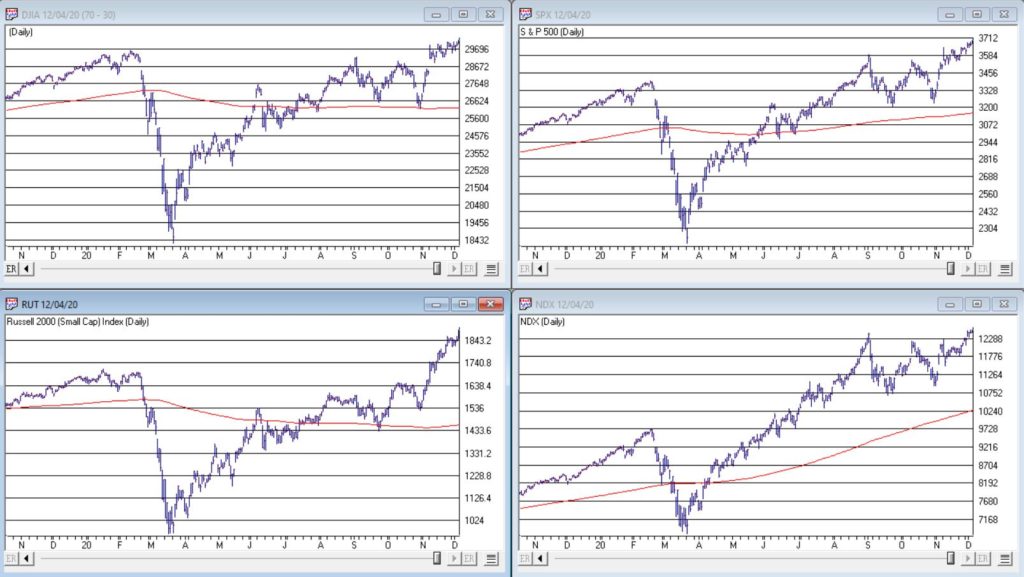
For the stock market right now, the bullish trend is our friend.  Figure 1 displays the 4 major indexes all above their respective – and rising – long-term moving averages.  This is essentially the definition of a “bull market.” 

Figure 1 – 4 Major Indexes in Bullish Trends (Courtesy AIQ TradingExpert)

In addition, a number of indicators that I follow have given bullish signals in the last 1 to 8 months.  These often remain bullish for up to a year.  So, for the record, with my trusted trend-following, oversold/thrust and seasonal indicators mostly all bullish I really have no choice but to be in the bullish camp.

Not that I am complaining mind you.  But like everyone else, I try to keep my eyes open for potential signs of trouble.  And of course, there are always some.  One of the keys to long-term success in the stock market is determining when is the proper time to actually pay attention to the “scary stuff.”  Because scary stuff can be way early or in other cases can turn out to be not that scary at all when you look a little closer. 

So, let’s take a closer look at some of the scary stuff.

Valuations

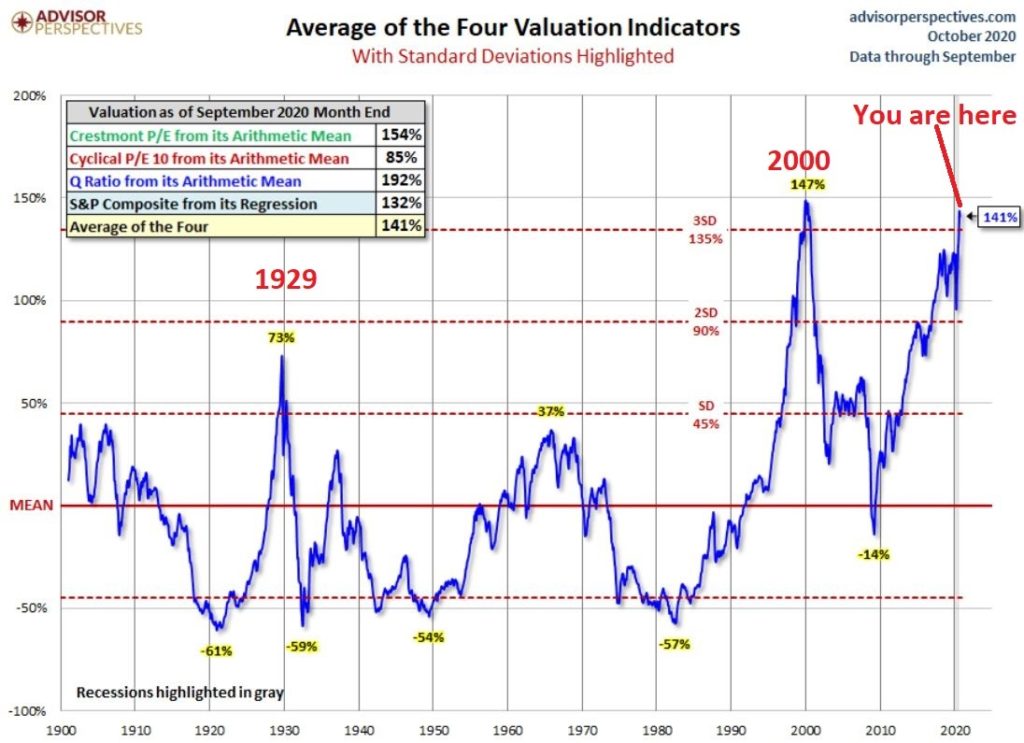
Figure 2 displays an aggregate model of four separate measures of valuation.  The intent is to gain some perspective as to whether stocks are overvalued, undervalued or somewhere in between.

Figure 2 – Stock Market valuation at 2nd highest level ever (Courtesy: www.advisorperspectives.com)

Clearly the stock market is “overvalued” if looked at from a historical perspective.  The only two higher readings preceded the tops in 1929 (the Dow subsequently lost -89% of its value during the Great Depression) and 2000 (the Nasdaq 100 subsequently lost -83% of its value). 

Does this one matter?  Absolutely.  But here is what you need to know:

*Valuation IS NOT a timing indicator.  Since breaking out to a new high in 1995 the stock market has spent most of the past 25 years in “overvalued” territory.  During this time the Dow Industrials have increased 700%.  So, the proper response at the first sign of overvaluation should NOT be “SELL.”

*However, ultimately valuation DOES matter. 

Which leads directly to:

Jay’s Trading Maxim #44: If you are walking down the street and you trip and fall that’s one thing.  If you are climbing a mountain and you trip and fall that is something else.  And if you are gazing at the stars and don’t even realize that you are climbing a mountain and trip and fall – the only applicable phrase is “Look Out Below”.

So, the proper response is this: instead of walking along and staring at the stars, keep a close eye on the terrain directly in front of you.  And watch out for cliffs.

Top 5 companies as a % of S&P 500 Index

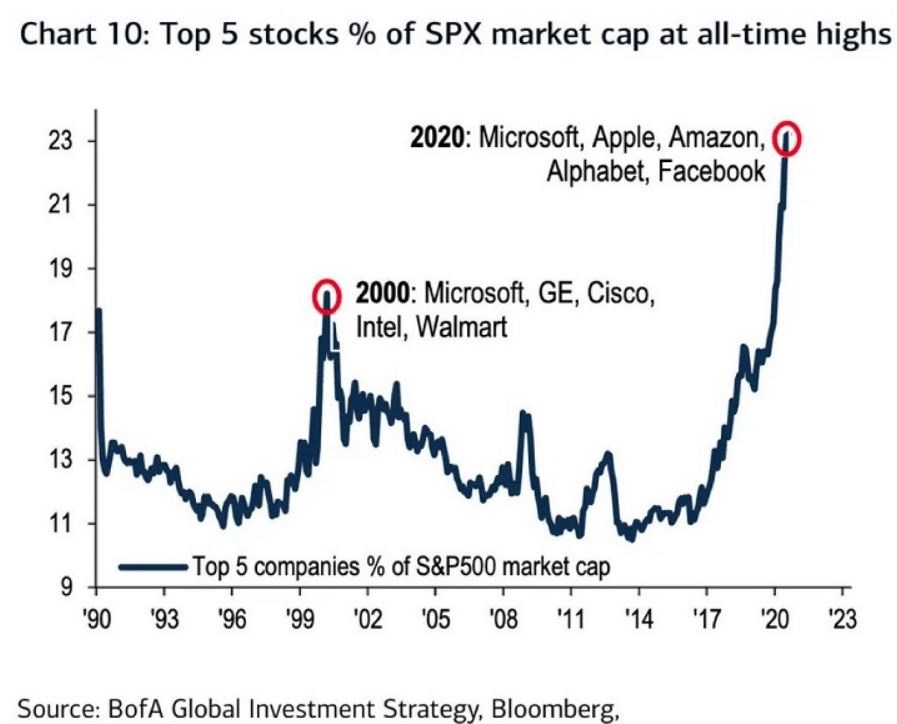
At times through history certain stocks or groups of stocks catch “lightning in a bottle.”  And when they do the advances are spectacular, enriching anyone who gets on board – unless they happen to get on board too late.  Figure 3 displays the percentage of the S&P 500 Index market capitalization made up by JUST the 5 largest cap companies in the index at any given point in time. 

Figure 3 – Top 5 stocks as a % of S&P 500 Index market cap (Courtesy: www.Bloomberg.com)

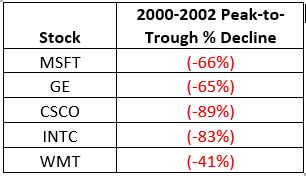
The anecdotal suggestion is pretty obvious.  Following the market peak in 2000, the five stocks listed each took a pretty significant whack as shown in Figure 4.

Figure 4 – Top Stocks after the 2000 Peak

Then when we look at how far the line in Figure 3 has soared in 2020 the obvious inference is that the 5 stocks listed for 2020 are due to take a similar hit.  And here is where it gets interesting.  Are MSFT, AAPL, AMZN, GOOGL and FB due to lose a significant portion of their value in the years directly ahead?

Two thoughts:

*There is no way to know for sure until it happens

*That being said, my own personal option is “yes, of course they are”

But here is where the rubber meets the road: Am I presently playing the bearish side of these stocks?  Nope.  The trend is still bullish.  Conversely, am I keeping a close eye and am I willing to play the bearish side of these stocks?  Yup.  But not until they – and the overall market – actually starts showing some actual cracks.

One Perspective on AAPL

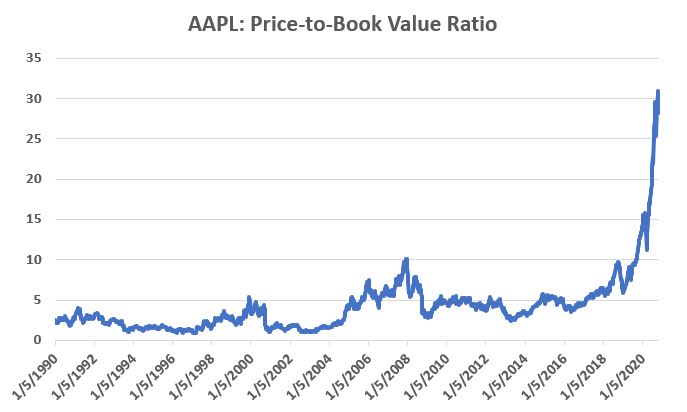
Apple has been a dominant company for many years, since its inception really.  Will it continue to be?  I certainly would not bet against the ability of the company to innovate and grow its earnings and sales in the years ahead. Still timing – as they say – is everything.  For what it is worth, Figure 5 displays the price-to-book value ratio for AAPL since January 1990.

Figure 5 – AAPL price-to-book value ratio (Data courtesy of Sentimentrader.com)

Anything jump out at you?

Now one can argue pretty compellingly that price-to-book value is not the way to value a leading technology company.  And I probably agree – to a point.  But I can’t help but look at Figure 5 and wonder if that point has possibly been exceeded.

Summary

Nothing in this piece is meant to make you “bearish” or feel compelled to sell stocks.  For the record, I am still in the bullish camp.  But while this information DOES NOT constitute a “call to action”, IT DOES constitute a “call to pay close attention.” 

Bottom line: enjoy the bull market but DO NOT fall in love with it. 

Jay Kaeppel

Disclaimer: The information, opinions and ideas expressed herein are for informational and educational purposes only and are based on research conducted and presented solely by the author.  The information presented represents the views of the author only and does not constitute a complete description of any investment service.  In addition, nothing presented herein should be construed as investment advice, as an advertisement or offering of investment advisory services, or as an offer to sell or a solicitation to buy any security.  The data presented herein were obtained from various third-party sources.  While the data is believed to be reliable, no representation is made as to, and no responsibility, warranty or liability is accepted for the accuracy or completeness of such information.  International investments are subject to additional risks such as currency fluctuations, political instability and the potential for illiquid markets.  Past performance is no guarantee of future results.  There is risk of loss in all trading.  Back tested performance does not represent actual performance and should not be interpreted as an indication of such performance.  Also, back tested performance results have certain inherent limitations and differs from actual performance because it is achieved with the benefit of hindsight.

The Ridiculous Seasonality of AMD

Don’t you hate it when some analyst analyzes historical data and then purports to find some “order” in the historical chaos?  Hi, my name is Jay.  And…it’s just kind of what I do.  Sorry, it’s just my nature.  Take for instance the ridiculous case of AMD.

Advanced Micro Devices – Ticker AMD

According to “Adjusted Close” price data from www.finance.yahoo.com ticker AMD advanced from $3.15 a share in March of 1980 to $56.39 by May 20, 2020.  Given that the stock has risen +1,693% on a buy-and-hold basis, it is not exactly a revelation that – particularly with the huge benefit of perfect hindsight – there was some money to be made by holding the stock.

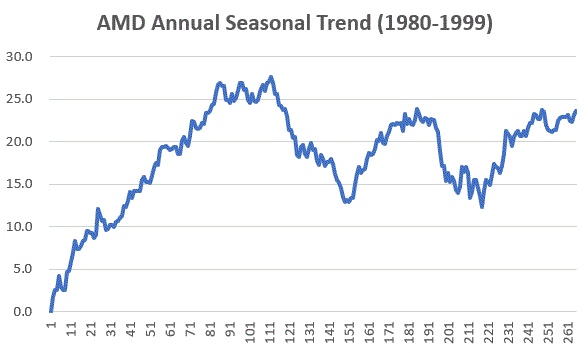
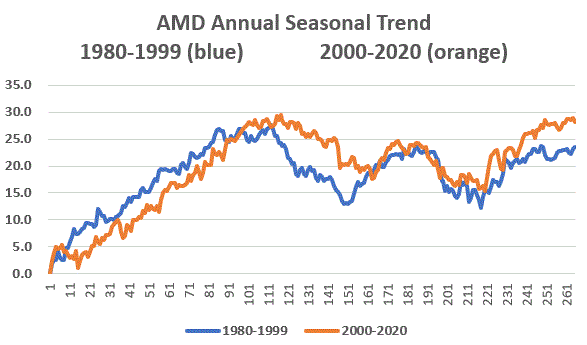
But that is only part of the story.  For as it turns out, AMD is one of the most consistently “cyclical” stocks you may ever find.  Figure 1 displays the average annual price trend for AMD from 3/17/1980 through 12/31/1999.  In other words, period 1 along the bottom of the chart is January Trading Day #1, and so on, through the last trading day of December.

Figure 1 – Annual Seasonal Price Trend for AMD (1980-1999)

As you can see, the stock tended to rally sharply through the end of May, from mid-July through about late August, and from late October through the end of the year (or more accurately, through the end of the next May).

Declines typically occurred between about June 1st and late July and again during September into late October.

Ah, sweet hindsight.

But what are the odds that any of this was meaningful after 1999?  I’m glad you asked.  Because that’s where the ridiculous part comes in. 

2000-2020

Figure 2 plots the same 1980-1999 annual seasonal price trend for AMD along with the annual seasonal trend for AMD from 2000-2019.  Notice any similarities? 

Figure 2 – Annual Seasonal Price Trend for AMD; 1980-1999 and 2000-2020

So, let’s make the ridiculous (there’s that word again) assumption that some (lucky) investor had started trading in and out of AMD on an annual basis the following seasonal calendar

Figure 3 – Annual Seasonal Bullish and Bearish Periods

Some how did the “walk forward” period of 2000 into late May-2020 compare to the “hindsight” period of 1980-1999?  Well there is good news and bad news.

The bad news is that results for each period was not quite as good during 2000-2020 as they were during 1980-1999.  The good news is that the 2000-2020 results were still pretty darn compelling.

Figure 4 – AMD performance during Bullish and Bearish Periods

The bottom line: The “bullish” periods have to continued to be quite bullish and the “bearish” periods continue to be quite bearish.

For the record, between March 1980 and May 2020:

*$1,000 in AMD on a buy-and-hold basis grew to $17,925

*$1,000 in AMD ONLY during the two “bullish” period discussed grew to $587,558,351

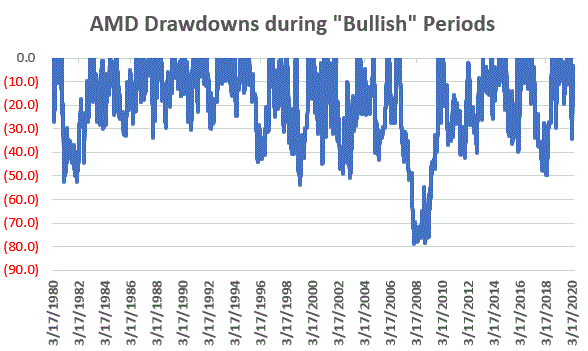
Let’s face it, these are – here I go again – ridiculous numbers.  And it should be pointed out that an investor holding AMD only during the “Bullish” periods would have suffered 4 separate drawdowns in excess of -50%, including a -79%(!) drawdown in 2008-2009.  See Figure 5.  So, don’t anybody get “stars in their eyes.”

Figure 5 – Drawdowns during Bullish Periods

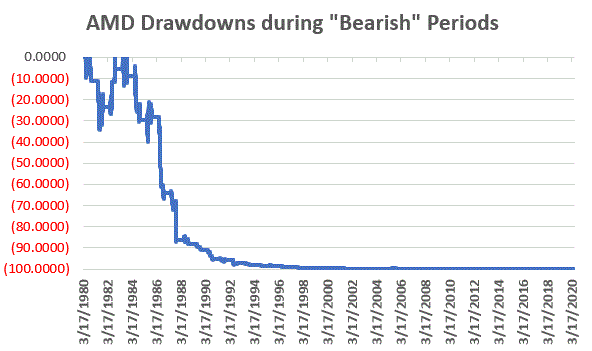
At the same time, it is still better than the drawdown racked up during the “bearish” periods, which checks in at a cool -99.9867%.  See Figure 6.

Figure 6 – Drawdowns during Bearish Periods

Where We Are

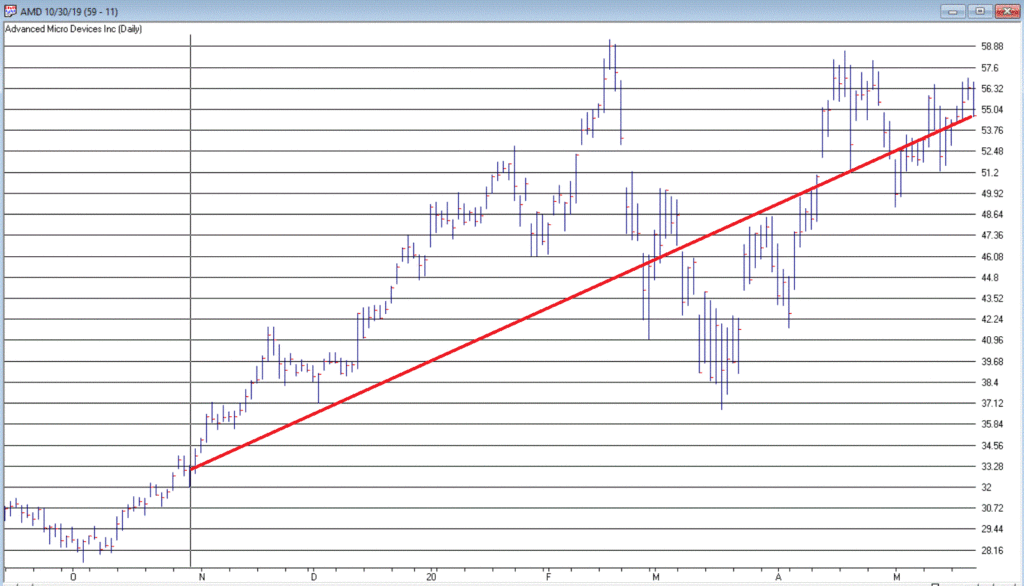
AMD has been in a “bullish” period since the 19th trading day of October 2019, and this period will last until the close on 5/29/2020.  Through 5/20/2020 AMD is up +73% during the current bullish period (i.e., pandemic, schmandemic).  See Figure 7.

Figure 7 – AMD during recent “Bullish” period (Courtesy AIQ TradingExpert)

The next “bearish” period will last from the close on 5/29/2020 through the close on 7/23/2020.

Summary

So, in hindsight, the annual seasonal pattern for AMD tracked very closely with the annual seasonal pattern for the previous 20 years.  But what about the next 20 years?  Ah, there’s the rub. Despite the fact that the annual seasonal trend for the past 20 years very closely mirrored the annual seasonal trend for the prior 20 years, it is not possible to state with any certainty what the next 20 years hold. 

Still, if I decide to trade AMD I will probably consult my calendar first.

See also Jay’s “A Strategy You Probably Haven’t Considered” Video

Jay Kaeppel

Disclaimer: The information, opinions and ideas expressed herein are for informational and educational purposes only and are based on research conducted and presented solely by the author.  The information presented represents the views of the author only and does not constitute a complete description of any investment service.  In addition, nothing presented herein should be construed as investment advice, as an advertisement or offering of investment advisory services, or as an offer to sell or a solicitation to buy any security.  The data presented herein were obtained from various third-party sources.  While the data is believed to be reliable, no representation is made as to, and no responsibility, warranty or liability is accepted for the accuracy or completeness of such information.  International investments are subject to additional risks such as currency fluctuations, political instability and the potential for illiquid markets.  Past performance is no guarantee of future results.  There is risk of loss in all trading.  Back tested performance does not represent actual performance and should not be interpreted as an indication of such performance.  Also, back tested performance results have certain inherent limitations and differs from actual performance because it is achieved with the benefit of hindsight.

March and April to the Rescue?

Well that got ugly quick.  For the record, if you have been in the markets for any length of time you have seen this kind of action plenty of times.  An index, or stock, or commodity or whatever, trends and trends and trend steadily and relentlessly higher over a period of time.  And just when it seems like its going to last forever – BAM.  It gives back all or much of its recent rally gains very quickly.  Welcome to the exciting world of investing.

I make no claims of “calling the top” – because I never have actually (correctly) called one and I don’t expect that I ever will.  But having written Part I and Part II of articles titled “Please Take a Moment to Locate the Nearest Exit” in the last week, I was probably one of the least surprised people at what transpired in the stock market in the last few sessions. 

Of course the question on everyone’s lips – as always in this type of panic or near panic situation – is, “where to from here?”  And folks if I knew the answer, I swear I would tell you.  But like everyone else, I can only assess the situation, formulate a plan of action – or inaction, as the case may be – and act accordingly.  But some random thoughts:

*Long periods of relative calm followed by extreme drops are more often than not followed by periods of volatility.  So, look for a sharp rebound for at least a few days followed by another downdraft and so on and so forth, until either:

a) The market bottoms out and resumes an uptrend

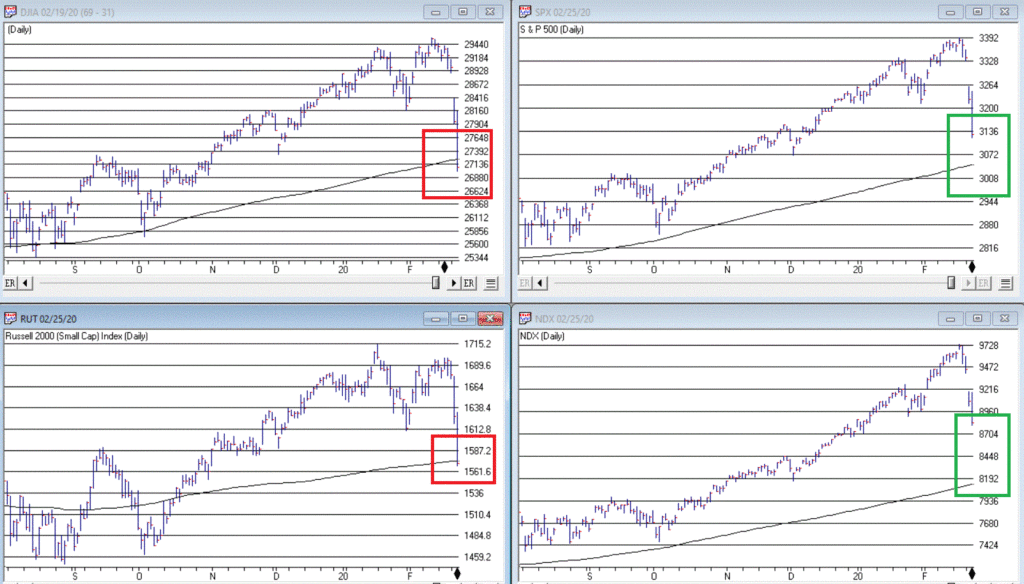
b) The major indexes (think Dow, S&P 500, Nasdaq 100, Russell 2000) drop below their 200-day moving averages.  As of the close on 2/25 both the Dow and the Russell 2000 were below their 200-day moving average.  That would set up another a) or b) scenario.

If the major indexes break below their long-term moving averages it will either:

a) End up being a whipsaw – i.e., the market reverses quickly to the upside

b) Or will be a sign of more serious trouble

The main point is that you should be paying close attention in the days and weeks ahead to the indexes in Figure 1.

Figure 1 – Major indexes with 200-day moving averages (Courtesy AIQ TradingExpert)

One Possible Bullish Hope

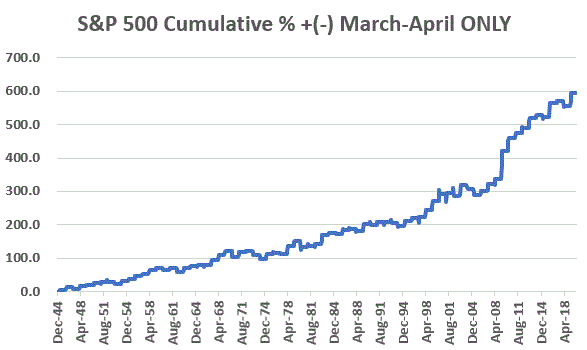
One reason for potential optimism is that the two-month period of March and April has historically been one of the more favorable two-month periods on an annual basis.  Figure 2 displays the cumulative price gain achieved by the S&P 500 Index ONLY during March and April every year since 1945.  The long-term trend is unmistakable, but year-to-year results can of course, vary greatly.

Figure 2 – S&P 500 cumulative price gain March-April ONLY (1945-2019)

For the record:

S&P 500 March-AprilResult
Number of times UP55 (73%)
Number of times DOWN20 (27%)
Average UP%+5.0%
Average DOWN%(-3.4%)

Figure 3 – Facts and Figures

Will March and April bail us out?  Here’s hoping.

As an aside, this strategy is having a great week so far.

Jay Kaeppel

Disclaimer: The information, opinions and ideas expressed herein are for informational and educational purposes only and are based on research conducted and presented solely by the author.  The information presented does not represent the views of the author only and does not constitute a complete description of any investment service.  In addition, nothing presented herein should be construed as investment advice, as an advertisement or offering of investment advisory services, or as an offer to sell or a solicitation to buy any security.  The data presented herein were obtained from various third-party sources.  While the data is believed to be reliable, no representation is made as to, and no responsibility, warranty or liability is accepted for the accuracy or completeness of such information.  International investments are subject to additional risks such as currency fluctuations, political instability and the potential for illiquid markets.  Past performance is no guarantee of future results.  There is risk of loss in all trading.  Back tested performance does not represent actual performance and should not be interpreted as an indication of such performance.  Also, back tested performance results have certain inherent limitations and differs from actual performance because it is achieved with the benefit of hindsight.

A Simple Way To Trade Seasonality


In “A Simple Way To Trade Seasonality” in the September 2019 Stocks & Commodities, author Perry Kaufman describes methods he uses for measuring the seasonality in markets and approaches he uses for trading these patterns

Editors note: The full article can be obtained from Stocks & Commodities magazine at
http://technical.traders.com/sub/sublog2.asp#Sep the system rules are from the article and are based on these rules

1. Average the monthly frequency of the past 4 years.

2. Find the last occurrence of the highest frequency and the last occurrence of the lowest frequency using the average frequency in step 1. That is, if both March and April have a frequency of 70, we use April.

3. Only trade if the high frequency is 75% or greater and the low frequency is 25% or lower.

4. If the high frequency comes first, sell short at the end of the month with the high frequency. Cover the short at the end of the month with the low frequency.

5. If the low frequency comes first, buy at the end of the month with the low frequency. Sell to exit at the end of the month with the high frequency

The importable AIQ EDS file and Excel spreadsheet for Perry Kaufman’s article can be obtained on request via email to info@TradersEdgeSystems.com. The code is also shown below

!A Simple Way to Trade Seasonality
!Author: Perry Kaufman, TASC September 2019
!Coded by: Richard Denning, 07/21/2019
!www.TradersEdgeSystem.com

C is [close].
year is 2019.
len is 4000.
OSD is offsettodate(month(),day(),year()).
FirstDate is firstdatadate().

EOM1 if Month()=2 and valresult(month(),1)=1 and year()=year.
EOMos1 is scanany(EOM1,len) then OSD+1.
EOMc1 is valresult(C,^EOMos1).
EOM2 if Month()=3 and valresult(month(),1)=2 and year()=year.
EOMos2 is scanany(EOM2,len) then OSD+1.
EOMc2 is valresult(C,^EOMos2).
EOM3 if Month()=4 and valresult(month(),1)=3 and year()=year.
EOMos3 is scanany(EOM3,len) then OSD+1.
EOMc3 is valresult(C,^EOMos3).
EOM4 if Month()=5 and valresult(month(),1)=4 and year()=year.
EOMos4 is scanany(EOM4,len) then OSD+1.
EOMc4 is valresult(C,^EOMos4).
EOM5 if Month()=6 and valresult(month(),1)=5 and year()=year.
EOMos5 is scanany(EOM5,len) then OSD+1.
EOMc5 is valresult(C,^EOMos5).
EOM6 if Month()=7 and valresult(month(),1)=6 and year()=year.
EOMos6 is scanany(EOM6,len) then OSD+1.
EOMc6 is valresult(C,^EOMos6).
EOM7 if Month()=8 and valresult(month(),1)=7 and year()=year.
EOMos7 is scanany(EOM7,len) then OSD+1.
EOMc7 is valresult(C,^EOMos7).
EOM8 if Month()=9 and valresult(month(),1)=8 and year()=year.
EOMos8 is scanany(EOM8,len) then OSD+1.
EOMc8 is valresult(C,^EOMos8).
EOM9 if Month()=10 and valresult(month(),1)=9 and year()=year.
EOMos9 is scanany(EOM9,len) then OSD+1.
EOMc9 is valresult(C,^EOMos9).
EOM10 if Month()=11 and valresult(month(),1)=10 and year()=year.
EOMos10 is scanany(EOM10,len) then OSD+1.
EOMc10 is valresult(C,^EOMos10).
EOM11 if Month()=12 and valresult(month(),1)=11 and year()=year.
EOMos11 is scanany(EOM11,len) then OSD+1.
EOMc11 is valresult(C,^EOMos11).
EOM12 if Month()=1 and valresult(month(),1)=12 and valresult(year(),1)=year.
EOMos12 is scanany(EOM12,len) then OSD+1.
EOMc12 is valresult(C,^EOMos12).
YEARavg is (EOMc1+EOMc2+EOMc3+EOMc4+EOMc5+EOMc6+EOMc7+EOMc8+EOMc9+EOMc10+EOMc11+EOMc12)/12.

AR1 is (EOMc1 / YEARavg-1)*100.
AR2 is (EOMc2 / YEARavg-1)*100.
AR3 is (EOMc3 / YEARavg-1)*100.
AR4 is (EOMc4 / YEARavg-1)*100.
AR5 is (EOMc5 / YEARavg-1)*100.
AR6 is (EOMc6 / YEARavg-1)*100.
AR7 is (EOMc7 / YEARavg-1)*100.
AR8 is (EOMc8 / YEARavg-1)*100.
AR9 is (EOMc9 / YEARavg-1)*100.
AR10 is (EOMc10 / YEARavg-1)*100.
AR11 is (EOMc11 / YEARavg-1)*100.
AR12 is (EOMc12 / YEARavg-1)*100.

EOMc if firstdate < makedate(1,20,2019-20).
AR if EOMc.

The EDS code is not a trading system but a way to get the data needed into an Excel spreadsheet to enable you to make the seasonal calculations. The EDS file should be run on a date after the end of the year being calculated. Each year for which data is needed must be run separately by setting the “year” variable. Multiple symbols can be run at the same time by using a list of the desired symbols. Each time a year is run, the “AR” report must be saved as a “.csv” file. Once all the years needed have been run and saved to separate “.csv” files, they all should be cut and pasted to a single Excel sheet. They then can be sorted by symbol and each symbol can be copied and pasted to a tab for that symbol.

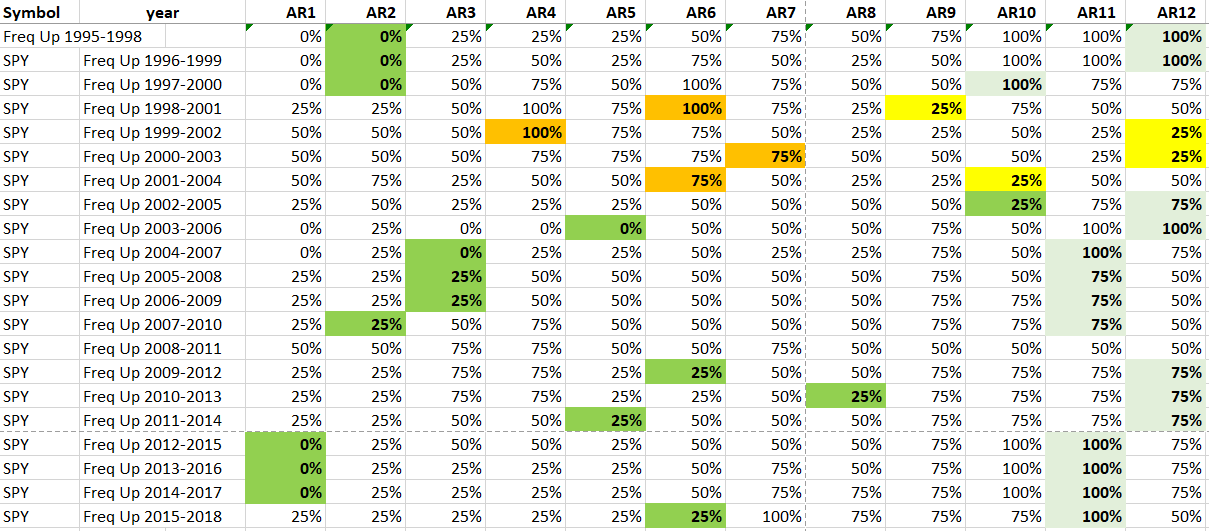
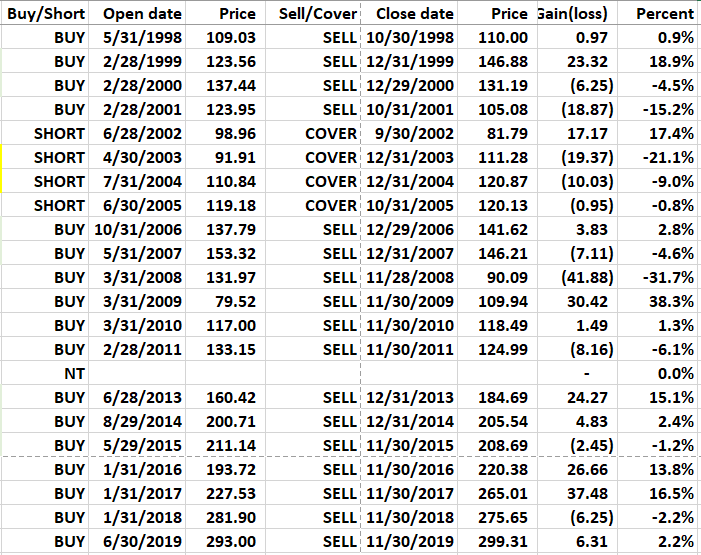
Figure 6 shows the rolling four-year frequency for the S&P 500 ETF (SPY) and Figure 7 shows the annual trades resulting from applying the seasonal rules to the frequency data.

Sample Chart

FIGURE 6: AIQ. Shown here is the rolling four-year frequency for the SPY.

Sample Chart

FIGURE 7: AIQ. Shown here are the annual trades resulting from applying the seasonal rules to the frequency data for SPY.

—Richard Denning
info@TradersEdgeSystems.com
for AIQ Systems