All posts by admin

Detecting Swings

The AIQ code based on Domenico D’Errico’s article in the May 2017 issue of Stoks Commodities, “Detecting Swings,” is provided below.

I tested the author’s four systems using the NASDAQ 100 list of stocks on weekly bars, as did the author, from 3/16/2005 through 3/14/2017. Figure 7 shows the comparative metrics of the four systems using the four-week exit. The results were quite different than the author’s, probably due to a different test portfolio and also a 10-year test period rather than the author’s 20-year period. In addition, my test results show longs only, whereas the author’s results are the average of both the longs and shorts.

Sample Chart
 
FIGURE 7: AIQ. As coded in EDS, this shows the metrics for the author’s four systems run on NASDAQ 100 stocks (weekly bar data) over the period 3/16/2005 to 3/14/2007.

The Bollinger Band (Buy2) system showed the worst results, whereas the author’s results showed the Bollinger Band system as the best. The pivot system (Buy1) showed the best results, whereas the author’s results showed the pivot system as the worst. I am not showing here the comparative test results for the Sell1 thru Sell4 rules, as all showed an average loss over this test period.

!DECTECTING SWINGS
!Author: Domenico D'Errico, TASC May 2017
!Coded by: Richard Denning, 3/15/17
!www.TradersEdgeSystems.com

!Set to WEEKLY in properties

Low is  [low].
Low1  is valresult(Low,1).
Low2  is valresult(Low,2). 
High is [high].
High1  is valresult(High,1).
High2  is valresult(High,2). 
PivotLow if Low1 < Low2  and Low1 < Low.
PivotHigh if High1 > High2  and High1 > High.

Buy1 if  PivotLow.  
Sell1 if  PivotHigh.    

!Set parameter for bollinger bands to 12 with 2 sigma (weekly) in charts:
Buy2 if [close] > [Lower BB] and valrule([close] <= [Lower BB],1).
Sell2 if [close] < [Upper BB] and valrule([close] >= [Upper BB],1).

!Set parameter for Wilder RSI to 5 (weekly) in charts:
Buy3 if [RSI Wilder] > 40 and valrule([RSI Wilder] <= 40,1).
Sell3 if [RSI Wilder] < 60 and valrule([RSI Wilder] >= 60,1).

Buy4 if [RSI Wilder] < 40  And Low > Low1.
Sell4 if [RSI Wilder] > 60  And High < High1.    

Exit if {position days} >= 4.
—Richard Denning
info@TradersEdgeSystems.com
for AIQ Systems
Editor note: The code and EDS file can be downloaded from http://aiqsystems.com/Detecting_Swings_TASC_May_2017.EDS

It’s Soon or Never for Bonds

There is great trepidation in the bond market these days. Most investors seem to have the “interest rates are sure to rise” mantra playing on auto loop in their head.  And this is not entirely unwarranted.  Given the historical tendency for bond yields to move in long, slow trends (20 years or more essentially in one direction is not uncommon), I for one am pretty confident in believing that interest rates will be higher 20 years from now than they are now.
But that is not the fear that is playing in people’s heads. The fear in people’s heads is that rates are rising soon (like immediately) and in a big way.  This however, may or may not prove to be the case.
Figure 1 displays a history of 10-year treasury yields through about 2012 (FYI 10-yr. yields are roughly in changed since that time).  Note the long-term nature of interest rate trends and that while there are “spikes” here and there, most major moves play out over time and not in “here today, sharply higher tomorrow” fashion.
1Figure 1 –
10-year treasury bond yields; 1900-2012(Courtesy: ObservationsandNotes.blogspot.com)
Also, you can see in Figure 2 – one can make a compelling argument that bond yields are not “officially rising”, at least not yet.
1
Figure 2 – Yields still “officially” in a downtrend
Bonds are Due to Bounce – But Will They?
One way to identify important turning points in any market is when a market doesn’t do something that it would normally be expected to do.  For example, here is a simple thought process:
1) The bond market is oversold
2) In the past 30 years, pretty much anytime it would get oversold a rally ensued
3) Therefore, bonds should rally soon
But will they – that is the question.  And in my opinion, the answer is important.
*If bonds rally soon (i.e., over the course of say the next several months) then “the status may still be quo”.
*If bonds do not rally soon, then it may be a sign that “things are changing”
Which Way Bonds?
Figures 3 and 4 below display ticker TLT (an ETF that tracks the long-term treasury bond) with an indicator I call UpDays20.  In this case we are looking at weekly bars and not daily bars, but the concept is the same.
UpDays20 is calculated by simply adding up all of the weeks that have showed a weekly gain over the past 20 weeks and then subtracting 10 (the AIQ TradingExpert Expert Design Studio code appears at the end of this article, after the disclaimer).
If 10 of the past 20 weeks have showed a weekly gain then the upDays20 indicator will read 0 (i.e., a total of 10 weeks were up minus 10 = 0).  If only 6 weeks showed a gain in the past 20 weeks then the UpDays20 indicator will read -4, etc.
What to look for: Typically (at least in the declining rate environment of recent decades) when UpDays20 rises by a value of 2 from a low of -2 or less, a decent rally in bonds has ensued.
For example, if UpDays20 falls to -4 then a rise to -2 or higher triggers a buy signal.  If it falls only as low as -3 then a rise to -1 or higher is required.  If it falls only as low as -2 then a rise to 0 or higher is required.
Figures 3 and 4 highlight signals since roughly 2004.
3
Figure 3 – Ticker TLT with UpDays20 weekly buy signals (2004-2010); (Courtesy AIQ TradingExpert)
4a
Figure 4 – Ticker TLT with UpDays20 weekly buy signals (2010-2017); (Courtesy AIQ TradingExpert)
As you can see in Figures 3 and 4, most of the signals highlighted were followed by at least a decent short-term rally.
In 2017, buy signals from the UpDays20 indicator occurred on 1/13 and 4/14.  TLT is up +0.3% since the 1/13 signal and down -1.4% since the 4/14 signal.
Summary
Either:
1) This is an excellent time to buy the long-term bond (looking for at least a short to intermediate term rally) as a rally is overdue
OR
2) The “times they may be a changing” for bonds
So keep an eye on TLT over the next several months.
Jay Kaeppel
Disclaimer:  The data presented herein were obtained from various third-party sources.  While I believe the data to be reliable, no representation is made as to, and no responsibility, warranty or liability is accepted for the accuracy or completeness of such information.  The information, opinions and ideas expressed herein are for informational and educational purposes only and do not constitute and should not be construed as investment advice, an advertisement or offering of investment advisory services, or an offer to sell or a solicitation to buy any security.
AIQ Expert Design Studio Code for UpDays20
Up1 if [close] > val([close],1).
Up2 if val([close],1) > val([close],2).
Up3 if val([close],2) > val([close],3).
Up4 if val([close],3) > val([close],4).
Up5 if val([close],4) > val([close],5).
Up6 if val([close],5) > val([close],6).
Up7 if val([close],6) > val([close],7).
Up8 if val([close],7) > val([close],8).
Up9 if val([close],8) > val([close],9).
Up10 if val([close],9) > val([close],10).
Up11 if val([close],10) > val([close],11).
Up12 if val([close],11) > val([close],12).
Up13 if val([close],12) > val([close],13).
Up14 if val([close],13) > val([close],14).
Up15 if val([close],14) > val([close],15).
Up16 if val([close],15) > val([close],16).
Up17 if val([close],16) > val([close],17).
Up18 if val([close],17) > val([close],18).
Up19 if val([close],18) > val([close],19).
Up20 if val([close],19) > val([close],20).
UpCount is (Up1+ Up2+Up3+Up4+Up5+Up6+Up7+Up8+Up9+Up10+Up11+Up12+Up13+Up14+Up15+Up16+Up17+Up18+Up19+Up20)-10.
You can also download the EDS file for this at this link http://aiqsystems.com/Its_Soon_or_Never_for_Bonds.EDS

Four Things to Watch for Warning Signs

First things first: I am primarily a trend-follower (this is based on, a) the relative long-term benefits of following trends and b) my lack of ability to actually “predict” anything – but I digress).
As a trend-follower I love the fact that the stock market has been trending higher and the fact that there is so much “angst” regarding the “inevitable top.”  Still, like a lot of investors I try to spot “early warning signs” whenever possible.  Here are the four “things” I am following now for signs of trouble.
Fidelity Select Electronics
In Figure 1 you see, a) the blow-off top of 1999-2000 and b) today.  Are the two the same?  I guess only time will tell.  But the point is, I can’t help but think that if and when the bloom comes off of the electronics boom, overall trouble will follow.  Here is hoping that I am not as correct here as I was here.
1
Figure 1 – Ticker FSELX (Courtesy AIQ TradingExpert)
Just asking.
Transportation Index
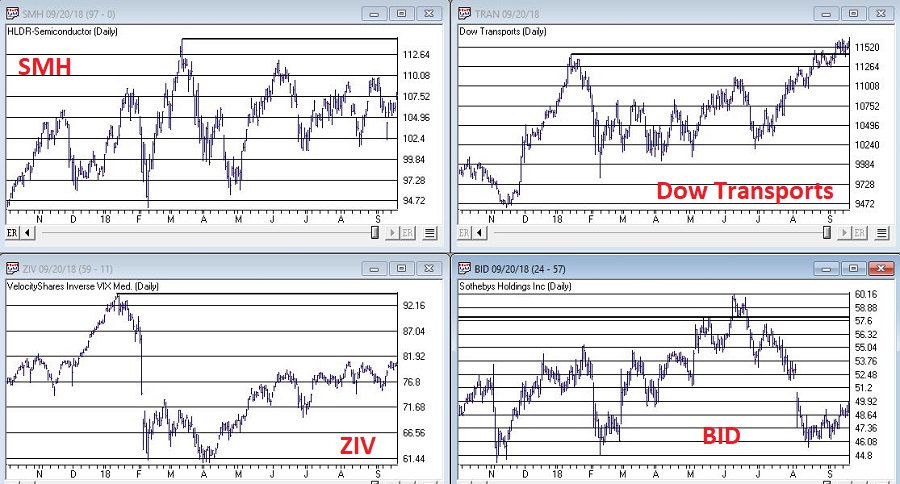
As you can see in Figure 2, the Dow Transports has a history of making double tops which is followed by trouble in the broader market.  Are we in the process of building another double top?  And will trouble follow if we are?  Dunno, hence the reason it is on my “Watch List” rather than on my “OH MY GOD SELL EVERYTHING NOW!!!!! List”.
2
Figure 2 – Dow Transportation Index (Courtesy AIQ TradingExpert)
I guess we’ll just have to wait and see.
Ticker XIV
Ticker XIV is an ETF that is designed to track inverse the VIX Index. As a refresher, the VIX Index tends to “spike” higher when stocks fall sharply and to decline when stocks are rising and/or relatively quiet.  To put it in simpler terms, in a bull market ticker XIV will rise.  As you can see in Figure 3 one might argue that XIV has gone “parabolic”.  This is a potential warning sign (assuming you agree that the move is parabolic) as a parabolic price move for just about anything is almost invariably followed by, well, let’s just say, “not so pretty”.
3
Figure 3 – Ticker XIV (Courtesy AIQ TradingExpert)
Let’s hope not.  Because if it does qualify as  parabolic that’s a very bad sign.
Ticker BID
This one may or may not be relevant but for what it is worth, Sotheby’s (ticker BID) has on several occasions served as something of a “leading indicator” at stock market tops (for the record it has also given some false signals, so this one is more for perspective purposes rather than actual trading purposes). Still, if this one tops out in conjunction with any or all of the above, it would likely serve as a useful warning sign.
4
Figure 4 – Ticker BID (Courtesy AIQ TradingExpert)
Summary
There is no “urgent action” to be taken based on any of this.  Bottom line: Nothing in this article should trigger you to run for the exits.
Still, it might be wise to at least take a look around and “locate the exit nearest you.”
You know, just in case.
Chief Market Analyst at JayOnTheMarkets.com and AIQ TradingExpert Pro (Courtesy AIQ TradingExpert) client. http://jayonthemarkets.com/
Disclaimer:  The data presented herein were obtained from various third-party sources.  While I believe the data to be reliable, no representation is made as to, and no responsibility, warranty or liability is accepted for the accuracy or completeness of such information.  The information, opinions and ideas expressed herein are for informational and educational purposes only and do not constitute and should not be construed as investment advice, an advertisement or offering of investment advisory services, or an offer to sell or a solicitation to buy any security.

The MACD ‘Tell’ Strikes Goldman Sachs

There are many ways to use the MACD indicator developed long ago by Gerald Apel.  This is one of them.  Maybe.  Nothing more, nothing less.
First the caveat: what follows is NOT a “trading system” or even something that you should consider on a standalone basis.
MACD
The MACD indicator uses exponential moving averages to identify the underlying trend for a given security and is also used by many traders to identify divergences which may signal an impending change of trend.
Figure 1 displays the daily MACD for ticker SPY.
1
Figure 1 – Ticker SPY with MACD Indicator (Courtesy AIQ TradingExpert)
The MACD ‘Tell’
While this is NOT intended to be a mechanical signal, I am going to put specific rules on it just to give it some structure.  The rules:
1) If the daily MACD (12,26,9) has declined for at least 7 consecutive trading days AND
2) The 2-day RSI is at 64 or above
Then an “alert” signal is flashed.  The key thing to note is that if the MACD ticks higher on the day that the 2-day RSI rises above 64, the signal is negated.
Before proceeding please note that the 12,26,9 parameter selection is simply the “standard” for MACD.  Also, there is nothing magic about 7 consecutive days – so one might experiment with different values there.  Finally, using the 2-day RSI and a “trigger” value of 64 are also both arbitrary.  There may be better values and/or different overbought/oversold indicators to use.
Ticker GS
A “classic” example of the MACD Tell appears in Figure 2 using ticker GS.
2
Figure 2 – Ticker GS with the MACD Tell (Courtesy AIQ TradingExpert)
The MACD Tell is typically best used as a short-term indicator.  In this case a short-term trader might have considered playing the short side of GS – or even better – using option strategies such as buying puts or selling bear call spreads.
Summary
No one should rush out and start trading put options based on this indicator (or any other indicator for that matter) without spending some time doing some homework and testing out the viability for producing profits.
In reality, this is the type of indicator that should typically be combined with “something else” and/or used as a confirmation rather than as a standalone approach.
Jay Kaeppel
 
Disclaimer:  The data presented herein were obtained from various third-party sources.  While I believe the data to be reliable, no representation is made as to, and no responsibility, warranty or liability is accepted for the accuracy or completeness of such information.  The information, opinions and ideas expressed herein are for informational and educational purposes only and do not constitute and should not be construed as investment advice, an advertisement or offering of investment advisory services, or an offer to sell or a solicitation to buy any security.

Volume-Weighted Moving Average Breakouts

The AIQ code based on Ken Calhoun’s article in the February 2017 issue of Technical Analysis ofSTOCKS & COMMODITIES, “Volume-Weighted Moving Average Breakouts,” can be found at http://aiqsystems.com/Volume-Weighted-Moving-Average-Breakouts.EDS 
 
Please note that I tested the author’s system using the NASDAQ 100 list of stocks on daily bars rather than intraday bars from 12/31/2008 thru 2/10/2017. Figure 7 shows the resulting equity curve trading the author’s system with the cross-down exit. Figure 8 shows the ASA report for this test. The annualized return showed about a 17% return with a maximum drawdown of 19%.
Sample Chart

FIGURE 7: AIQ. Here are sample test results from the AIQ Portfolio Manager taking three signals per day and 10 concurrent positions maximum run on NASDAQ 100 stocks (daily bar data) over the period 12/31/08 to 2/10/07.
Sample Chart

FIGURE 8: AIQ. This shows the ASA report for the system, which shows the test metrics and settings.
The code and EDS file can be downloaded from http://aiqsystems.com/Volume-Weighted-Moving-Average-Breakouts.EDS , and is also shown below.
!Volume-Weighted Moving Average Breakouts
!Author: Ken Calhoun, TASC Apr 2017
!Coded by: Richard Denning 2/11/17
!www.TradersEdgeSystems.com

!INPUTS:
smaLen is 70.
vwmaLen is 50.

SMA is simpleavg([close],smaLen).
VWMA is sum([close]*[volume],vwmaLen)/sum([volume],vwmaLen).
HasData if hasdatafor(max(smaLen,vwmaLen)+10)>max(smaLen,vwmaLen).
Buy if SMA < VWMA and valrule(SMA > VWMA,1) and HasData.
Sell if SMA > VWMA.

rsVWMA is VWMA / valresult(VWMA,vwmaLen)-1.
rsSMA is SMA / valresult(SMA,smaLen)-1.
—Richard Denning
info@TradersEdgeSystems.com
for AIQ Systems