All posts by admin

A Technical Method For Rating Stocks

The AIQ code based on Markos Katsanos’ article in this issue, “A Technical Method For Rating Stocks,” is shown below.
Synopsis from Stocks & Commodities June 2018
I’s it possible to create a stock rating system using multiple indicators or other technical criteria? If so, how does it compare with analyst ratings? Investors around the world move billions of dollars every day on advice from Wall Street research analysts. Most retail investors do not have the time or can’t be bothered to read the full stock report and rely solely on the bottom line: the stock rating. They believe these ratings are reliable and base their investment decisions at least partly on the analyst buy/sell rating. But how reliable are those buy/sell ratings? In this article I will present a technical stock rating system based on five technical criteria and indicators, backtest it, and compare its performance to analyst ratings.
!A TECHNICAL METHOD FOR RATING STOCKS
!Author: Markos Katsanos, TASC June 2018
!Coded by: Richard Denning, 4/18/18
!www.TradersEdgeSystems.com

!INPUTS:
  MAP is 63. 
  STIFFMAX is 7. 
  VFIPeriod is 130. 
  MASPY is 100. 
  MADL is 100.
  SCORECRIT is 5.
  W1 is 1.
  W2 is 1.
  W3 is 1.
  W4 is 1.
  W5 is 2.
 
!VFI FORMULA: 
  COEF is 0.2.
  VCOEF is 2.5.
  Avg is ([high]+[low]+[close])/3.
  inter is ln( Avg ) - ln( Valresult( Avg, 1 ) ). 
  vinter is sqrt(variance(inter, 30 )).
  cutoff is Coef * Vinter * [Close].
  vave is Valresult(simpleavg([volume], VFIPeriod ), 1 ).
  vmax is Vave * Vcoef.
  vc is Min( [volume], VMax ).
  mf is Avg - Valresult( Avg, 1 ).
  vcp is iff(MF > Cutoff,VC,iff(MF < -Cutoff,-VC,0)).
  vfitemp is Sum(VCP , VFIPeriod ) / Vave.
  vfi is expavg(VFItemp, 3 ).

!STIFFNESS 
  ma100 is Avg. 
  CLMA if [close] < MA100.
  STIFFNESS is countof(CLMA,MAP).

!CONDITIONS:
 ! MONEY FLOW:
   COND1 is iff(VFI>0,1,0). 
 !SIMPLEAVG:
    SMA is simpleavg([close],MADL).                              
    COND2 is iff([close]>SMA,1,0).  
 !SIMPLEAVG DIRECTION:                       
    COND3 is iff(SMA>valresult(SMA,4),1,0).  
!STIFFNESS:                          
    COND4 is iff(STIFFNESS<= STIFFMAX,1,0).  
!MARKET DIRECTION:
    SPY is TickerUDF("SPY",[close]).
    COND5 is iff(EXPAVG(SPY,MASPY)>= 
 valresult(EXPAVG(SPY,MASPY),2),1,0).            

SCORE is  W1*COND1+W2*COND2+W3*COND3+
   W4*COND4+W5*COND5.

 buy if Score>=SCORECRIT and hasdatafor(300)>=268. 
Figure 11 shows the summary results of a backtest using NASDAQ 100 stocks during a generally bullish period from April 2009 to April 2018. Figure 12 shows the backtest using the same list of NASDAQ 100 stocks during a period that had two bear markets (April 1999 to April 2009). The average results are similar except that there are fewer trades during the period that contained the two bear markets. Both backtests use a fixed 21-bar exit.
Sample Chart

FIGURE 11: AIQ, BULL MARKET. Here are the summary results of a backtest using NASDAQ 100 stocks during a generally bullish period from April 2009 to April 2018.
Sample Chart

FIGURE 12: AIQ, BEAR MARKET. Here are the summary results of a backtest using NASDAQ 100 stocks during a period from April 1999 to April 2009 that contained two bear markets.
—Richard Denning info@TradersEdgeSystems.com for AIQ Systems

Dollar and Gold ‘To the Barricades’

This week it is the U.S. dollar and Gold taking their turns testing critical inflection points.

U.S. Dollar

As you can see in Figure 1, on a seasonal basis the dollar is moving into a traditionally weaker time of year.1Figure 1 – U.S. Dollar seasonality (Courtesy Sentimentrader.com)

In Figure 2 you can see that traders have been and remain pretty optimistic.  This is traditionally a bearish contrarian sign.2Figure 2 – U.S. Dollar trade sentiment (Courtesy Sentimentrader.com)

In Figure 3 we see the “line in the sand” for ticker UUP – an ETF that tracks the U.S. Dollar.  Unless and until UUP punches through to the upside there is significant potential downside risk.3Figure 3 – U.S. Dollar w/resistance (Courtesy AIQ TradingExpert)

Gold

As you can see in Figure 4, on a seasonal basis the dollar is moving into a traditionally stronger time of year.4Figure 4 – Gold seasonality (Courtesy Sentimentrader.com)

In Figure 5 you can see that traders have been and remain pretty pessimistic.  This is traditionally a bullish contrarian sign.5Figure 5 – Gold trader sentiment (Courtesy Sentimentrader.com)

In Figure 6 we see the “line(s) in the sand” for ticker GLD – an ETF that tracks gold bullion.

6Figure 6 – Gold w/support (Courtesy  AIQ TradingExpert)

I would be hesitant about trying to “pick a bottom” as gold still looks pretty week.  But if:

a) GLD does hold above the support area in Figure 6 and begins to perk up,

AND

b) Ticker UUP fails to break out to the upside

Things could look a lot better for gold very quickly.

Summary

As usual I am not actually making any “predictions” here or calling for any particular action.  I mainly just want to encourage gold and/or dollar traders to be paying close attention in the days and weeks ahead, as the potential for a major reversal in both markets appears possible.

Likewise, if no reversal does take place – and if the dollar breaks out to the upside and gold breaks down, both markets may be “off to the races.”

So dollar and gold traders – take a deep breath; focus your attention; and prepare for action…one way or the other.

Jay Kaeppel

Disclaimer:  The data presented herein were obtained from various third-party sources.  While I believe the data to be reliable, no representation is made as to, and no responsibility, warranty or liability is accepted for the accuracy or completeness of such information.  The information, opinions and ideas expressed herein are for informational and educational purposes only and do not constitute and should not be construed as investment advice, an advertisement or offering of investment advisory services, or an offer to sell or a solicitation to buy any security.

Here Are The Warning Signs to Watch For

Here’s a number for you – 88%.  Since 1948, over any 10-year period the Dow has showed a gain 88% of the time.  That’s a pretty good number.  It also explains why we should give bull markets the benefit of the doubt (for the record, if you only hold the Dow between the end of October and the end of May every year you would have a showed a 10-year gain 98% of the time!  But this article is not about seasonality per se, so that’s a topic for another day).
Of course, there is a lot of variability along the way, and if you Google “current signs of a bear market” you come up with 4,280,000 articles to peruse.  So, few investors ever feel “contented”.  We’re always waiting for the “other shoe to drop.”
Some Warning Signs to Look For
#1. Major Indexes
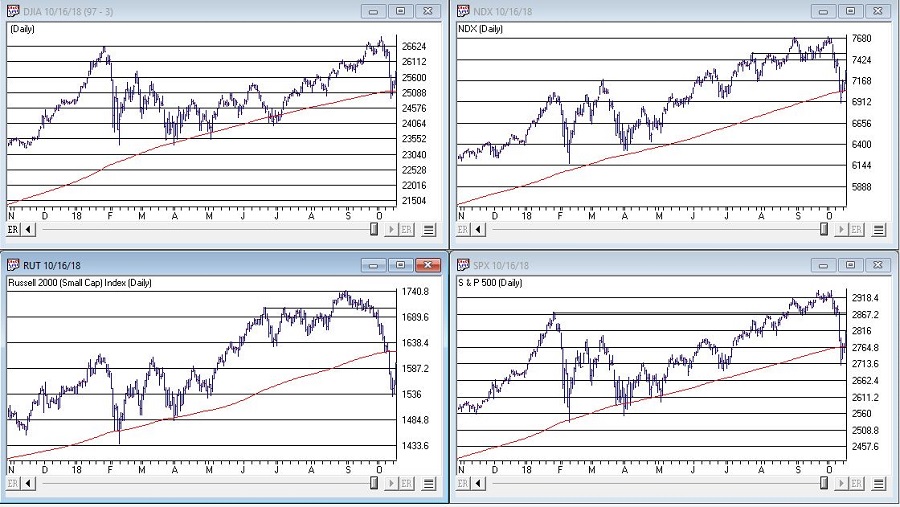
Figure 1 displays the four major average – Dow, S&P 500, Nasdaq 100 and Russell 2000 with their respective 200-day moving averages.  In the last few days the Dow slipped a little below its 200-day average, the other three remain above.

(click to enlarge)1aFigure 1 – Four major market averages with 200-day moving averages (Courtesy AIQ TradingExpert)

Warning Sign to Watch For: If 3 or more of these averages drop below their 200-day moving average.
#2. Market Bellwethers
Figure 2 displays my four market “bellwhethers” – tickers SMH (semiconductors), TRAN (Dow Transports), ZIV (inverse VIX) and BID (Sotheby’s Holdings) with their respective 200-day moving averages.  At the moment only ZIV is below it’s 200-day moving average but some of the others are close

(click to enlarge)2Figure 2 – Four market bellwethers with 200-dqy moving averages (Courtesy AIQ TradingExpert)

Warning Sign to Watch For: If 3 or more of these averages drop below their 200-day moving average.
#3. S&P 500 Monthly Method
In this article I detailed a simple timing method using S&P 500 Index monthly closing prices.  Figure 3 show the S&P 500 Index with it’s “trigger warning” price of 2,532.69 highlighted.

(click to enlarge)3Figure 3 – S&P 500 Index Monthly Method Trigger Points (Courtesy AIQ TradingExpert)

Warning Sign to Watch For: If SPX closes below 2532.69 without first taking out the January high of 2872.87
#4. International Growth Stocks
When growth stocks around the world are performing well, things are good.  When they top out, try to rebound and then fail, things are (typically) not so good.  The last two major U.S. bear markets were presaged by a break in ticker VWIGX (Vanguard International Growth) as seen in Figure 4.

(click to enlarge)4Figure 4 – Dow Jones Industrials Average (top) and previous warnings from ticker VWIGX (bottom)(Courtesy AIQ TradingExpert)

Warning Sign to Watch For: Technically this one is currently flashing a warning sign.  That warning will remain active unless and until VWIGX takes out the January high of 33.19.
#5. The 10-Year minus 2-Year Yield Spread
This is one of the most misrepresented indicators, so I will state it as plainly as possible:
*A narrowing yield curve IS NOT a bearish sign for the stock market
*An actual inverted yield curve IS a bearish sign for the stock market
Figure 5 displays the latest 10-year minus 2-year spread.  Yes, it has narrowed quite a bit.  This has launched a bazillion and one erroneously frightening articles.  But remember the rules above.

(click to enlarge)5Figure 5 – 10-year treasury yield minus 2-year treasury yield (Courtesy: www.StockCharts.com)

Warning Sign to Watch For: If the 10-year yield minus the 2-year yield falls into negative territory it will flash a powerful warning sign for the stock market and the overall economy.  Until then ignore all the hand-wringing about a “flattening” yield curve.
Summary
We are in a seasonally unfavorable period for the stock market and – as always – we are bombarded daily with a thousand and one reasons why the next bear market is imminent.
So my advice is to do the following:
1. Ignore it all and keep track of the items listed above
2. The more warning signs that appear – if any – the more defensive you should become
In the meantime, try to go ahead and enjoy your summer.
Jay Kaeppel
Disclaimer:  The data presented herein were obtained from various third-party sources.  While I believe the data to be reliable, no representation is made as to, and no responsibility, warranty or liability is accepted for the accuracy or completeness of such information.  The information, opinions and ideas expressed herein are for informational and educational purposes only and do not constitute and should not be construed as investment advice, an advertisement or offering of investment advisory services, or an offer to sell or a solicitation to buy any security.

What in the World to Watch

If an investor were to sit down and peruse the Web looking for guidance regarding the stock market, there is a good chance they would come away bewildered and confused.

So, let’s try to simplify things a bit.

The Current Trend

Here I will defer to:

Jay’s Trading Maxim #14: When in doubt, usually the best question to ask is “What is the trend right now?”

There are always a million and one reasons why an investor may feel doubt.  But answering that simple question can often lead to a much greater deal of clarity.  Like now for instance.

In Figure 1 we see the Dow, Nasdaq 100, Russell 200 small-cap index and the S&amp;P 500.  The key thing to note is that all 4 of them are above their respective 200-day moving average, i.e., “right now” the trend is up.

Which leads to:

Jay’s Trading Maxim #14a: If the trend right now is “Up”, act accordingly.  At least until the answer changes.

1

Figure 1 – Major U.S. Indexes in Up Trends (Courtesy AIQ TradingExpert)

SPX Monthly Trend-Following

I wrote here and here about a simple monthly trend-following method using the S&amp;P 500 Index.

This method gave an “alert” when the S&amp;P 500 went 3 calendar months (Feb, March and April) without making a new high.

The “line in the sand” is the low during this period of 2532,69.  As long as price holds above this level, this method deems the trend as still “Up”.

It will take a move above the January high 2872.87 to eliminate this line in the sand.  Between here and there there is resistance at 2801.90.

4

Figure 2 – S&P 500 Index key support and resistance (Courtesy AIQ TradingExpert)

The (Problematic) World

I am not speaking in any geopolitical sense here.  And I don’t want to sound like the Ugly American.  But while the U.S. stock market is “taking care of business” and moving higher, the stock markets of much of the rest of the world are not.  And I am not sure if I should worry about this or not.

But for what it is worth, all 4 regional single country ETF indexes that I created (Americas, Asia/Pacific, Europe and Middle East) and follow are not looking terribly inspiring at the moment.

(click to enlarge)

3

Figure 3 – The Rest of the World Lags (Courtesy AIQ TradingExpert)

Summary

The trend “right now” is “Up”.  So enjoy.

But maybe check back again soon.  Just in case.

Jay Kaeppel

Disclaimer:  The data presented herein were obtained from various third-party sources.  While I believe the data to be reliable, no representation is made as to, and no responsibility, warranty or liability is accepted for the accuracy or completeness of such information.  The information, opinions and ideas expressed herein are for informational and educational purposes only and do not constitute and should not be construed as investment advice, an advertisement or offering of investment advisory services, or an offer to sell or a solicitation to buy any security.

World, Interrupted

I suppose a more accurate title would be, “A Bunch of Single Country ETFs, Interrupted”, but, well, that just doesn’t have quite the same succinct simplicity.

I always (always, always) try to make an effort to focus on “the current trend” and to avoid focusing on things that “maybe might prove to be ominous signs in retrospect” or to imply that a certain tidbit of information is predictive when in reality it is mostly just anecdotal.  Still, human nature is – unfortunately, in this case – a powerful force.  Which reminds me to invoke:

Jay’s Trading Maxim #17: Human nature is a detriment to trading and investment success, and should be avoided as much as, well, humanly possible.

The bottom line is that despite my very own warnings and admonitions, sometimes that pesky human nature gets the best of me.

What Has My Attention

OK, rather than me telling you what I think, please simply peruse the charts in Figures 1, 2 and 3 and see if anything jumps out at you.

(click to enlarge)1

Figure 1 – India, Sweden, Japan, Germany (clockwise); (Courtesy AIQ TradingExpert)

(click to enlarge)2

Figure 2 – Switzerland, Netherlands, South Korea, Austria (clockwise); (Courtesy AIQ TradingExpert)

(click to enlarge)3a

Figure 3 – South Africa, China, Taiwan, Thailand (clockwise); (Courtesy AIQ TradingExpert)

Perhaps you noticed the same thing I did, i.e., a whole bunch of single country ETF’s hitting new highs or testing old resistance and getting rejected. In a number of cases, after appearing to break out to new highs for a period of weeks or month only to fall back below the “line in the sand.”

It’s sort of like the World Cup of Failed Breakouts.

Summary

Now here’s the thing.  I have displayed a bunch of charts that anecdotally seem to imply something bearish.  To spell it out, failed breakouts are often – though definitely not always – followed by something much worse.

So the line of reasoning goes like this, “If the stock market in umpteen countries is failing to advance then this must be a bad thing.”

But the reality is that all these markets have to do is rally and this whole sort of made up area of concern goes away.

Still, until that actually happens I think I will:

a) Enjoy the rally here in the U.S.

b) Remain vigilant

It seems like a reasonable plan.

Jay Kaeppel

Disclaimer:  The data presented herein were obtained from various third-party sources.  While I believe the data to be reliable, no representation is made as to, and no responsibility, warranty or liability is accepted for the accuracy or completeness of such information.  The information, opinions and ideas expressed herein are for informational and educational purposes only and do not constitute and should not be construed as investment advice, an advertisement or offering of investment advisory services, or an offer to sell or a solicitation to buy any security.