Category Archives: commodities

Can Corn?

It’s January.  It’s cold.  And the ground in the Midwest is frozen (and getting more frozen by the moment I might #$%^ add).  So of course, it is time to thinking about planting corn!

Wait, what!?

Well, yes as it turns out just about everyone involved in the agricultural industry has questions (doubts?) about corn planting in the spring and the eventual crop harvested in fall.  And the big questions are, “How will planting go?” and “how much corn will be produced?”  As it relates to corm the whole supply/demand thing you learned about way back when hinges on the ultimate answers to those two questions.

In a nutshell, there is “doubt.”  No surprise really as there is absolutely not a single corn seed planted anywhere in the Midwest at this moment.  So, who knows for sure?

One thing we do know for sure is that a lot of people are aware of this phenomenon in corn and feel compelled to “hedge their bets”, typically on an annual basis.  Figure 1 displays an annual seasonal chart for corn futures from www.sentimentrader.com.1Figure 1 – Annual Seasonal trend for Corn (Courtesy Sentimentrader.com)
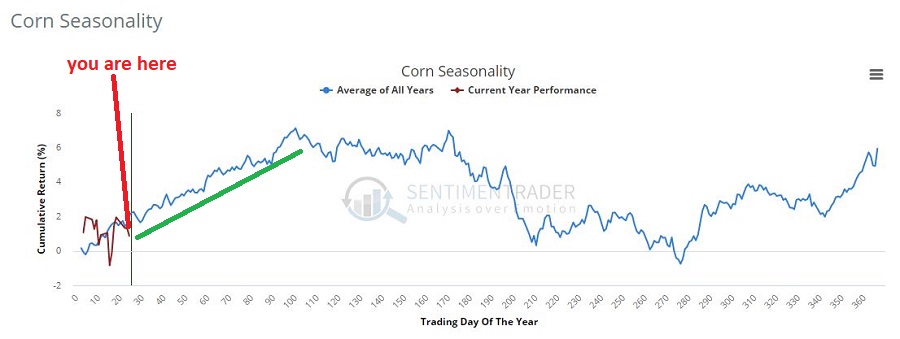
As you can see, price strength is typical in the first 4 to 5 months of the year.  This should not be surprising because – as I described above – doubt about supply causes buying pressure (typically).

So for traders the real question is “should I be buying corn in anticipation of buying pressure?”  The answer is “definitely, maybe!”  Let’s take a closer look.

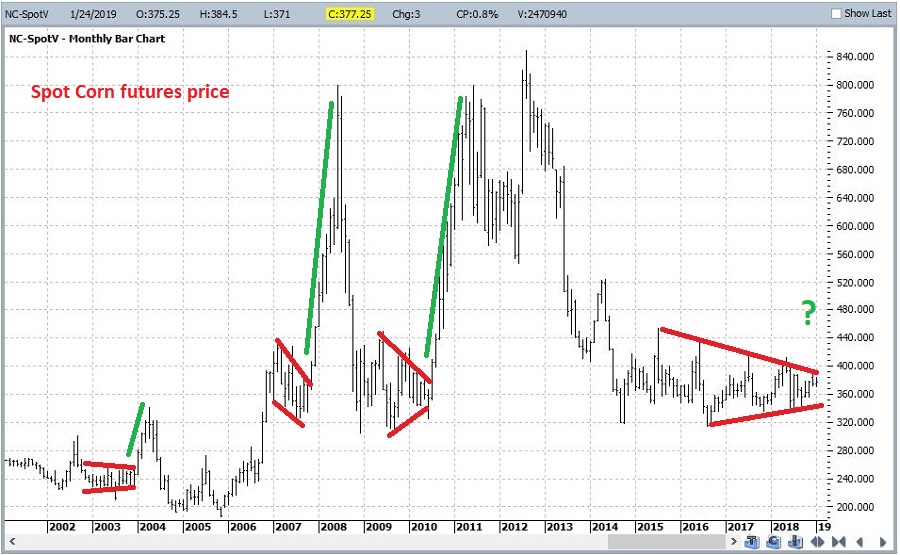
Figure 2 displays spot corn prices since 2001.
2

Figure 2 – Spot Corn prices (Courtesy ProfitSource by HUBB)

We can notice two things:

*Corn is presently in a fairly prolonged consolidation/compression range

*Previous consolidation/compression ranges have been followed by some significant advances

Despite this, one should not necessarily assume that corn is about to burst higher in price.  So let’s look at things from a more technical/tactical trading point of view.

How to Play Corn

*The “purest’ play is corn futures.  However, corn futures are not for most people.  In Figure 2, corn is trading at “350”, which equates to $3.50 a bushel in corn futures parlance.  Here is what you need to know:

If one were to buy a corn futures contract at $3.50 a bushel, a move to $4.50 a bushel would generate a gain of +$5,000 and a move to $2.50 a bushel would generate a loss of -$5,000.

In sum, a great way to make a lot of money if you are right and a great way to lose a lot of money if you are wrong.  There is an alternative for the “average” investor.

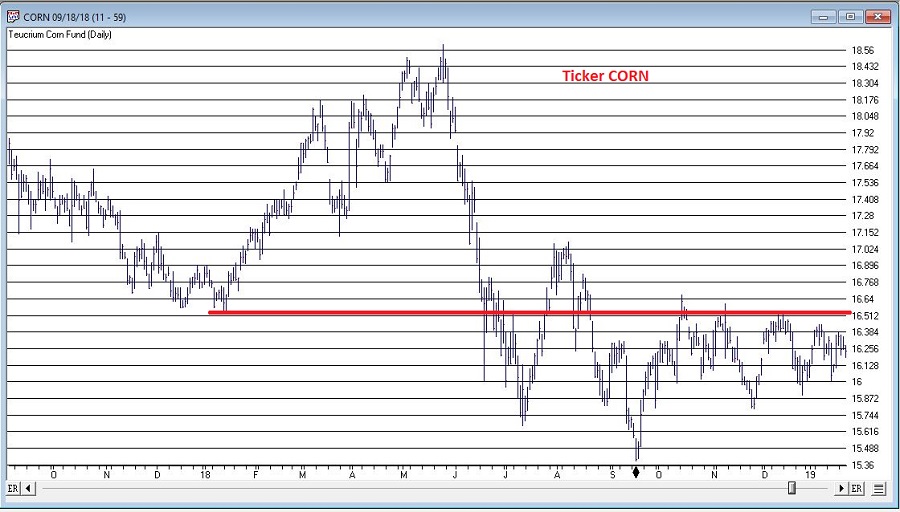
*Ticker CORN is the Teucrium Corn ETF which allows investors to trade corn like they would trade shares of stock.  Figure 3 displays a daily chart for ticker CORN.
3

Figure 3 – Ticker CORN with a significant resistance level around $16.53 (Courtesy AIQ TradingExpert)

Note that I have drawn a horizontal line $16.53, which connect the January 2018 low and the December 2018 high.  As with any line that one might arbitrarily draw on a bar chart, there is nothing “magic” about this price level.  But it does represent a potential line in the sand that be utilized in the following “highly complex” manner:

*CORN above $16.53 = (Possibly) Good

*CORN below $16.53 = Bad

The Choices

So what’s an investor to do?  As always, there are choices.

Choice #1 is flush this idea and forget all about corn.

Choice #2 is to buy now in hopes of an upside breakout, possibly with a stop-loss under the September 2018 low of $15.39.

Choice #3 is to wait for an upside breakout above $16.53 as confirmation that an actual bullish trend is forming.

Summary

I don’t make “recommendations” here at JOTM, so whether you prefer #1, #2 or #3 above is entirely up to you.  The key points though are:

It appears that there may be an opportunity forming (higher seasonal corn prices based on perceptions of problematic weather for planting and a long consolidation/compression in price).

A trader considering this idea needs to make decisions regarding what to trade (futures or CORN ETF), when to actually get in (before the breakout or after) and where to place a stop-loss.

Jay Kaeppel

Disclaimer:  The data presented herein were obtained from various third-party sources.  While I believe the data to be reliable, no representation is made as to, and no responsibility, warranty or liability is accepted for the accuracy or completeness of such information.  The information, opinions and ideas expressed herein are for informational and educational purposes only and do not constitute and should not be construed as investment advice, an advertisement or offering of investment advisory services, or an offer to sell or a solicitation to buy any security.
A Long and Short-Term Bond Market Perspective, Part I

Meanwhile, back in the bond market.  Yes, the stock market has been the place for “action” recently.  First a massive decline in short order followed immediately by a stunning advance.  But many investors also look to the bond market in order to achieve their long-term goals.  So, let’s try to put things in perspective a bit.

The Main Points

*Point ARates will likely work their way higher over time

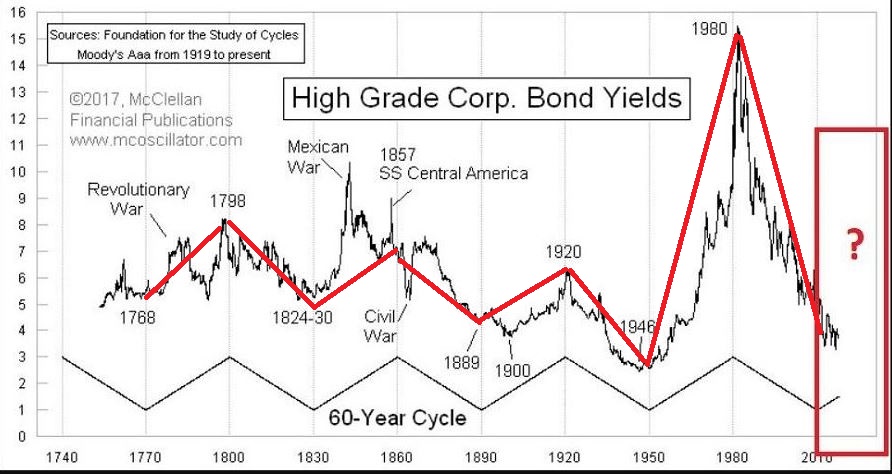
There has historically been a roughly 60-year cycle in interest rates (See Figure 1).  If this holds to form, odds are the next 30 years will not look anything like the last 30 years in the bond market, i.e., rates will likely work their way higher over time.

1

Figure 1 – 60-year cycle in rates suggest higher yields in years ahead (Source: mcoscillator.com)

*Point BInvestors should be wary of buying and holding long-term bonds

Figure 1 does not mean that rates will rise in a straight-line advance.  But again, odds are that rates will rise over time, so as a result, investors should be wary of buying and holding long-term bonds (as they stand to get hurt the most if rates rise).  That being said, in the short-term anything can happen, and long-term bonds may still be useful to shorter-term traders, BUT…

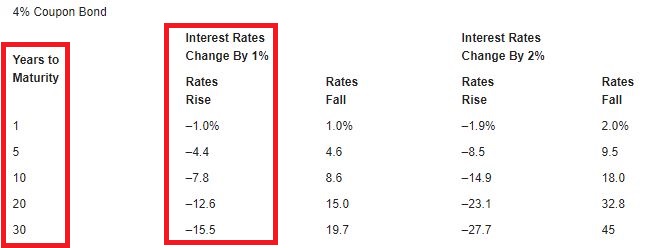
…Short to intermediate term bond funds are better now for investors than long-term bonds (if rates rise over time investors in short/intermediate term bonds can reinvest more quickly at higher rates, while long-term bond holders just lose principal).

4

Figure 2 – Affect of rising rates on bonds of various maturities (Source: AAII.com)

*Point CIt appears to be too soon to declare a confirmed “Bond Bear Market!!!”

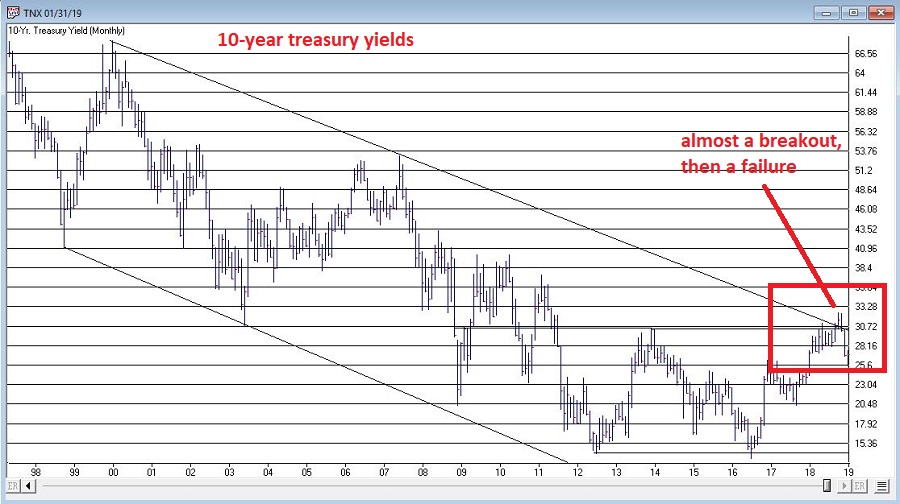
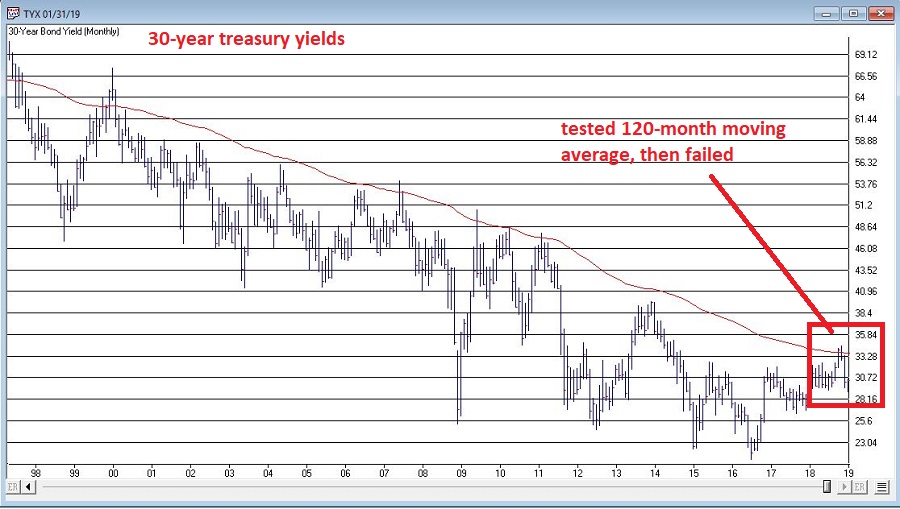
Bond yields looked in 2018 like they were staging a major upside breakout – and then reversed back to the downside.  So – Point A above not withstanding – it appears to be too soon to declare confirmed “Bond Bear Market!!!”

2

Figure 3 – 10-year treasury yield “breakout fake out” (Source: AIQ TradingExpert)

3

Figure 4 – 30-year treasury yield tested 120-month moving average, then failed  (Source: AIQ TradingExpert)

*Point DCorporate bonds as a whole carry more risk than in years past

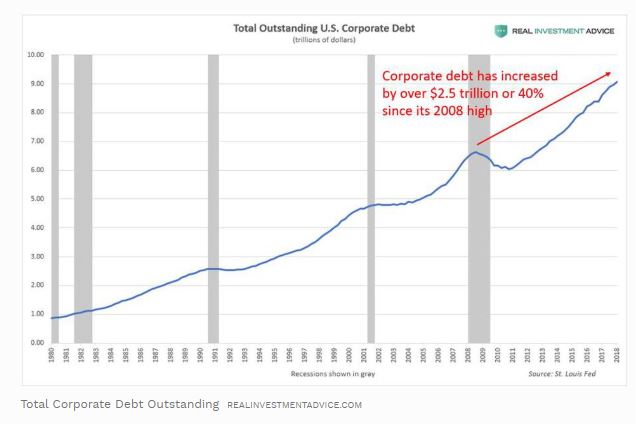
The risk associated with corporate bonds as an asset class are higher than in the past due to A) a higher rate of debt, and B) a large segment of the corporate bond market is now in the BBB or BBB- rating category.  If they drop one grade they are no longer considered “investment grade” and many institutional holders will have no choice but to sell those bonds en masse.  Which raises the age-old question, “too whom?”

For more on this topic see herehere and here.5Figure 5 – Rising corporate debt (Source: Real Investment Advice)

*Point E:

On the brighter side, two bond market models that I follow are presently bullish.  More about these in Part II.

Jay Kaeppel

Disclaimer:  The data presented herein were obtained from various third-party sources.  While I believe the data to be reliable, no representation is made as to, and no responsibility, warranty or liability is accepted for the accuracy or completeness of such information.  The information, opinions and ideas expressed herein are for informational and educational purposes only and do not constitute and should not be construed as investment advice, an advertisement or offering of investment advisory services, or an offer to sell or a solicitation to buy any security.
A Long and Short-Term Bond Market Perspective, Part II

In Part I here I laid out my main thoughts regarding the bond market.  The final point mentioned that two trading models for bonds that I follow are presently bullish.  So in Part II let’s bring those up-to-date.

#1. Japanese Stocks (EWJ) vs. Long-Term Treasuries (TLT)

I have written about this model on several occasions in the past (herehere and here).  But in a nutshell:

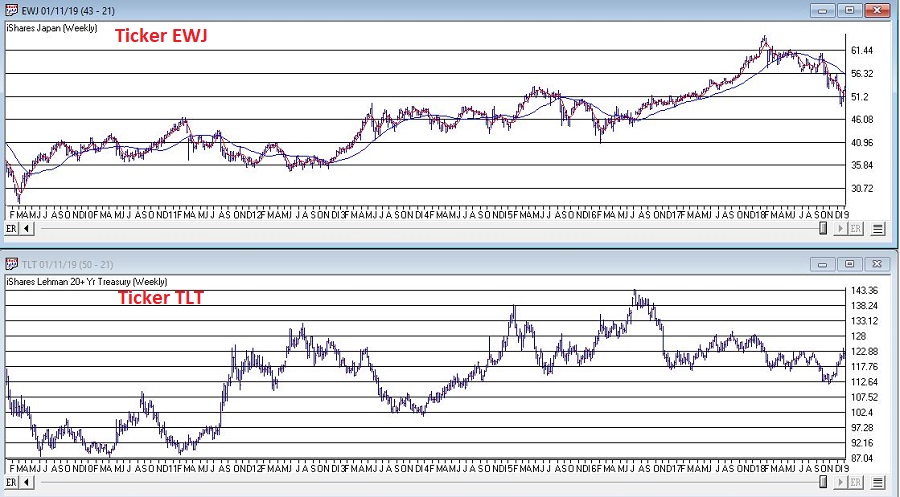
*The Japanese stock market (using ETF ticker EWJ as a proxy) and long-term U.S. treasury bonds (using ETF ticker TLT as a proxy) tend to have an inverse relationship over time.

Therefore:

*A bearish trend for EWJ (5-week moving average below 30-week moving average) tends to be bullish for bonds.

*A bullish trend for EWJ (5-week moving average above 30-week moving average) tends to be bearish for bonds.

Figure 1 displays the EWJ on top with TLT on the bottom.  Note the general inverse correlation in price movement.

1

Figure 1 – T-Bonds (ticker TLT in bottom clip) tend to move inversely to Japanese stocks (ticker EWJ with 5-weel and 30-week moving averages in top clip) (Courtesy AIQ TradingExpert)

#2. Gold/Copper Ratio versus Bonds

I have written about this before here.  In a nutshell:

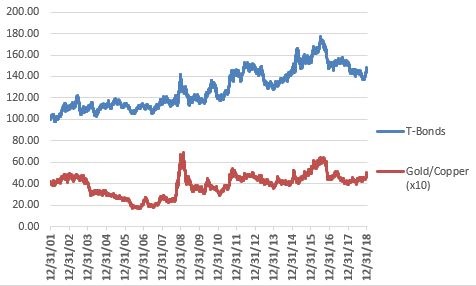
*The gold/copper ratio has a relatively high correlation to the price of t-bonds (current correlation coefficient = 0.73; a reading of 1.00 means they mirror each other, a reading of -1 means there are trade exactly inversely).

Figure 2 displays treasury bond futures prices (blue) versus the Gold/Copper Ratio (x10) since 2001.  The correlation is fairly obvious to the naked eye.

2

Figure 2 – T-bond futures price (blue) versus Gold/Copper ratio (x10); 12/31/01-1/11/2019

*When the gold/copper ratio is in an uptrend (see here for how that designation is made) this indicator is considered bullish for bonds

*When the gold/copper ratio is in a downtrend this indicator is considered bearish for bonds

Putting the Two Together

*If either of the models is bullish that is considered bullish for bonds

*If both models are bearish that is considered very bearish for bonds

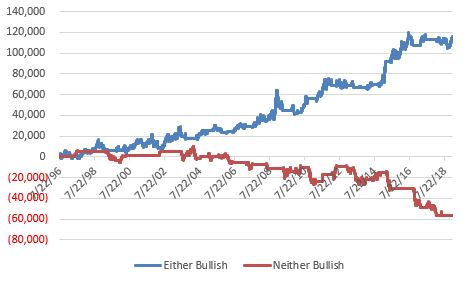
Figure 3 displays the gain or loss from holding a long position in a treasury bond futures contract depending on whether, a) neither model is bullish (red), or, b) one or more of the models is bullish (blue)

3

Figure 3 – Cumulative $ gain (loss) from holding long t-bond futures if 1 or more model is bullish (blue) versus if neither model is bullish (red); 7/22/96-1/11/19

As you can see, a bullish reading in no way guarantees higher bond price and a bearish reading in no way guarantees lower bond price.  Still, given the stark differences between the performance of the blue line and the red line, that would seem to be the way to bet.

For what it is worth, both models detailed above are bullish at the moment.

Summary

*In Part I, I basically inferred a preference for short to intermediate term bonds for people who buy and hold bonds (or bond funds) as part of a longer-term investment strategy (if rates rise 1 percentage point, a 30-year bond paying 4% a year, will lose -15% in principal – too much risk from my perspective).

*At the same time, as highlighted here in Part II, long-term bonds can still offer outstanding trading opportunities both on the long side and the short side – for those inclined to play.

Jay Kaeppel

Disclaimer:  The data presented herein were obtained from various third-party sources.  While I believe the data to be reliable, no representation is made as to, and no responsibility, warranty or liability is accepted for the accuracy or completeness of such information.  The information, opinions and ideas expressed herein are for informational and educational purposes only and do not constitute and should not be construed as investment advice, an advertisement or offering of investment advisory services, or an offer to sell or a solicitation to buy any security.
‘Dogs’ ‘Due’ for ‘Days’

While I am by and large an avowed “trend-follower” I also recognize that sometimes things get beaten down so much that they ultimately offer great potential long-term value.  Or, as they say, “every dog has it’s day.”  So, let’s consider some “dogs”.

For the record, and as always, I am not “recommending” these assets – I am simply highlighting what look like potential opportunities.

Dog #1: Soybeans (ticker SOYB)

As I wrote about in this article, soybeans are very cyclical in nature.  According to that article there are two “bullish seasonal periods” for beans and one “bearish”:

*Long beans from close on the last trading day of January through the close on 2nd trading day of May

*Short beans from the close on 14th trading day of June through the close on 2nd trading day of October

*Long beans from the close on 2nd trading day of October through the close on 5th trading day of November

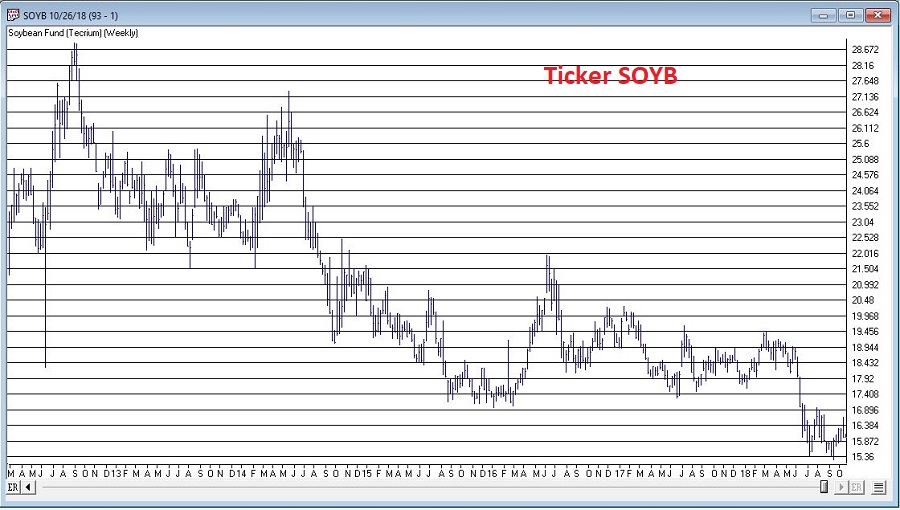
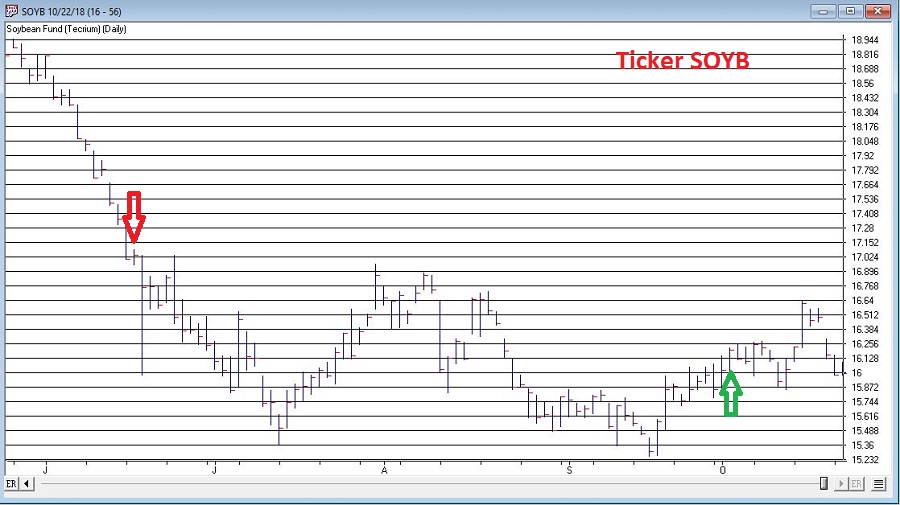
In Figure 1 (ticker SOYB – an ETF that tracks the price of soybean futures) has been beaten down quite a bit.  This doesn’t mean price can’t go lower.  However, given the cyclical nature of bean prices they probably won’t go down forever.

1

Figure 1 – Weekly SOYB; prices beaten down (Courtesy AIQ TradingExpert)

Figure 2 is a daily chart of SOYB and displays the recent “bearish” seasonal period and the latest “bullish” period so far.

2

Figure 2 – Daily SOYB (Courtesy AIQ TradingExpert)

Dog #2: Uranium (ticker URA)

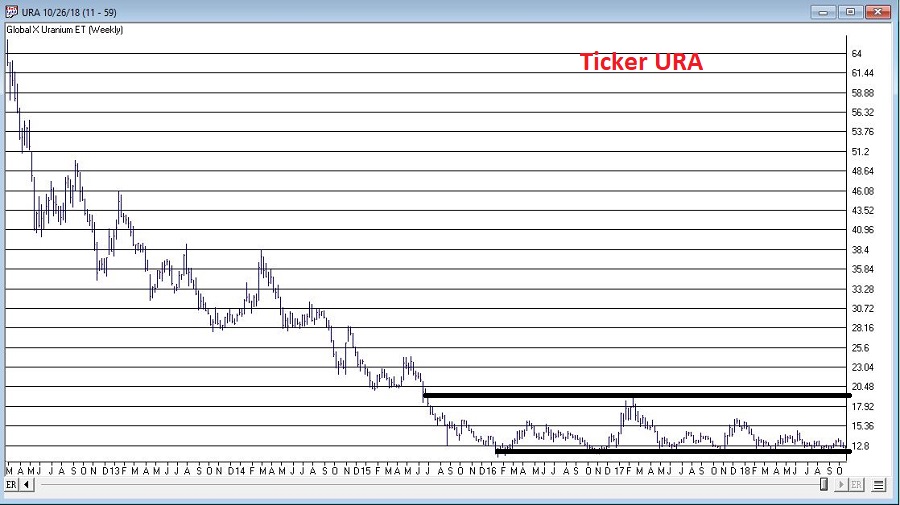
In this article and this article, I wrote about the prospects for uranium and ticker URA – an ETF that tracks the price of uranium.  Since that time URA has basically continued to go nowhere.  As you can see in Figure 3, it has been doing just that for some time.  While there is no guarantee that the breakout out of the range indicated in Figure 2 will be to the upside, historically, elongated bases such as this often lead to just that.  A trader can buy it at current levels and put a stop loss somewhere below the low for the base and take a reasonable amount of risk if they are willing to bet on an eventual upside breakout.

3

Figure 3 – Ticker URA with a long (really long) base (Courtesy AIQ TradingExpert)

Dog #3: Base Metals (Ticker DBB)

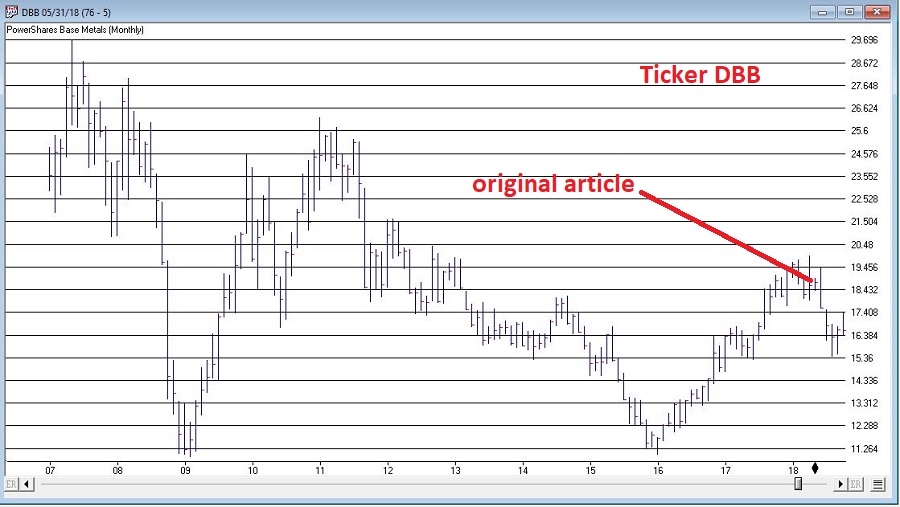
Under the category of – I called this one way, way too soon – in this article I wrote about the potential for ticker DBB to be an outperformer in the years ahead.  As you can see in Figure 4, so far, not so good.

4

Figure 4 – Base Metals via ticker DBB (Courtesy AIQ TradingExpert)

Still, the argument for base metals is this:

*In Figure 3 is this article you can see that commodities as an asset class are due for a good move relative to stocks in the years ahead.

*In addition, the Fed is raising interest rates.

As discussed historically base metals have been the best performing commodity sector when interest rates are rising.  Ticker DBB offers investors a play on a basket of base metals.

Summary

Will any of these “dog” ideas pan out?  As always, only time will tell.  But given the cyclical nature of commodities and the price and fundamental factors that may impact these going forward, they might at least be worth a look.

In the meantime, “Woof” (which – as far as I can tell – means “Have a nice day”).

Jay Kaeppel

Disclaimer:  The data presented herein were obtained from various third-party sources.  While I believe the data to be reliable, no representation is made as to, and no responsibility, warranty or liability is accepted for the accuracy or completeness of such information.  The information, opinions and ideas expressed herein are for informational and educational purposes only and do not constitute and should not be construed as investment advice, an advertisement or offering of investment advisory services, or an offer to sell or a solicitation to buy any security.
A Look Ahead in Stocks, Bonds and Commodities

In the interest of full disclosure, the reality is that I am not great at “predicting” things.  Especially when it involves the future.  That being said, I am pretty good at:

*Identifying the trend “right now”

*Understanding that no trend lasts forever

*Being aware of when things are getting a bit “extended”

So, I am going to highlight a few “thoughts” regarding how one might best be served in the markets in the years ahead.

Where We Have Been

*After 17 years of sideways action (1965-1982) the stock market has overall been in a bullish trend since about 1982 – albeit with some major declines (1987, 2000-2002 and 2007-2009) when the market got significantly overvalued.

*Bond yields experienced a long-term decline starting in 1981 and bottomed out in recent years.

*Commodities have mostly been a “dog” for many years.

The way the majority of investors approach these goings on is to:

*Remain bullish on the stock market (“Because it just keeps going up”)

*Continue to hold bonds (“Because I have to earn a yield somewhere”)

*Avoid commodities (“Because they suck – and they’re scary”)

And as an avowed trend-follower I don’t necessarily disapprove.  But as a market observer I can’t help but think that things will be “different” in the not too distant future.

Considerations Going Forward

Stocks

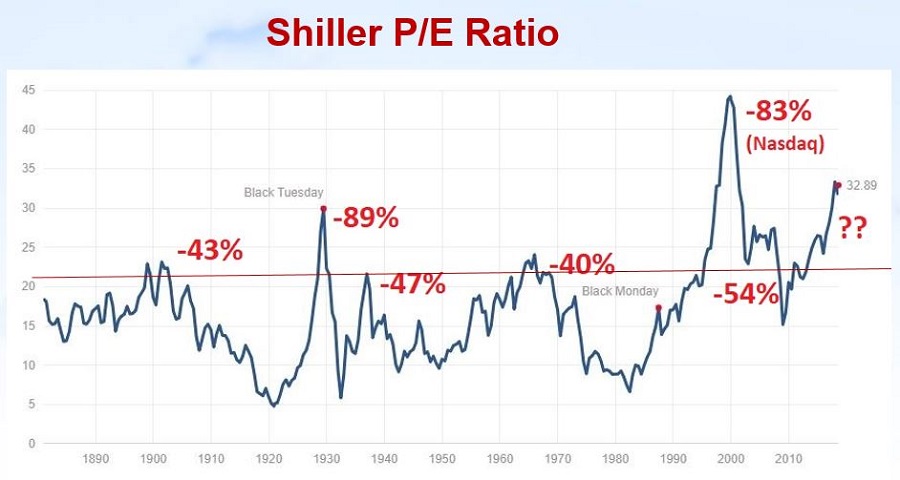
Figure 1 displays the Shiller P/E ratio.  For the record, valuation measures are NOT good “timing” tools.  They don’t tell you “When” the market will top or bottom out.  But they do give a good indication of relative risk going forward (i.e., the higher the P/E the more the risk and vice versa).

Note:

*The magnitude of market declines following previous peaks in the P/E ratio

*That we are presently at (or near) the 2nd highest reading in history

(click on any chart below to enlarge it)

1

Figure 1 – Shiller P/E Ratio (and market action after previous overvalued peaks) (Courtesy: www.multpl.com/shiller-pe/)

The bottom line on stocks:  While the trend presently remains bullish, valuation levels remind us that the next bear market – whenever that may be – is quite likely to be “one of the painful kind”.

Bonds

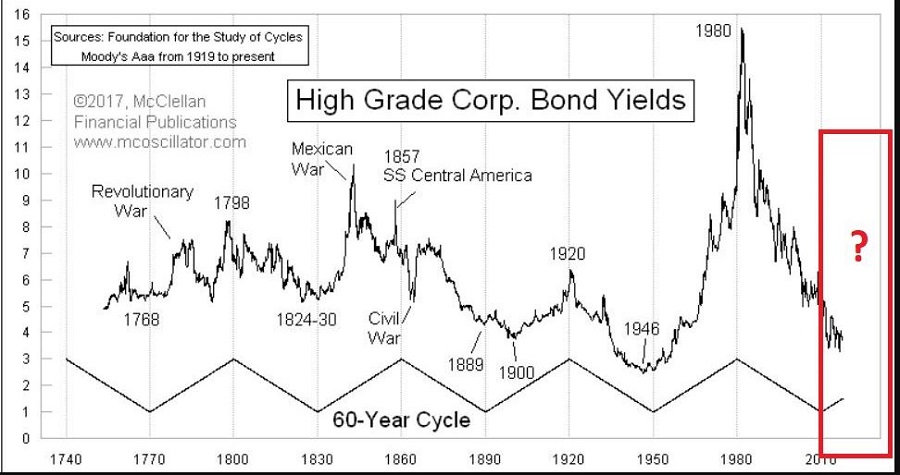
Figure 2 displays the 60-year cycle in interest rates.2

Figure 2 – 60 -year cycle in interest rates (Courtesy: www.mcoscillator.com)

Given the historical nature of rates – and the Fed’s clear propensity for raising rates – it seems quite reasonable to expect higher interest rates in the years ahead.

Commodities

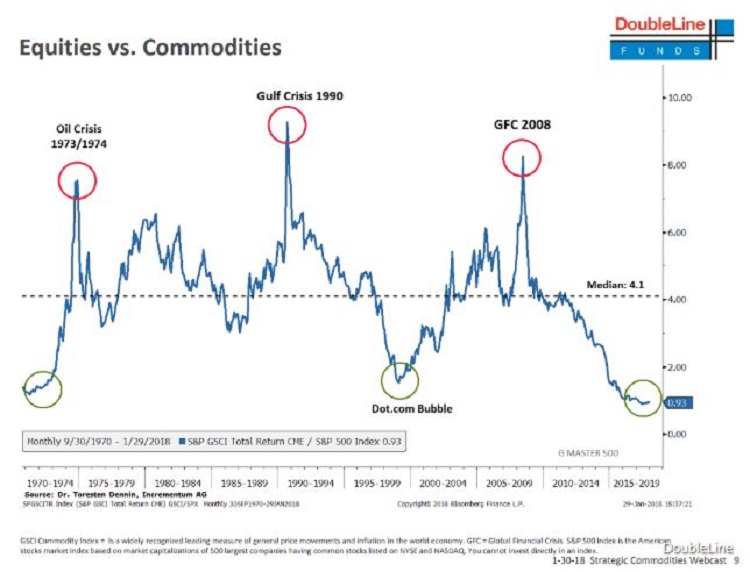
As you can see in Figure 3 – which compares the action of the Goldman Sachs Commodity Index to that of the S&P 500 Index) – commodities are presently quite undervalued relative to stocks.  While there is no way to predict when this trend might change, the main point is that history strongly suggests that when it does change, commodities will vastly outperform stocks.3Figure 3 – Commodities extremely undervalued relative to stocks (Courtesy: Double Line Funds)

The Bottom Line – and How to Prepare for the Years Ahead

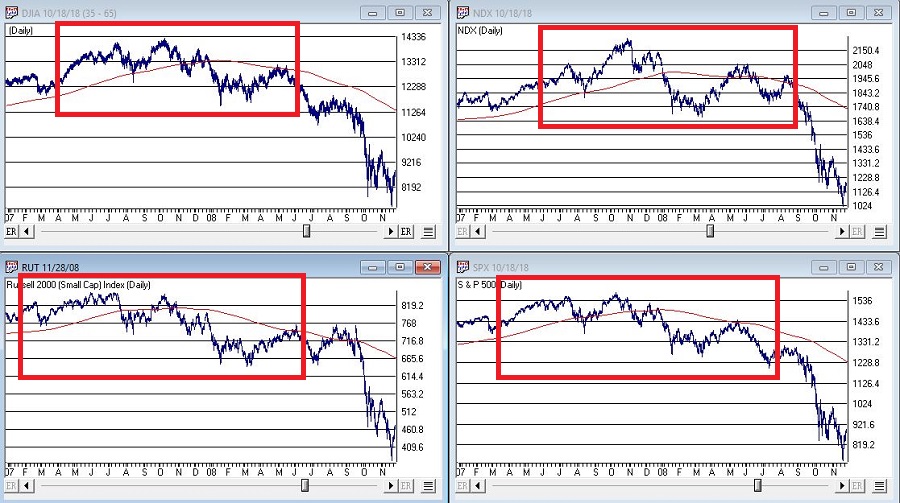
*No need to panic in stocks.  But keep an eye on the major averages.  If they start to drop below their 200-day averages and those moving average start to “roll over” (see example in Figure 4), it will absolutely, positively be time to “play defense.”

4

Figure 4 – Major stock average rolling over prior to 2008 collapse (Courtesy AIQ TradingExpert)

*Avoid long-term bonds.  If you hold a long-term bond with a duration of 15 years that tells you that if interest rates rise one full percentage point, then that bond will lose roughly 15% in value.  If it is paying say 3.5% in yield, there is basically no way to make up that loss (except to wait about 4 years and hope rates don’t rise any more in the interim – which doesn’t sound like a great investment strategy).

*Short-term to intermediate-term bonds allow you to reinvest more frequently at higher rates as rates rise. Historical returns have been low recently so many investors avoid these.  But remember, recent returns mean nothing going forward if rates rise in the years ahead.

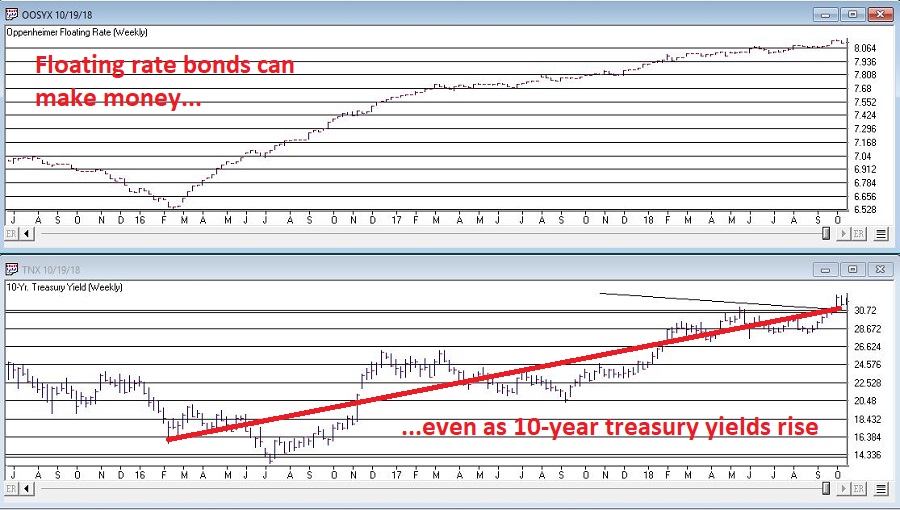
*Consider floating rate bonds.  Figure 5 displays ticker OOSYX performance in recent years versus 10-year t-note yields. While I am not specifically “recommending” this fund, it illustrates how floating rate bonds may afford bond investors the opportunity to make money in bonds even as rates rise.5

Figure 5 – Ticker OOSYX (floating rate fund) versus 10-year treasury yields)

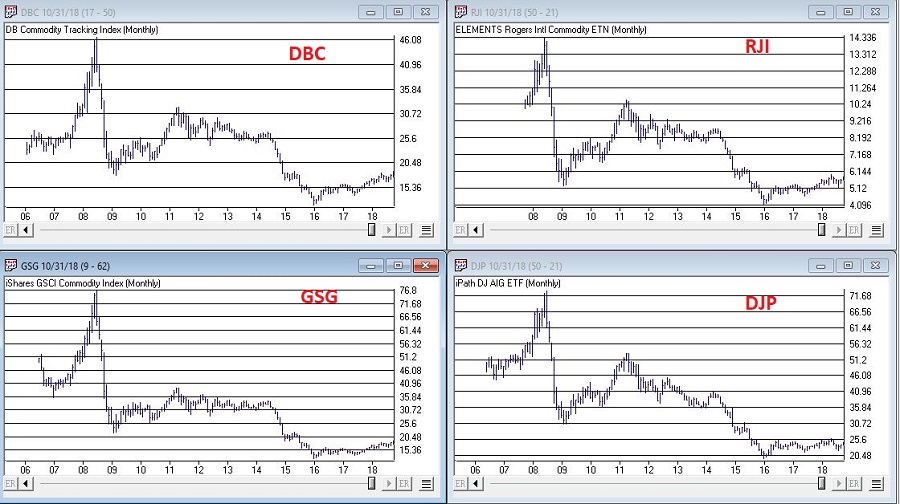
*Figure 6 display 4 ETFs that hold varying “baskets” of commodities (DBC, RJI, DJP and GSG clockwise from upper left).  When the trend in Figure 3 finally does reverse, these ETFs stand to perform exceptionally well.6

Figure 6 – Commodities performance relative to stock performance (GSCI versus SPX)

Finally, the truth is that I don’t know “when” any of this will play out.  But the bottom line is that I can’t help but think that the investment landscape is going to change dramatically in the years ahead.

So:

a) Pay attention, and

b) Be prepared to adapt

Jay Kaeppel

Disclaimer:  The data presented herein were obtained from various third-party sources.  While I believe the data to be reliable, no representation is made as to, and no responsibility, warranty or liability is accepted for the accuracy or completeness of such information.  The information, opinions and ideas expressed herein are for informational and educational purposes only and do not constitute and should not be construed as investment advice, an advertisement or offering of investment advisory services, or an offer to sell or a solicitation to buy any security.