All posts by admin

So Who Wants to Pick a Bottom in Gold Stocks?

“Everybody knows” that trying to pick the exact bottom in anything is stupid.  I mean what are the odds that you’ll actually get it right?  Still, human nature is a pesky thing, no?.  So who is willing to call “the bottom” in gold and gold stocks?
Well, not me necessarily.  Of course, I’ve never been very good at predictions in the first place.  Back in the early days I must admit I thought I could stare into my crystal ball of indicators/oscillators/chart patterns/etc and see what was coming next.  Alas, I stared into that damn thing for a long time before I realized that it wasn’t actually working.
Still – as just another victim of that aforementioned “human nature” – I “feel the urge” once in awhile.  Now if you are like me (and like most other traders) when you get the urge to pick a bottom (or top) you get the one voice on one shoulder saying “Go for it!  Bet the ranch!  Make a killing!”  And the voice on the other shoulder that says, “You know better than to do something so foolish.  Besides that trick never works.”
Here’s what I have found (and recommend) as a compromise to the voice in my, er, your head.  Allocate up to (but no more than) 10% of your investment capital to “Speculation/Hedging”.  You get the urge to “take a shot”.  By all means, go ahead.  But don’t risk more than a small portion of your investment capital.  If it turns out that you are actually pretty good at “taking a shot” the big payoffs on your small bets can add up to a lot of money over time.  And if the voice on the other shoulder is right, well, hey you’ve allowed yourself some discretion, you took your shot (granted you failed) but hey, it didn’t really hurt you financially.
So how about the gold market?
Here is my “analysis” of gold:
As you can see in Figure 1, my Anti-Gold Index remains in an undeniable uptrend.  As this is an inverse indicator, this trend is bearish for gold.  So make no mistake that what we are about to discuss is a “counter trend” trade is every sense of the word.
1
Figure 1 – Jay’s Anti-Gold Index versus ticker GLD (CourtesyAIQ TradingExpert Pro)
Gold broke out to the downside on 11/17 and 11/18 but then closed back above the downside breakout point on 11/19 as you can see in Figure 2.  Technical theory suggests that this could ultimately prove to mark an important double bottom (Well it could).
2
Figure 2 – A false breakdown and bullish reversal for GLD??? (Courtesy:www.ProfitSource.com)
So is this the bottom?  I have to go with my standard answer here – “It beats the heck out of me.”  But I am not so much interest in “the bottom” as I am interested in “a bottom” (i.e., one that holds for at least 29 calendar days for reasons we will get to in a moment) But someone might think so.  So let’s highlight one possible way to play.
Switching to Gold Stocks
In Figure 3 we see ticker GDX, an ETF that tracks gold mining stocks rather than gold bullion.  Gold stocks did not break down below support and have spent the better part of four months trying to build a base.
3
Figure 3 – Ticker GDX; Gold stocks forming a base (CourtesyAIQ TradingExpert Pro)
If nothing else we can identify the price of $12.62 a share as the “line in the sand” for ticker GDX.  Believe it or not, this simple designation opens the way to a potential option trade.
One Way to Play
OK, first the CYA disclaimers: I am not saying that gold stocks have bottomed.  I am not telling you that you should think gold stocks have bottomed.  I am not “recommending” that you make the trade I am about to highlight.  The purpose of this example is simply to highlight one way to use options to speculate on a position that can make money if the security in question remains above an objectively identified “line in the sand” ($12.62 on GDX in this instance).  OK, backside sufficiently covered, let’s move on.
The overarching “theme” for this trade is that everything hinges on GDX remaining above $12.62 a share.  If that price is broken to the downside then the premise for making this trade evaporates and defensive action is in order.  We are not even forecasting that GDX is going to rise substantially in price.  So we want a position that will make money so long as GDX holds above our “line in the sand.”
First let’s assume that a trader has a $50,000 account, is willing to commit 8% to a single trade, and is willing to speculate that GDX will hold above $12.62 through December option expiration (12/18/15).
The bull put spread trade displayed in Figures 4 and 5:
*Sells 46 December 12.5 puts
*Buys 46 December 11.5 puts
*Has a maximum profit potential of $598
*This represents a maximum profit % of 14.98% on risk capital and 1.2% of total capital
*The maximum risk is -$4,002 (we will look at reducing this risk in a moment by adding a stop-loss point)
*With GDX at $13.97 the breakeven price on the trade is $12.37.  So essentially, this trade will show a profit if GDX does anything besides fall -11.5% over the next 29 days.
4Figure 4 – GDX Dec 12.5/11.5 Bull  put spread (Courtesy www.OptionsAnalysis.com)5
Figure 5 – Risk Curves for GDX Dec 12.5/11.5 Bull  put spread (Courtesy www.OptionsAnalysis.com)
For a trader putting on this trade (and again I am not recommending that you do, only that you use this example to learn what factors are most important in managing a trade such as this – hey, we take CYA seriously here at JayOnTheMarkets.com), the first and foremost decision is “where to place a stop-loss?”  There are two possibilities that make sense:
*At some price below the recent low of $12.62: This makes sense because as I stated earlier, once 12.62 is broken the rationale for being in the trade is essentially gone.
*At or below the actual breakeven price of $12.37.  This makes sense because the reality of this trade is that GDX can take out its low of 12.62 and still generate a profit.
Another piece of good advice I got a long time ago: Upon entering a trade ask yourself “what is the worst case scenario, what will I do if it happens and can I handle the loss?”
*In this case, the worst case is if immediately after this trade is entered GDX plummets to the $12.37.  In this case the trader would be confronted with an open loss of approximately -$1,145 (note where the two red lines connect in Figure 5).  So a trader is essentially risking roughly $1,145 to make roughly $600.
*As you can see in Figure 5, the risk curves move to the right which highlights the fact that as time goes by time decay begins to work in our favor.
*Once the trade is entered and a stop-loss point is selected the thing to do is “nothing”.  In other words, as long as the stop-loss point is not hit, no action needs to be taken as the position will slowly but surely become more profitable as option expiration.
Summary
Is attempting to pick a bottom in gold stocks even a good idea?  Conventional wisdom says “No.”  And given gold stocks track record over the past several years, bottom picking certainly seems like a foolish idea.
Still, for a trader who is willing to speculate with a small portion of his or her trading capital, the trade highlighted herein can make money as long as GDX does anything but drop 11.5% or more over the next over the next 29 calendar days (hypothetically speaking of course).
Jay Kaeppel
Chief Market Analyst at JayOnTheMarkets.com and AIQ TradingExpert Pro (http://www.aiq.com) client

ChartProfit Weekly Market Analysis 11-13-15

Every week for the past 10 years Bob Debnam, Senior Partner – Investment Research at Financial Themes has published his ChartProfit newsletter. This comprehensive assessment includes market charts, major ETFS and market sentiment and these key areas with commentary:

  • Key support ad resistance points on major markets
  • consensus polls plotted as an indicator including AAII, Investors Intelligence, NAAIM exposure index and more
  • Mutual Funds –  Bobs own version of the Rydex Asset ratio and Lippurs funds flow
  • Commitment of traders large and small in major markets
  • Unique breadth analysis of major US and UK markets including support and resistance on the QQQ, DIA, SPY and more
  • Option sentiment vs major market and VIX and VXN analysis
  • Bonds, Gold, Oil and Dollar analysis with commitment of traders and unique ChartProfit Price Oscillator 
  • EURUSD, JPYUSD and more

Check out the current video issue http://www.chartprofit.com/video/cp__151113.html

Bob Debnam

Senior Partner – Investment Research, Financial Themes
Bob began developing computer based market systems as far back as 1983. Using DOS based programs he developed systems to help him trade stocks and later to trade futures from 1987.  In 1999, interest created by articles that Bob had written for Investors Chronicle and Shares magazine led to speaking engagements and since then Bob has taught hundreds of investors at seminars both here and in the U.S.A.
In early 2010, he co-founded Financial Themes. http://www.financialthemes.com/ a wholly independent Wealth Management and Financial Advisory firm
Bob also edits the ChartProfit service for AIQ Systems which is a unique weekly video/ebook analysis of the major markets mainly for U.S. investors. If you would like to learn more about this service and the future ChartProfit services with AIQ Systems, please email us at AIQ Sales with the subject “Let me know when ChartProfit services are available” and we’ll keep you posted.

Santa Claus is Coming to Town (I Hope!!)

The renowned “Santa Claus Rally” is second only to “Sell in May” in generating a flood of articles from us “market analyst types”.  But I haven’t seen too many Santa Claus Rally articles so far this year so I’ve decided to try to beat the crowd.  Plus “rally time” is (hopefully) just a short ways away.
Different “market analyst types” define the Santa Claus Rally time period differently.  Here is how I define it:
The “bullish” Santa Claus Rally period extends:
*From the close of trading on the Friday before Thanksgiving;
*Through the end of trading on the third trading day of the next calendar year.
So in this case, it extends from the close on 11/20/15 through the close on 1/6/16.
This begs the obvious question: Should we really be putting any faith in way too simple idea?  Let’s let the numbers help you to decide.
The Santa Claus Rally Results
The test below involves holding the Dow Jones Industrials Average only during the time period described above, every year starting in November 1949.
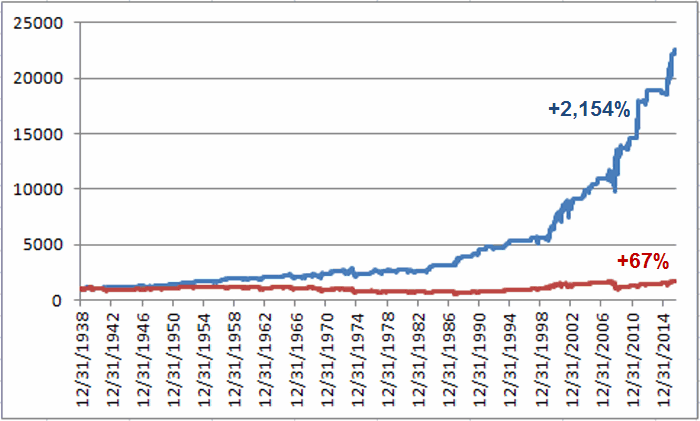
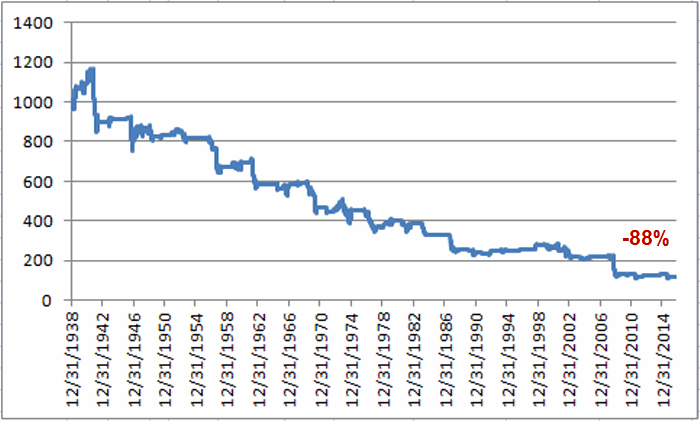
Figure 1 displays the growth of $1,000 on a cumulative basis (no interest is assumed during the times when out of the market).
1
Figure 1 – Growth of $1,000 invested in the Dow Industrials only during the Santa Claus Rally period each year (11/19/49-11/13/15)
Figure 2 displays the annual results on a year-by-year basis.
Period Ending DJIA % +(-)
1/5/50 3.6
1/4/51 4.0
1/4/52 3.9
1/6/53 4.6
1/6/54 2.9
1/5/55 5.1
1/5/56 0.2
1/4/57 3.7
1/6/58 (0.0)
1/6/59 5.7
1/6/60 5.8
1/5/61 3.2
1/4/62 (1.0)
1/4/63 5.0
1/6/64 5.0
1/6/65 (1.2)
1/5/66 3.0
1/5/67 (0.5)
1/4/68 4.3
1/6/69 (3.1)
1/6/70 (2.4)
1/6/71 10.0
1/5/72 11.6
1/4/73 3.4
1/4/74 2.0
1/6/75 3.6
1/6/76 6.0
1/5/77 3.1
1/5/78 (3.7)
1/4/79 3.6
1/4/80 1.6
1/6/81 1.5
1/6/82 0.9
1/5/83 2.3
1/5/84 2.5
1/4/85 (0.3)
1/6/86 5.7
1/6/87 4.3
1/6/88 6.5
1/5/89 6.2
1/4/90 5.4
1/4/91 0.6
1/6/92 13.9
1/6/93 2.4
1/5/94 2.8
1/5/95 0.9
1/4/96 3.7
1/6/97 1.5
1/6/98 1.8
1/6/99 4.2
1/5/00 1.1
1/4/01 2.7
1/4/02 4.0
1/6/03 (0.4)
1/6/04 9.5
1/5/05 1.3
1/5/06 1.1
1/5/07 0.4
1/4/08 (2.9)
1/6/09 12.0
1/6/10 2.5
1/5/11 4.6
1/5/12 5.3
1/4/13 6.7
1/6/14 1.6
1/6/15 (2.5)
Figure 2 – % Gain/Loss for Dow Industrials during Santa Claus Rally period year-by-year
Figure 3 displays the “Summary” results
Measure Result
Number Times UP 55
Number Times DOWN 11
% Times UP 83.3%
% Times DOWN 16.7%
Average % +(-) All Yrs. 3.24%
Average % +(-) UP Yrs. 4.08%
Average % +(-) DOWN Yrs. -1.62%
Best Up Year (1991-92) 13.90%
Worst Down Year (1977-78) -3.70%
Figure 3 – Santa Claus Rally by the numbers
Summary
In a nutshell, over the course of the previous 66 years the Santa Claus Rally time period has witnessed the Dow generate 83% winners with an average win/average loss ratio of 2.5-to-1.
*The good news is that that is a pretty darn good “real time” track record.
*The bad news is that there is no guarantee that Santa will come through for us this year.
Folks, now more than ever, “We have got to believe!!”
Jay Kaeppel
Chief Market Analyst at JayOnTheMarkets.com and AIQ TradingExpert Pro (http://www.aiq.com) client

Daylight is Bad for Gold Stocks (Apparently)”

Well, at least as far as I can tell.  To understand what I am talking about consider the following results generated using daily open/high/low/close data for ticker GDX (an ETF that tracks gold mining stocks).
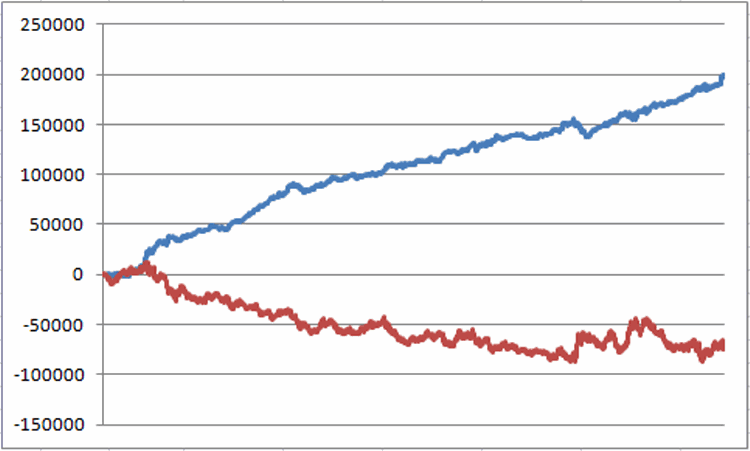
Figure 1 displays the cumulative $ gain/loss achieved by holding 100 shares of ticker GDX since it started trading in May 2006.
1aFigure 1 – $ gain/loss from holding 100 shares of ticker GDX since 5/22/06
From May 2006 into September 2011, 100 shares gained $2,940.
Since then it has lost -$5,201 for a net cumulative loss of -$2,261.  So that is our “baseline”.
GDX Overnight
Figure 2 displays the $ growth achieved using the following test.
Test #1:
Buy 100 shares of GDX at the close of trading each and every single trading day.  Sell those shares at the open of the following trading day (this test does not deduct trading commissions.  The sole intention is to display trading results achieved overnight).
2aFigure 2 – $ gain/loss from holding 100 shares of GDX from each day’s close until the next day’s open
The net result is a gain of +$11,809.  Through September 8, 2011 the gain was +11,827.  Since then there has been a loss of -$18.
GDX in the Light of Day
Figure 3 displays the growth achieved using the following test:
Test #2:
Buy 100 shares of GDX at the open each and every single trading day.  Sell those shares at the close of trading the same day.
3aFigure 3 – $ gain/loss from holding 100 shares of GDX from each day’s open through the close of the same day
The net result is a loss of -$14,070.  Through September 8, 2011 the loss was -$8,887.  Since then there has been a further loss of -$5,183.
Go figure.
Summary
If you are considering buying gold stocks at the open this morning – you might want to consider sleeping in instead.
Jay Kaeppel
Chief Market Analyst at JayOnTheMarkets.com and AIQ TradingExpert Pro (http://www.aiq.com) client

Vitali Apirine’s – Average Percentage True Range

The AIQ code based on Vitali Apirine’s article in the November issue of Stocks & Commodities, “Average Percentage True Range,” is provided at www.TradersEdgeSystems.com/traderstips.htm.
The code provided is used as an indicator (which I’ve called “PATR”). An example of the PATR is shown in Figure 7 on a chart of Apple Inc. (AAPL) compared to the same indicator on the S&P 500 index (SPX).
Sample Chart

FIGURE 7: AIQ. Here is the percentage average true range (PATR) on a chart of AAPL in comparison to the same indicator plotted on the SPX index.
As mentioned, the code and EDS file can be downloaded fromwww.TradersEdgeSystems.com/traderstips.htm, and is shown below.
!AVERAGE PERCENTAGE TRUE RANGE
!Author: Vitali Apirine, TASC Nov 2015
!Coded by: Richard Denning 9/7/2015
!www.TradersEdgeSystems.com

WilderLen is 14.
Index is "SPX".
H is [high].
L is [low].
C is [close].
C1 is valresult(C,1).

LH is H - L.
HC is Abs(H - C1).
LC is abs(L - C1).

M is max(LH,HC).
MM is max(M,LC).

ATR1 is iff(MM=HC,HC,0).
MID1 is iff(ATR1>0,(valresult(C,1)+(HC/2)),0.00001).

ATR2 is iff(MM=LC and ATR1=0,LC,0).
MID2 is iff(ATR2>0,(L+(LC/2)),0.00001).

ATR3 is iff(MM=LH and ATR1=0 and ATR2=0,LH,0).
MID3 is iff(ATR3>0,(L+(LH/2)),0.00001).

ATRS is iff(ATR1>0,ATR1/MID1,iff(ATR2>0,ATR2/MID2,iff(ATR3>0,ATR3/MID3,0)))*100.

ExpLen is WilderLen*2-1.
APTR is expavg(ATRS,ExpLen). !PLOT

APTRidx is TickerUDF(Index,APTR). !PLOT

ShowValues if 1.
—Richard Denning
info@TradersEdgeSystems.com
for AIQ Systems