Category Archives: commodities

Guida ai Casinò Non AAMS per Giocatori alla Ricerca di Esperienze Uniche

Quando si parla di divertimento e opportunità nel settore del gioco d’azzardo, molti utenti si interrogano sui metodi adottati dai casinò non certificati. Queste piattaforme offrono una serie di vantaggi che meritano di essere esplorati, a cominciare dai bonus di registrazione più allettanti e da una varietà di giochi disponibili. È fondamentale considerare le proprie esperienze e i feedback ricevuti da altri giocatori per scegliere la piattaforma giusta.

La documentazione riguardante la sicurezza di tali casinò resta una delle preoccupazioni principali. A differenza dei casinò AAMS, le opzioni non certificate possono suscitare dubbi, e sapere come protegerci diviene cruciale. È pertanto necessario fare ricerche approfondite prima di intraprendere qualsiasi attività, per garantire un’esperienza di gioco non solo divertente, ma anche sicura. Per maggiori dettagli, consulta questo casino online non AAMS per comprendere i vari aspetti e le politiche di sicurezza.

Inoltre, l’analisi dei metodi di pagamento può rivelarsi un elemento decisivo per chi cerca di massimizzare la propria esperienza ludica. Gli operatori non AAMS possono offrire soluzioni innovative, ma è sempre saggio rimanere informati su eventuali limiti e sui costi associati. Solo così si possono fare scelte consapevoli, riducendo al minimo eventuali problematiche.

Come Scegliere Casinò Alternativi Sicuri

La registrazione in una piattaforma di gioco non AAMS richiede attenzione e discernimento. È fondamentale verificare i metodi di pagamento offerti, così come le esperienze di altri utenti che hanno già interagito con il sito. Controllare il feedback lascia intuire la serietà del casinò e può rivelare vantaggi e svantaggi nell’utilizzo. È consigliabile esaminare la documentazione disponibile; le informazioni sulla licenza e le regolazioni sono segnali chiave per i nuovi giocatori.

In presenza di preoccupazioni riguardo alla sicurezza, il servizio di assistenza clienti diventa cruciale. Un supporto efficace può fare la differenza nella valutazione generale di un casinò. Considera di consultare forum e risorse online per approfondire, in modo da avere un quadro completo e prendere decisioni consapevoli. Con un’attenta ricerca, si possono scoprire opzioni affidabili e profittevoli.

Metodi di Pagamento Disponibili

Metodi di Pagamento Disponibili

La registrazione nei portali di gioco offre numerosi metodi di pagamento, consentendo agli utenti di scegliere l’alternativa più adatta alle loro necessità e preferenze. È fondamentale che i giocatori comprendano le diverse opzioni disponibili per effettuare transazioni in modo sicuro e conveniente.

Molti utenti hanno espresso feedback positivo sulla varietà di metodi, che include carte di credito, portafogli elettronici, e bonifici bancari. Ogni soluzione presenta vantaggi e svantaggi specifici, e scegliere quello giusto può migliorare notevolmente l’esperienza di gioco.

È importante considerare la documentazione necessaria per ciascun metodo di pagamento. Gli operatori richiedono spesso informazioni aggiuntive, specialmente per i portafogli digitali, al fine di garantire la sicurezza delle transazioni e prevenire frodi.

Metodo Vantaggi Preoccupazioni
Carte di Credito Facilità d’uso, ampia accettazione Sicurezza, commissioni
Portafogli Elettronici Velocità nelle transazioni, anonimato Limitazioni geografiche, documentazione
Bonifici Bancari Metodi tradizionali, protezione Tempi lunghi, complessità

Assegnare importanza all’assistenza clienti è fondamentale nel processo di scelta del metodo di pagamento. Risolvere eventuali problematiche relative a transazioni o documentazione può fare la differenza nella soddisfazione dell’utente.

Considerare i feedback degli altri giocatori può aiutare a farsi un’idea più chiara delle varie opzioni. Analizzare esperienze altrui fornisce un contesto utile per prendere decisioni informate riguardo ai metodi di pagamento.

Strategie di Gioco per Massimizzare le Vincite

Strategie di Gioco per Massimizzare le Vincite

Quando si approcciano metodiche di gioco, la sicurezza deve essere una priorità. Giocatori esperti suggeriscono sempre di utilizzare piattaforme che garantiscano una protezione adeguata per i propri dati e fondi. Questo aspetto non solo aiuta a evitare problematiche, ma offre anche esperienze più piacevoli e senza intoppi.

È fondamentale informarsi sui diversi metodi disponibili, ognuno dei quali può offrire vantaggi unici. Le strategie possono variare da sistemi di puntata progressiva ad approcci più conservativi, a seconda della propensione al rischio di ciascun giocatore. L’importante è scegliere un metodo che si adatti al proprio stile e budget.

In aggiunta, i giocatori dovrebbero cercare assistenza attraverso forum e canali di feedback, dove condividere esperienze e apprendere dai successi altrui. Le recensioni possono rivelarsi inestimabili per capire quali strategie siano state più efficaci e quali comportamenti siano da evitare.

Le preoccupazioni relative al gioco dovrebbero sempre essere tenute in considerazione. Avere un piano chiaro e consultare la documentazione proposta dai vari operatori può ridurre notevolmente il rischio e garantire un divertimento senza problematiche. Migliorare la propria esperienza ludica, integrando indicazioni basate sui feedback ricevuti, può condurre a risultati sorprendenti nel tempo.

Regolamenti e Leggi sui Casinò Non AAMS in Italia

I siti di gioco non autorizzati in Italia presentano una serie di peculiarità normative che gli utenti dovrebbero conoscere. Le esperienze dei giocatori possono variare notevolmente; alcuni trovano vantaggi nell’avere accesso a bonus e metodi di pagamento più flessibili, mentre altri esprimono preoccupazioni riguardo alla sicurezza e all’affidabilità di tali piattaforme. È importante che i giocatori consultino la documentazione disponibile per assicurarsi di scegliere ambienti di gioco che offrono un’assistenza clienti responsabile e feedback positivi da parte di altri utenti.

Le regolazioni attorno a questi operatori possono sembrare poco chiare, ma comprendere il contesto legale è fondamentale. Non avendo una licenza AAMS, i casinò alternativi devono attenersi a regole diverse, andando a influenzare vari aspetti del gioco responsabile e della protezione del consumatore. Gli utenti sono incoraggiati a informarsi e a fare scelte consapevoli per garantire un’esperienza di gioco sicura e pienamente soddisfacente.

Domande e risposte:

Quali sono i principali rischi associati a giocare nei casinò non AAMS?

Giocare in casinò non AAMS comporta diverse insidie, come la mancanza di protezione dei giocatori, la potenziale assenza di giustizia nei giochi e la difficoltà di risolvere eventuali controversie. Inoltre, i casinò non regolamentati possono non garantire pagamenti tempestivi o in conformità con quanto promesso, esponendo i giocatori a rischi finanziari significativi.

Come posso riconoscere un casinò non AAMS affidabile?

Nonostante la mancanza di una licenza AAMS, ci sono alcuni segnali da cercare. Controlla se il casinò ha licenze da altre autorità rispettabili, come quelle di Malta o del Regno Unito. Leggi le recensioni di altri giocatori per avere un’idea dell’affidabilità del sito. Inoltre, verifica la presenza di misure di sicurezza chiaro e l’uso di software di crittografia per proteggere le informazioni personali e finanziarie.

È legale giocare nei casinò non AAMS in Italia?

Sì, giocare nei casinò non AAMS è legale, ma è importante essere consapevoli dei rischi. Non ci sono garanzie di protezione dei giocatori e non si applicano le leggi italiane riguardanti il gioco. È consigliabile informarsi adeguatamente sui vari aspetti prima di decidere di giocare in uno di questi casinò.

Posso contestare un pagamento non ricevuto in un casinò non AAMS?

Contestare un pagamento in un casinò non AAMS può rivelarsi complicato, a causa della mancanza di regolamentazione. Di solito, i casinò riconosciuti hanno procedure di risoluzione delle dispute, ma in quelli non regolamentati questo potrebbe non essere il caso. È fondamentale conservare tutte le comunicazioni e la documentazione relativa alla contestazione per tentare di risolvere il problema, anche se le possibilità di successo potrebbero essere limitate.

Che misure di sicurezza dovrei considerare quando gioco in un casinò non AAMS?

Quando giochi in un casinò non AAMS, verifica che ci siano misure di sicurezza come la crittografia SSL per proteggere le tue informazioni sensibili. Controlla anche se il casinò ha politiche di gioco responsabile e offre strumenti per autolimitarsi. Infine, è utile informarsi sui metodi di pagamento e se sono considerati sicuri e affidabili.

Quali sono i rischi associati al gioco nei casinò non AAMS?

Giocare nei casinò non AAMS comporta diversi rischi, principalmente legati alla sicurezza e alla legalità. Questi casinò non sono regolamentati dall’Agenzia delle Dogane e dei Monopoli, il che significa che non seguono le stesse norme di protezione dei giocatori. Di conseguenza, i fondi possono non essere al sicuro, e le probabilità di vincita potrebbero non essere trasparenti. Inoltre, in caso di controversie, i giocatori non hanno la protezione legale che avrebbero giocando in un casinò autorizzato.

Come posso riconoscere un casinò online affidabile senza licenza AAMS?

Per riconoscere un casinò online affidabile non AAMS, è fondamentale controllare alcuni fattori. Verifica la presenza di una licenza internazionale, come quelle emesse da Malta o Gibilterra, che possono indicare un certo livello di regolamentazione. Inoltre, cerca casinò con buone recensioni da parte dei giocatori e che utilizzano metodi di pagamento sicuri. Infine, un buon servizio clienti è un segnale positivo: chat live, email e supporto telefonico possono fare la differenza nella tua esperienza di gioco.

The Rally in “Stuff” Rolls On

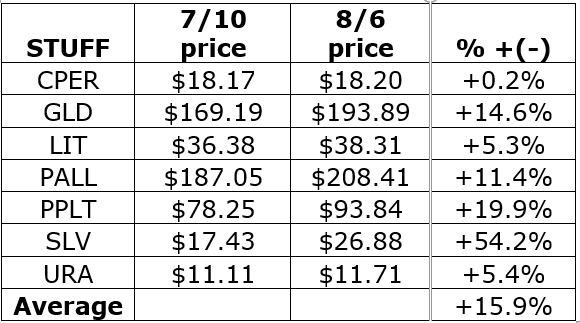
In this article, dated 7/10/2020, I noted that my “Stuff” Index was coming on strong and that its performance may be a “shot across the bow” that some changes may be coming to the financial markets.  Since then, the trend has accelerated.

STUFF vs. FANG vs. QQQ

Figure 1 displays the performance of STUFF components since 7/10

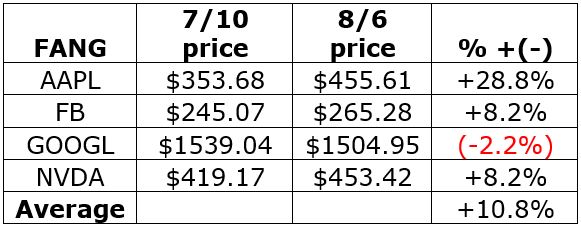
Figure 2 displays the performance of FANG components since 7/10

Figure 1 – Price performance of Jay’s STUFF Index components since 7/10

Figure 2 – Price performance of FANG stocks since 7/10

For the record, the “high-flying” Nasdaq 100 Index (using ticker QQQ as a proxy investment) is up +4.0% during the same time.

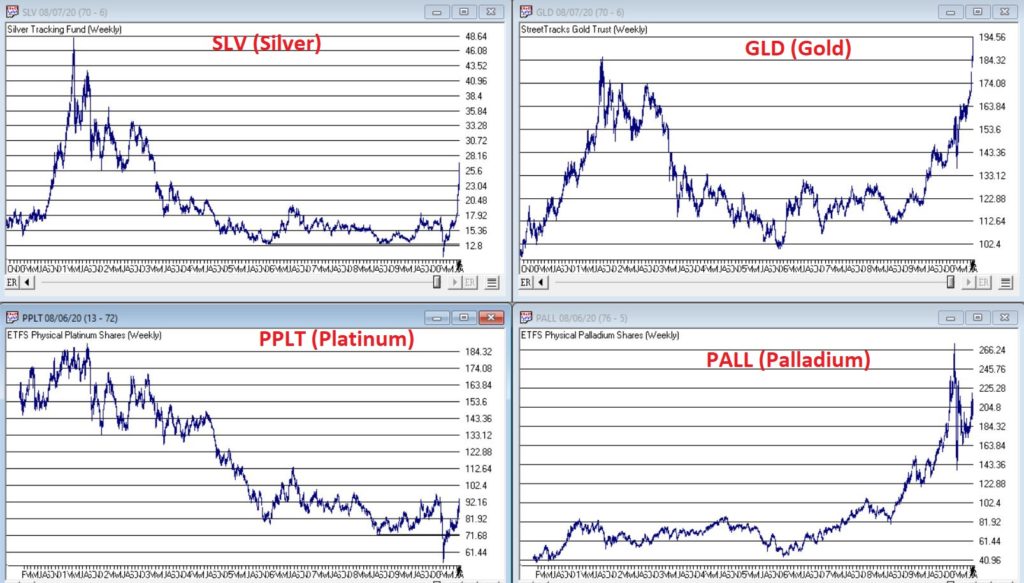
Is this a trend – or a blip?  Unfortunately, I can’t answer that question. But it certainly appears that there is something afoot in “Stuff”, particularly the metals.  Figure 3 displays the weekly charts for ETFs tracking Silver, Gold, Palladium and Platinum (clockwise from upper left). 

Figure 3 – The metals components of the Stuff Index (Courtesy AIQ TradingExpert)

When it comes bull markets in metals, the typical pattern historically goes something like this:

*Gold leads the way (check)

*Eventually silver comes on strong and often ends up outperforming gold (check)

*The other metals rise significantly “under the radar” as everyone focus on – literally in this case, ironically – the “shiny objects” (gold and silver)

Again, while I had inklings that a bull market in metals was forming (and have held positions in them for several years, and still hold them), I certainly did not “predict” the recent explosion in gold and silver prices. 

Two things to note:

*Gold and silver are obviously very “overbought”, so buying a large position here entails significant risk

*Still it should be noted that both SLV and PPLT would have to double in price from their current levels just to get back to their previous all-time highs of 2011

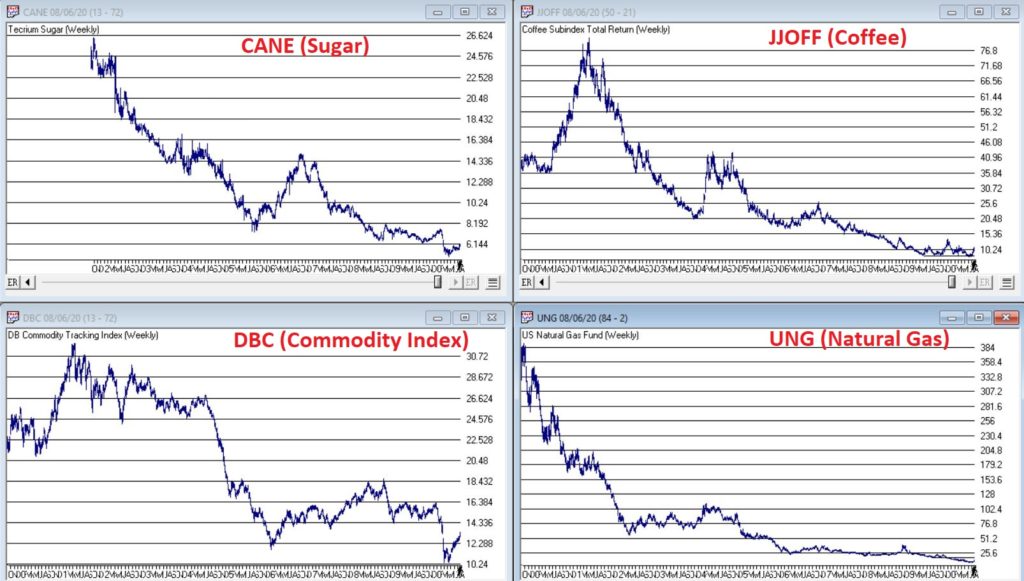
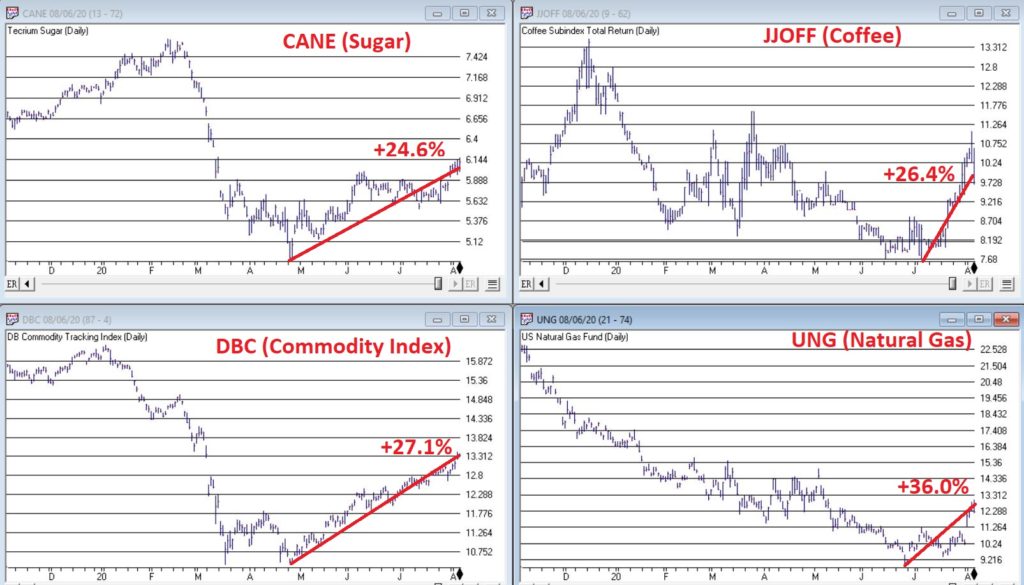
So, don’t be surprised if “Stuff” enjoys a continued resurgence.  Note in Figure 4 that a number of commodity related ETFs are way, way beaten down and could have a lot of upside potential if a resurgence actually does unfold.

Figure 4 – Four commodity ETFs weekly (Courtesy AIQ TradingExpert)

What is interesting – and almost not visible to the naked eye – is the action in the lower right hand corner of these four charts. To highlight what is “hiding in plain sight”, Figure 5 “zooms in” on the recent action of same four tickers as Figure 4, but in a daily price format rather than a monthly price format.

Figure 5 – Four commodity ETFs daily (Courtesy AIQ TradingExpert)

Despite the ugly pictures painted in Figure 4, it is interesting to note in Figure 5 that all four of these commodity related ETFs have rallied sharply of late.  There is of course, no guarantee this will continue.  But if the rally in “Stuff” – currently led by metals – spreads to the commodity sector as a whole, another glance in Figures 3 and 4 reveals a lot of potential upside opportunity.

Time will tell.  In the meantime, keep an eye on the “shiny objects” (gold and silver) for clues as to whether or not the rally in “Stuff” has staying power.

See also Jay Kaeppel Interviewin July 2020 issue of Technical Analysis of Stocks and Commodities magazine

See also Jay’s “A Strategy You Probably Haven’t Considered” Video

See also Video – The Long-Term…Now More Important Than Ever

Jay Kaeppel

Disclaimer: The information, opinions and ideas expressed herein are for informational and educational purposes only and are based on research conducted and presented solely by the author.  The information presented represents the views of the author only and does not constitute a complete description of any investment service.  In addition, nothing presented herein should be construed as investment advice, as an advertisement or offering of investment advisory services, or as an offer to sell or a solicitation to buy any security.  The data presented herein were obtained from various third-party sources.  While the data is believed to be reliable, no representation is made as to, and no responsibility, warranty or liability is accepted for the accuracy or completeness of such information.  International investments are subject to additional risks such as currency fluctuations, political instability and the potential for illiquid markets.  Past performance is no guarantee of future results.  There is risk of loss in all trading.  Back tested performance does not represent actual performance and should not be interpreted as an indication of such performance.  Also, back tested performance results have certain inherent limitations and differs from actual performance because it is achieved with the benefit of hindsight.

How to Know When to Worry About Inflation

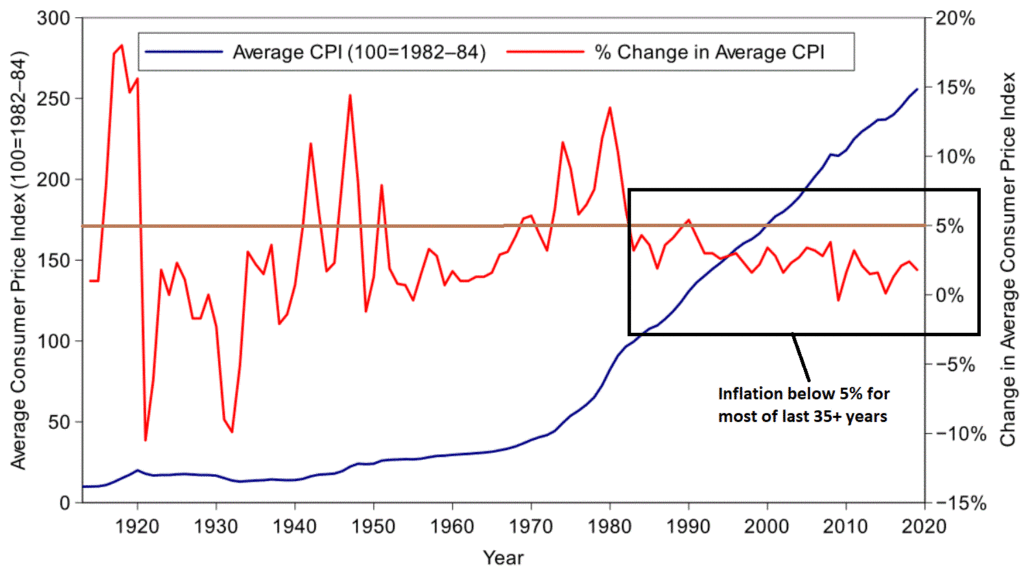
Inflation was a big deal – back in the late 70’s and early 80’s.  Since then it has been the subject of a whole lot of “the boy crying wolf” scenarios.  Take a look at Figure 1.  The red line displays the 12-month rate-of-change in the Consumer Price Index (i.e., the annual rate of inflation) since 1913.

Figure 1 – The Consumer Price Index (1913-2020)

Things to note, focusing on 1930 forward to the present:

*In the 1930’s we had deflation (actually much worse than inflation as the economy essentially spirals lower and slower) with the CPI reaching almost -10%

*There were peaks in the 15% range in the late 1940’s and late 70’s/early 80’s

*As you can see in the black box to the right hand side, inflation has been less than 5% annually for most of the last 35 years

As a result, most investors have been conditioned to not fret too much about inflation.  And any time spent actually worrying about inflation in the past several decades has been a waste of good anxiety.

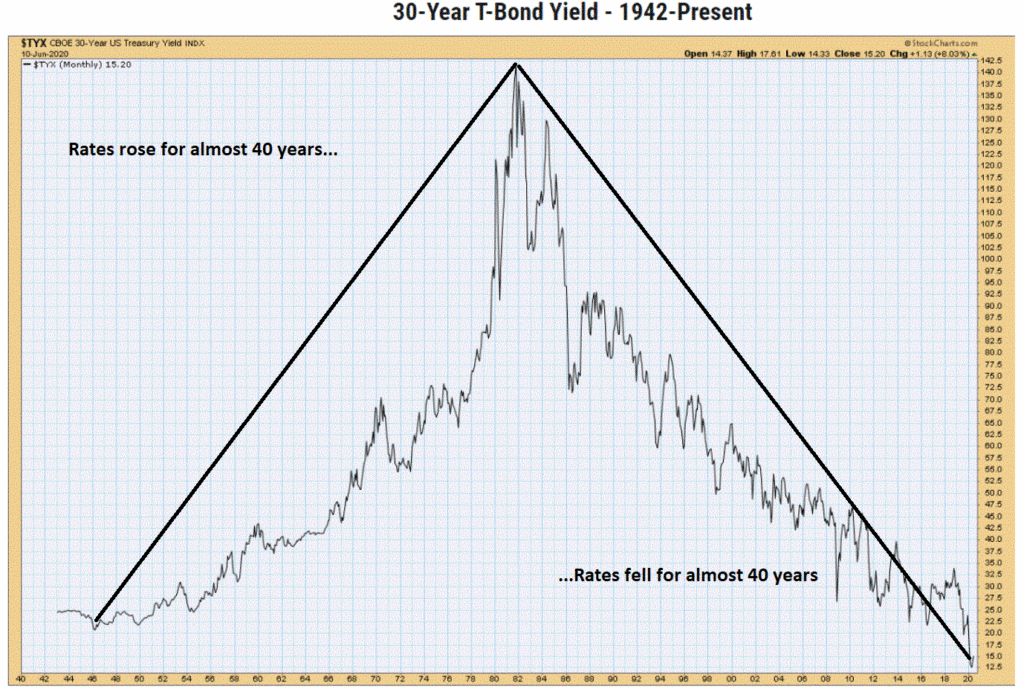
But nothing lasts forever.  Especially in the financial markets, where things tend to move in a cyclical nature over long periods of time.  To illustrate this point with a random, yet related example, consider Figure 2 which displays the yield on 30-year treasury bonds since 1942.

Figure 2 – 30-year treasury bond yield (1942-2020) (Courtesy: www.StockCharts.com)

Since the early 1980’s, investors have been nicely rewarded for holding bonds – especially long-term bonds.  But from the mid 1950’s into 1980 the experience was much different (rising yields equate to lower bond prices).  Presumably someday rates will rise again and an entire generation of bond investors will have no idea what is happening to their investments (see hereherehere and here).  But for now, we are focusing on inflation.

How to Know When to Worry About Inflation

I’ll give you three things to follow. 

#1. Gold

In a recent paper co-authored by legendary trader Paul Tudor Jones (see here) the authors laid out the case for higher inflation in the years ahead and suggested gold bullion could reach $2,400 an ounce.  Is this a possibility?  Absolutely. 

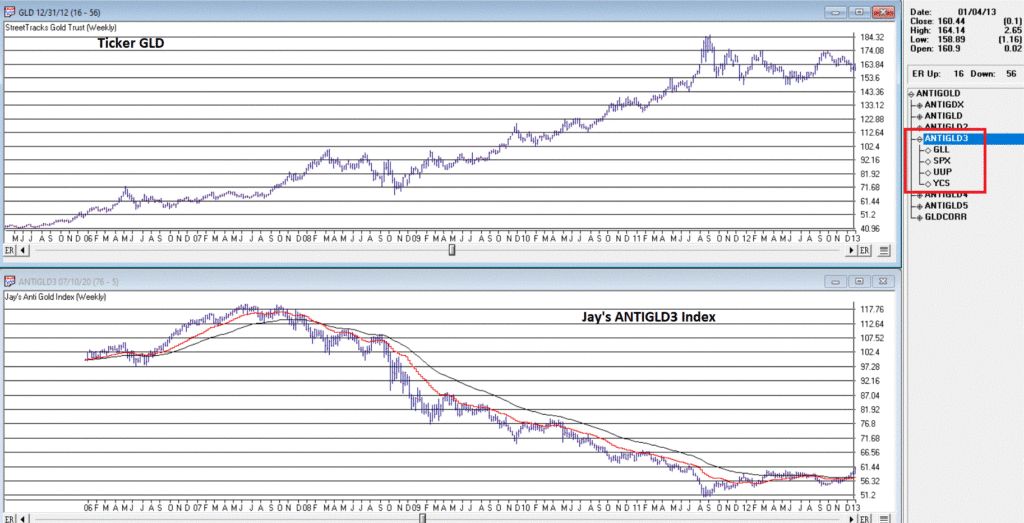
Figure 3 displays from 2005 through 2012:

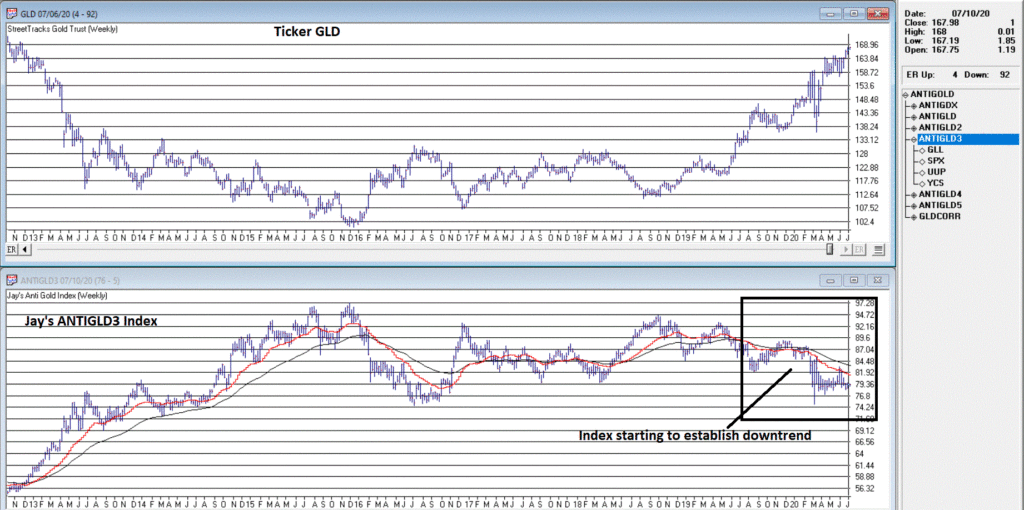
*ticker GLD (an ETF that tracks the price of gold bullion)

*my own index called ANTIGLD3 (components highlighted on right) with a Front Weighted Moving Average and a 55-week exponential moving average)

The ANTIGLD3 Index is a contrarian trend-following tool, i.e., when this index is in a downtrend it is bullish for gold and vice versa.

Figure 3 – Ticker GLD versus Jay’s ANTIGLD3 Index (2005-2012) (Courtesy AIQ TradingExpert)

Figure 4 displays the same tickers from 2012 into 2020

Figure 4 – Ticker GLD versus Jay’s ANTIGLD3 Index (2012-2020) (Courtesy AIQ TradingExpert)

The key thing to note in Figure 4 is that after several years of whipsaws the two trend-following indicators applied to ANTIGLD3 are in a clear downtrend (since this is a contrarian index that means it is purportedly bullish for gold). 

So, is it off to the races for gold?  I can’t say for sure. But it appears to be trying. Also note that gold can rally significantly in price for reasons other than inflation (see 2005-2011 rally)

I have positions in gold and gold stocks but not huge ones.  For whatever reason, so far, I am “not feeling it.”  As you will see in a moment, some inflation trend-following “things” that I watch have yet to confirm that inflation is an imminent threat at this exact moment.

But I am holding my positions just in case gold itself is the actual “leading indicator” in this story.

#2. The Aussie Dollar versus its 24-month moving average

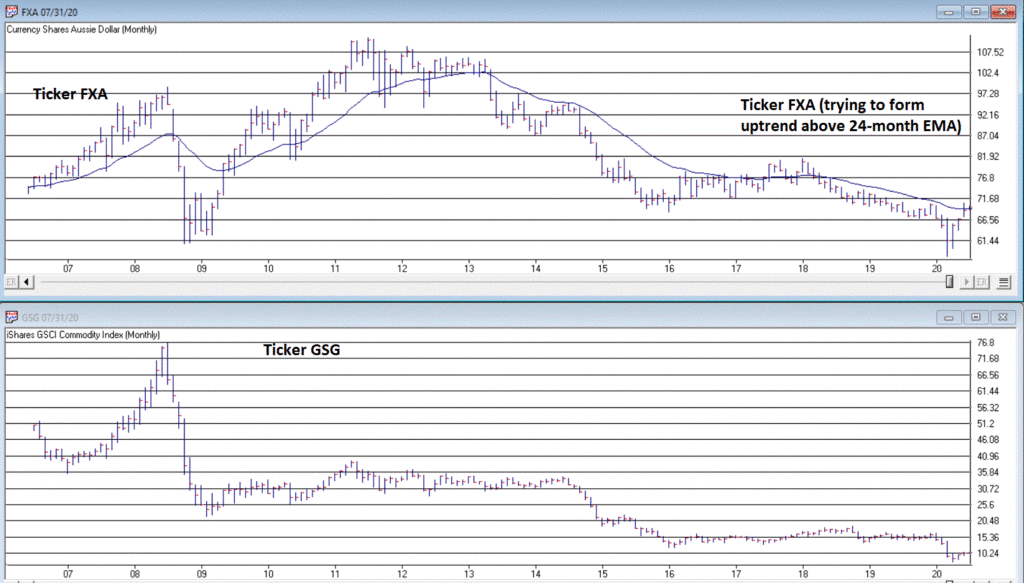
I covered this in detail here so will not get too in-depth here.  But you can get the gist of it pretty simply from Figure 5. The top chart is ticker FXA with a 24-month exponential moving average and the bottom chart is ticker GSG which tracks the Goldman Sachs Commodity Index.

Figure 5 – Ticker FXA (top) and ticker GSG (bottom) (Courtesy AIQ TradingExpert)

Long story short, commodities – or “hard assets”, are typically a good place to be during a period of sharply rising and/or high inflation – perform better when FXA is in an uptrend (i.e., above the 24-month EMA) than when below.  As of early July FXA has just moved above its 24-month EMA.  For the record, I usually only consider this at month-end.  So, check back after 7/31. 

If FXA establishes an uptrend, the likelihood of higher prices for commodities – including gold – rises. Thus, an uptrend for FXA would be another potential warning sign of impending inflation.

#3. TIPs versus Long-Term Treasuries

TIPs bonds are Treasury Inflation Protected securities, i.e., the principal can rise as inflation (based on the Consumer Price Index) rises (see here).  In other words, a TIP bond can gain value as inflation rises. Long-term treasuries on the other hand are the securities most likely to get hurt by a rise in inflation (as the rate of return is fixed once you buy the bond and a rise in inflation can reduce the future value and/or purchasing power of that fixed return). 

So, in a low inflationary period we typically see TIPs fall relative to long-term treasuries and during rising inflation we would expect to see TIPS rise relative to long-term bonds. 

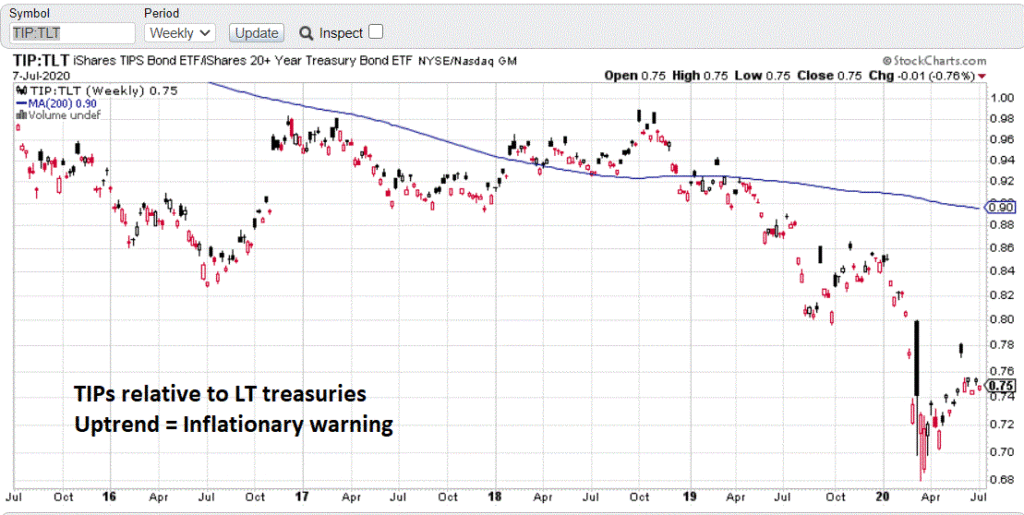
Figure 6 displays the chart of ticker TIP relative to ticker TLT on a weekly basis (with a 200-wekk moving average) from www.StockCharts.com.

Figure 6 – Ticker TIP relative to ticker TLT (weekly) still trending lower (Courtesy: www.StockCharts.com)

The bottom line: While gold itself is attempting to breakout to the upside and the Aussie Dollar is trying to establish an uptrend, the TIP:TLT relationship is not presently indicating any meaningful inflationary concerns. 

Summary

Inflation has been low for about 35 years.  But as they say, “don’t go to sleep on it.” 

If you want to be objectively prepared, keep an eye on:

*Gold bullion (in an uptrend, confirmed by a downtrend in my “anti-gold index”)

*The Aussie Dollar (No trend at the moment, but trying to establish an uptrend)

*Ticker TIP versus ticker TLT (Nowhere close to an uptrend right now)

So one up, one down and one sideways.  But pay close attention going forward.

If and when all three establish uptrends, the game we’ve all been playing for several decades will likely change dramatically.

See also Jay Kaeppel Interview in July 2020 issue of Technical Analysis of Stocks and Commodities magazine

See also Jay’s “A Strategy You Probably Haven’t Considered” Video

See also Video – The Long-Term…Now More Important Than Ever

Jay Kaeppel

Disclaimer: The information, opinions and ideas expressed herein are for informational and educational purposes only and are based on research conducted and presented solely by the author.  The information presented represents the views of the author only and does not constitute a complete description of any investment service.  In addition, nothing presented herein should be construed as investment advice, as an advertisement or offering of investment advisory services, or as an offer to sell or a solicitation to buy any security.  The data presented herein were obtained from various third-party sources.  While the data is believed to be reliable, no representation is made as to, and no responsibility, warranty or liability is accepted for the accuracy or completeness of such information.  International investments are subject to additional risks such as currency fluctuations, political instability and the potential for illiquid markets.  Past performance is no guarantee of future results.  There is risk of loss in all trading.  Back tested performance does not represent actual performance and should not be interpreted as an indication of such performance.  Also, back tested performance results have certain inherent limitations and differs from actual performance because it is achieved with the benefit of hindsight.

The Ultimate Ugly Contrarian Play

They always say you should buy when there is “blood in the street.”  They also say, “buy them when nobody wants them.”  So, let’s consider today what could be the most unloved, bombed out, everybody hates it “thing” in the world – coal.

Ugh, just the mention of the word coal elicits a recoiling response.  “Dirty energy!”  “Climate change inducing filth!” “Ban coal!”.  And so and so forth.  And maybe they have a point.  But “they” also say “facts are stubborn things” (OK, for the record, I think it’s a different “they” who says that but never mind about that right now).

So here is a stubborn fact: coal supplies about a quarter of the world’s primary energy and two-fifths of its electricity.  As I write, two of the fastest growing economies (at least they were as of a few months ago) – China and India – are not only heavily reliant upon coal for energy, but are still building more and more coal-fired plants.  Now I am making no comment on whether this is a good thing or a bad thing but the point is, it most definitely is a “thing.”

So however one feels about coal, the reality is that it is not going to go away anytime soon.  Does this mean it will “soar in value” anytime soon – or even ever for that matter?  Not necessarily.  But as an unloved commodity it’s sure is hard to beat coal.  And as “they” (they sure are a bunch of know it all’s they?) say, “opportunity is where you find it.” 

Ticker KOL is an ETF that invests in coal industry related companies.  And what a dog it has been.  Figure 1 displays a monthly chart of price action.  Since peaking in June 2008 at $60.80 a share, it now stands at a measly $6.29 a share, a cool -89.6% below its peak.  And like a lot of things it has been in a freefall of late.

Figure 1 – Ticker KOL Monthly chart (Courtesy AIQ TradingExpert)

So, is this a great time to buy KOL?  That’s not for me to say.  But for argument’s sake, Figure 2 displays a weekly chart of KOL with an indicator I call Vixfixaverageave (I know, I know), which is a version of an indicator developed a number of years ago by Larry Williams (Indicator code is at the end of the article).

Figure 2 – KOL weekly chart with Vixfixaverageave indicator (Courtesy AIQ TradingExpert)

Note that Vixfixaverageave is presently above 90 on the weekly chart.  This level has been reached twice before – once in 2008 and once in 2016.  Following these two previous instances, once the indicator actually peaked and ticked lower for one week, KOL enjoyed some pretty spectacular moves. 

To wit:

*Following the 12/19/08 Vixfixaverageave peak and reversal KOL advanced +252% over the next 27.5 months

*Following the 2/19/16 Vixfixaverageave peak and reversal KOL advanced +182% over the next 23.5 months

When will Vixfixaverageave peak and reverse on the weekly KOL chart?  There is no way to know.  One must just wait for it to happen.  And will it be time to buy KOL when this happens?  Again, that is not for me to say.  None of this is meant to imply that the bottom for KOL is an hand nor that a massive rally is imminent.

Still, if there is anything at all to contrarian investing, its hard to envision anything more contrarian that KOL.

Vixfixaverageave Calculations

hivalclose is hival([close],22).  <<<<<The high closing price in that last 22 periods

vixfix is (((hivalclose-[low])/hivalclose)*100)+50. <<<(highest closing price in last 22 periods minus current period low) divided by highest closing price in last 22 periods (then multiplied by 100 and 50 added to arrive at vixfix value)

vixfixaverage is Expavg(vixfix,3). <<< 3-period exponential average of vixfix

vixfixaverageave is Expavg(vixfixaverage,7). <<<7-period exponential average of vixfixaverage

Jay Kaeppel

Disclaimer: The information, opinions and ideas expressed herein are for informational and educational purposes only and are based on research conducted and presented solely by the author.  The information presented does not represent the views of the author only and does not constitute a complete description of any investment service.  In addition, nothing presented herein should be construed as investment advice, as an advertisement or offering of investment advisory services, or as an offer to sell or a solicitation to buy any security.  The data presented herein were obtained from various third-party sources.  While the data is believed to be reliable, no representation is made as to, and no responsibility, warranty or liability is accepted for the accuracy or completeness of such information.  International investments are subject to additional risks such as currency fluctuations, political instability and the potential for illiquid markets.  Past performance is no guarantee of future results.  There is risk of loss in all trading.  Back tested performance does not represent actual performance and should not be interpreted as an indication of such performance.  Also, back tested performance results have certain inherent limitations and differs from actual performance because it is achieved with the benefit of hindsight.

Where We Are (and One Thing to Watch For)

I haven’t written a lot lately.  Mostly I guess because there doesn’t seem to be a lot new to say.  As you can see in Figure 1, the major market indexes are in an uptrend.  All 4 (Dow, S&P 500, Russell 2000 and Nasdaq 100) are above their respective 200-day MA’s and all but Russell 2000 have made new all-time highs.

Figure 1 – 4 Major Market Indexes (Courtesy AIQ TradingExpert)

As you can see in Figure 2, my market “bellwethers” are still slightly mixed.  Semiconductors are above their 200-day MA and have broken out to a new high, Transports and the Value Line Index (a broad measure of the stock market) are holding above their 200-day MA’s but are well off all-time highs, and the inverse VIX ETF ticker ZIV is in a downtrend (ideally it should trend higher with the overall stock market).

Figure 2 – Jay’s 4 Market “Bellwethers” (Courtesy AIQ TradingExpert)

As you can see in Figure 3, Gold, Bonds and the U.S. Dollar are still holding in uptrends above their respective 200-day MA’s (although all have backed off of recent highs) and crude oil is sort of “nowhere”.

Figure 3 – Gold, Bonds, U.S. Dollar and Crude Oil (Courtesy AIQ TradingExpert)

Like I said, nothing has really changed.  So, at this point the real battle is that age-old conundrum of “Patience versus Complacency”.  When the overall trend is clearly “Up” typically the best thing to do is essentially “nothing” (assuming you are already invested in the market).  At the same time, the danger of extrapolating the current “good times” ad infinitum into the future always lurks nearby. 

What we don’t want to see is:

*The major market averages breaking back down below their 200-day MA’s.

What we would like to see is:

*The Transports and the Value Line Index break out to new highs (this would be bullish confirmation rather the current potentially bearish divergence)

The Importance of New Highs in the Value Line Index

One development that would provide bullish confirmation for the stock market would be if the Value Line Geometric Index were to rally to a new 12-month high.  It tends to be a bullish sign when this index reaches a new 12-month high after not having done so for at least 12-months.

Figure 4 displays the cumulative growth for the index for all trading days within 18 months of the first 12-month new high after at least 12-months without one.

Figure 4 – Cumulative growth for Value Line Geometric Index within 18-months of a new 12-month high

Figure 5 displays the cumulative growth for the index for all other trading days.

Figure 5 – Cumulative growth for Value Line Geometric Index during all other trading days

In Figure 4 we see that a bullish development (the first 12-month new high in at least 12 months) is typically followed by more bullish developments. In Figure 5 we see that all other trading days essentially amount to nothing.

Figure 6 displays the Value Line Geometric Index with the relevant new highs highlighted.

Figure 6 – Value Line Geometric Index (Courtesy AIQ TradingExpert)

Summary

The trend at this very moment is “Up.”  So sit back, relax and enjoy the ride.  Just don’t ever forget that the ride WILL NOT last forever.  If the Value Line Geometric Index (and also the Russell 2000 and the Dow Transports) joins the party then history suggests the party will be extended.  If they don’t, the party may end sooner than expected.

So pay attention.

Jay Kaeppel

Disclaimer: The information, opinions and ideas expressed herein are for informational and educational purposes only and are based on research conducted and presented solely by the author.  The information presented does not represent the views of the author only and does not constitute a complete description of any investment service.  In addition, nothing presented herein should be construed as investment advice, as an advertisement or offering of investment advisory services, or as an offer to sell or a solicitation to buy any security.  The data presented herein were obtained from various third-party sources.  While the data is believed to be reliable, no representation is made as to, and no responsibility, warranty or liability is accepted for the accuracy or completeness of such information.  International investments are subject to additional risks such as currency fluctuations, political instability and the potential for illiquid markets.  Past performance is no guarantee of future results.  There is risk of loss in all trading.  Back tested performance does not represent actual performance and should not be interpreted as an indication of such performance.  Also, back tested performance results have certain inherent limitations and differs from actual performance because it is achieved with the benefit of hindsight.