Tried, Tested, Working – even in these volatile markets

Have you ever bought a stock you thought had great earnings, only to see it fail miserably?

It is not enough to have a list of great fundamental stocks. You must go deeper into the analysis of each final candidate on the list. But, what other analysis can be done? At Top Stock Analyzer we use our own proprietary tool, we call the the FATI® Score to help us unlock profits.

The FATI® Score is based upon leading investment research studies which show stocks with a lower standard deviation of earnings estimates from the consensus (higher degree of agreement among analysts) the better performance of the stock. 

The study concluded stocks with a higher degree of earnings certainty (lower standard deviation of estimates) outperformed stocks with a lower degree of earnings certainty by +8.7% per year over a fifteen-year period. That is a significant performance enhancement. One which cannot be ignored. 
With out FATI® Score we fine tune stock selection beyond a list of great fundamentally screened stocks. There is no magic here, nor any guarantees, but face it; investing is hard enough. Why not select stocks which have a high probability of outperforming the markets both long and short?
Each week we generate a report of high scoring stocks both long and short, then feature one stock for an in-depth analysis.

Here’s an excerpt from our May 30, 2016 newsletter and the long stock that the FATI® Score highlighted 

Featured Stock – Dycom Industries – DY
Industry – Heavy Construction
Dycom Indiustries is a specialty contracting firm servicing
the telecom and utilities industries. The firm provides engineering, construction and maintenance services. They
have a long list of prominent clients, such as AT&T, Verizon, Comcast and Century Link. 
Dycom is experiencing enormous
growth due to the high demand for network and mobile bandwidth. As the bandwidth demand grows, customers need to
expand the capacity of their networks. This demand has created a backlog of over $5.6 billion is contract work
for Dycom. With this years sales growth estimated at over 26% earnings should continue to be outstanding.

As of 7/6/2016 DY was up 6.59% 

Here’s an excerpt from our June 6, 2016 newsletter and the long stock that the FATI® Score highlighted

Featured Stock – Copart, Inc. – CPRT
Industry – Auction/Valuation Services
Copart, Inc. provides online auction and related services to
process or sell salvage and marketable vehicles. The buyers and sellers include
insurance companies, banks and financial institutions, car dealerships, fleet
operators, and vehicle rental companies, licensed dealers and of course the
general public as well.
The company’s operations span the globe. Operations are well
established in Canada, Europe, South America and India. With increasing
revenues. declining expenses and global expansion into the Middle East, Copart
has been hitting on all cylinders. So far in 2016 the company has added 4 new
facilities to handle the increase in volume. Two in Colorado and two in Texas.
Earnings revisions are strong and are coming in higher
across quarterly and annual estimates. With a three year projected EPS growth
rate of 27% the party is not over yet. The P/E of 23 may sound expensive on a
relative basis, but with its EPS growth rate, it is actually reasonable.

As of 7/6/2016 CPRT was up 1.15% 


The ‘Short Side’ List

We also analyze for candidates to consider shorting for downward trending markets. The criterion for screening is not exactly the opposite of the long screen. To be most effective with the short list and minimize your risk associated with shorting, it is best to look for newcomers to the short list on a weekly basis.

Remember, shorting is an advanced trading technique. You have unlimited loss potential, so remember to be selective, use a stop loss order and only short in a confirmed downward trending market.

Here’s an excerpt from our June 13, 2016 newsletter and the short stock that the FATI® Score highlighted

Featured Stock – Conn, Inc. – CONN
Industry – Specialty Retailer
Conn, Inc is a regional specialty retailer in the southern
part of the U.S., in particular Texas and Louisiana. They sell home appliance
and garden equipment along with an array of other electronics. The company has
seen their gross margin severely impact by the rising cost of goods. In
addition their interest expense has doubled over the past year. These items, as
well as others have cause a severe contraction in earnings.
There doesn’t seem to be any daylight coming for Conn.
Earnings are expected to decline -89% this year, the P/E stands at 73 and F1
estimates have fallen from $1.77 to $0.11 over the past 90 days. Of the six
analysts following the stock, there doesn’t appear to be any agreement on the
actual EPS as depicted in a FATI Score of 534. Remember, anything over a score
of 12 or higher is disqualified from our long recommendations list.
With a pending market decline and the growing deterioration
of Conn, Inc. fundamentals, we see this as a good shorting opportunity. As with
any short trade, place a stop order and monitor the stock daily.

As of 7/6/2016 CONN was up 12.73% 

Putting it All Together

There you have it. “Fundamentals Made Simple”. Just select your stocks from the list and go right into your technical analysis. All the fundamental screening has already been done for you. Each and every week you will receive an updated screening of Top Stock Analyzer with the power of the FATI® Score. You can see the score of each stock. 

Here’s our featured stock performance as of 7/6/2016

Our weekly newsletter is a collaboration between AIQ Systems LLC and Fortunatus Advisors, Inc. if you want to learn more about our service visit 

The World is Your Oyster – 4 Days a Month

Some things are just plain hard to explain.  I did the following test using all 17 of the iShares single country funds that started trading 1996:
I tested the performance of each single country ETF on each specific trading day of the month (i.e., the 1st trading day of any month is TDM 1, the next day is TDM 2, etc.)
I also examined the last 7 trading days of the month counting backwards (i.e., the last trading day of the month is TDM -1, the day before that is TDM -2, etc.)
The basic idea was to see if there were any consistently favorable or unfavorable days of the month.  I wasn’t necessarily expecting much given that the stock markets of each of 17 different countries could  rightly be expected to “walk to the beat of their own drum”, given that the fundamentals underlying the stock market in any given country may be unique from that of other countries.
Or maybe not so much.
For what it is worth, the results from 3/25/1996 through 6/20/2016 appear in Figure 1.
(click to enlarge)
1
Figure 1 – Trading Day of Month Results for 17 iShares single country ETFs; 3/25/96 through 6/20/16
Each column displays the cumulative % return for each individual single country ETF if we held a long position in that ETF on only that particular trading day of the month.
As you can see – and what are the odds of this, I am not even sure how to calculate that – there are 4 days (highlighted in green in Figure 1) that were uniformly “favorable”, i.e., all 17 ETFs showed a net gain on that particular trading day of the month (for the record, there are three trading days – TDM #7 and TDMs -7 and -6 – during which all  17 ETFs showed a net loss (highlighted in yellow in Figure 1.  Go figure).
Using as a Strategy
I am not recommended the following strategy, but wanted to test it out for arguments sake.  Figure 2 displays the results of the following test:
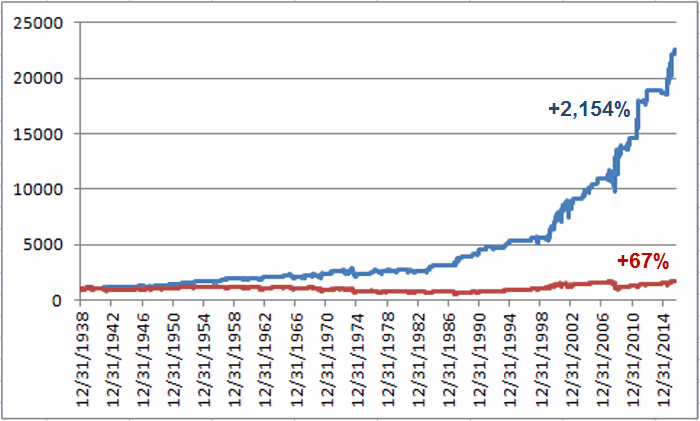
*Buy and hold an equally weighted position in all 17 single country ETFs only on TDM 1, 9, 13 and -4 (i.e., if Friday is the last trading day of the month then – barring a holiday – TDM -4 would be the Tuesday of that week), earn annualized interest of 1% per month while out of ETFs.
*Versus simply buying and holding all 17 single country ETFs from 3/25/1996 through 6/20/2016.
2
Figure 2 – Cumulative % return for holding all 17 single country ETF only 4 days a month (blue) versus buying and holding (red); 3/25/96 through 6/20/16
Summary
Yes, this model can probably be accused of being “curve fit”.  Also, does anybody really want to trade in and out of 17 single country ETFs 4 times a month?  I don’t know.  But the bigger points are:
*Why would all 17 single country ETFs all be up (or down) on a particular day of the month over a 20 year period?
*If I were considering buying and holding a cross section of individual country ETF’s, um, well, I can’t help but think that I would be haunted by the thought that there might be a better way.
Jay Kaeppel
Chief Market Analyst at JayOnTheMarkets.com and AIQ TradingExpert Pro (http://www.aiqsystems.com) client
One of the things …….. is that the U.K. is not in great financial shape right now – comments June 21, 2016

The Dow shot up over 270 points at the open, then spent the rest of the day giving back about half of those points to close up 130 at 17,805.  Volume was moderate, coming in at 96 percent of its 10-day average.  There were 178 new highs and only 9 new lows.

Yesterday’s rally was the Big Move predicted by last Thursday’s small change in the A-D oscillator.  It also came on the heels of last Wednesday’s VIX Buy Signal.
The rally was fueled by two polls released in the U.K. over the weekend that showed the ‘Stay’ vote taking a small lead. Prior polls had been showing the ‘Leave’ vote with a small lead, so the markets took the change in polling as a positive sign.  I wouldn’t get too excited about the polls, because the result of Thursday’s vote is still way too close to call, especially in view of the impact that a ‘Leave’ vote could have on financial markets.
One of the things that students should realize is that the U.K. is not in great financial shape right now.  The country is running significant account deficits and a lower pound won’t be that much help to British consumers and exporters.
In September 1992, when the UK last devalued its currency by 15 percent, the country was able to recover because interest rates had been running over 10 percent, so consumers and businesses benefited by the devalued pound which lowered interest rates.  But now with interest rates running near zero, a 10-15+ percent devaluation of the pound could have entirely different consequences.  It could severely impact the UK’s economy and put the country into a deep recession that could take years to recover.
So we need to be on our toes going into Thursday’s vote.  If the ‘Leave’ voters win, Friday could be a very bad day for world markets.  On the other hand, IF the ‘Stay’ voters get the upper hand, world markets should react positively with the Dow likely to re-test the 20 April high of 18,168.
Please be careful going into Thursday.  In my opinion, the vote on Brexit is too close to call and could go either way.  This means that the risk to your portfolio is very high.
So because of the high risk, I am mostly focused on short-term scalps.  With a positive Dean’s List, a neutral Tide, and negative DMIs and Money Flow indicators, the cockpit indicators are about as mixed as they can be.  They’re telling me to be on the sidelines or scalp trade only.

Try our Cum Laude service for 2 weeks and receive 8 nightly updates (just like this one)

and 2 weekend strategy reviews
PLUS the Dean’s List of favored stocks
ONLY $9.99 
However, my custom VTI turned positive after yesterday’s trading, so I’m going to look for scalp trades to the long side today.  One of the things I’ve found is that whenever the VTI changes direction, stocks highlighted for the Honor Roll tend to do well over the short term.  We’ll see if this holds true today with BP and Continental Resources (CLR), the two energy stocks that were highlighted last night.
My other focus will be on gold.  Yesterday’s early rally in the equity markets caused most gold stocks to pull back.  It also caused UUP to drop off the Dean’s List and the UDN, inverse Dollar ETF, to re-appear. So for the very short term, the Dean is telling is us the Dollar is weakening, which means the environment for gold could be getting stronger.
Also, the 2-period RSI Wilder on ABX closed with an oversold reading of 22.17. So with ABX in an Uptrend (50>200) and an oversold RSI on the Daily chart, its telling me that it might be a good time to go hunting. I spent several hours last night polishing my Rifle)
That’s what I’m doing,
The Professor
Market Signals for
06-21-2016
DMI (DIA) NEG
DMI (QQQ) NEG
COACH (DIA) NEG
COACH (QQQ) NEG
A/D OSC
DEANs LIST POS
THE TIDE NEU
SUM IND NEG

Try our Cum Laude service for 2 weeks and receive 8 nightly updates (just like this one)

and 2 weekend strategy reviews
PLUS the Dean’s List of favored stocks
ONLY $9.99 

Zero In On The MACD

The AIQ code based on Barbara Star’s article in May issue of Stocks and Commodities “Zero In On The MACD,” is provided at www.TradersEdgeSystems.com/traderstips.htm, and is also shown below.
Sample Chart

FIGURE 7: AIQ. Here is a sample chart of VIAB with MACDhist, the color bars, and the 34- and 55-bar EMAs.
Figure 7 shows the MACD histogram on a chart of Viacom (VIAB) with the color bars and the 34- and 55-bar exponential moving averages (EMA). Note that I did not code the weighted moving average (WMA) but substituted the EMA for the WMA. I chose to view the chart of VIAB by running the EDS “Zero MACD.eds” on 3/14/2016 and examining the alert messages on the report “List.” VIAB is the only one on that date that showed a cross up on the MACDhist (see Figure 8 for a look at part of this report for 3/14/2016).
Sample Chart

FIGURE 8: AIQ. This shows part of the EDS custom report “List” that shows the MACDhist values on 3/14/2016, the color status, and any alerts that were generated for that day.
! ZERO IN ON THE MACD

! Author: Barbara Star, TASC May 2016

! Coded by: Richard Denning 3/14/16

! www.TradersEdgeSystems.com


! INPUTS:

macd1  is  12.

macd2  is  26.

macdSig is  1.


! INDICATORS:

emaST  is expavg([Close],macd1).

emaLT  is expavg([Close],macd2).

MACD  is emaST - emaLT.  ! MACD line

SigMACD is expavg(MACD,macdSig). ! MACD Signal line

MACDosc is MACD - SigMACD. ! MACD Oscillator


HD if hasdatafor(macd2) = macd2.

MACDhist is MACD.                                 ! plot as historigram

MACDblue if MACDhist > 0.  ! use these rules to color MACDhist

MACDred  if MACDhist < 0.  ! use these rules to color MACDhist

MACDcolor is iff(MACDblue and HD,"Blue",iff(MACDred and HD,"Red","White")). !for report list

List if 1.


!ALERTS:

EMA1 is expavg([close],34).

EMA2 is expavg([close],55).

xupEMA1 if [close] > EMA1 and valrule([close] < EMA1,1).

xdnEMA1 if [close] < EMA1 and valrule([close] > EMA1,1).

xupEMA2 if [close] > EMA2 and valrule([close] < EMA2,1).

xdnEMA2 if [close] < EMA2 and valrule([close] > EMA2,1).

xupMACD if MACDhist > 0 and valrule(MACDhist < 0,1).

xdnMACD if MACDhist < 0 and valrule(MACDhist > 0,1).

UpAlerts is iff(xupEMA1,"xupEMA1",iff(xupEMA2,"xupEMA2",iff(xupMACD,"xupMACD"," "))).

DnAlerts is iff(xdnEMA1,"xdnEMA1",iff(xdnEMA2,"xdnEMA2",iff(xdnMACD,"xdnMACD"," "))).

The code and EDS file can be downloaded from www.TradersEdgeSystems.com/traderstips.htm.

AIQ Market AI signals a 100 rating to the downside

Artificial Intelligence Market Signal issues a 0-100 to the downside on June 10, 2016
AIQ TradingExpert AI signals are designed to anticipate changes in the direction of price movement.  Some are accurate and some are not.  However, more often than not, the Expert Rating signals are accurate.  The strongest level of confirmation for market timing signals like this 0-100 down on June 10, 2016 can be found by examining one of TradingExpert’s other market indication components. 

One possible confirmation of market timing signals (Expert Ratings of 95 or greater) is the the Up/Down Signal Ratio, on the Weighted Action List (WAL), an AIQ report.  A Signal Ratio of 85 or greater in the direction of the signal could be viewed as significant, as the AI system used for stocks is completely separate in terms of expert system knowledge base and data, and share no information or expert rules with the market timing system. 

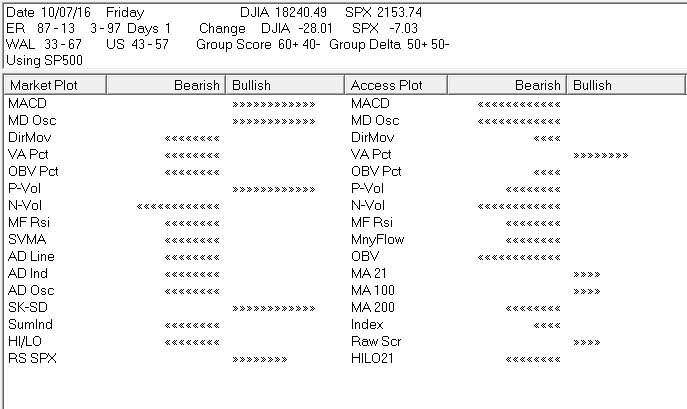
The image below is taken from the AIQ Reports Daily Market Log. This report pulls elements from various parts of TradingExpert. You’ll notice the 0-100 down signal  on DJIA on 6/10/2016. Just below that is WAL 5-95. This is the Up/Down Signal Ratio from the Weighted Action List (WAL) in this case using SP500 stocks. This 5-95 confirms that 95% of the SP500 stocks have down signals according to the stock expert system.

The Access Plot area on the right gives a bullish/bearish consensus for the SP 500 stocks using 16 technical indicators.

The two independent components of TradingExpert are in agreement calling for the market to move in the same direction. This is a very powerful type of validation, both the equity and market timing systems have signaled a change in market direction at the same time.

While no system is perfect, it is interesting to note the previous 0-100 market timing signal occurred December 8, 2015 prior to the correction at the start of 2016.