Relative strength has more information embedded within it than meets the eye. Here is a way to identify and compress several dimensions of relative strength into one single scalable value, the RS4r, which allows you to compare and then rank securities for robustness across timeframes and shifting market conditions…
The importable AIQ EDS file based on James Garofallou’s article in Stocks & Commodities magazine September 2020 issue, “The RS4r: Tracking Relative Strength In Four Dimensions,” can be obtained on request via email to info@TradersEdgeSystems.com. The code is also available here:
! The RS4r: Tracking Relative Strength in Four Dimensions
! Author: James Garofallou, PhD, TASC Sept 2020
! Coded by: Richard Denning, 7/18/2020

!INPUTS
C is [close].
len1 is 10.
len2 is 15.
NumIndx is 4.
BuyLvl is 80.

!FORMULAS
SPYc is TickerUDF("SPY",C).      !SP500
QQQc is TickerUDF("QQQ",C).     !NASDAQ100
MDYc is TickerUDF("MDY",C).     !SP400
IWMc is TickerUDF("IWM",C).      !Russel2000

RS1spy is C/SPYc.
RS1qqq is C/QQQc.
RS1mdy is C/MDYc.
RS1iwm is C/IWMc.

FastSPY is Expavg(RS1spy,len1).
MedSPY is Simpleavg(FastSPY,7).
SlowSPY is Simpleavg(FastSPY,15).
VSlowSPY is Simpleavg(SlowSPY,30).

FastQQQ is Expavg(RS1qqq,Len1).
MedQQQ is Simpleavg(FastQQQ,7).
SlowQQQ is Simpleavg(FastQQQ,15).
VSlowQQQ is Simpleavg(SlowQQQ,30).

FastMDY is Expavg(RS1mdy,Len1).
MedMDY is Simpleavg(FastMDY,7).
SlowMDY is Simpleavg(FastMDY,15).
VSlowMDY is Simpleavg(SlowMDY,30).

FastIWM is Expavg(RS1iwm,Len1).
MedIWM is Simpleavg(FastIWM,7).
SlowIWM is Simpleavg(FastIWM,15).
VSlowIWM is Simpleavg(SlowIWM,30).

Tier1spy is iff(FastSPY>=MedSPY and MedSPY>=SlowSPY and SlowSPY>=VslowSPY,10,0).
Tier1qqq is iff(FastQQQ>=MedQQQ and MedQQQ>=SlowQQQ and SlowQQQ>=VslowQQQ,10,0).
Tier1mdy is iff(FastMDY>=MedMDY and MedMDY>=SlowMDY and SlowMDY>=VslowMDY,10,0).
Tier1iwm is iff(FastIWM>=MedIWM and MedIWM>=SlowIWM and SlowIWM>=VslowIWM,10,0).

Tier2spy is iff(FastSPY>=MedSPY and MedSPY>=SlowSPY and SlowSPY<VslowSPY,9,0).
Tier2qqq is iff(FastQQQ>=MedQQQ and MedQQQ>=SlowQQQ and SlowQQQ<VslowQQQ,9,0).
Tier2mdy is iff(FastMDY>=MedMDY and MedMDY>=SlowMDY and SlowMDY<VslowMDY,9,0).
Tier2iwm is iff(FastIWM>=MedIWM and MedIWM>=SlowIWM and SlowIWM<VslowIWM,9,0).

Tier3spy is iff(FastSPY<MedSPY and MedSPY>=SlowSPY and SlowSPY>=VslowSPY,9,0).
Tier3qqq is iff(FastQQQ<MedQQQ and MedQQQ>=SlowQQQ and SlowQQQ>=VslowQQQ,9,0).
Tier3mdy is iff(FastMDY<MedMDY and MedMDY>=SlowMDY and SlowMDY>=VslowMDY,9,0).
Tier3iwm is iff(FastIWM<MedIWM and MedIWM>=SlowIWM and SlowIWM>=VslowIWM,9,0).

Tier4spy is iff(FastSPY<MedSPY and MedSPY>=SlowSPY and SlowSPY<VslowSPY,5,0).
Tier4qqq is iff(FastQQQ<MedQQQ and MedQQQ>=SlowQQQ and SlowQQQ<VslowQQQ,5,0).
Tier4mdy is iff(FastMDY<MedMDY and MedMDY>=SlowMDY and SlowMDY<VslowMDY,5,0).
Tier4iwm is iff(FastIWM<MedIWM and MedIWM>=SlowIWM and SlowIWM<VslowIWM,5,0).

RS2spy is Tier1spy + Tier2spy + Tier3spy + Tier4spy.
RS2qqq is Tier1qqq + Tier2qqq + Tier3qqq + Tier4qqq.
RS2mdy is Tier1mdy + Tier2mdy + Tier3mdy + Tier4mdy.
RS2iwm is Tier1iwm + Tier2iwm + Tier3iwm + Tier4iwm.


RS3x is  (RS2spy+RS2qqq+RS2mdy+RS2iwm).

RS4 is (RS3x/NumIndx)*10.
RS4osc is simpleavg(RS4,3).
mvSig is simpleavg(RS4osc,5).
RS4r is round(RS4).

mvRS4 is expavg(RS4r,4).
RS4up is iff(RS4r >= 80 or RS4r > mvRS4,1,0).

X is iff(RS4 >= 80,1,0).
R5 is iff(RS4up =1,round(simpleavg(X,len2)*100),0).

Buy if R5 >= BuyLvl.
ExitBuy if R5 < BuyLvl.

ShowValues if 1.
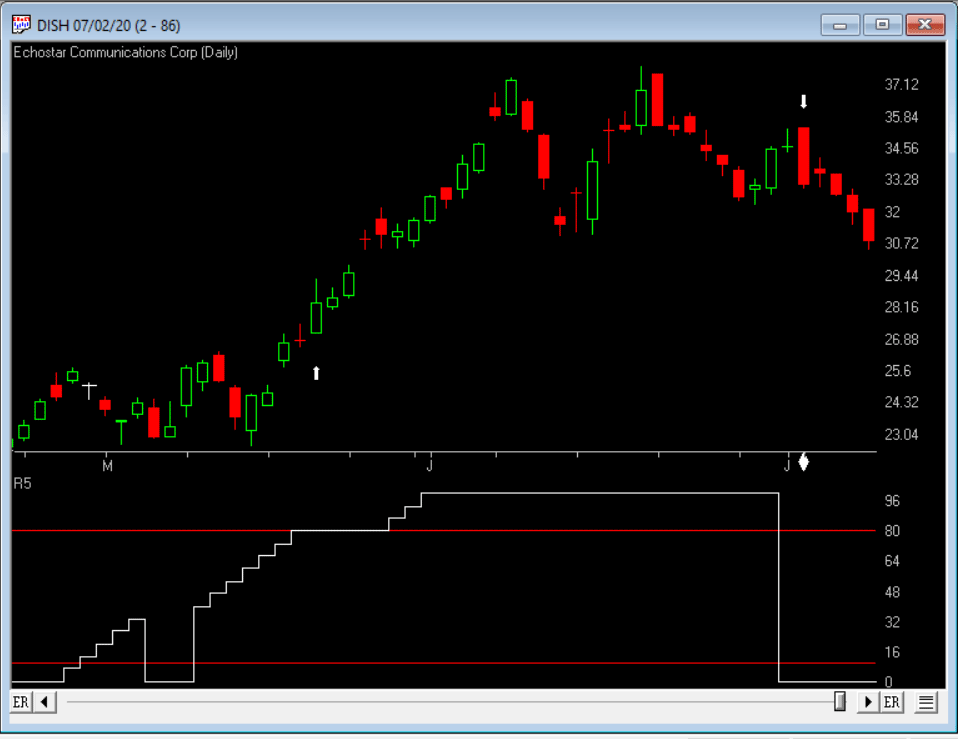
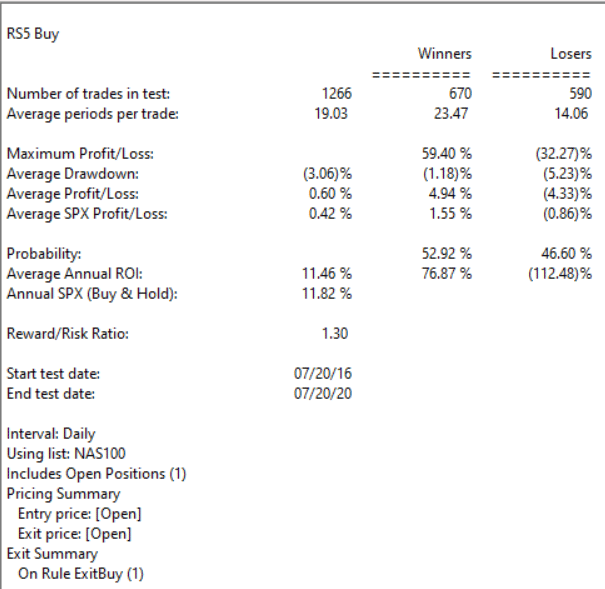
Code for the RS4r is included in the EDS file. I also coded a system that uses the RS4r (R5). I used four independent ETFs as indexes rather than the 11 mutual funds that the author used. I used SPY, QQQQ, MDY, and IWM. The trading system buys (long only) when the R5 >= 80 and exits the long position when RS4r < 80. The summary EDS backtest report for trading this system on the Nasdaq 100 stocks (commission & slippage not subtracted) is shown in Figure 13 and a sample trade on DISH with the R5 indicator is shown in Figure 12.
FIGURE 12: AIQ. Chart of DISH with R5 indicator and sample trade using R5 indicator >= 80 to buy.
FIGURE 13: AIQ. Summary EDS backtest report for the R5 system that trades the Nasdaq 100 stocks over the last 4 years.
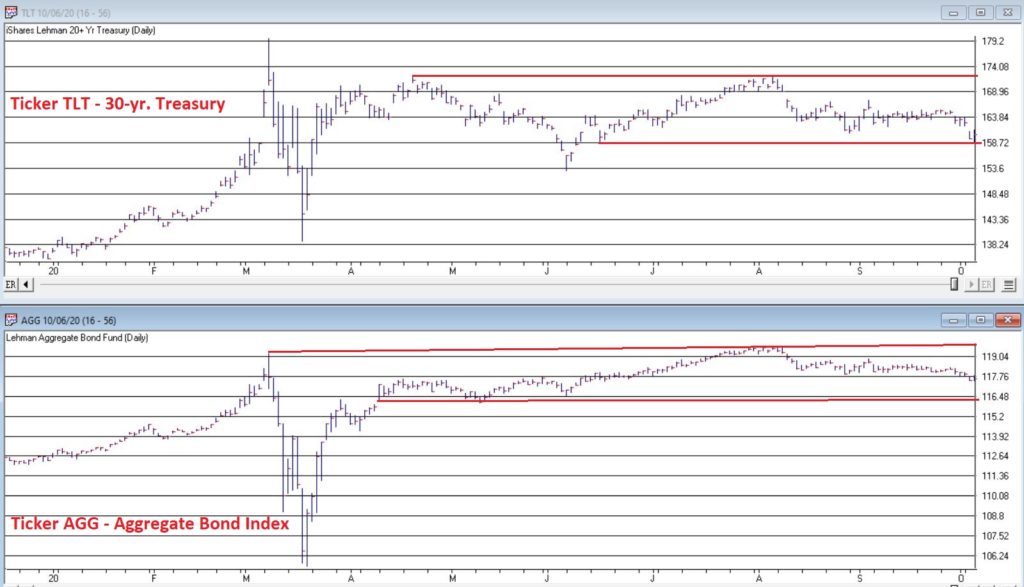
The bond market was very quiet in the 3rd quarter. Figure 1 displays ticker IEF (7-10 year treasuries ETF) in the to clip and ticker AGG (Aggregate Bond Index ETF) in the bottom clip.
Essentially the entire bond market has been flat since early June. The market seems to be assuming that “the Fed will take of everything” and keep interest rates low and stable for the foreseeable future so…..ZZZZZZZZ.
But this type of activity often breeds complacency. I am not making any predictions here but I do want to raise a question that investors might wish to ponder, i.e., “what would be more shocking that a spike in interest rates?” OK, yes, I realize it is 2020 and it is pretty much hard to be shocked by anything anymore. But still, on a relative basis how many investors are even thinking about the potential risk of higher interest rates at the moment?
Could it Happen?
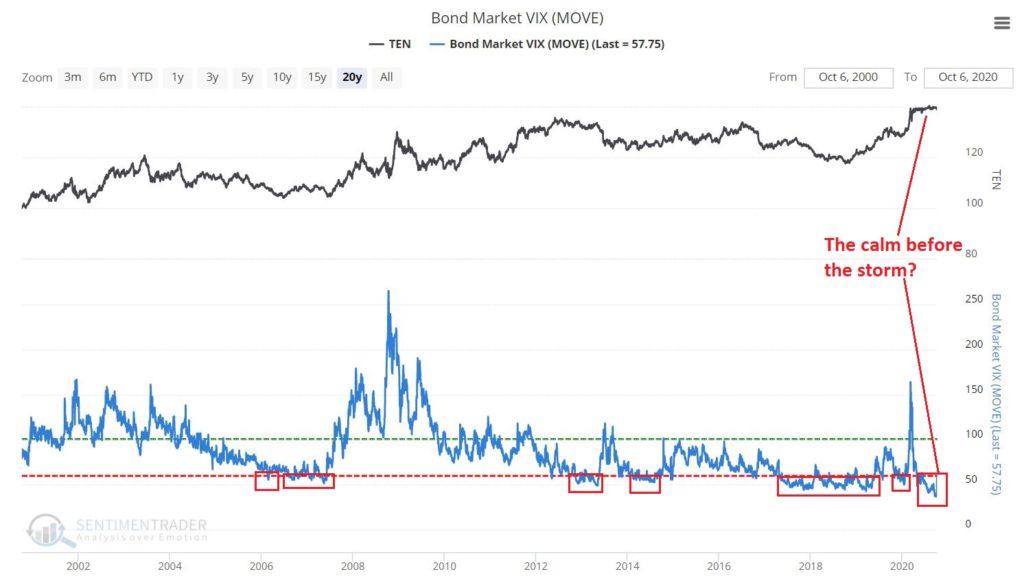
The Bond Market VIX (ticker MOVE) recently fell to its lowest level ever (before spiking sharply higher on 10/5/20). As you can see in Figure 2 this type of “quietness” often precedes a significant move in the bond market. For the record, low readings in MOVE can be followed by large up moves in price as easily as large down moves in price. So, a low MOVE reading is not “bearish” per se, but rather merely suggests that we are experiencing the “calm before the storm.”
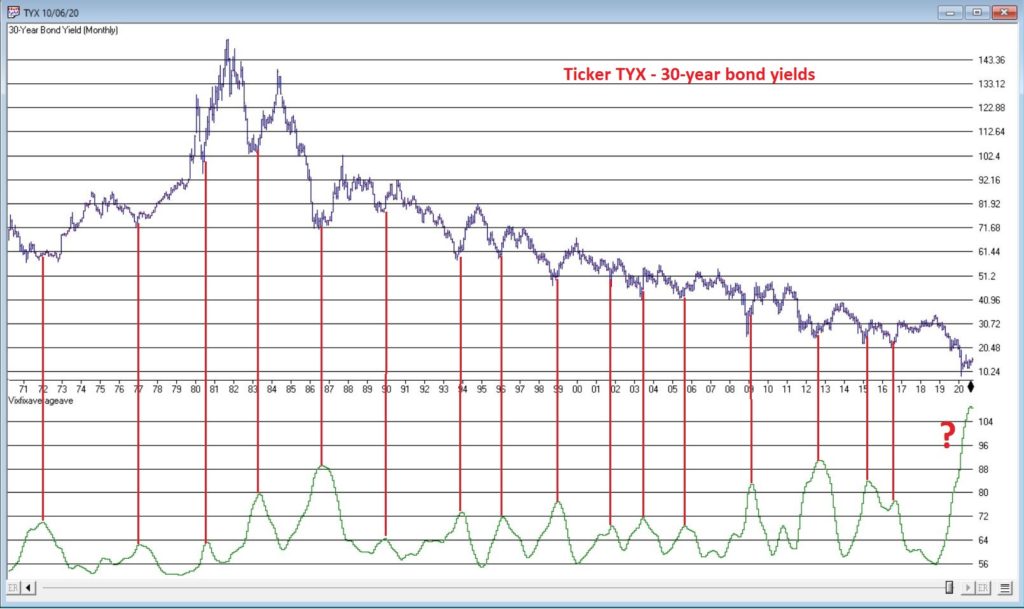
So why is my “Spidey sense” tingling? Figure 3 displays the yield on 30-year treasuries (ticker TYX) on the bottom and an indicator I refer to as VFAA on the bottom (the calculation appears at the end of this piece). VFAA is a derivative on a Larry William’s indicator he calls VixFix.
Figure 3 – 30-year treasury yields with VFAA suggesting a potential bottoming area (Courtesy AIQ TradingExpert)
As you can see in Figure 3, peaks in the VFAA indicator often occur near intermediate term lows in bond yields (reminder: bond prices move inversely to yield, so a bottom in interest rates indicates a top in bond prices). As you can also see on the far-right hand side, the stage clearly appears to be set for “the next go round.”
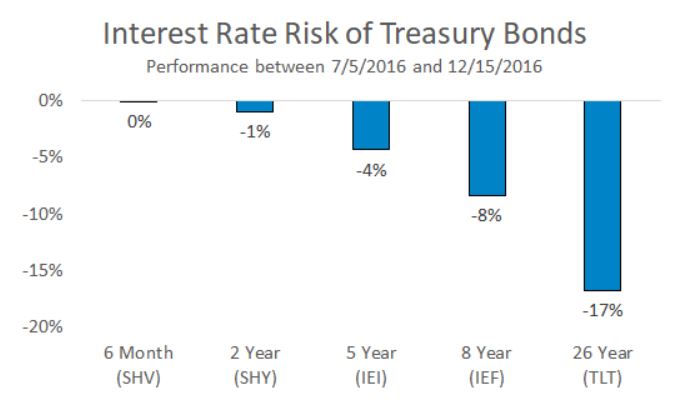
Why does this matter? If interest rates do rise in the months ahead bond prices – particularly long-term bond prices can get hit hard. To illustrate the potential risks, Figure 4 displays the action of treasury security ETFs of various maturity during a 5-month rise in rates back in 2016.
Figure 4 – Bond ETF action during rate rise in 2016
Summary
It is possible for long and short-term bonds to “de-couple”. In other words, the possibilities are:
*Short-term rates remain stable (as the Fed keeps pumping) while long-term rates rise (as inflation fears arise as a result of all the Fed pumping)
*Short-term rates remain stable while long-term rates plummet (if the economy appears to be weakening). This would result in gains for long-term bonds only
*None of the above
The bottom line: Bonds have fallen asleep – but DO NOT fall asleep on bonds.
VFAA Formula
Below is the code for VFAA
VixFix is an indicator developed many years ago by Larry Williams which essentially compares the latest low to the highest close in the latest 22 periods (then divides the difference by the highest close in the latest 22 periods). I then multiply this result by 100 and add 50 to get VixFix.
*Next is a 3-period exponential average of VixFix
*Then VFAA is arrived at by calculating a 7-period exponential average of the previous result (essentially, we are “double-smoothing” VixFix)
Are we having fun yet? See code below:
hivalclose is hival([close],22).
vixfix is (((hivalclose-[low])/hivalclose)*100)+50.
vixfixaverage is Expavg(vixfix,3).
vixfixaverageave is Expavg(vixfixaverage,7).
VFAA = vixfixaverageave
Jay Kaeppel
Disclaimer: The information, opinions and ideas expressed herein are for informational and educational purposes only and are based on research conducted and presented solely by the author. The information presented represents the views of the author only and does not constitute a complete description of any investment service. In addition, nothing presented herein should be construed as investment advice, as an advertisement or offering of investment advisory services, or as an offer to sell or a solicitation to buy any security. The data presented herein were obtained from various third-party sources. While the data is believed to be reliable, no representation is made as to, and no responsibility, warranty or liability is accepted for the accuracy or completeness of such information. International investments are subject to additional risks such as currency fluctuations, political instability and the potential for illiquid markets. Past performance is no guarantee of future results. There is risk of loss in all trading. Back tested performance does not represent actual performance and should not be interpreted as an indication of such performance. Also, back tested performance results have certain inherent limitations and differs from actual performance because it is achieved with the benefit of hindsight.
Truth be told I am not much of a “stock picker”. Oh, I can pick ‘em alright just like anyone else. They just to don’t go the right way as often as I’d like. I also believe that the way to maximize profitability is to follow a momentum type approach that identifies stocks that are performing well and buying them when they breakout to the upside (ala O’Neil, Minervini, Zanger, etc.) and then riding them as long as they continue to perform. Unfortunately, I’m just not very good at it.
Back when I started out, there was such a thing as a “long-term investor.” People would try to find good companies selling at a decent price and they would buy them and hold them for, well, the long-term. Crazy talk, right? As I have already stated, I am not claiming that that is a better approach. I am just pointing out that it was “a thing.”
An Indicator
There is an indicator (I will call it VFAA, which is short for vixfixaverageave, which – lets face it – is a terrible name) that I follow that was developed as an extension of Larry William’s VixFix Indicator. There is nothing magic about it. Its purpose is to identify when price has reached an exceptionally oversold level and “may” be due to rally. The code for this indicator appears later.
For the record, I DO NOT systematically use this indicator in the manner I am about to describe, nor am I recommending that you do. Still, it seems to have some potential value, so what follows is merely an illustration for informational purposes only.
The Rules
*We will look at a monthly bar chart for a given stock
*A “buy signal” occurs when VFAA reaches or exceeds 80 and then turns down for one month
*A “sell (or exit) signal” occurs when VFAA subsequently rises by at least 0.25 from a monthly closing low
Seeing as how this is based solely on monthly closes it obviously this is not going to be a “precision market timing tool.”
Some “Good Companies” with “Troubled Stocks”
So now let’s apply this VFAA indicator to some actual stocks. Again, I AM NOT recommending that anyone use this approach mechanically. The real goal is merely to try to identify situations where a stock has been washed out, reversed and MAY be ready to run for a while.
Ticker BA
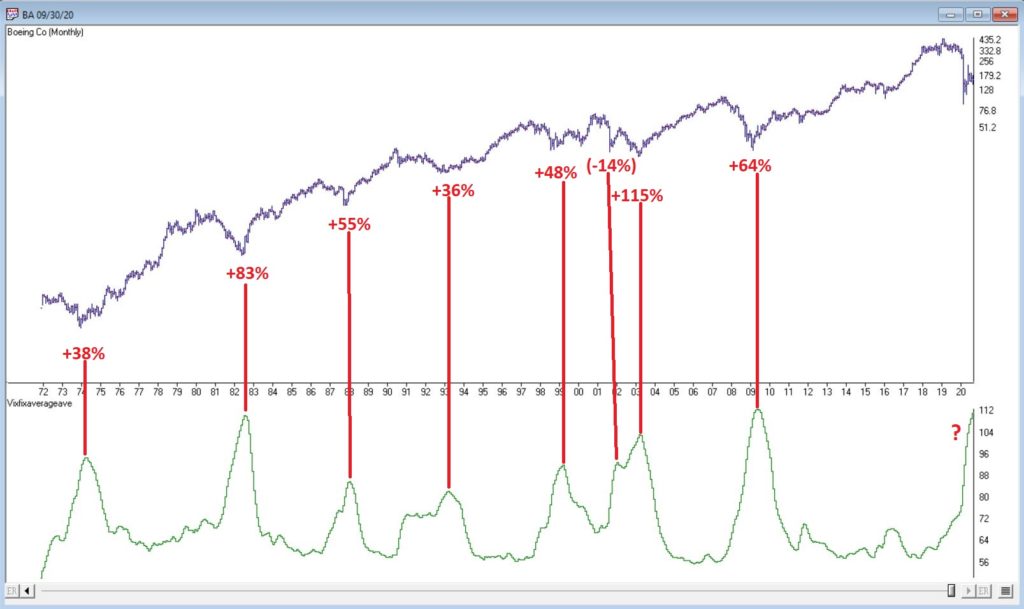
Figure 1 displays a monthly chart for Boeing (BA) with VFAA at the bottom. The numbers on the chart represent the hypothetical + (-) % achieved by applying the rules above (although once again, to be clear I am not necessarily suggesting anyone use it exactly this way).
From March 2019 into March 2020 BA declined -80%. It has since bounced around and VFAA has soared to 110.88. VFAA has yet to rollover on a month-end basis, so nothing to do here except exhibit – what’s that word again – oh right, “patience.”
Ticker GD
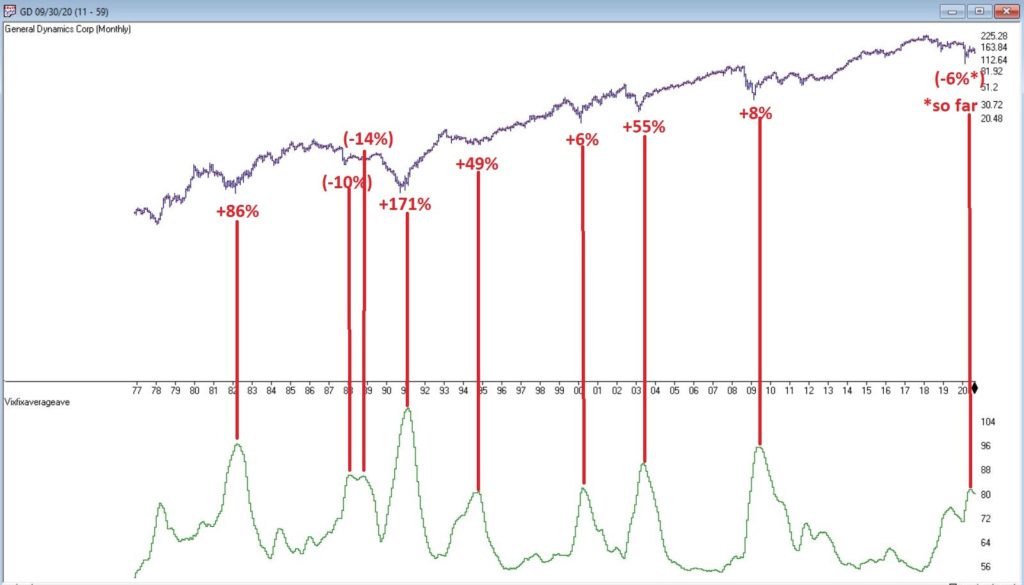
Figure 2 displays a monthly chart for General Dynamics (GD) with VFAA at the bottom.
Are these “world-beating numbers”? Not really. But in terms of helping to identify potential opportunities, not so bad. VFAA gave a “buy signal” for GD at the end of July. So far, not so good as the stock is down about -6%.
Ticker WFC
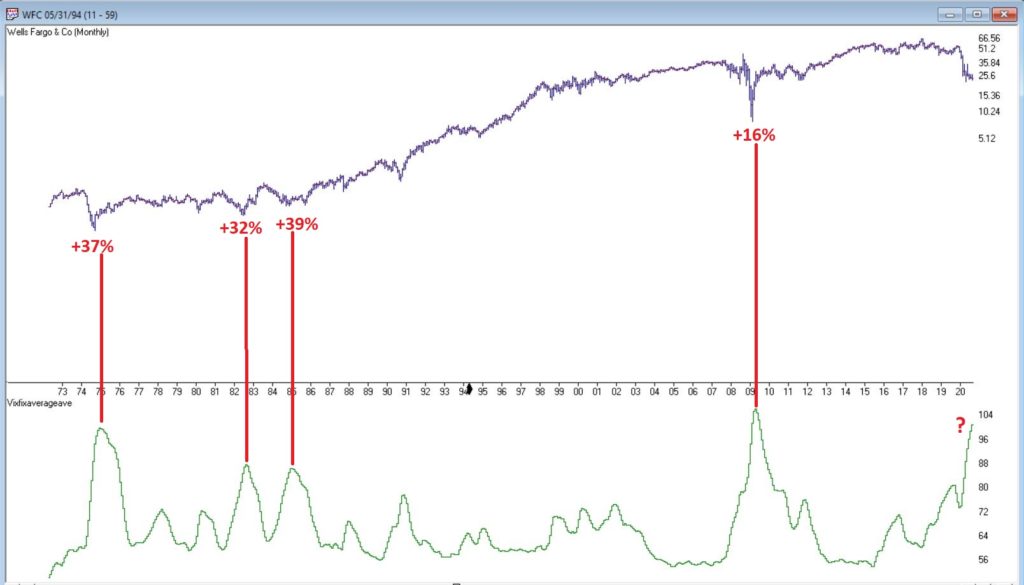
Figure 3 displays a monthly chart for Wells Fargo (WFC) with VFAA at the bottom.
There are not many “signals” but the ones that occurred have been useful. Between 2018 and 2020 WFC declined -65%. It has since bounced around and VFAA has soared to 102.44. VFAA has yet to rollover on a month-end basis. But at some point it will, and a potential opportunity may arise.
VFAA Formula
Below is the code for VFAA
VixFix is an indicator developed many years ago by Larry Williams which essentially compares the latest low to the highest close in the latest 22 periods (then divides the difference by the highest close in the latest 22 periods). I then multiply this result by 100 and add 50 to get VixFix.
*Next is a 3-period exponential average of VixFix
*Then VFAA is arrived at by calculating a 7-period exponential average of the previous result (essentially, we are “double-smoothing” VixFix)
Are we having fun yet? See code below:
hivalclose is hival([close],22).
vixfix is (((hivalclose-[low])/hivalclose)*100)+50.
vixfixaverage is Expavg(vixfix,3).
vixfixaverageave is Expavg(vixfixaverage,7).
VFAA = vixfixaverageave
EDITORS NOTE: The AIQ Expert Design Studio code for the indicator is available to download from here. Save this file to your /wintes32/EDS Strategies folder https://aiqeducation.com/VFAA.EDS
Summary
One thing to note is that VFAA “signals” on a monthly chart don’t come around very often. So, you can’t really sit around and wait for a signal to form on your “favorite company”. You have to look for opportunity wherever it might exist.
One last time let me reiterate that I am not suggesting using VFAA as a standalone systematic approach to investing. But when a signal does occur – especially when applied to quality companies that have recently been “whacked”, it can help to identify a potential opportunity.
Jay Kaeppel
Disclaimer: The information, opinions and ideas expressed herein are for informational and educational purposes only and are based on research conducted and presented solely by the author. The information presented represents the views of the author only and does not constitute a complete description of any investment service. In addition, nothing presented herein should be construed as investment advice, as an advertisement or offering of investment advisory services, or as an offer to sell or a solicitation to buy any security. The data presented herein were obtained from various third-party sources. While the data is believed to be reliable, no representation is made as to, and no responsibility, warranty or liability is accepted for the accuracy or completeness of such information. International investments are subject to additional risks such as currency fluctuations, political instability and the potential for illiquid markets. Past performance is no guarantee of future results. There is risk of loss in all trading. Back tested performance does not represent actual performance and should not be interpreted as an indication of such performance. Also, back tested performance results have certain inherent limitations and differs from actual performance because it is achieved with the benefit of hindsight.
I hope all of you had a nice summer. It was definitely different from what we are used too to say the least. Covid 19 has positively changed our lives and businesses in so many ways. With 6.7 million cases and 200,000 deaths reported the USA, businesses are doing business differently than we are accustomed too. To keep us safe we are using the phone, Zoom, DocuSign, the fax and scanning more than we ever did. In addition we are using online services more as well. This is definitely hurting much of the economy that relies on people going to the malls, restaurants, stores, and other “nonessential” businesses. Restaurants are coming back a little but not that much, and most business traffic is down significantly from one year ago. Resort, cruise ship, hotel and airline traffic are way down as well. But, the technology sector as people are using their home office and staying home playing games and online shopping is up tremendously. This will continue for as long as Covid 19 is present. As the hopes of a vaccine over the next 6 to 8 months become apparent the normal economy should strengthen and people will start to travel more, go to their offices and use all the services they did prior to Covid 19. It will take some time but when things go back to the norm, and there is a safe and effective vaccine that won’t give you other diseases I think most businesses will come back, but not all of them. Has the consumer changed during the Covid pandemic? Yes, their habits have changed and some businesses will go away and new ones will emerge. The idea to investing is to keep an eye on the new emerging businesses and possibly invest in those that could have long term trend on the upside.
This year more than two thirds of all S&P stocks are down for the year. That is why the Equal weighted S&P is down 5% for the year. The equal weighted S&P 500 means that every stock will have a 0.2% weighting as opposed to the tech stocks like Apple having a 6%+ weighting. That is why the S&P 500 is up 4.4%. It’s because stocks like Apple, Amazon and Microsoft going up so much this year and have skewed the indexes and have us believe that the market is doing better than it is. Tech is doing well and they represent the largest market value in the S&P 500 but most of the S&P stocks are down for the year.
CURRENT TRENDS:
We are now in the part of the year where seasonal weakness on the stock market happens. Between mid to late August and October the stock market, historically has been weak. It’s not guaranteed but my computer models went to Sell signals a week or so ago, and caution over the short term is now appropriate. This doesn’t mean to sell everything, no, maybe realign your allocation and sell some depending on your time, risk tolerance, and goals. The market between now and after the election could get more volatile. This Monday if the main indexes (S&P; Dow; NASDAQ) fall below the 50 day moving average I will have a much more negative outlook.
As you can see below the only thing that is up is the tech sector that’s in the NASDAQ, and the market weighted S&P for the most part. It’s all about technology that is used at home for business and leisure.
Some of the INDEXES of the markets both equities and interest rates are below. The source is Morningstar.com up until September 12, 2020.
Dow Jones -2.2% S&P 500 +4.4% EQUAL WEIGHTED S&P 500 –5.0% NASDAQ Aggressive growth +27% Large Cap Value -9.3% I Shares Russell 2000 ETF (IWM) Small cap -9.0% Midcap stock funds -9-11.-12% International Index (MSCI – EAFE ex USA -4.2% Financial stocks -18% Energy stocks -43% Healthcare Stocks +3.6% Moderate Mutual Fund Investment Grade Bonds (AAA) Long duration –3.56% High Yield Merrill Lynch High Yield Index -0.5% Floating Rate Bond Funds -1.9% Short Term Bond +1.6% Fixed Bond Yields (10 year) .67% Yield
Classicalprinicples.com and Robert Genetskis Excerpts:
Market Outlook
The correction in stock prices continued this past week as the NASDAQ and QQQs fell 5%. They are both down roughly 10% off their highs of just over a week ago. The Dow, S&P500, and small caps fell 2%-3% as the market continues to consolidate. On a positive note, the declines brought all major indexes back it the vicinity of their 50-day moving averages. The steep decline in the Nasdaq brought it back from an extremely overvalued position. The S&P500 is now fairly valued. There was no significant news moving the market. Rather, it appears the market got ahead of itself and is now back on track. While the market will do what it will do, I expect the most likely course will be a leveling off close to its current position. This is not a time for aggressive buying or selling, but a time to stay put.
A Look Back
This week’s Inflation numbers provided the only economic news. Consumer prices in August continued to rebound rising at a 4% rate for the third consecutive month. The year over year increases are still below 2%. Surprisingly, even though commodity prices rose sharply, wholesale prices of finished goods ticked down. Go figure. Unemployment news was mostly unchanged in the latest week. Initial claims for unemployment insurance were unchanged at 884,000 in the first week of September. This is just over a million fewer claims than in August. Unemployment insurance payments in August went to 14 million workers, 3 million less than in July. While the economy has recovered rapidly, there were still 14 million unemployed in August.
source: AIQ Systems
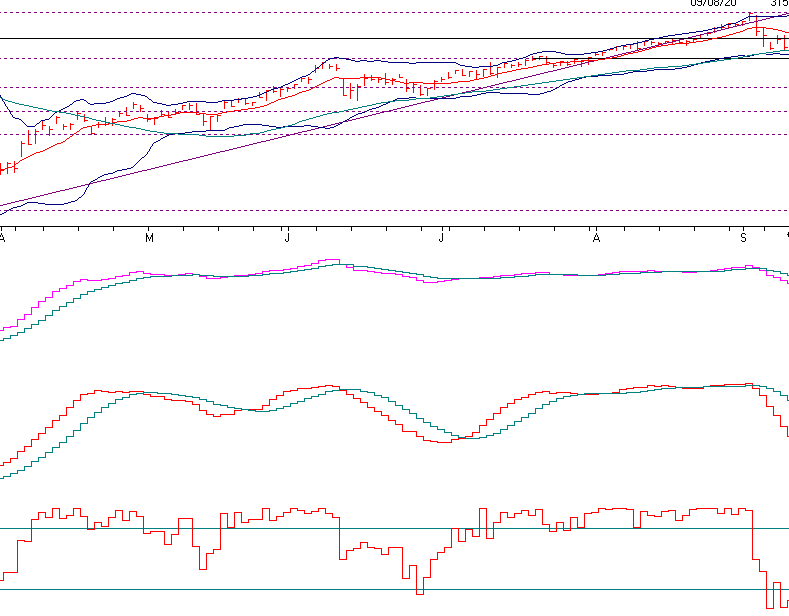
The S&P is above. This is the Market Weighted S&P about which we refer. Three things happened.
The S&P broke the upward trend line. This is negative
We are just above the 50 Day moving Average.
It is right at support of the breakout in July
What this means to me and this is not guaranteed is that if the S&P has a big down day and CLOSES below 3263 it would set us up for a longer decline and correction in the market, The NASDAQ closed below the 50 day moving average Friday. If the market doesn’t go up and stay up Monday or Tuesday then in my opinion there should be more downside. The MACD or momentum index has crossed below the signal Sell line. The SD-SD Stochastics has crossed below the signal line but the short term Stochastics has gone to a short term oversold level. So we could have a bounce right here.
I am very concerned about the crossing and closing below the 50 day moving average. So a decisive break and close below the 50 moving average is very important and not a good thing. We are not there yet.
This is the short term daily chart. This shows more short term volatility. Longer term the market still long okay and is still in an upward trend.
source: AIQ Systems
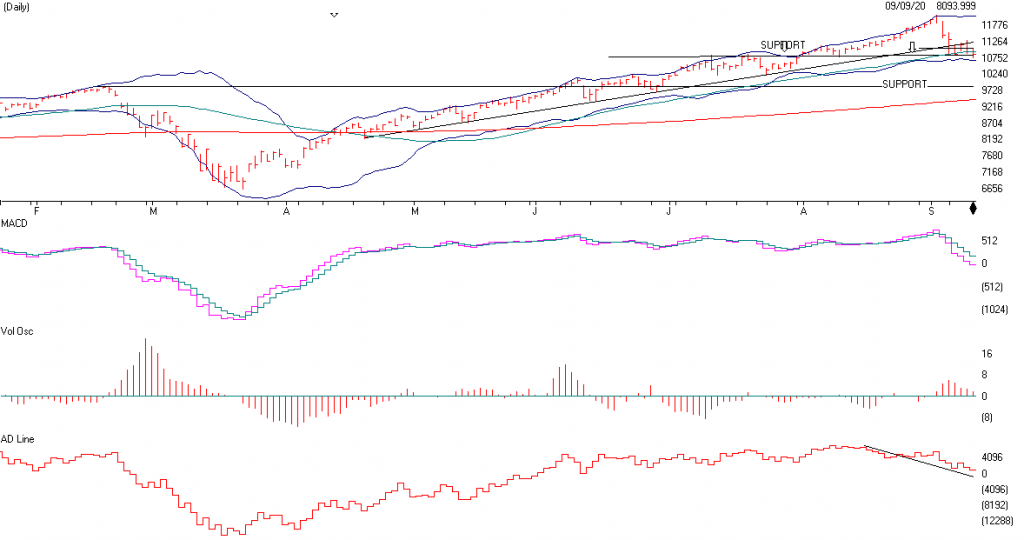
The NASDAQ and the tech stocks have been the big winner this year by a longer shot. With most stocks down for the year, the tech stocks like Apple, Microsoft, Amazon, Zoom and more have clearly been the big winners and leaving the other 905 of stocks in the dust. As you can see to the left, the NASDAQ is above the highs reached in February while the S&P and the Dow are below the highs in February. The NASDAQ is now of concern. Look to the left as you will see three things. I will point them out.
The Trend-line that started in April is now broken
The 50 Day moving Average was violated Friday. Negative
The NASDAQ better not break the SUPPORT level of 10822, and is only 30 points below. If it does, there is no SUPPORT until 9839 on the NASDAQ, then 9457, the 200 Day Moving Average.
Momentum has broken down as seen by the pink line dipping below the blue line. In addition Volume has picked up as the NASDAQ fell. Lastly, the Advance Decline Line has been negative while the NASDAQ has gone higher. See the NASDAQ go higher as most stocks have fallen? This is not a good sign and it shows that most stocks are going down while only a few large company stock are going higher.
I’m expecting a short term bounce here but the NASDAQ needs to stay above its 50 day moving average. In addition, the market is now in seasonal weakness. Going into October coupled with the upcoming election in November. This is not a time to get aggressive, but to take some stock or equity funds off the table.
The NASDAQ needs to stay above support and the 50 day moving average. If it doesn’t it should go lower.
Support levels on the S&P 500 area are 3321, 3101, 3054, and 2890.
These might be accumulation levels, especially 2649, or 2500. 2936 and 3015 are resistance.
Support levels on the NASDAQ are 10819, 10626, 9838 and 9419. Topping areas are 11,361 and 10000
On the Dow Jones support is at 27582, 27311, 26977 area and 26295. Then 24873.. Topping areas 28199 and 29211, these may be safer areas to get into the equity markets on support levels slowly on the accumulation areas.
THE BOTTOM LINE:
The market is up slightly over the last month. The tech sector that has been the stalwart is now cooling off and has broken and closed below its 50 day moving average and has also broken a 5 month trend-line. Further weakness in the NASDAQ and the S&P will happen unless the stock indexes go up on Monday and Tuesday and stay there. If this doesn’t happen quick then traders will start selling pushing this market lower. We are now in seasonal weakness for the stock markets between August and October. With the Election coming up in November more volatility should be at hand. If you are in or nearing retirement and your stock allocation is higher than normal for your goals you may want to rebalance or take a little off the table and reallocate to short term bonds or fixed accounts. I am still longer term Bullish on the market, but shorter term I am concerned about the stock market Trend-lines that are essential to hold. If they don’t hold, then there could be a setback to support the levels stated above. I still like the USA market better than the international one. When the vaccine actually shows promise the market should rebound.
Best to all of you,
Joe Bartosiewicz, CFP® Investment Advisor Representative 92 High Street Thomaston, CT 06787 860-940-7020
Charts provided by AIQ Systems:
Technical Analysis is based on a study of historical price movements and past trend patterns. There is no assurance that these market changes or trends can or will be duplicated shortly. It logically follows that historical precedent does not guarantee future results. Conclusions expressed in the Technical Analysis section are personal opinions: and may not be construed as recommendations to buy or sell anything.
Disclaimer: The views expressed are not necessarily the view of Sage Point Financial, Inc. and should not be interpreted directly or indirectly as an offer to buy or sell any securities mentioned herein. Securities and Advisory services offered through Sage Point Financial Inc., Member FINRA/SIPC, an SEC-registered investment advisor.
Past performance cannot guarantee future results. Investing involves risk, including the potential loss of principal. No investment strategy can guarantee a profit or protect against loss in periods of declining values. Please note that individual situations can vary. Therefore, the information presented in this letter should only be relied upon when coordinated with individual professional advice. *There is no guarantee that a diversified portfolio will outperform a non-diversified portfolio in any given market environment. No investment strategy, such as asset allocation, can guarantee a profit or protect against loss in periods of declining values.
It is our goal to help investors by identifying changing market conditions. However, investors should be aware that no investment advisor can accurately predict all of the changes that may occur in the market.
The price of commodities is subject to substantial price fluctuations of short periods and may be affected by unpredictable international monetary and political policies. The market for commodities is widely unregulated, and concentrated investing may lead to Sector investing may involve a greater degree of risk than investments with broader diversification.
Indexes cannot be invested indirectly, are unmanaged, and do not incur management fees, costs, and expenses.
Dow Jones Industrial Average: A weighted price average of 30 significant stocks traded on the New York Stock Exchange and the NASDAQ.
S&P 500: The S&P 500 is an unmanaged indexed comprised of 500 widely held securities considered to be representative of the stock market in general.
NASDAQ: the NASDAQ Composite Index is an unmanaged, market-weighted index of all over the counter common stocks traded on the National Association of Securities Dealers Automated Quotation System
(IWM) I Shares Russell 2000 ETF: Which tracks the Russell 2000 index: which measures the performance of the small capitalization sector of the U.S. equity market.
A Moderate Mutual Fund risk mutual has approximately 50-70% of its portfolio in different equities, from growth, income stocks, international and emerging markets stocks to 30-50% of its portfolio in different categories of bonds and cash. It seeks capital appreciation with a low to moderate level of current income.
The Merrill Lynch High Yield Master Index: A broad-based measure of the performance of non-investment grade US Bonds
MSCI EAFE: the MSCI EAFE Index (Morgan Stanley Capital International Europe, Australia, and Far East Index) is a widely recognized benchmark of non-US markets. It is an unmanaged index composed of a sample of companies’ representative of the market structure of 20 European and Pacific Basin countries and includes reinvestment of all dividends.
Investment grade bond index: The S&P 500 Investment-grade corporate bond index, a sub-index of the S&P 500 Bond Index, seeks to measure the performance of the US corporate debt issued by constituents in the S&P 500 with an investment-grade rating. The S&P 500 Bond index is designed to be a corporate-bond counterpart to the S&P 500, which is widely regarded as the best single gauge of large-cap US equities.
Floating Rate Bond Index is a rule-based, market-value weighted index engineered to measure the performance and characteristics of floating-rate coupon U.S. Treasuries, which have a maturity greater than 12 months.
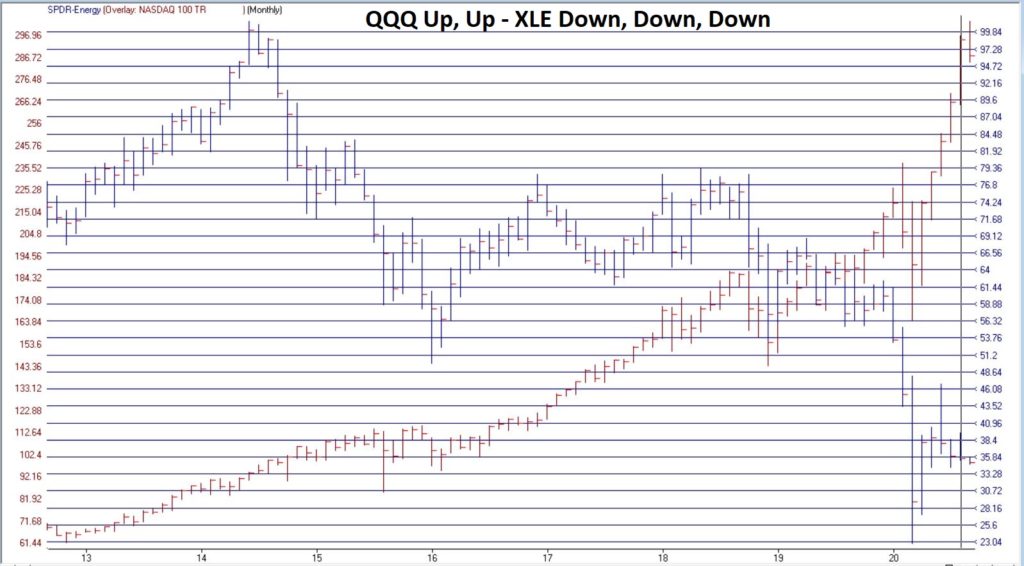
Everyone hates the energy sector (Foreshadowing alert: Well, almost everyone). And a quick perusal of Figure 1 clearly illustrates why the energy sector is unloved.
Since ticker XLE (Energy Select Sector SPDR ETF) topped out in 2014:
*XLE has lost -65%
*QQQ has gained +210%
And in another kick in the head to the energy sector, Exxon (ticker XOM) was just kicked out of the Dow Jones Industrial Average. Take that, losers!
So yeah, who wouldn’t hate energy stocks and decide to shun them? Well, as it turns out, the answer to that question of late is “the people who know the energy business the best.”
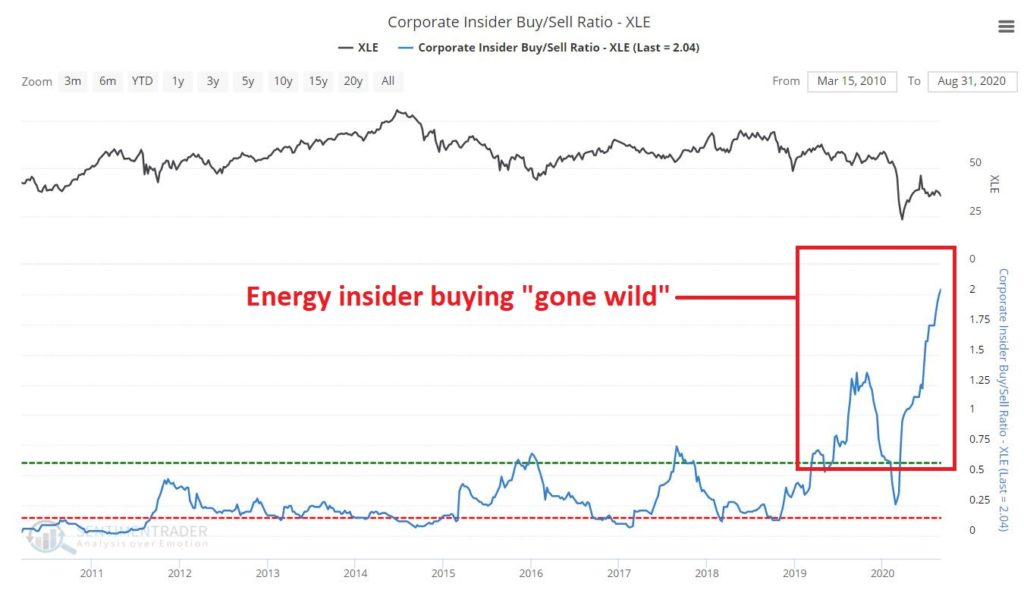
Figure 2 from www.Sentimentrader.com displays the Insider Buy/Sell ratio for executives and other muckety-mucks running energy related corporations. The picture speaks for itself.
As you can see, energy corporate insiders have been on a massive buying binge of late. Interestingly, they went on a buying binge in 2019 – apparently expecting an improvement in the sector – then the sector got waylaid by Covid-19. Instead of bailing out the insiders really kicked their share buying into overdrive as you can see at the far right of Figure 2.
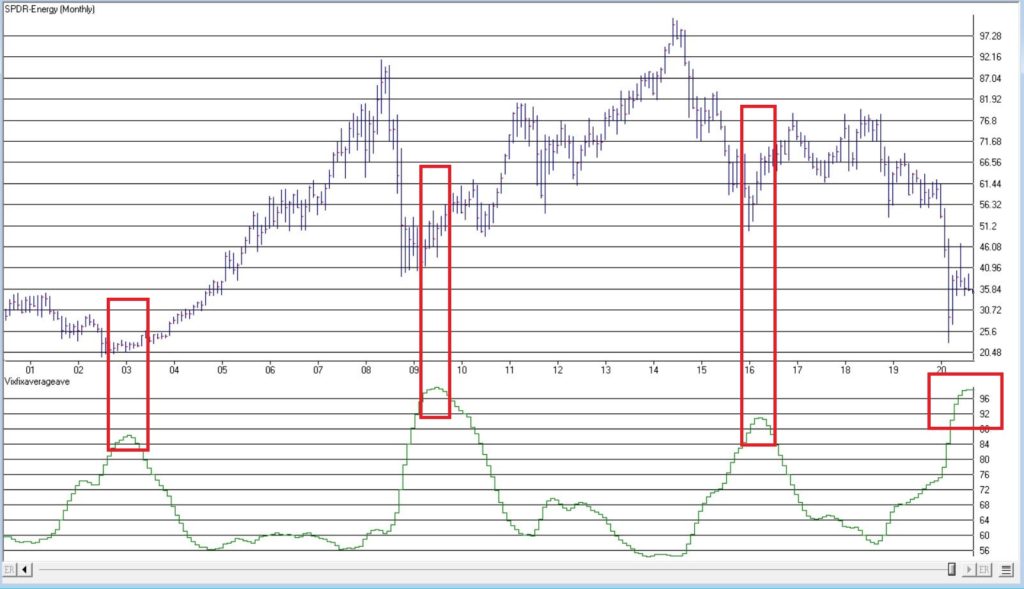
Figure 3 displays ticker XLE with an indicator that I developed by simply smoothing Larry Williams VixFix indicator. The gist of the idea, is that when this indicator reaches an extreme high level and then turns down, it often highlights a “washed out” situation which may be followed by a bullish move. Ticker XLE is presently nearing that point.
EDITTORS NOTE: VixFix smoothed indicator code sections can be copied and pasted into AIQ EDS or you can download the indicator code in an EDS file from here and save it to your /wintes32/EDS Strategies folder.
This indicator is based on another indicator called VixFix which was developed many years ago by Larry Williams.
hivalclose is hival([close],22). <<<<<The high closing price in that last 22 periods
vixfix is (((hivalclose-[low])/hivalclose)*100)+50. <<<(highest closing price in last 22 periods minus current period low) divided by highest closing price in last 22 periods (then multiplied by 100 and 50 added to arrive at vixfix value)
vixfixaverage is Expavg(vixfix,3). <<< 3-period exponential average of vixfix
vixfixaverageave is Expavg(vixfixaverage,7). <<<7-period exponential average of vixfixaverage
Should savvy investors follow the insider’s lead and start piling into the energy sector? Unfortunately, hindsight is the only way to know for sure. But for what it is worth, my own answer is “probably, but maybe not just yet.”
Energy Seasonality
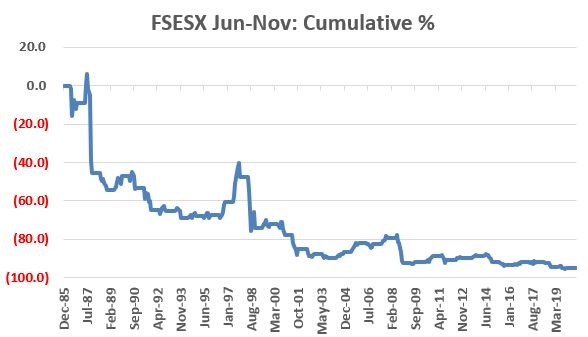
The primary reason for hesitation at this exact moment in time is seasonality. Let’s use ticker FSESX (Fidelity Select Sector Energy Services) as a proxy for the broader energy index. This fund’s first full month of trading was January 1986. Figure 4 displays the cumulative total return for ticker FSESX ONLY during the months of June through November every year since 1986.
Figure 4 – FSESX cumulative % return June through October (1986-2020)
The cumulative total return during these months for holders of FSESX during June through November is -94.7%(!!!) So, you see my hesitation with “piling in”.
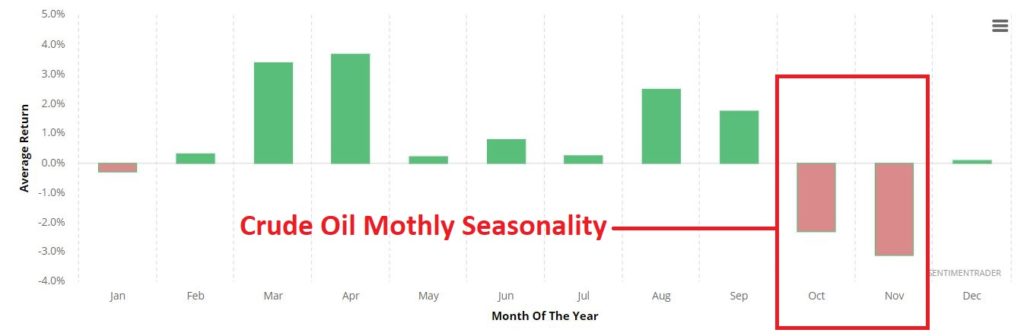
Additionally – climate change concerns aside – much of the energy industry still revolves around crude oil. Figure 4 displays the annual seasonal trend by month for crude oil.
Seasonal trends can vary widely from year-to-year, and there is NO guarantee that trouble lies ahead in Sep-Oct-Nov for the energy sector.
But that is what history suggests.
Summary
The bottom line is this:
*Energy sector corporate insider buying should be seen as a bullish longer-term sign for the sector
*The energy sector is so beaten down, battered and unloved that it probably accurate to refer to the situation as “Blood in the Streets”
Based on these factors I look for energy to surprise investors in the years ahead. That being said:
*Trying to pick the exact bottom in anything is typically a fool’s errand
*Getting bullish on the energy sector in early September is at times fraught with peril.
Sometime around December 1st it will be time to take a close look at the energy sector. If an actual uptrend develops or has already developed, the time may be write for investors to join the insiders.
Jay Kaeppel
Disclaimer: The information, opinions and ideas expressed herein are for informational and educational purposes only and are based on research conducted and presented solely by the author. The information presented represents the views of the author only and does not constitute a complete description of any investment service. In addition, nothing presented herein should be construed as investment advice, as an advertisement or offering of investment advisory services, or as an offer to sell or a solicitation to buy any security. The data presented herein were obtained from various third-party sources. While the data is believed to be reliable, no representation is made as to, and no responsibility, warranty or liability is accepted for the accuracy or completeness of such information. International investments are subject to additional risks such as currency fluctuations, political instability and the potential for illiquid markets. Past performance is no guarantee of future results. There is risk of loss in all trading. Back tested performance does not represent actual performance and should not be interpreted as an indication of such performance. Also, back tested performance results have certain inherent limitations and differs from actual performance because it is achieved with the benefit of hindsight.