Category Archives: seasonal

Seasonal Bonds Strategy using TMF

Recently Jay Kaeppel of Jay On The Markets posted an update on the Seasonal Bonds Strategy using TMF. The gist of the strategy is straightforward,  “Long TMF on the last 5 day of each month” 

I’ve posted the article below. 

Here’s a seasonal chart of the last 3 years with the average of the 3 years (black line). I colored the last 5 trading days of the average line in yellow to see what Jay was referring to. 8 of the 12 months were positive, 2 flat and 2 negative. Looks pretty good. At the bottom of the page you can see the returns this strategy yields.

BTW this Chart type, known as a seasonality chart will be included in the next AIQ TradingExpert Pro release this fall (OK marketing bit over) 


On 3/15/15 I wrote about an even more aggressive strategy using triple-leveraged ticker TMF that tracks long-term t-bonds using leverage of 3-to-1.
So of course the bond market rewarded my “brilliance” with a swift kick in the you know where in the months of March and April 2015 and especially in August 2015.
This would typically be enough to cause many people to go, “Well that guy’s and idiot” and to move on.  But fortunately in this case, the market is a marathon and not a sprint.
Update
Figure 1 displays the results generated by:
*Holding long 1 t-bond futures contract ONLY for the last 5 days of each month since 12/30/1983
*Holding long 1 t-bond futures contract during all other days since 12/30/19831
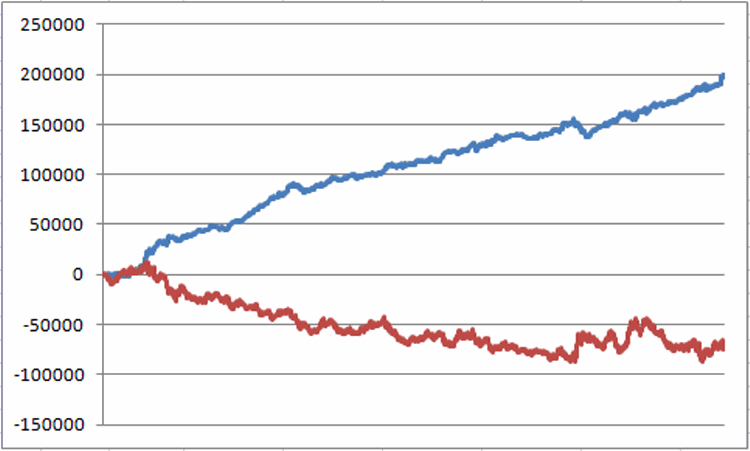
Figure 1 – Long 1 t-bond futures contract ONLY during last 5 trading days of month (blue) versus long 1 t-bond futures contract on all other days  (red); 12/31/1983-8/12/2016
The results sort of speak for themselves.
After I wrote about my aggressive TMF strategy, TMF (of course) got hit very hard (as triple leveraged ETFs will do from time to time, hence the use of the words “aggressive” and “risky”), in March 2015 (-4.5%), April 2015 (-5.3%) and especially in August 2015 (-11.5%).
Still, as you can see in Figure 2, things have rebounded nicely since (hmmm, maybe I should be worried).2
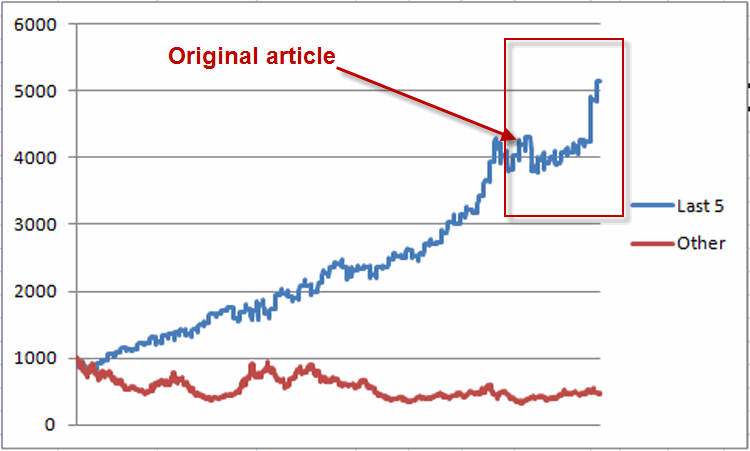
Figure 2– Growth of $1,000 Long ETF ticker TMF ONLY during last 5 trading days of month (blue) versus long TMF all other days; (red); 12/9/2009-8/12/2016
So far the “Long TMF on the last 5 day of each month” strategy is up +31.8% for the year in 2016.
Year Last 5 TDM Long TMF
2009* +12.9%
2010 +33.4%
2011 +15.2%
2012 +35.7%
2013 +6.7%
2014 +45.7%
2015 +6.8%
2016** +31.8%
*-Starting 4/16/2009 when TMF started trading
**-Through 8/12/2016
Summary
So did this odd little strategy “weather the storm” and “take the market’s best shot” in 2015 and now it is “smooth sailing”?  Probably not.  Make no mistake – this is a strategy that entails a great deal of risk.  Still, for aggressive traders looking for an “edge”, it might be worth a closer look.
Jay Kaeppel
The 3 Days of the Month to Avoid

Some days are just better than others – am I right or am I right?  As a corollary, some days are worse than others.  Wouldn’t it be nice to know in advance which days were going to be which?

Well, when it comes to the stock market, maybe you can.

The 3 Days to Miss

For our purposes we will refer to the very last trading day of the month as TDM -1.  The day before that will be TDM -2, the one before that TDM -3, etc.  Now let’s focus specifically on TDMs -7, -6 and -5.

Let’s now assume that we will buy and hold the Dow Jones Industrials Average every day of every month EXCEPT for those three days – i.e., we will sell at the close of TDM -8 every single month and buy back in 3 days later.  We will refer to this as Jay’s -765 Method.  Granted some may not be comfortable trading this often, but before dismissing the idea please consider the results.

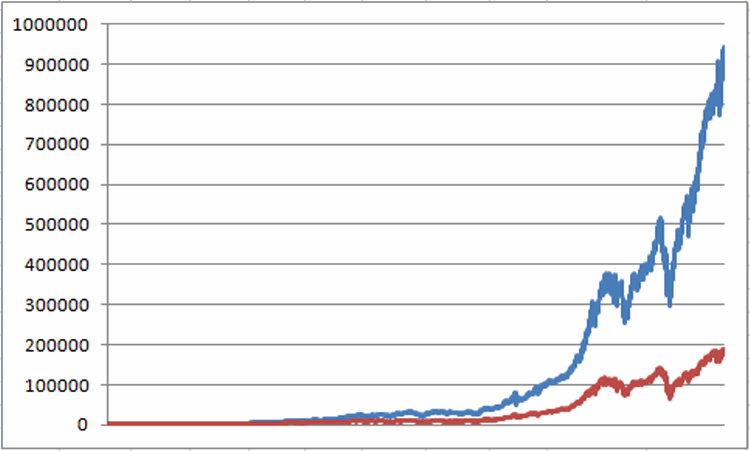
Figure 1 displays the growth of $1,000 invested in the Dow as described above versus the growth of $1,000 from buying and holding the Dow.

*The starting date for this test is 12/1/1933.
*For this test no interest is assumed on the 3 days a month spent out of the market.
1

Figure 1 – Growth of $1,000 invested in Dow Industrials during all days EXCEPT TDM -7,TDM -6 and TDM -5 (blue line) versus $1,000 invested in Dow Industrials using buy-and-hold (red line); 12/1/1933-8/15/2016

For the record:
*Jay’s -765 Method gained +94,190%
*The Dow buy-and-hold gained +18,745%

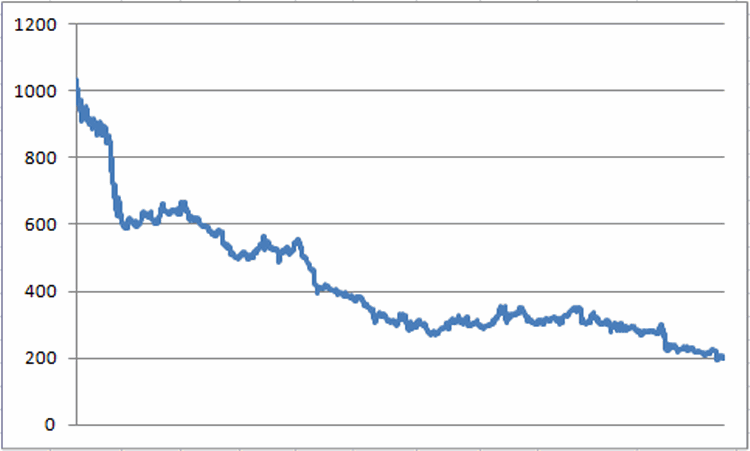
While these results are compelling, the real “Wow” comes from looking at would have happened if you had been long the Dow ONLY on TDMs -7,-6 and -5 every month since 1933.  These results appear in Figure 2 (but you’d better brace yourself before taking a glance).
2

Figure 2 – Growth of $1,000 invested in the Dow ONLY on the 7th to last, 6th to last and 5th to last trading days of every month since 12/1/1933

The net result is an almost unrelenting 83 year decline of -80%.

Summary

I would guess that some readers would like me to offer a detailed and logical reason as to why this works.  Unfortunately, I will have to go with my stock answer of “It beats me.”  Of course, as a proud graduate of “The School of Whatever Works” (Team Cheer: “Whatever!”) I am not as interested in the “Why” of things as I am the “How Much.”

Sorry, it’s just my nature.

Jay Kaeppel
Chief Market Analyst at JayOnTheMarkets.com and AIQ TradingExpert Pro (http://www.aiqsystems.com) client

August/September – Play it Safe or Swing for the Fences?

We are entering an “interesting” time of year for investors (Unfortunately, that’s “Interesting” as in the ancient Chinese curse stating “May you live in interesting times”).
Now I personally I have no idea if the stock market is going to break out to the upside and rally to further new highs or if this latest lull will be followed by a painful reversal of fortune.  I am willing to play the long side as long as things are holding up/moving in the right direction.  But investors should be aware that the August/September timeframe is the “Danger Zone” for the stock market historically.
August/September Historically
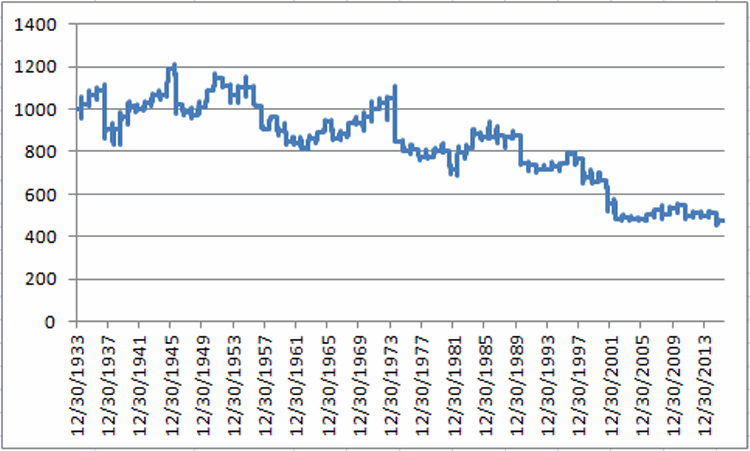
Figure 1 speaks for itself.  The chart displays the growth of $1000 invested in the Dow Jones Industrials Average only during the months of August and September every year starting in1934.
1
Figure 1 – Growth of $1,000 invested in Dow Jones Industrials Average (using price data only) ONLY during August and September; 12/31/1933-present
Two key takeaways:
*The net result has been a loss of -53% or the past 82 year.  Not exactly the kind of returns most of us are looking for.
HOWEVER
*Despite the negative net results, the fact is that the Aug/Sep period has showed a gain more often (45 times) than not (37 times).
So while caution appears to be in order, no one should assume that the next two months are doomed to show a loss.
Stocks versus Bonds
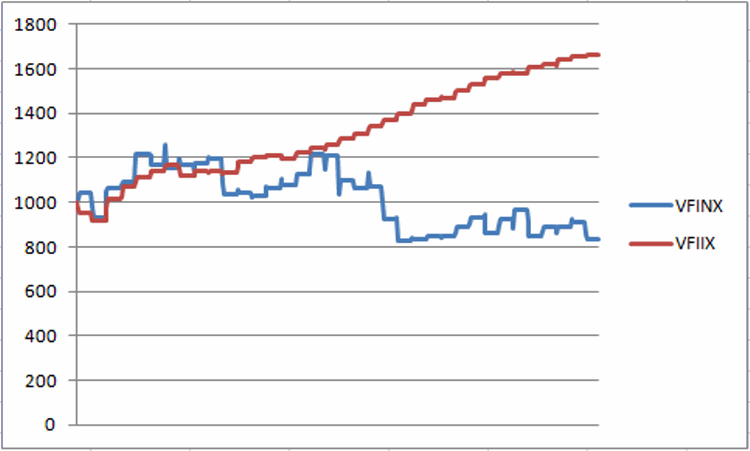
Figure 2 compares the performance of:
Ticker VFINX – Vanguard S&P 500 Index fund
*Ticker VFIIX – Vanguard Mortgage Bond Fund
(*VFIIX is used as a proxy for intermediate-term treasuries as it has a high correlation to IT treasuries and a longer data history.  Any short-to-intermediate term treasury fund or ETF would likely produce similar results)
The test starts in 1980 (when VFIIX started trading) and shows the total return for buying and holding each fund ONLY during the months of August and September each year since.
2
Figure 2 – Growth of $1,000 invested in VFINX (stocks; blue line) versus VFIIX (bonds; red line); August 1980 to present
Summary
So what will it be this year?  A breakout to new highs?  Or something much worse?  I wish I could tell you the answer.  But at least now you have some information to help guide your “speculative” versus “conservative” instincts in the months ahead.
Jay Kaeppel
Chief Market Analyst at JayOnTheMarkets.com and AIQ TradingExpert Pro (http://www.aiqsystems.com) client

The World is Your Oyster – 4 Days a Month

Some things are just plain hard to explain.  I did the following test using all 17 of the iShares single country funds that started trading 1996:
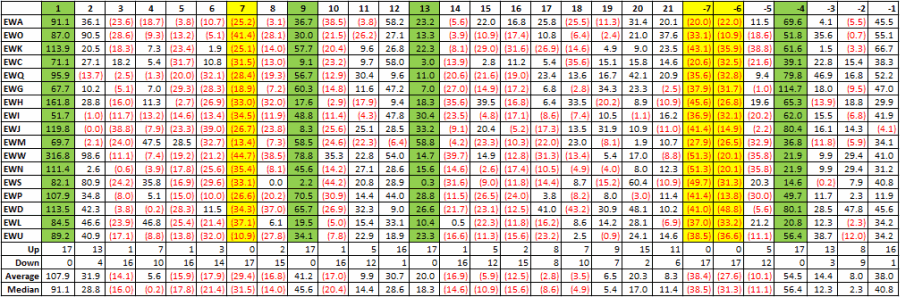
I tested the performance of each single country ETF on each specific trading day of the month (i.e., the 1st trading day of any month is TDM 1, the next day is TDM 2, etc.)
I also examined the last 7 trading days of the month counting backwards (i.e., the last trading day of the month is TDM -1, the day before that is TDM -2, etc.)
The basic idea was to see if there were any consistently favorable or unfavorable days of the month.  I wasn’t necessarily expecting much given that the stock markets of each of 17 different countries could  rightly be expected to “walk to the beat of their own drum”, given that the fundamentals underlying the stock market in any given country may be unique from that of other countries.
Or maybe not so much.
For what it is worth, the results from 3/25/1996 through 6/20/2016 appear in Figure 1.
(click to enlarge)
1
Figure 1 – Trading Day of Month Results for 17 iShares single country ETFs; 3/25/96 through 6/20/16
Each column displays the cumulative % return for each individual single country ETF if we held a long position in that ETF on only that particular trading day of the month.
As you can see – and what are the odds of this, I am not even sure how to calculate that – there are 4 days (highlighted in green in Figure 1) that were uniformly “favorable”, i.e., all 17 ETFs showed a net gain on that particular trading day of the month (for the record, there are three trading days – TDM #7 and TDMs -7 and -6 – during which all  17 ETFs showed a net loss (highlighted in yellow in Figure 1.  Go figure).
Using as a Strategy
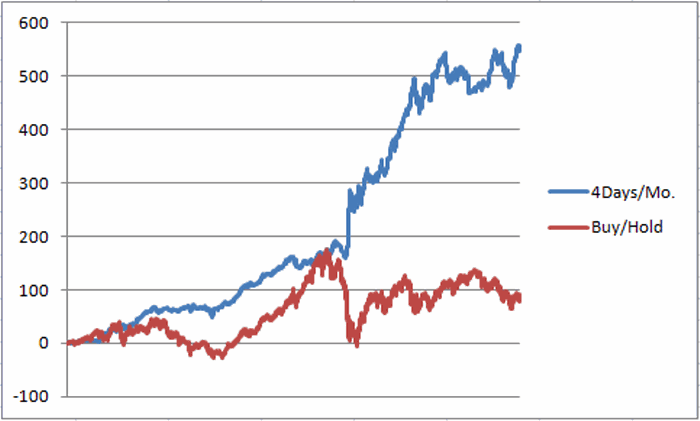
I am not recommended the following strategy, but wanted to test it out for arguments sake.  Figure 2 displays the results of the following test:
*Buy and hold an equally weighted position in all 17 single country ETFs only on TDM 1, 9, 13 and -4 (i.e., if Friday is the last trading day of the month then – barring a holiday – TDM -4 would be the Tuesday of that week), earn annualized interest of 1% per month while out of ETFs.
*Versus simply buying and holding all 17 single country ETFs from 3/25/1996 through 6/20/2016.
2
Figure 2 – Cumulative % return for holding all 17 single country ETF only 4 days a month (blue) versus buying and holding (red); 3/25/96 through 6/20/16
Summary
Yes, this model can probably be accused of being “curve fit”.  Also, does anybody really want to trade in and out of 17 single country ETFs 4 times a month?  I don’t know.  But the bigger points are:
*Why would all 17 single country ETFs all be up (or down) on a particular day of the month over a 20 year period?
*If I were considering buying and holding a cross section of individual country ETF’s, um, well, I can’t help but think that I would be haunted by the thought that there might be a better way.
Jay Kaeppel
Chief Market Analyst at JayOnTheMarkets.com and AIQ TradingExpert Pro (http://www.aiqsystems.com) client

Beware the Middle of May

The beginning of the month of May and the end of the month of May into early June have overall been a decent time to be in the stock market.  The middle of May, typically not so much.
For our purposes we will split May (into June) into three segments:
*Segment 1: The first 3 trading days of May (Bullish)
*Segment 2: May trading days #4 through #16 (Bearish)
*Segment 3: May trading day #17 through the 5th trading day of June
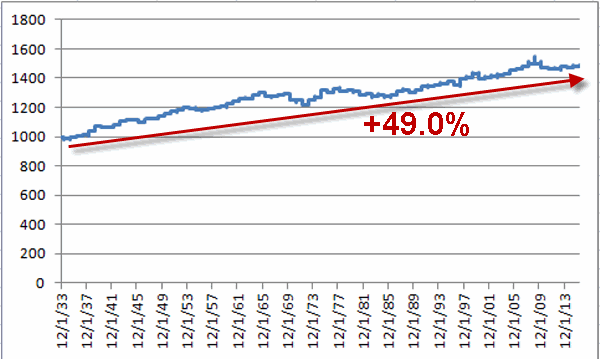
Figure 1 displays the growth of $1,000 invested in the Dow Jones Industrials Average only during the first three trading days of May since 1934.
1
Figure 1 – Growth of $1,000 invested in Dow Industrials during 1st three trading days of May (1934-present)
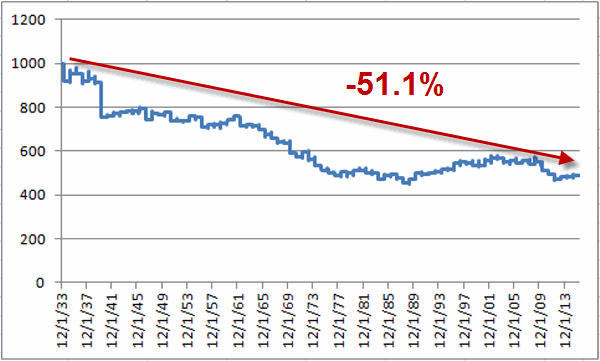
Figure 2 displays the growth of $1,000 invested in the Dow Jones Industrials Average only during trading days 4 through 16 of May since 1934.
2
Figure 2 – Growth of $1,000 invested in Dow Industrials during trading days 4 through 16 of May (1934-present)
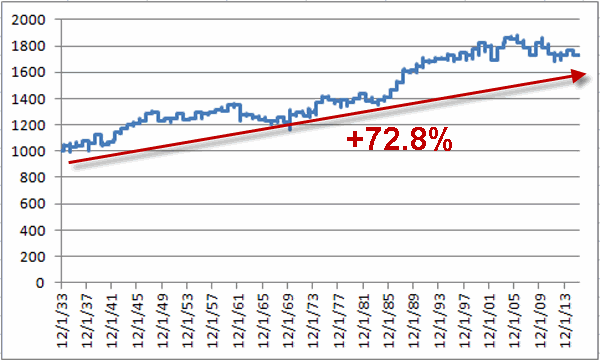
Figure 3 displays the growth of $1,000 invested in the Dow Jones Industrials Average only from the close of May trading day #16 and the close of the 5th trading day of June.
3
Figure 3 – Growth of $1,000 invested in Dow Industrials during trading days #17 and higher during May and the 1st five trading days of June  (1934-present)
Combining and Comparing
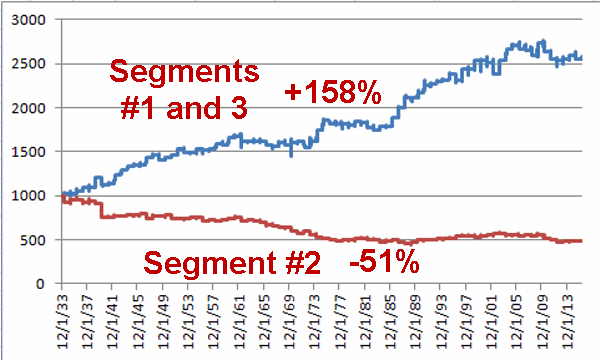
In Figure 4 the blue line displays the growth of $1,000 invested in the Dow only during Segment #1 and Segment #3.  The red line displays the growth of $1,000 invested in the Dow only during Segment #2.
4
Figure 4 – Growth of $1,000 during Segments 1 and 3 (blue) versus Segment 2 (red)
*During Segments #1 and #3 the Dow gained +157.5%
*During Segment #2 the Dow lost -51.1%
During 2016:
*Segment #1 extends from the close on 4/29/16 through the close on 5/4/16
*Segment #2 extends from the close on 5/4/16 through the close on 5/23/16
*Segment #3 extends from the close on 5/23/16 through the close on 6/7/16
Summary
So is the Dow sure to gain ground during Segments #1 and 3 and to lose ground during Segment #2?  Not at all.  For the record:
*Segments 1 and 3 combined have gained an average of +1.2% with 65% of years showing a gain and 35% showing a loss
*Segments 2 has lost an average of (-0.8%) with 49% of years showing a gain and 51% showing a loss
So clearly there are no “sure things” being unveiled here.  Still, if the early days of May see the stock market register a meaningful gain it might make sense to avoid jumping on to the band wagon.
At least for another 13 trading days.….
Jay Kaeppel
Chief Market Analyst at JayOnTheMarkets.com and AIQ TradingExpert Pro (http://www.aiq.com) client