Att få sina vinster utbetalda är en avgörande aspekt av spelupplevelsen på bettingsidor. Många spelare undrar över utbetalningstider och vad som påverkar snabbheten i denna process. Faktorer som beroende av betalmetod samt specifika uttagsvillkor kan variera betydligt mellan olika aktörer, vilket kan leda till olika verifikationstider för användarna.
Det är viktigt att ha en klar förståelse för eventuella kostnader som kan uppstå vid uttag. Spelare bör vara medvetna om feedback från spelare och användartester för att navigera rätt i valet av bettingsidor. Genom att jämföra olika alternativ kan man upptäcka vilka plattformar som erbjuder bäst snabbhet hos bettingsidor.
En annan aspekt att beakta är förseningar som kan inträffa under bearbetningen av uttag. Att förstå dessa hinder kan hjälpa spelare att få en bättre insikt i vad de kan förvänta sig när det kommer till sina utbetalningar. För mer information om plattformar som erbjuder snabba och effektiva uttag utan svensk licens, besök bettingsidor utan licens i sverige.
Olika metoder för uttag och deras tidsramar
Att förstå de olika metoder för uttag är avgörande för alla som deltar i spel och vadslagning. Varje metod kommer med sina egna utbetalningstider och eventuella kostnader, vilket påverkar hur snabbt medel kan nå spelare.
Banköverföringar är traditionella och pålitliga, men de kan medföra förseningar på flera dagar beroende på bankernas verifikationstider. Många användare rapporterar att denna metod, trots sin säkerhet, ibland kan vara frustrerande långsam.
Å andra sidan erbjuder e-plånböcker, som PayPal och Skrill, betydligt snabbare utbetalningstider. Spelare kan ofta se sina medel inom några timmar, vilket gör dessa alternativ populära för dem som vill ha omedelbar åtkomst.
När det kommer till uttagsvillkor, kan regler variera. Det är viktigt att läsa igenom villkoren för varje metod noga, eftersom de kan innehålla specifika krav som spelaren måste uppfylla innan en utbetalning kan genomföras.
Feedback från spelare är en annan viktig aspekt att överväga. Många användartester har visat att snabbheten för uttag är en stor faktor för nöjdhet och kan påverka spelarnas framtida val i plattformar.
Cryptovalutor har blivit en alternativ lösning med snabba transaktionstider och låga avgifter. Dock kan även här beroende av betalmetod påverka hur snabbt medel förs över, om plattformen som används stöder detta.
Både spelare och plattformar bör vara medvetna om de potentiella kostnaderna som kan uppstå. Vissa metoder kan innebära avgifter som kan minska det belopp som faktiskt mottas av spelaren, vilket är en viktig faktor att beakta.
Sammanfattningsvis är valet av metod för uttag avgörande för hur snabbt spelare kan få sina vinster. Genom att utbilda sig om de olika alternativen och deras specifika tidpunkter kan spelare optimera sin upplevelse och undvika onödiga förseningar.
Faktorer som påverkar uttagstiden
Det finns flera aspekter som avgör hastigheten hos bettingsidor när det kommer till utbetalningstider. En viktig faktor är de metoder för uttag som erbjuds. Vissa betalningsalternativ, såsom elektroniska plånböcker, är kända för att ge snabba transaktioner, medan banköverföringar kan ta längre tid. Dessutom spelar verifikationstider en avgörande roll; om spelaren har slutfört nödvändig identitetskontroll kan det snabba på processen. Behandlingstiden för uttag varierar också beroende på webbplatsens rutiner och kan påverkas av användartester samt feedback från spelare.
Eventuella kostnader knutna till uttag bör också beaktas, eftersom dessa kan påverka valet av metod och därmed uttagsvillkor. Att förstå de specifika regler och tidsramar som gäller för olika alternativ är avgörande för att få en smidig upplevelse. En del spelare kan uppleva längre tider beroende på betalningsmetod, så det är bra att vara väl informerad innan man gör sitt val.
Optimera utbetalningar för bästa resultat
Att få sina vinster snabbare handlar inte bara om tur. Många faktorer influera utbetalningstider, och en grundlig förståelse av uttagsvillkor och verifikationstider är avgörande. När man väljer en bettingsida, är det nödvändigt att granska användartester för att se hur pålitliga och snabba betalmetoder är. Med vissa metoder kan det finnas eventuella kostnader som påverkar den slutgiltiga summan som når användaren.
Olika betalmetoder erbjuder olika hastigheter för uttag, och det är viktigt att beakta hur snabbt en metod faktiskt gör utbetalningar. Det är möjligt att uppleva förseningar beroende av betalmetod, så att välja alternativ med kortare fördröjningar kan ge större fördelar. Både traditionella bankalternativ och digitala plånböcker kan skilja sig avsevärt när det kommer till snabbhet.
Betalmetod
Uttagstid
Eventuella kostnader
Banköverföring
3-5 arbetsdagar
0-100 SEK
Kreditkort
1-3 arbetsdagar
0 SEK
Digital plånbok
0-24 timmar
0 SEK
Vanliga frågor och svar om uttagstider
Uttagsvillkor varierar kraftigt beroende på olika faktorer, inklusive metoder för uttag och verifikationstider. Många spelare ifrågasätter snabbheten hos bettingsidor, särskilt när feedback från spelare ofta handlar om eventuella förseningar. Det är viktigt att förstå hur olika betallösningar kan påverka din utbetalningstid, så att du kan välja en metod som passar dina behov.
Uttagsmetoder: En del bettingsidor erbjuder överföringar via bank, medan andra stödjer e-plånböcker och kryptovalutor. Varje metod har sina egna fördelar och nackdelar gällande hastighet och kostnader.
Användartester: Resultat från tester visar att vissa metoder är snabbare än andra, vilket kan vara avgörande för spelare som söker snabba uttag.
För att undvika missförstånd kring uttagstider är det bästa att läsa igenom villkoren innan du gör en insättning. Information om eventuella kostnader och förväntade tidsramar för utbetalning är ofta dokumenterad klart på hemsidan, vilket kan bespara tid och frustration senare.
– Frågor och svar:
Hur snabbt kan jag förvänta mig mina uttag efter att jag gjort en begäran?
Tiden det tar att få dina uttag beror på vilken metod du använder. Generellt sett kan banköverföringar ta mellan 3 till 5 arbetsdagar, medan uttag via e-plånböcker ofta behandlas inom några timmar.
Vilka faktorer påverkar uttagets hastighet?
Uttagets hastighet kan påverkas av flera faktorer, såsom den valda uttagsmetoden, eventuell verifiering av din identitet, och hur snabbt casinot eller plattformen hanterar begäran. Det är alltid bra att kolla casinots regler för specifika tider.
Vad kan jag göra för att snabba på min uttagsprocess?
För att snabba på uttagsprocessen bör du säkerställa att ditt konto är korrekt verifierat. Använd gärna en snabb uttagsmetod som e-plånböcker för att få din vinst snabbare.
Är det några specifika dagar då uttag kan ta längre tid?
Ja, uttag kan ta längre tid under helger eller helgdagar, eftersom banker ofta har begränsade öppettider. Det är också värt att notera att vissa casinon kan ha dagar i veckan där de behandlar uttag mer effektivt än andra.
Vad händer om mitt uttag tar längre tid än vanligt?
Om ditt uttag tar längre tid än vad som anges av casinot bör du kontakta deras kundtjänst. De kan ge dig information om eventuella förseningar och hjälpa till att lösa eventuella problem.
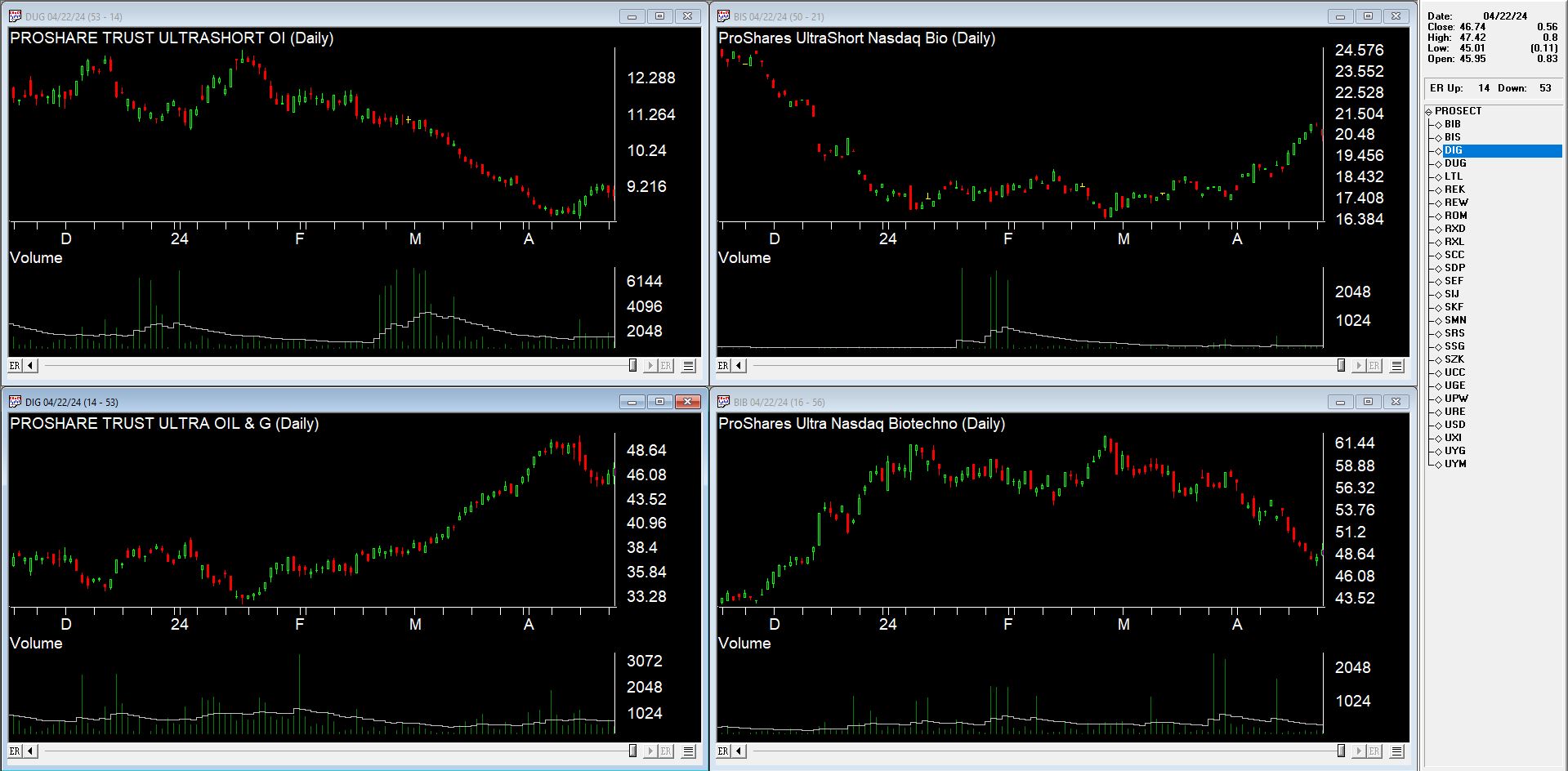
There are many ETF families in the market today, and of course, the oldest and most popular ETF, SPY has been around since 1993. Ultra ProShares Exchange Traded Funds (ETFs) developed by Profunds and traded on the AMEX. are one of the most actively traded areas of the markets. With $billions pouring into the UltraShort QQQ ETF, QID, it’s evident that it’s become one of the most actively traded ETFs globally.
Whether you’re a trader or investor, these Ultra ETFs serve as valuable tools capable of enhancing returns while mitigating risks.
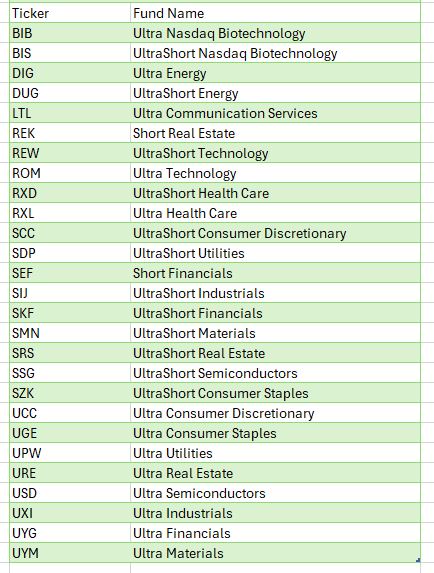
Ultra bullish and UltraShort ETFs on broad market indices expanded some years ago to include leveraged bullish and bearish Sector and International ETFs. These additions enable investors to hedge or amplify sector exposure effortlessly. Moreover, these Ultra and UltraShort ETFs are compatible with IRAs or retirement accounts, where shorting or margin trading is typically restricted.
From a trader’s perspective, the liquidity and leverage of Ultra Bullish and UltraShort ETFs, which move two times the underlying index or inversely track it, offer a simpler and less risky alternative to options, futures, or shorting stocks.
For day traders, the highly liquid QQQ ETFs, QLD and QID, along with S&P500 ETFs, SDS and SSO, have become favored vehicles. The volatility of these ETFs presents opportunities for swift gains.
For investors and portfolio managers, ProShares ETFs offer a plethora of risk management tactics and asset allocation strategies. They provide flexibility to hedge against market risk or capitalize on market fluctuations. Furthermore, leveraging Ultra ETFs in asset allocation frees up capital for further diversification, allowing for strategic positioning across various sectors and markets. Sectors, in particular, have gained importance in recent times, with ProShares Sector ETFs offering exposure to Dow Jones Sectors.
For further leveraging the leverage, listed options on Ultra ETFs bring new possibilities for creative strategies. Covered call writes on bearish ETFs or options on Ultra ETFs provide avenues for managing risk and capitalizing on market movements with added leverage.
Given these ‘options on steroids’ move so quickly, only spend as much as you can afford to lose keeping in mind the thought “Have a hunch – buy a bunch. Hunch is wrong – bunch is gone”. While using Puts or Calls on Ultra Short and Ultra ETF’s requires some upside down and out-of-the-box thinking they add are few arrows to the trader’s quiver.
In conclusion, the Ultra ProShares ETFs have revolutionized trading and investing, offering opportunities previously inaccessible to individual investors.
I hope all of you are keeping healthy in this pandemic. Some of you may have had the COVID-19 virus or have a family member who may have contracted it, but for the most part as a whole, we are working together to get through this and doing okay.
RECAP:
Last month I illustrated the previous time we have a virus that was similar to the Coronavirus, and that was the Spanish Flu back in 1918. It was a horrible time where more than 51 million and some estimates are up to 100 million people died. More than 675,000 people died from the Spanish flu in the U.S. It infected more than 50 million people worldwide and was a disaster. There was very little anyone could do during that time, and there was little medicinal relief. The Spanish Flu is called the most significant medical holocaust in history. And yet the stock markets in this country fell 34% from the beginning of the flu to the lowest part in the stock market. A year later, it went up 80% approximately from its low to its high. Am I saying this will happen again? No, I’m not planning on it, but if the world recovered from a 50 million person loss and a massive pandemic it had when the world population was much smaller, then we should recover and move beyond this as well.
Over the last month, the stock and bond markets, especially the NASDAQ, have soared with the NASDAQ now up 1.66% for the year. The reason is that with most people confined to their homes, stocks like Amazon, Google, Netflix, Facebook, Microsoft, Zoom, DocuSign, and more are being used, contributing to their earnings and revenues dramatically. Stocks like Airlines, cruise ships, restaurants, manufacturing, and many more are not doing well. That is why you will see below that the sectors in terms of which areas are declining and which are growing are very different.
CURRENT TRENDS:
The growth sector has done relatively well, but only a few large companies have contributed. These few large companies are why the Equal Weighted S&P 500 is -16.2% but the regular S&P is down 9%. I continue to like the large tech and health care companies, the NASDAQ is nearing the end of its game, and it is not much below its high it hit in February. The Midcaps are down 18-23% this year, and particular issues have more of a potential move upward, in my opinion. A year or two out from this point, I think this sector and the markets should be nicely higher. Can it go down from here into the fall and winter if we have a second wave down? Absolutely, but it is an excellent time to add money to your equity side in a diversified portfolio over the next 6 months. Many people are doubling up their contributions on a monthly basis. If you are more than five years before retirement, you may want to think about doing something similar. If stocks are cheap then isn’t it smart to buy when they are reasonably priced if over the long term the market should be higher?
Have we gone down this much over the last 50 years? Yes, many times. Has it recovered each time? Yes. Because capitalism works and good companies over the long term make money, we are all in this together.
Some of the INDEXES of the markets both equities and interest rates are below. The source is Morningstar.com up until May 8, 2020. These are passive indexes. Dow Jones -14.0% S&P 500 -9.0% EQUAL WEIGHTED S&P 500 -16.1% NASDAQ Aggressive growth +1.66% I Shares Russell 2000 ETF (IWM) Small cap -20% Midcap stock funds -18-23% International Index (MSCI – EAFE ex USA -19.0% Financial stocks -27% Energy stocks -34% Healthcare Stocks -.50%
Moderate Mutual Fund Investment Grade Bonds (AAA) Long duration -8.5% High Yield Merrill Lynch High Yield Index -9.4% Floating Rate Bond Funds -7.3% Short Term Bond -3.52% Fixed Bond Yields (10 year) .68% Yield As you see above, the only index doing well is Large tech. You should have this sector, but most everything else is starting to recover.
Classicalprinicples.com and Robert Genetskis Excerpts:
After soaring a week ago, stock prices turned mixed. The Nasdaq and Nasdaq 100 were up 1% and 4%, while the S&P 500 and Dow fell 1%, and small caps were down 2% to 4%.
The economic collapse in April has led forecasters to revise downward estimates of the decline in output, employment, and profits. Last week I expected the economy would begin to recover in May. It will. Unfortunately, ongoing restrictions from Governors and the stimulus bill will limit the initial stage of the recovery. Due to these current restrictions, means the economy will not show signs of a meaningful recovery until June at the earliest.
As a result, the financial damage to the economy in terms of lost output, jobs, wages and salaries, profits and debt will continue for another month
While several technology companies are holding up well, non-tech companies are suffering. And few companies are willing to guide earnings.
The 800-pound gorilla continues to be the outlook for the virus. Containing the spread of the virus remains a crucial problem.
Some countries and states succeed without a lockdown, while others are less successful. Due to the differing results, it raises the near-term uncertainties over how quickly the economy can recover. If setbacks occur, stocks will be vulnerable.
Despite a 15%+ unemployment rate in April and probably higher in May, the stock prices continue to anticipate better times and a recovery in the markets. I am optimistic longer term for the stock markets, although the short term could be more volatile.
Dr. Genetski’s opinion is that every person and circumstance is different. There are no guarantees expressed or implied in any part of this correspondence. Source: Classical Principles.com
DOW JONES
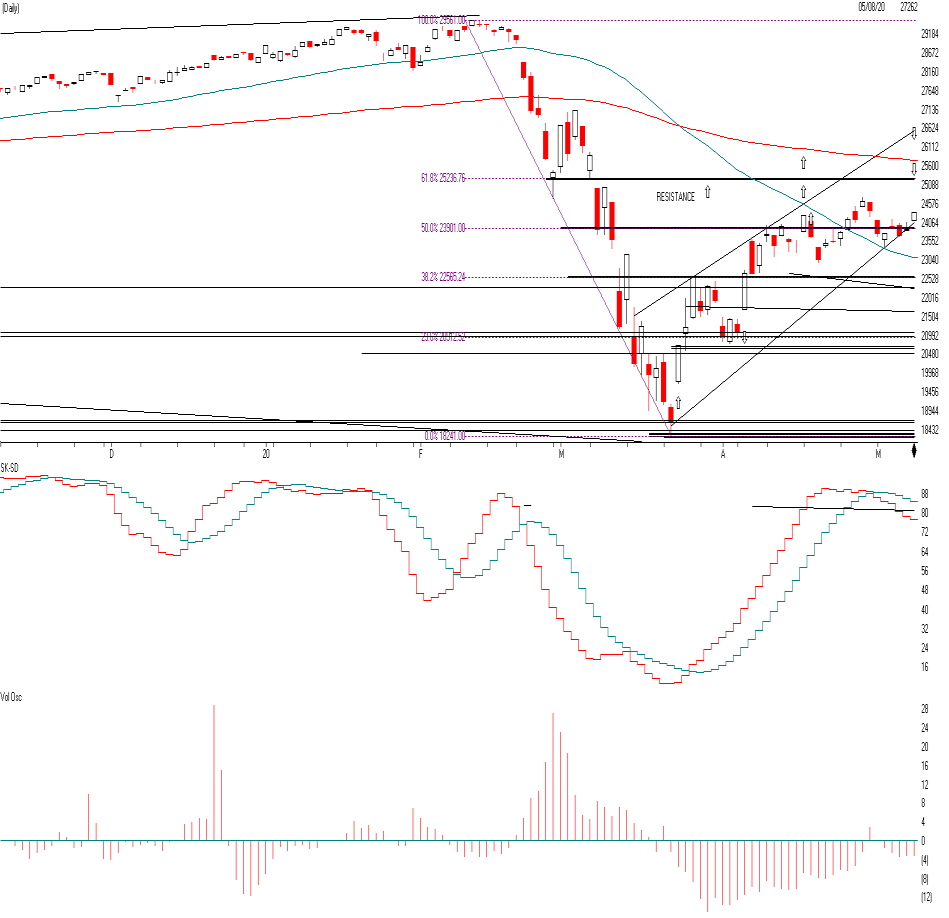
As you can see the Dow went down to the 18,300 level and has risen to the 50% Fibonacci Level at 23,901. In other words when markets decline, they tend to retrace much of the decline at the 23.8%, the 50% the 61.8% and the 78.6% level and stall and reverse. Notice at the 23901 level the Dow tended to hang around there for a couple of weeks and tried to go up to the next level at the 25236 level. This is the next level where the Dow Jones could stall if it keeps rising. The Dow Jones is made up of a lot of large industrial, and value stocks that have really not participating in the rally as much as the NASDAQ tech stocks seen on the next page. Watch for a trend line break of 23901 to confirm another down leg to the 22565 if it is on big volume. This is short term. Long term I am still positive over the next 2 years or so, when we get a vaccine and a treatment, and more herd immunity.
The SK-SD stochastics model. If it is above the 88 level like it is now the market is a little over bought and this means don’t buy now short term. Volume over the last month or so the market has been rising on low volume. This means people are afraid to commit and there may not be a lot of conviction on the rally.
NASDAQ QQQ
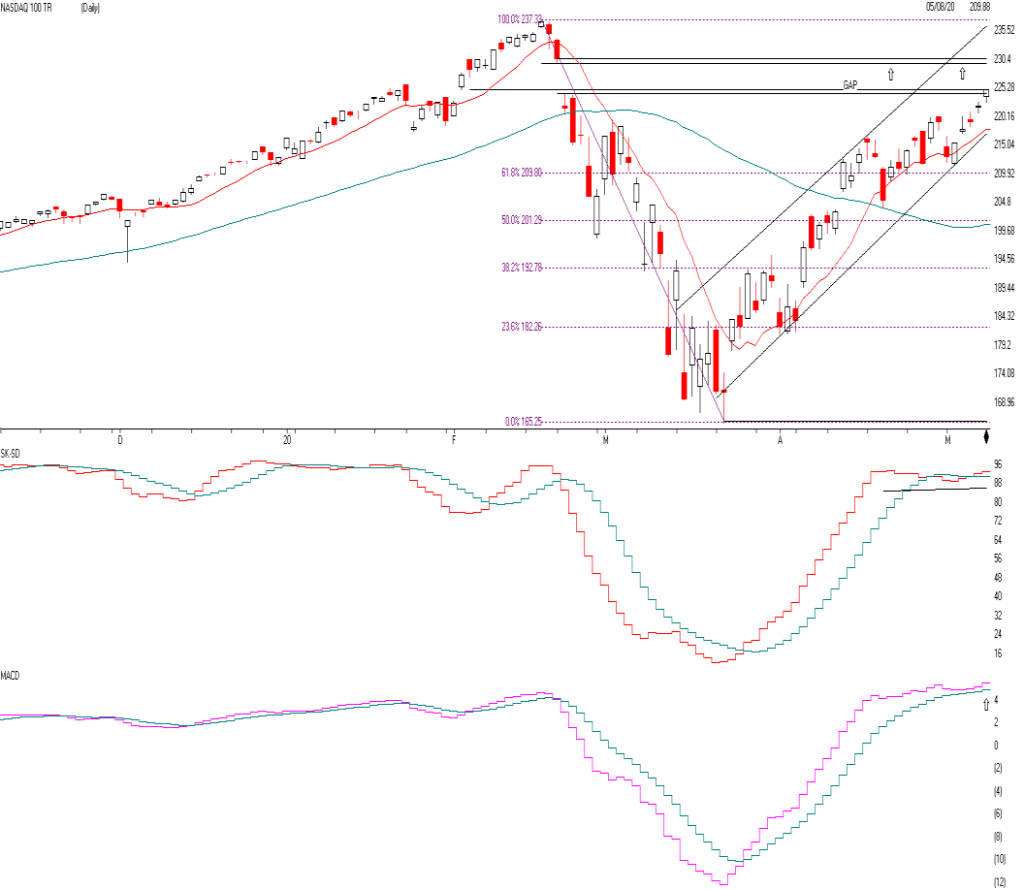
The true Champ this year again has been the NASDAQ. These stocks include, Facebook, Amazon, Docusign, Paypal, Mcrosoft, Netflix, etc. All of the stocks that benefit by you and your businesses being home. This QQQ are the top 100 NASDAQ stocks and is now up 3% plus for the year while everything else in the normal world is down 16-38%. The QQQ is now getting a little OVERBOUGHT so I would not go out and buy a bunch of tech stocks here. In fact, the QQQ is approaching a pretty substantial resistance level. The first is a gap fill and could bring the QQQ to 230.55 and reverse or it could reach its old high of 237 and reverse. Longer term I think it will break through the old high, but we are now getting to a point I think the QQQ has gone up as far as it should. So watch the 230.55 to fill the gap and reverses or the old high of 237 area.
The SK-SD Stochastics is overbought just like it was in the Dow Jones. The Momentum indicator gave a Buy signal at the blue arrow as it as the pink crossed the blue line, if it crosses the blue lien going down it is a SELL. This large tech area is still long term bullish, but short term I would take a few chips off the table as an index. The midcap, small cap and large cap value sector has a lot more to recover.
If the QQQ falls or closes below 216.8 or breaks the trend line I am getting Cautious to very Cautious.
SUPPORT LEVELS:
Support levels on the S&P 500 area are 2882, 2796, 2649, and 2500. These might be accumulation levels, especially 2649, or 2500. 2936 and 3015 is resistance. Support levels on the NASDAQ are 9036, 8612, and 7856 Topping areas 9323 to 9573. On the Dow Jones support is at 23,901, 22,569, and 20912. Topping areas 25,236 and 27,077. These may be safer areas to get into the equity markets on support levels slowly on the accumulation areas.
THE BOTTOM LINE:
The market has rebounded nicely over the last month mainly on the NASDAQ tech stocks that benefit from people staying at home and using all of the tech companies to their benefits. This stay “at home” policy has increased demand for technology, and why the internet stocks have done so well. The other part of the markets from the financial to energy and other value stocks are still down from 18-33%. It is all about the growth sector that is benefiting the most. Over the long term, I am very bullish on the market, but over a short time, I can see a topping or sideways to down on the large growth companies as they are now reasonably priced. If the market continues to do well, I would expect the Midcaps to start to outperform. But there is a caveat. There are trend-line right below the markets, and if they are broken and close below those areas, then the markets could start a correction again. Trend-lines are essential to hold. If they don’t hold, then there could be a setback to support the levels stated above. I still like the USA market better than the international one.
Best to all of you,
Joe Bartosiewicz, CFP® Investment Advisor Representative 5 Colby Way Avon, CT 06001 860-940-7020 or 860-404-0408
SECURITIES AND ADVISORY SERVICES OFFERED THROUGH SAGE POINT FINANCIAL INC., MEMBER FINRA/SIPC, AND SEC-REGISTERED INVESTMENT ADVISOR.
Charts provided by AIQ Systems:
Technical Analysis is based on a study of historical price movements and past trend patterns. There is no assurance that these market changes or trends can or will be duplicated shortly. It logically follows that historical precedent does not guarantee future results. Conclusions expressed in the Technical Analysis section are personal opinions: and may not be construed as recommendations to buy or sell anything.
Disclaimer: The views expressed are not necessarily the view of Sage Point Financial, Inc. and should not be interpreted directly or indirectly as an offer to buy or sell any securities mentioned herein. Securities and Advisory services offered through Sage Point Financial Inc., Member FINRA/SIPC, and an SEC-registered investment advisor.
Past performance cannot guarantee future results. Investing involves risk, including the potential loss of principal. No investment strategy can guarantee a profit or protect against loss in periods of declining values. Please note that individual situations can vary. Therefore, the information presented in this letter should only be relied upon when coordinated with individual professional advice. *There is no guarantee that a diversified portfolio will outperform a non-diversified portfolio in any given market environment. No investment strategy, such as asset allocation, can guarantee a profit or protect against loss in periods of declining values. It is our goal to help investors by identifying changing market conditions. However, investors should be aware that no investment advisor can accurately predict all of the changes that may occur in the market. The price of commodities is subject to substantial price fluctuations of short periods and may be affected by unpredictable international monetary and political policies. The market for commodities is widely unregulated, and concentrated investing may lead to Sector investing may involve a greater degree of risk than investments with broader diversification. Indexes cannot be invested indirectly, are unmanaged, and do not incur management fees, costs, and expenses.
Dow Jones Industrial Average: A weighted price average of 30 significant stocks traded on the New York Stock Exchange and the NASDAQ. S&P 500: The S&P 500 is an unmanaged indexed comprised of 500 widely held securities considered to be representative of the stock market in general.
NASDAQ: the NASDAQ Composite Index is an unmanaged, market-weighted index of all over the counter common stocks traded on the National Association of Securities Dealers Automated Quotation System (IWM) I Shares Russell 2000 ETF: Which tracks the Russell 2000 index: which measures the performance of the small capitalization sector of the U.S. equity market.
A Moderate Mutual Fund risk mutual has approximately 50-70% of its portfolio in different equities, from growth, income stocks, international and emerging markets stocks to 30-50% of its portfolio in different categories of bonds and cash. It seeks capital appreciation with a low to moderate level of current income.
The Merrill Lynch High Yield Master Index: A broad-based measure of the performance of non-investment grade US Bonds
MSCI EAFE: the MSCI EAFE Index (Morgan Stanley Capital International Europe, Australia, and Far East Index) is a widely recognized benchmark of non-US markets. It is an unmanaged index composed of a sample of companies’ representative of the market structure of 20 European and Pacific Basin countries and includes reinvestment of all dividends. Investment grade bond index: The S&P 500 Investment-grade corporate bond index, a sub-index of the S&P 500 Bond Index, seeks to measure the performance of the US corporate debt issued by constituents in the S&P 500 with an investment-grade rating. The S&P 500 Bond index is designed to be a corporate-bond counterpart to the S&P 500, which is widely regarded as the best single gauge of large-cap US equities.
Floating Rate Bond Index is a rule-based, market-value weighted index engineered to measure the performance and characteristics of floating-rate coupon U.S. Treasuries, which have a maturity greater than 12 months.
Money Flow; The Money Flow Index (MFI) is a momentum indicator that measures the flow of money into and out of a security over a specified period. It is related to the Relative Strength Index (RSI) but incorporates volume, whereas the RSI only considers SK-SD Stochastics. When an oversold stochastic moves up through its MA, a buy signal is produced. Furthermore, Lane recommends that the stochastic line be smoothed twice with three-period simple moving averages: SK is the three-period simple moving average of K, and SD is the three-period simple moving average of SK
Rising Wedge; A rising wedge is a technical indicator, suggesting a reversal pattern frequently seen in bear markets. This pattern shows up in charts when the price moves upward with pivot highs and lows converging toward a single point known as the apex
The 2020 COVID-19 Virus has adversely affected the entire world, and this will go down as one of the most volatile years in the stock and bond market in generations and even more volatile than the 2008 Bear Market.
CURRENT MARKET CONDITIONS:
This reason is that the declines came over eight days and not like the 2007-2009 decline which took a year and one half. The great recession of 2008 was a humanmade financial problem and this is a virus where very few are working. In the Recession of 2008, people were at least going to work and going out and spending money to support the economy. Now we are all destined to stay in the house unless we have an essential business. But the U.S. Government is doing everything it can to give grants and forgivable loans so that the economy doesn’t totally crash. That is better than in 2008. It is still serial to be confined to your house or go for a walk.
When we get our statement of our investments from our 401(k) s or from these accounts, you will see pretty large drops in values in the investment account and you will wonder if this is all worth it to stay in it or are we all destined just to make 1-3% in a savings account or a 3% fixed annuity with me. Right now getting 3% with no fees looks pretty good.
If you believe that good stocks and funds from successful growing businesses do well over the long term and this sell-off in the markets are BUYING opportunities over the next few months you may want to dollar cost average into the markets. If you believe that this COVID-19 virus will soon be over within months and that 1 to 3 years from now the markets will be higher than they are now is it worth holding on OR Buying more when markets are lower? The question is if you are buying or investing for the next 1-20 years. Do you like suitable stock and bond investments that are cheap now or more expensive? If your answer is yes, than you may want to average into the markets over the next few months as it is down during this pandemic.
MARKET RECAP:
On my last 3 Bartometers I was getting and got Very Cautious about the stock and bond markets, but did I expect this? Not really. I said if the NASDAQ broke 9200, I will get very Cautious but a 25 to 35% decline I did not expect. The markets had rallied 20%+ from the low hit a couple of weeks ago but still, the markets are down 17-20% into 2020. Are we in a recession now? I’d say yes, but it is forced because of COVID-19, but it will be one just because of the number of people laid off.
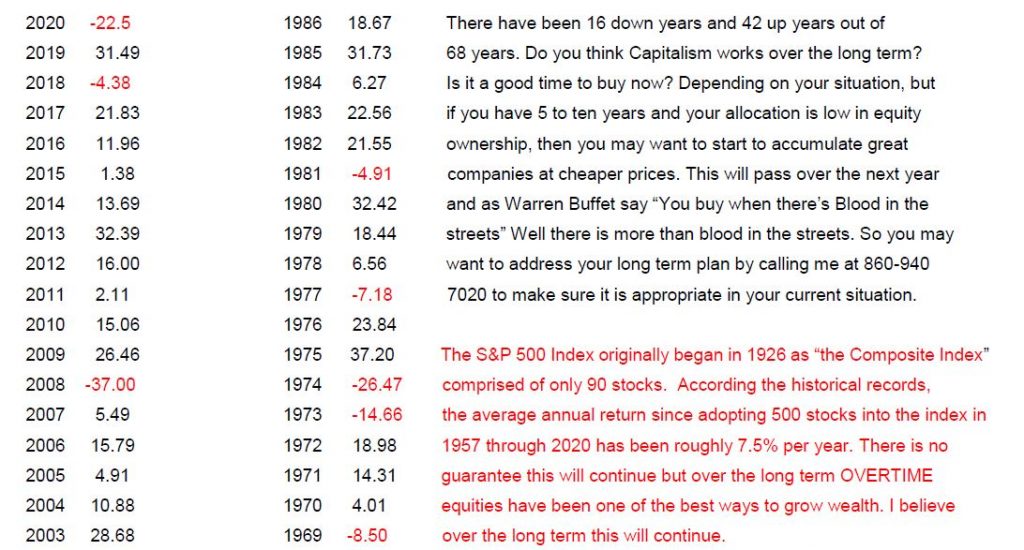
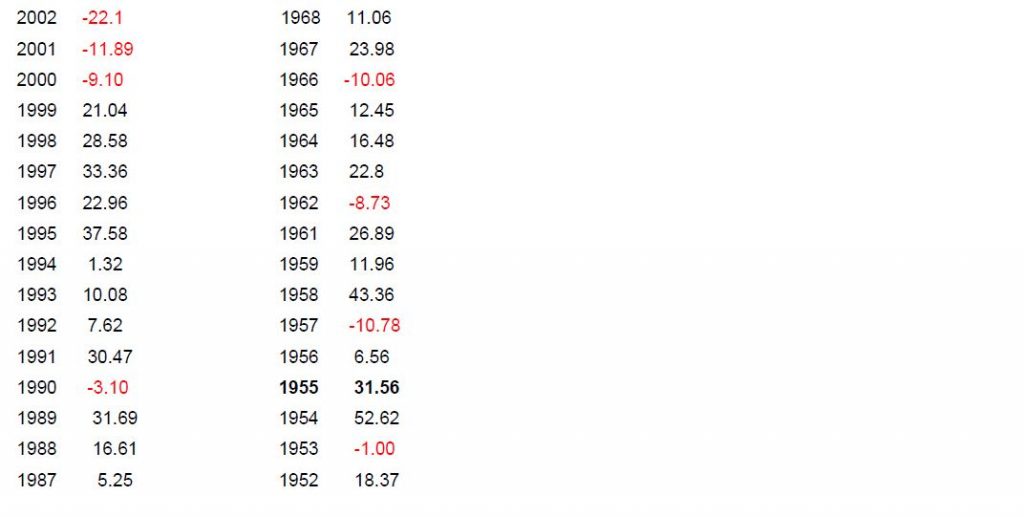
In the following pages are discussions of the long term of the markets, what do in a Bear market and my technicals of the markets going forward. But above I would like to say that even though American Capitalism is under fire, and also though the market got hurt as well as our portfolios, we will rise to the COVID-19 challenge like any other war or attack on the United States of America going back to the Revolutionary War to WW1, WW2, and all the other wars we had in our history. This country and its citizens will find a vaccine to this virus and I believe in my heart that 1 to 2 years from now this market should be nicely higher. Dollar-cost averaging currently buying a lower priced shares of good companies should, with no guarantees expressed or implied, be a good deal higher over the next few years. What do you think? Have we gone down this much over the last 50 years? Yes, many times. Has it recovered each time? Yes. Because capitalism works and good companies over the long term make money.
Some of the INDEXES of the markets both equities and interest rates are below. The source is Morningstar.com up until April 7, 2020. These are passive indexes. *Dow Jones -20% S&P 500 -17% NASDAQ Aggressive growth -9% I Shares Russell 2000 ETF (IWM) Small cap -31% Midcap stock funds -29% International Index (MSCI – EAFE ex USA -22% Investment Grade Bond -4% High Yield Bond -13% Government bond +4% The average Moderate Fund is down -16% this year fully invested as a 65% in stocks and 35% in bonds and nothing in the money market.
WANT TO SHOW YOU THE YEAR BY YEAR RETURNS OF THE S&P 500 TOTAL RETURNS BY YEAR
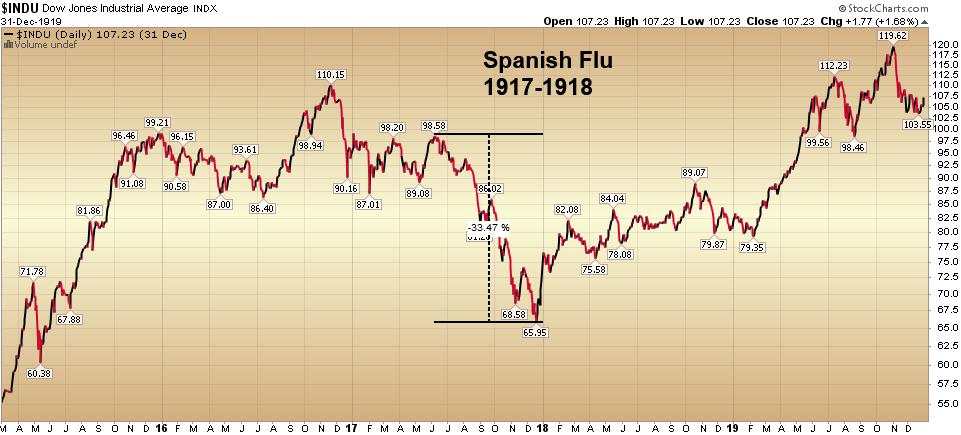
WHAT HAPPENED TO THE MARKETS DURING THE PANDEMIC AND SPANISH FLU IN 1917-1918:
The stock market today is looking a lot like it did a century ago, and if Great Hill Capital’s Thomas Hayes’s interpretation of the trendlines is on point, the bottom could be approaching.
“Just as the market started discounting the worst-case scenario in 1917,” he wrote, “it was already discounting a recovery months before the worst-case scenario occurred in 1918.”
What was going on in 1917? The Spanish Flu was just starting to bubble up, with the deadliest month of the whole pandemic not hitting until October 1918 — by then, as you can see from this chart, the Dow Jones Industrial Average DJIA, -1.68% had already begun to heal.
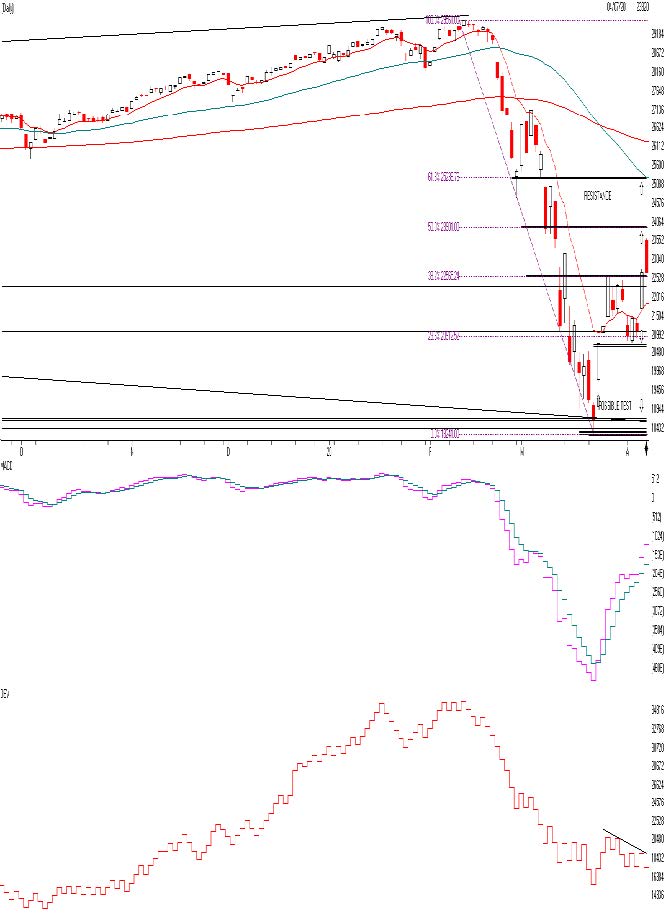
Hayes then posted this chart of the modern-day market plunge, noting that the nasty drawdowns amid the early stages of both pandemics were virtually the same.
More than 51 million people died globally in the Spanish Flu Pandemic, and the market rebounded more than 80% in the following two years from its bottom to top. This is no guarantee the market will rally that much or at all, but the USA is now better equipped to handle a massive Pandemic then in 1918 to 1919. Also, many companies are internet companies that could do well as people shop and do business over the internet; in addition, it is much more diversified and global than it was in 1918. For these reasons and more, I believe that the long term is more promising now for a recovery over the next 1 to 2 years.
There is one caveat; the Commodity index is right near its low of 2009, where it found it at a 29-year support level. If that breaks through that level, then we can go into a deeper recession for a more extended period. The market rebound depends on how quickly the government fixes this problem and people go back to work. I am optimistic over the next two years; but understand a recession should happen at least for a few quarters. I think the Recession should be relatively short term.
Since this graph was made a week ago, look at the next page and it is up to date. COMPARE the next graph to the Pandemic of 1918 and it is starting to look more like it. There is no guarantee expressed or implied, but look at the Pandemic and then the updated Dow on the next page.
The Dow Jones is above. This is the Daily Chart. As you can see, the decline of the Dow Jones Average was relatively very quick. Current is sitting at 22653 right BELOW THE 50% Fibonacci retracement level. A normal BEAR market usually tops on a countertrend rally right at a 50% or 61.8% Fibonacci level and declines or puts in a short top. So if this is true in this case there could be resistance at 23,901 or 25,236 area. There is also some resistance at the 200 day moving average at 26,660 and sloping downward. My AIQ models gave a BUY on 3/24/2020, but only a short term Buy not a longer term Weekly Buy. So even though the market is somewhat short term Bullish, there could be a short term top at 23,901, 25,236 or the 26,660 areas.
Momentum is good but can change quickly on the downside after earnings come out that will be bad. A buy signal is giving when the lavender line crosses blue line and Sell signal when it does it on the downside
One thing I don’t like is the On Balance Volume Line. Notice as the market is going up it is going up on low relative volume. This is somewhat negative. Over all I think the market should be higher when this is all done and when there is a vaccine and people go on living their normal lives it should be better. This market will be volatile. The market may continue on the upside but over the short term I think the rally is limited to the levels I said above on the Fibonacci levels and the 200 day moving average. In addition, the market may not like the earnings numbers over the next couple of weeks and the market could drop again towards 20000 or below again.
Key investor Points to remember in a Bear Market:
Stay calm and keep a long-term perspective.
Maintain a balanced and broadly diversified portfolio.
Balance equity portfolios with a mix of dividend-paying companies and growth stocks.
Choose funds with a strong history of weathering market declines.
Use high-quality bonds to help offset equity volatility.
Advisors can help investors navigate periods of market volatility
THE BOTTOM LINE:
The market has had its worst decline in 10 years. It has recovered about 35% of the loss over the last week. It is not a time to sell during this decline in my opinion but for some of you it would a great time to start to nibble in your mutual funds on setbacks because the COV19 virus should be controlled over the next year and if you look at all of the virus pandemics we have had, it has been a good time to Buy if your goals are longer term. It is not a time to throw caution to the wind but call me to make selective dollar-cost average buys. In addition, when EARNINGS come out in the next 2 weeks the stock market could go back down again. Remember you buy when there is blood in the streets. Bonds should be more in the investment-grade or short- term investment grade side. If you are a long-term investor and have 20 years+ towards retirement use sell-offs to add through dollar-cost averaging. Diversification is essential but portfolios should be somewhat safer.
Best to all of you,
Joe Bartosiewicz, CFP® Investment Advisor Representative 5 Colby Way Avon, CT 06001 860-940-7020 or 860-404-0408
SECURITIES AND ADVISORY SERVICES OFFERED THROUGH SAGE POINT FINANCIAL INC., MEMBER FINRA/SIPC, AND SEC-REGISTERED INVESTMENT ADVISOR.
Charts provided by AIQ Systems:
Technical Analysis is based on a study of historical price movements and past trend patterns. There is no assurance that these market changes or trends can or will be duplicated shortly. It logically follows that historical precedent does not guarantee future results. Conclusions expressed in the Technical Analysis section are personal opinions: and may not be construed as recommendations to buy or sell anything.
Disclaimer: The views expressed are not necessarily the view of Sage Point Financial, Inc. and should not be interpreted directly or indirectly as an offer to buy or sell any securities mentioned herein. Securities and Advisory services offered through Sage Point Financial Inc., Member FINRA/SIPC, and an SEC-registered investment advisor.
Past performance cannot guarantee future results. Investing involves risk, including the potential loss of principal. No investment strategy can guarantee a profit or protect against loss in periods of declining values. Please note that individual situations can vary. Therefore, the information presented in this letter should only be relied upon when coordinated with individual professional advice. *There is no guarantee that a diversified portfolio will outperform a non-diversified portfolio in any given market environment. No investment strategy, such as asset allocation, can guarantee a profit or protect against loss in periods of declining values. It is our goal to help investors by identifying changing market conditions. However, investors should be aware that no investment advisor can accurately predict all of the changes that may occur in the market. The price of commodities is subject to substantial price fluctuations of short periods and may be affected by unpredictable international monetary and political policies. The market for commodities is widely unregulated, and concentrated investing may lead to Sector investing may involve a greater degree of risk than investments with broader diversification. Indexes cannot be invested indirectly, are unmanaged, and do not incur management fees, costs, and expenses.
Dow Jones Industrial Average: A weighted price average of 30 significant stocks traded on the New York Stock Exchange and the NASDAQ. S&P 500: The S&P 500 is an unmanaged indexed comprised of 500 widely held securities considered to be representative of the stock market in general.
NASDAQ: the NASDAQ Composite Index is an unmanaged, market-weighted index of all over the counter common stocks traded on the National Association of Securities Dealers Automated Quotation System (IWM) I Shares Russell 2000 ETF: Which tracks the Russell 2000 index: which measures the performance of the small capitalization sector of the U.S. equity market.
A Moderate Mutual Fund risk mutual has approximately 50-70% of its portfolio in different equities, from growth, income stocks, international and emerging markets stocks to 30-50% of its portfolio in different categories of bonds and cash. It seeks capital appreciation with a low to moderate level of current income.
The Merrill Lynch High Yield Master Index: A broad-based measure of the performance of non-investment grade US Bonds
MSCI EAFE: the MSCI EAFE Index (Morgan Stanley Capital International Europe, Australia, and Far East Index) is a widely recognized benchmark of non-US markets. It is an unmanaged index composed of a sample of companies’ representative of the market structure of 20 European and Pacific Basin countries and includes reinvestment of all dividends. Investment grade bond index: The S&P 500 Investment-grade corporate bond index, a sub-index of the S&P 500 Bond Index, seeks to measure the performance of the US corporate debt issued by constituents in the S&P 500 with an investment-grade rating. The S&P 500 Bond index is designed to be a corporate-bond counterpart to the S&P 500, which is widely regarded as the best single gauge of large-cap US equities.
Floating Rate Bond Index is a rule-based, market-value weighted index engineered to measure the performance and characteristics of floating-rate coupon U.S. Treasuries, which have a maturity greater than 12 months.
Money Flow; The Money Flow Index (MFI) is a momentum indicator that measures the flow of money into and out of a security over a specified period. It is related to the Relative Strength Index (RSI) but incorporates volume, whereas the RSI only considers SK-SD Stochastics. When an oversold stochastic moves up through its MA, a buy signal is produced. Furthermore, Lane recommends that the stochastic line be smoothed twice with three-period simple moving averages: SK is the three-period simple moving average of K, and SD is the three-period simple moving average of SK
Rising Wedge; A rising wedge is a technical indicator, suggesting a reversal pattern frequently seen in bear markets. This pattern shows up in charts when the price moves upward with pivot highs and lows converging toward a single point known as the apex
Over the last month the stock market has had one of its worst declines over the shortest periods of time in history. Not even did the 2008 declines beat the velocity of the declines we saw over the last month. In 2 days the NASDAQ fell over almost 11% because of the rightfully so, Corona Virus and its potential to not only kill people but mainly do disrupt the business process of selling and the supply lines to get product. Two things I do want to say is
1. You don’t base your long term financial goals based on a short term flu. 5 years from now this will be just another flu we had. People will have forgotten about it.
2. Over the last two months I have be saying to take profits as we were overvalued, I was getting Cautious with the Rising Wedge pattern and thought the S&P 500 would go to the 3280-3380 and top out. The S&P 500 topped at 3386 and fell through the trend lines to the 2900 area, down 13% from the 3380 level. As of this point I am still very Cautious, but looking for a bottom soon over the next 2 months.
This is why I do technical analysis. People can say that the Corona Virus did it, and it did contribute, but the market was positioning itself for a fall. I think the market will continue to be volatile and potentially fall more. With the outbreak just beginning the USA, the S&P should test the 2855 level it hit a week ago and either bounce from there but I feel it will probably break down below that and hit the 2600 to the 2750 level. There have only been less than 500 people who have gotten the tests. Once the US government opens the tests up to many more people there should be many many more people who have the virus. This will scare people to stop going out at restaurants, coffee shops, theatres, cruise ships, travel and more. It will take out a percentage out of the Gross Domestic Product, (GDP). It will probably cause the markets to fall another 5 to 10%+, but it will not kill Capitalism. It should only be a short term. Remember, if this is a flu where less than 1% of the people who contract it dies, then who are dying? The elderly and the sick who have immune problems. So protect yourself. Get the N95 masks on Amazon, get myricetin as a supplement people are recommending to build up your immune system. Talk to your doctor first. Call me to rearrange your portfolios with me and your 401(k). Remember too, this will pass, but I think we have more on the downside.
This is what’s happened over the last 20 years:
2000 Y2k is going to kill us all.
2001 Anthrax is going to kill us all.
2002 West Nile Virus is going to kill us all.
2003 SARS is going to kill us all.
2005 The Bird Flu is going to kill us all. 2008 The Great Recession is going to kill us all.
2010 BP Oil is going to kill us all.
2012 The Mayan Calendar is going to kill us all.
2013 North Korea is going to kill us all.
2014 Ebola is going to kill us all.
2015 Disney Measles and ISIS is going to kill us all.
2016 Zika virus is going to kill us all.
2020 Corona Virus is going to kill us all.
Now granted this is worse because it is a pandemic and it is worse than most of the others, not in life as we lose 30-60 thousand every year to the regular flu, but there is no vaccine yet, and it is creating FEAR. But mostly the FEAR is stopping people from spending money, this will cause the markets to fall. So FEAR is killing you. Protect yourself. Be smart. Use FEAR in the markets as an advantage. Over the last few months, go to the old Bartometers, I have been saying to take profits, the markets are too overbought, that we had a Rising Wedge formation that is a reversal pattern and I thought we could go down. Well now that that has happened, is the market a BUY yet? No, because I feel it will go down more, but it may bottom over the next month or two.
There may be buying opportunities that only come once every 10 years or so. With no guarantees, if the market goes below the 2855 level down to the 2600 level to the 2750 level you may want to call me for potential buying opportunities. Remember what Warren Buffet says, “ Buy when there is BLOOD in the STREETS” That’s when most make money over the long term, When Florida houses were plummeting in the 2008 recession, were there great BUYS? In the great recession, did stocks go so low that if you bought in early 2009 did you get unbelievable deals on stocks and funds? Yes… You make money in the bull markets by buying in the BEAR MARKETS. I am not saying to buy now but get your GREED hats on. You all need to contact me to discuss strategy now. Remember, can we go down more? YES and probably will. Can we go into a Recession because of this situation? Maybe and most likely, economists are giving it a 50-50% chance. Should you reduce equities more, possibly depending on your situation and how close you are to retirement? Last month I said to take money off the table because the markets were too high. Now it’s more of a shift between funds and change some of the bonds as if Oil keeps falling, you don’t want to have much in the High Yield Bond sector or Floating rate bond area. I am concerned, however, about the corporations continue to buy back their own shares while they are issuing debt to do it. This buying back of stock is building the asset bubble. This is one concern I have in addition Corona Virus.
An excerpt from Fundamental Economist Dr. Robert Genetski: from Classical Principles.com: Stock Market Volatile as the Virus Gains
Investors switched from euphoria to fear and back several times this past week. When the dust settled, the Nasdaq, Nasdaq 100 and S&P 500 rose 1%-3% while small cap stocks fell 1%-2%.
The reason I recommend caution is related to the expectation of a sharp increase in the virus in the US. The US conducted only 473 tests through March 1. The number of tests will increase dramatically in the period ahead. More testing means more confirmed cases. The latest figures for the US show 226 cases.
Outside the US infections are growing at a rate of 20% a day. The rate of increase has slowed in Korea, but has increased dramatically in Italy and throughout Europe.
There is some good news. The daily rate of increase in China has slowed to less than 0.2% for the four days ending March 5th. Flexport, a global freight logistics company, reports that 60% of China’s manufacturing capacity is now back on line. Since US companies depend on China for critical supplies and medicines, the threat of shortages should soon be less pressing. There was more good news this past week as surveys of business activity show the US economy remained remarkably strong in February. While various international companies are suffering greatly, recent indications show the US is weathering the storm well, at least through February. Amid the uncertainty over the spread of the virus in the US, it continues to make sense to be cautious about owning stocks.
Returns in 2020 Some of the INDEXES of the markets both equities and interest rates are below. The source is Morningstar.com up until March 7, 2020. These are passive indexes.
*Dow Jones -8.9% S&P 500 -8.2% NASDAQ Aggressive growth -4.4% I Shares Russell 2000 ETF (IWM) Small cap -12.84% Midcap stock funds -12.54% International Index (MSCI – EAFE ex USA -10.4% Moderate Mutual Fund Investment Grade Bonds (AAA) Long duration -4.70% High Yield Merrill Lynch High Yield Index -3.7%
Floating Rate Bond Funds -2.4% Short Term Bond +1.3% Fixed Bond Yields (10 year) .76% Yield
The average Moderate Fund is down -4.70% this year fully invested as a 65% in stocks and 35% in bonds and nothing in the money market.
Interest rates look stable going forward over the next 6 months
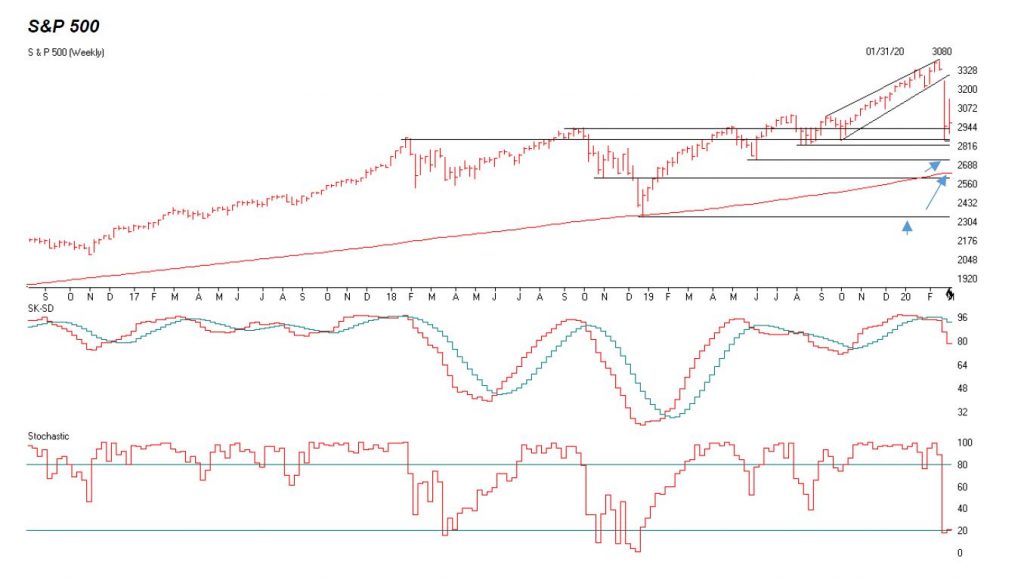
The S&P 500 is above. I used a weekly chart as I think the S&P will fall below 2855 and possibly hit the following support levels for support. 2822, 2721-2747, 2600-2630, and 2340.
These are points that investors are looking at as a support levels. I think we have more to go on the downside. The Blue arrows are areas that listed to the left I think the S&P can go too.
The middle graph is the SK-SD stochastics. This shows a breakdown, Last month I said anything over the 88 level is overbought. It’s 21 to 48 on the Daily, now it’s getting OVERSOLD but can go down more.
The third graph is the Stochastics chart. Anything below 20 is showing the market is very oversold. But can still trend lower.
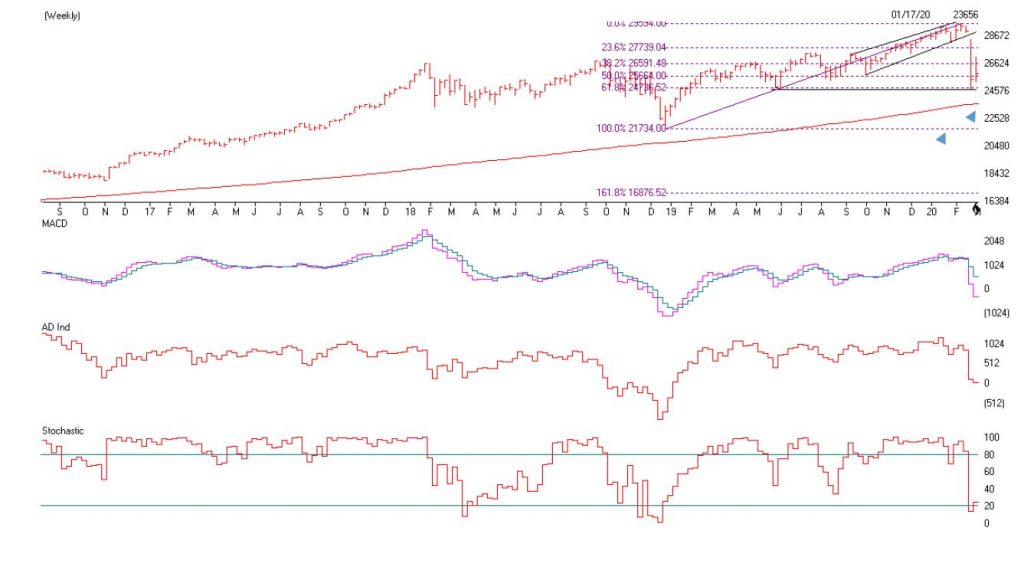
The Dow Jones is above. I drew the last three years and notice the that the 23576 is support right at the red line , but I believe the low will breakdown as it could test and breakdown and test its 200 week moving average at 23,587. If that doesn’t hold then the old lows of 21,734 are next.
This could be the capitulation investors are looking at to starting getting back into the markets. If this happens then there is a much greater chance that a Recession will occur. Please call me to Strategize your portfolio at 860-940-7020.
Support levels on the S&P 500 area are 2822, 2721-2747, 2600-2630 and 2340. These might be accumulation areas if you are a Long term investor. Support levels on the NASDAQ are 7658 to 7715, 7303, and 6861. On the Dow Jones support is at 23,587 (200 week moving average), 21,734, 19,794 and 17,863 These may be safer areas to get into the equity markets on support levels slowly.
THE BOTTOM LINE: Now that the markets have broken down the trend line I explained last month. I am more Cautious on the markets. The Corona Flu will scare people and they will pull in their horns towards traveling, going out and this act alone can cause a Recession. The market is starting to become somewhat oversold but I still would no Buy here, but wait until the Corona Virus Fear is nearing the worst it could get. That could be over the next 2 months or so. I think the S&P 500 and the markets could continue to fall as energy is also going down.
Best to all of you,
Joe Bartosiewicz, CFP® Investment Advisor Representative Contact information:
5 Colby Way Avon, CT 06001 860-940-7020 or 860-404-0408
SECURITIES AND ADVISORY SERVICES OFFERED THROUGH SAGE POINT FINANCIAL INC., MEMBER FINRA/SIPC, AND SEC-REGISTERED INVESTMENT ADVISOR.
Charts provided by AIQ Systems: Technical Analysis is based on a study of historical price movements and past trend patterns. There is no assurance that these market changes or trends can or will be duplicated shortly. It logically follows that historical precedent does not guarantee future results. Conclusions expressed in the Technical Analysis section are personal opinions: and may not be construed as recommendations to buy or sell anything.
Disclaimer: The views expressed are not necessarily the view of Sage Point Financial, Inc. and should not be interpreted directly or indirectly as an offer to buy or sell any securities mentioned herein. Securities and Advisory services offered through Sage Point Financial Inc., Member FINRA/SIPC, an SEC-registered investment advisor.
Past performance cannot guarantee future results. Investing involves risk, including the potential loss of principal. No investment strategy can guarantee a profit or protect against loss in periods of declining values. Please note that individual situations can vary. Therefore, the information presented in this letter should only be relied upon when coordinated with individual professional advice. *There is no guarantee that a diversified portfolio will outperform a non-diversified portfolio in any given market environment. No investment strategy, such as asset allocation, can guarantee a profit or protect against loss in periods of declining values.
It is our goal to help investors by identifying changing market conditions. However, investors should be aware that no investment advisor can accurately predict all of the changes that may occur in the market.
The price of commodities is subject to substantial price fluctuations of short periods and may be affected by unpredictable international monetary and political policies. The market for commodities is widely unregulated, and concentrated investing may lead to Sector investing may involve a greater degree of risk than investments with broader diversification.
Indexes cannot be invested indirectly, are unmanaged, and do not incur management fees, costs, and expenses.
Dow Jones Industrial Average: A weighted price average of 30 significant stocks traded on the New York Stock Exchange and the NASDAQ.
S&P 500: The S&P 500 is an unmanaged indexed comprised of 500 widely held securities considered to be representative of the stock market in general.
NASDAQ: the NASDAQ Composite Index is an unmanaged, market-weighted index of all over the counter common stocks traded on the National Association of Securities Dealers Automated Quotation System
(IWM) I Shares Russell 2000 ETF: Which tracks the Russell 2000 index: which measures the performance of the small capitalization sector of the U.S. equity market.
A Moderate Mutual Fund risk mutual has approximately 50-70% of its portfolio in different equities, from growth, income stocks, international and emerging markets stocks to 30-50% of its portfolio in different categories of bonds and cash. It seeks capital appreciation with a low to moderate level of current income.
The Merrill Lynch High Yield Master Index: A broad-based measure of the performance of non-investment grade US Bonds
MSCI EAFE: the MSCI EAFE Index (Morgan Stanley Capital International Europe, Australia, and Far East Index) is a widely recognized benchmark of non-US markets. It is an unmanaged index composed of a sample of companies’ representative of the market structure of 20 European and Pacific Basin countries and includes reinvestment of all dividends.
Investment grade bond index: The S&P 500 Investment-grade corporate bond index, a sub-index of the S&P 500 Bond Index, seeks to measure the performance of the US corporate debt issued by constituents in the S&P 500 with an investment-grade rating. The S&P 500 Bond index is designed to be a corporate-bond counterpart to the S&P 500, which is widely regarded as the best single gauge of large-cap US equities.
Floating Rate Bond Index is a rule-based, market-value weighted index engineered to measure the performance and characteristics of floating-rate coupon U.S. Treasuries, which have a maturity greater than 12 months.
Money Flow; The Money Flow Index (MFI) is a momentum indicator that measures the flow of money into and out of a security over a specified period. It is related to the Relative Strength Index (RSI) but incorporates volume, whereas the RSI only considers
SK-SD Stochastics. When an oversold stochastic moves up through its MA, a buy signal is produced. Furthermore, Lane recommends that the stochastic line be smoothed twice with three-period simple moving averages: SK is the three-period simple moving average of K, and SD is the three-period simple moving average of SK
Rising Wedge; A rising wedge is a technical indicator, suggesting a reversal pattern frequently seen in bear markets. This pattern shows up in charts when the price moves upward with pivot highs and lows converging toward a single point known as the apex