The MACD ‘Tell’ Strikes Goldman Sachs

There are many ways to use the MACD indicator developed long ago by Gerald Apel.  This is one of them.  Maybe.  Nothing more, nothing less.
First the caveat: what follows is NOT a “trading system” or even something that you should consider on a standalone basis.
MACD
The MACD indicator uses exponential moving averages to identify the underlying trend for a given security and is also used by many traders to identify divergences which may signal an impending change of trend.
Figure 1 displays the daily MACD for ticker SPY.
1
Figure 1 – Ticker SPY with MACD Indicator (Courtesy AIQ TradingExpert)
The MACD ‘Tell’
While this is NOT intended to be a mechanical signal, I am going to put specific rules on it just to give it some structure.  The rules:
1) If the daily MACD (12,26,9) has declined for at least 7 consecutive trading days AND
2) The 2-day RSI is at 64 or above
Then an “alert” signal is flashed.  The key thing to note is that if the MACD ticks higher on the day that the 2-day RSI rises above 64, the signal is negated.
Before proceeding please note that the 12,26,9 parameter selection is simply the “standard” for MACD.  Also, there is nothing magic about 7 consecutive days – so one might experiment with different values there.  Finally, using the 2-day RSI and a “trigger” value of 64 are also both arbitrary.  There may be better values and/or different overbought/oversold indicators to use.
Ticker GS
A “classic” example of the MACD Tell appears in Figure 2 using ticker GS.
2
Figure 2 – Ticker GS with the MACD Tell (Courtesy AIQ TradingExpert)
The MACD Tell is typically best used as a short-term indicator.  In this case a short-term trader might have considered playing the short side of GS – or even better – using option strategies such as buying puts or selling bear call spreads.
Summary
No one should rush out and start trading put options based on this indicator (or any other indicator for that matter) without spending some time doing some homework and testing out the viability for producing profits.
In reality, this is the type of indicator that should typically be combined with “something else” and/or used as a confirmation rather than as a standalone approach.
Jay Kaeppel
 
Disclaimer:  The data presented herein were obtained from various third-party sources.  While I believe the data to be reliable, no representation is made as to, and no responsibility, warranty or liability is accepted for the accuracy or completeness of such information.  The information, opinions and ideas expressed herein are for informational and educational purposes only and do not constitute and should not be construed as investment advice, an advertisement or offering of investment advisory services, or an offer to sell or a solicitation to buy any security.

Volume-Weighted Moving Average Breakouts

The AIQ code based on Ken Calhoun’s article in the February 2017 issue of Technical Analysis ofSTOCKS & COMMODITIES, “Volume-Weighted Moving Average Breakouts,” can be found at http://aiqsystems.com/Volume-Weighted-Moving-Average-Breakouts.EDS 
 
Please note that I tested the author’s system using the NASDAQ 100 list of stocks on daily bars rather than intraday bars from 12/31/2008 thru 2/10/2017. Figure 7 shows the resulting equity curve trading the author’s system with the cross-down exit. Figure 8 shows the ASA report for this test. The annualized return showed about a 17% return with a maximum drawdown of 19%.
Sample Chart

FIGURE 7: AIQ. Here are sample test results from the AIQ Portfolio Manager taking three signals per day and 10 concurrent positions maximum run on NASDAQ 100 stocks (daily bar data) over the period 12/31/08 to 2/10/07.
Sample Chart

FIGURE 8: AIQ. This shows the ASA report for the system, which shows the test metrics and settings.
The code and EDS file can be downloaded from http://aiqsystems.com/Volume-Weighted-Moving-Average-Breakouts.EDS , and is also shown below.
!Volume-Weighted Moving Average Breakouts
!Author: Ken Calhoun, TASC Apr 2017
!Coded by: Richard Denning 2/11/17
!www.TradersEdgeSystems.com

!INPUTS:
smaLen is 70.
vwmaLen is 50.

SMA is simpleavg([close],smaLen).
VWMA is sum([close]*[volume],vwmaLen)/sum([volume],vwmaLen).
HasData if hasdatafor(max(smaLen,vwmaLen)+10)>max(smaLen,vwmaLen).
Buy if SMA < VWMA and valrule(SMA > VWMA,1) and HasData.
Sell if SMA > VWMA.

rsVWMA is VWMA / valresult(VWMA,vwmaLen)-1.
rsSMA is SMA / valresult(SMA,smaLen)-1.
—Richard Denning
info@TradersEdgeSystems.com
for AIQ Systems

March and April (and the Train Rolls On)

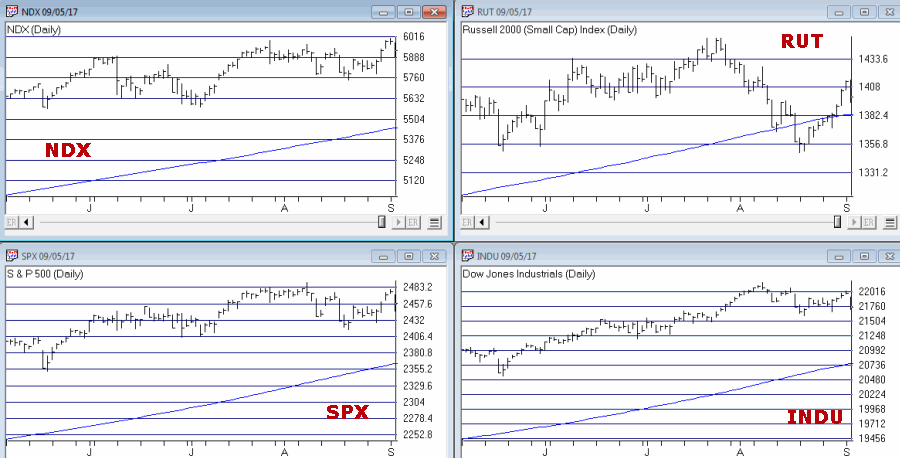
The stock market is off to a flying start in 2017.  We have a buy signal from the January Barometer, the 40-Week Cycle just turned bullish  and most of the major U.S. indexes soaring to new all-time highs.  See Figure 1.

1a

Figure 1 – Major U.S. Average hitting new highs (charts courtesy AIQ TradingExpert Pro)

With the turn of the month near, what lies ahead for March and April?  Well, it’s the stock market, so of course no one really knows for sure.  Still, if history is an accurate guide (and unfortunately it isn’t always – and I hate that part), the odds for a continuation of the advance in the months just ahead may be pretty good.

Figure 2 displays the growth of $1,000 invested in the Dow Jones Industrials Average ONLY during the months of March and April starting in 1946.

2a

Figure 2 – Growth of $1,000 invested in the Dow Jones Industrials Average ONLY during the months of March and April (1946-2016)

For the record, the months of March and April combined:

*Showed a gain 53 times (75% of the time)

*Showed a loss 18 times (25% of the time)

*The average UP year showed a gain of +5.2%

*The average DOWN year showed a loss of (-3.3%)

*The largest Mar/Apr gain was +15.9% (1999)

*The largest Mar/Apr loss was (-6.0%) (1962)

Summary

So is the stock market train sure to “roll on” during the March/April timeframe?  Not at all.  But with “all systems Go” at the moment and with a historically favorable period approaching – and despite a lot of overly bullish sentiment beginning to bubble up – I feel compelled to stay on board at least until the next stop..

Jay Kaeppel

Chief Market Analyst at JayOnTheMarkets.com and AIQ TradingExpert Pro (http://www.aiqsystems.com) client. http://jayonthemarkets.com/

Disclaimer:  The data presented herein were obtained from various third-party sources.  While I believe the data to be reliable, no representation is made as to, and no responsibility, warranty or liability is accepted for the accuracy or completeness of such information.  The information, opinions and ideas expressed herein are for informational and educational purposes only and do not constitute and should not be construed as investment advice, an advertisement or offering of investment advisory services, or an offer to sell or a solicitation to buy any security.

Exponential Standard Deviation Bands

The AIQ code based on Vitali Apirine’s article in the 2017 issue of Stocks & Commodities magazine, “Exponential Standard Deviation Bands”

Editor note: “Author Vitali Apirine presented a method intended to help traders see volatility while a stock is trending. These bands, while similar to Bollinger Bands, are calculated using exponential moving averages rather than simple moving averages. Like Bollinger Bands, they widen when volatility increases and narrow as volatility decreases. He suggests that the indicator can be used as a confirming indication along with other indicators such as the ADX. Here’s an AIQ Chart with the Upper, Lower and Middle Exponential SD added as custom indicators.”


To compare the exponential bands to Bollinger Bands, I created a trend-following trading system that trades long only according to the following rules:
  1. Buy when there is an uptrend and the close crosses over the upper band. An uptrend is in place when the middle band is higher than it was one bar ago.
  2. Sell when the low is less than the lower band.
Figure 8 shows the summary test results for taking all signals from the Bollinger Band system run on NASDAQ 100 stocks over the period 12/9/2000 to 12/09/2016. Figure 9 shows the summary test results for taking all signals from the exponential band system on NASDAQ 100 stocks over the same period. The exponential band system improved the average profit per trade while reducing the total number of trades.

Sample Chart

FIGURE 8: AIQ. Here are summary test results for taking all signals from the Bollinger Band system run on NASDAQ 100 stocks over the period 12/9/2000 to 12/09/2016.

Sample Chart

FIGURE 9: AIQ. Here are summary test results for taking all signals from the exponential band system run on NASDAQ 100 stocks over the period 12/9/2000 to 12/09/2016.
The EDS file can be downloaded from http://aiqsystems.com/EDS/Exponential_Standard_Deviation_Bands.EDS 
and is also shown here:
!Exponential Standard Deviation Bands
!Author: Vitali Apirine, TASC February 2017
!Coded by: Richard Denning 12/11/2016
!www.TradersEdgeSystems.com!INPUT:
xlen is 20.
numSD is 2.

!INDICATOR CODE:
ExpAvg is expavg([close],xlen).
Dev is [close] – ExpAvg.
DevSqr is Dev*Dev.
SumSqr is sum(DevSqr,xlen).
AvgSumSqr is SumSqr / xlen.
ExpSD is sqrt(AvgSumSqr).

!UPPER EXPONENTIAL SD BAND:
UpExpSD is ExpAvg + numSD*ExpSD.  !PLOT ON CHART

!LOWER EXPONENTIAL SD BAND:
DnExpSD is ExpAvg – numSD*ExpSD.   !PLOT ON CHART

!MIDDLE EXPONENTIAL SD BAND:
MidExpSD is ExpAvg.

!BOLLINGER BANDS FOR COMPARISON:
DnBB is [Lower BB].  !Lower Bollinger Band
UpBB is [Upper BB].  !Upper Bollinger Band
MidBB is simpleavg([close],xlen). !Middle Bollinger Band
!REPORT RULE TO DISPLAY VALUES:
ShowValures if 1.

!TRADING SYSTEM USING EXPPONENTIAL SD BANDS:
UpTrend if MidExpSD > valresult(MidExpSD,1).
BreakUp if [close] > UpExpSD.
BuyExpSD if UpTrend and BreakUp and valrule(Breakup=0,1).
ExitExpSD if [Low] < DnExpSD.  ! or UpTrend=0.

!TRADING SYSTEM USING BOLLINGER BANDS:
UpTrendBB if MidBB > valresult(MidBB,1).
BreakUpBB if [close] > UpBB.
BuyBB if UpTrendBB and BreakUpBB and valrule(BreakupBB=0,1).
ExitBB if [Low] < DnBB.  ! or UpTrend=0.

—Richard Denning
info@TradersEdgeSystems.com
for AIQ Systems

With Retailers, it’s ‘When’ Not ‘What’

I’ve been seeing a number of panicked missives lately regarding the retailing sector.  They typically go something like this:
“Despite new highs for most of the major market indexes, the retailing sector has been struggling – and in some cases hit hard – therefore it is clearly (paraphrasing here) THE END OF THE WORLD AS WE KNOW IT, AHHHHHHHHHHHHH……………………..”
Or something along those lines.  And the truth is that they may be right.  But as it turns out, with the retailing sector it is typically more a question of “when” and not “what” (or even WTF
Recent Results
The concerns alluded to above are understandable given recent results in certain segments of the retailing sector. Figure 1 displays the stock price action for four major retailers.  It isn’t pretty.
(click to enlarge)
1
Figure 1 – Major retailers taking a hit (Chart courtesy AIQ TradingExpert)
So if major retailers are performing poorly one can certainly see why someone might extrapolate this to conclude that the economy is not firing on all cylinders and that the recent rally to new highs by the major averages is just a mirage.  And again, that opinion may ultimately prove to be correct this time around.
But before swearing off of retailing stocks, consider the following.
Retailers – When not What
For our test we will use monthly total return data for the Fidelity Select Retailing sector fund (ticker FSRPX).  Figure 2 displays the growth of $1,000 invested in FSRPX only during the months of:
*February, March, April, May, November, December
2
Figure 2 – Growth of $1,000 invested in ticker FSRPX only during the “favorable” months since 1986
For the record:
*An initial $1,000 grew to $50,274, or +4,927% (this test does not include any interest earned during the months out of FSRPX).
*# of years showing a net gain = 27
*# of years showing a net loss = 4
*Average UP year = +17.0%
*Average DOWN year = (-3.4%)
*Maximum UP Year = +50.0% (1990)
*Maximum DOWN Year = (-5.9%) (1994)
The Year-by-Year Results appear in Figure 3
Year % +(-)
1986 26.2
1987 15.8
1988 12.2
1989 16.9
1990 50.0
1991 45.5
1992 8.0
1993 4.6
1994 (5.9)
1995 3.0
1996 26.1
1997 18.1
1998 45.7
1999 4.0
2000 1.8
2001 12.5
2002 (0.1)
2003 18.5
2004 11.3
2005 10.3
2006 0.1
2007 (2.8)
2008 (4.7)
2009 44.9
2010 24.5
2011 4.6
2012 10.8
2013 16.6
2014 11.5
2015 6.1
2016 9.2
Figure 3 – Year-by-Year Results for  “Favorable” Months since 1986
The Rest of the Year
If for some reason you had decided to skip the months above and hold FSRPX only during all of the other months of the year, your results appear in Figure 4.4
Figure 4 – Growth of $1,000 invested in ticker FSRPX only during the “unfavorable” months since 1986
For the record:
*An initial $1,000 grew to $1,037, or +3.7% (this test does not include any interest earned during the months out of FSRPX).
Summary
Is the retailing sector guaranteed to generate a gain during our “favorable” months in 2017?  Not at all.  Still, given that retailing is presently beaten down a bit and the fact that the worst full year loss during the favorable months was -5.9%, it may be time to think about taking a look (although – as always, and for the record – I am not “recommending” retailing stocks, only pointing out the historical trends).
Still, as the old saying goes, the results below are what we “quantitative types” refer to as “statistically significant”.
*Favorable months since 1986 = +4,927%
*Unfavorable months since 1986 = +3.7%
 Jay Kaeppel

Chief Market Analyst at JayOnTheMarkets.com and AIQ TradingExpert Pro (http://www.aiqsystems.com) client. http://jayonthemarkets.com/