The Bartometer

August 08, 2020

Hello Everyone,

As the COVID 19 Virus bounces back from a lower number a month ago, the stock markets, especially the technology stocks continue to rise. The difference this time is that although cases are rising, the number of deaths is much less proportionately than they were just 3 to 4 months ago. The reason, now the 20 to 49-year-olds are now getting the virus, but because they are generally healthier than the 70 to 80-year-olds, they are beating the virus as their immune system is stronger. The reason the technology stocks are continuing to rally is that people are staying at home and using Apple, Google, Amazon, Tesla, Netflix, Zoon, Docusign, etc.

One somewhat concerning fact is that The Top 15 Stocks in the S&P 500 account in Market Value 35% of the entire S&P 500 stock market. The Bottom 420 Stocks in the S&P 500 account in Market Value 33.8% of the entire S&P 500 stock market. This means that 15 stocks are controlling the entire S&P 500. This troubling skewed market is again showing that a very small number of stocks are making us money and the rest are on their back

  1. It’s mostly technology stocks, large technology stocks. That’s it, other than some special situations. I am still positive on the stock market long term, but the large growth stocks, although still good for the longer term are now fairly valued and could have somewhat of a setback soon. The more aggressive clients are doing well as the aggressive technology stocks represent a bigger percentage of your portfolio than the bonds and dividend stocks. When the vaccine is available and people go back to work and when people feel safe to get back to some semblance of normalcy to make people want to travel, go to a local restaurant or simply to a movie, we could see these value and dividend stocks climb, but until that happens, the technology stocks will most likely dominate the stock markets.
  2. Take a look below, The Dow is down 3%, The Equal weighted S&P 500 is down almost 4%, but the NASDAQ is up 22% because of 15 stocks and the values of their company controlling the entire market including the regular market-weighted S&P only up 5%.

CURRENT TRENDS:

Some of the INDEXES of the markets both equities and interest rates are below. The source is Morningstar.com up until August 8, 2020. These are passive indexes.

Dow Jones -3.0%
S&P 500 +5.0%
EQUAL WEIGHTED S&P 500 -4.0%
NASDAQ Aggressive growth +22%
Large Cap Value -5.0%
I Shares Russell 2000 ETF (IWM) Small cap -9.0%
Midcap stock funds -4.7-15.76%
International Index (MSCI – EAFE ex USA -6.2%
Financial stocks -18%
Energy stocks -36.53%
Healthcare Stocks +2.8% Moderate Mutual Fund Investment Grade Bonds (AAA) Long duration +1.5%
High Yield Merrill Lynch High Yield Index -2.8% Floating Rate Bond Funds -3.4%
Short Term Bond +1.6%
Fixed Bond Yields (10 year) .85% Yield

Classicalprinicples.com and Robert Genetskis Excerpts:

Despite concerns over a weak recovery, the S&P500 reached my estimate of fair value. In contrast, the Nasdaq has far exceeded all prior measures of reasonable valuation. How can stocks rise with the economy so weak? There are two reasons. First, the economy is not weak. It continues to recover rapidly. Second, monetary policy is more expansive than at any time in history.

Although stocks are either fully-valued or over-valued, they can still go higher. At this point, I’m comfortable continuing to ride the wave higher while holding 10% cash for use when the market corrects. Stay cautiously bullish.

Friday’s employment report shows a gain of 1.5 million private-sector workers in early July. The number of unemployed remains high at 16 million. The good news is that weekly unemployment insurance claims continued to improve through the end of July.

The ISM surveys of manufacturers and service companies also show employment contracting. However, these surveys show a strong surge in new orders, which will lead to an ncrease in jobs in August. There are reasons why unemployment remains high. Given the uncertainty over the outlook, it’s natural to await new orders before hiring. Also, employers need to trim unessential costs to pay for the increased costs associated with the virus. Finally, government payments not to work have appealed to many.

Source: Classical Principles.com

S&P 500


Source:AIQsystems.com

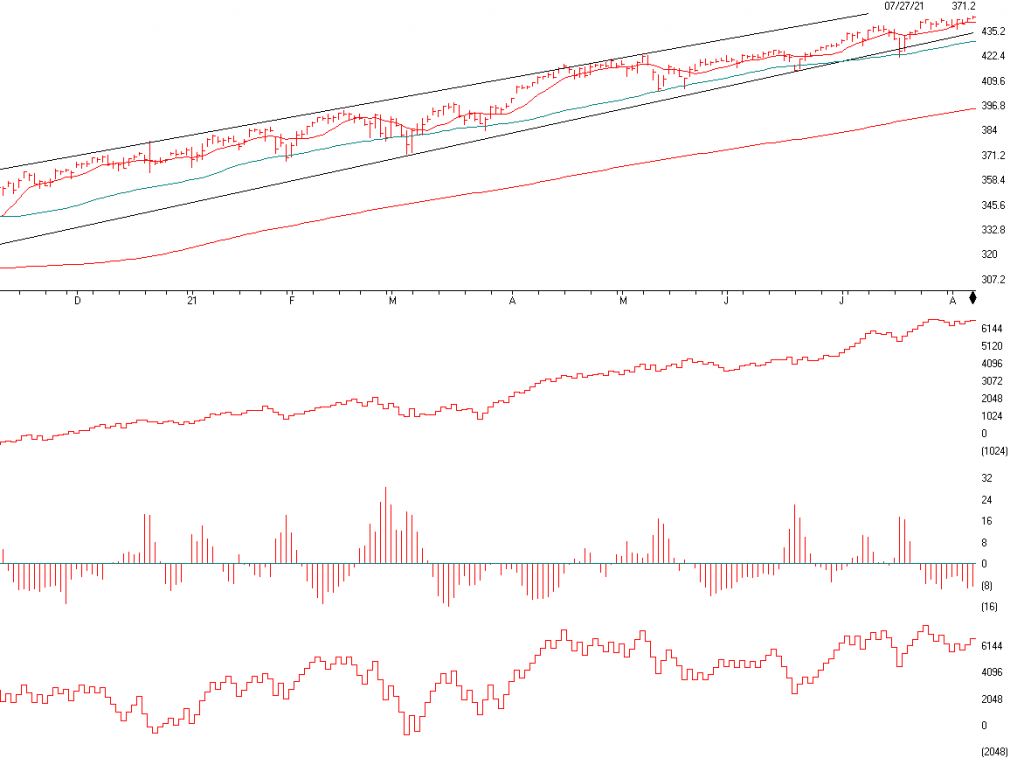
The S&P 500 chart is above. It is the Market weighted index described on the first page. Because technology is a major component of this index, stocks like Apple, Amazon, Microsoft and more are making is look
better than what the entire market is doing which is still down 4-10%+ if you look at all stocks.

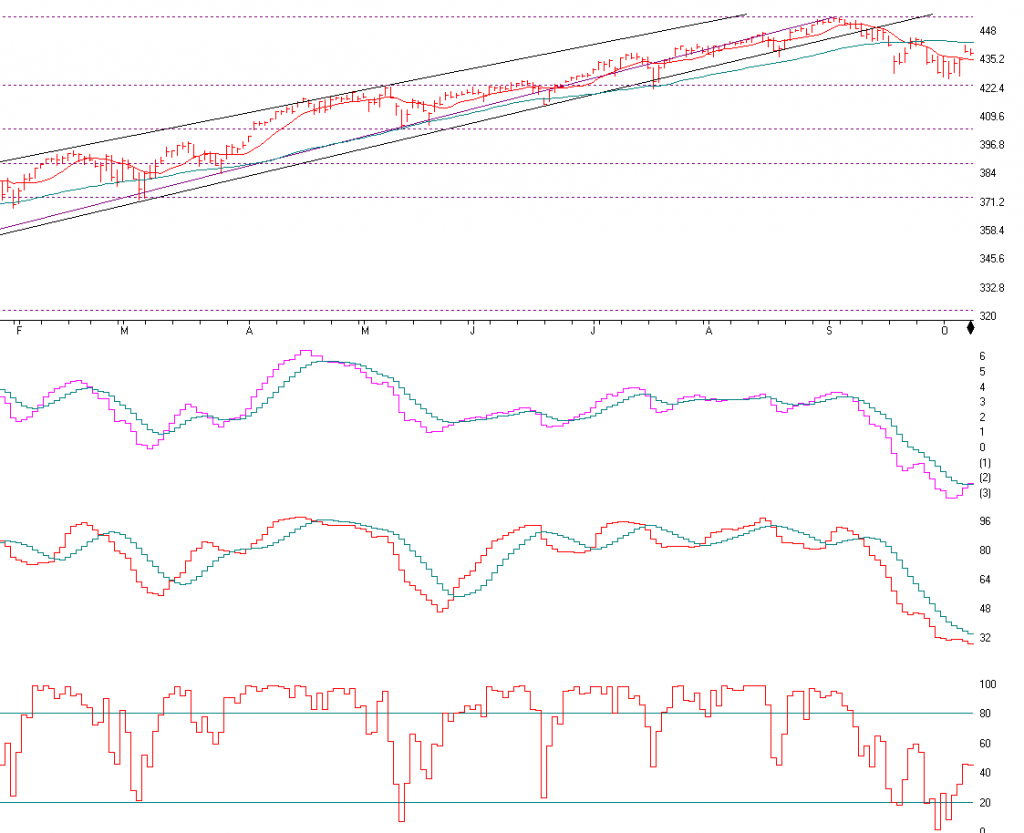
I tried to make it simple see above. The 3390 area on the S&P 500 is major resistance and 3260, where the Up arrows are should act as support. Right below that is the 50 day moving average. Many traders or investors will sell if the S&P 500 drops and closes below the 50 moving average or the Trend line you see above. Many of you may want to sell if the S&P 500 drops below 3260. In addition the second graph shows the SD-SK Stochastics model as Overbought because the number is over 88. This is another overbought indicator.

Support levels on the S&P 500 area are 3328, 3264, 3150. 3390 is resistance.

▪ These may be safer areas to get into the equity markets on support levels slowly on the accumulation areas.

THE BOTTOM LINE:

The market has rebounded nicely over the last month mainly on the decline in Covid19 cases, and the economy reopening. The NASDAQ has done the best and should continue to do well IF the market continues higher, But now I am thinking that the small to midcap growth and value sector is more undervalued especially when the USA goes back to work and there is a safe and effective vaccine. The Midcap and Small caps could outperform if the rally continues from here. There is a major trend-line right below the markets, see above. If those are broken on a Close I will get Cautious
to Very Cautious. It is important for the trendlines and the 50 day moving to hold or it could start a correction. I like the USA market better than the international market, however the International Emerging markets is getting interesting.

If you have any questions, please call me at 860-940-7020.
Best to all of you,
Joe
Joe Bartosiewicz, CFP®
Investment Advisor Representative

Securities and advisory services offered through SagePoint Financial, Inc. (SPF), member FINRA/SIPC. SPF is separately owned and other entities and/or marketing names, products or services referenced here are
independent of SPF. 800-552-3319 20 East Thomas Road Ste 2000 Phoenix AZ 85012

Charts provided by AIQ Systems:

Technical Analysis is based on a study of historical price movements and past trend patterns. There is no assurance that these market changes or trends can or will be duplicated shortly. It logically follows that historical precedent does not guarantee future results. Conclusions expressed in the Technical Analysis section are personal opinions: and may not be construed as recommendations to buy or sell anything.

Disclaimer: The views expressed are not necessarily the view of Sage Point Financial, Inc. and should not be interpreted directly or indirectly as an offer to buy or sell any securities mentioned herein. Securities and Advisory services offered through Sage Point Financial Inc., Member FINRA/SIPC, an SEC-registered investment advisor.

Past performance cannot guarantee future results. Investing involves risk, including the potential loss of principal. No investment strategy can guarantee a profit or protect against loss in periods of declining values. Please note that individual situations can vary. Therefore, the information presented in this letter should only be relied upon when coordinated with individual professional advice. *There is no guarantee that a diversified portfolio will outperform a non-diversified portfolio in any given market environment. No investment strategy, such as asset allocation, can guarantee a profit or protect against loss in periods of declining values.

It is our goal to help investors by identifying changing market conditions. However, investors should be aware that no investment advisor can accurately predict all of the changes that may occur in the market. The price of commodities is subject to substantial price fluctuations of short periods and may be affected by unpredictable international monetary and political policies. The market for commodities is widely unregulated, and concentrated investing may lead to Sector investing may involve a greater degree of risk than investments with broader diversification. Indexes cannot be invested indirectly, are unmanaged, and do not incur management fees, costs, and expenses.

Dow Jones Industrial Average: A weighted price average of 30 significant stocks traded on the New York Stock Exchange and the NASDAQ.
S&P 500: The S&P 500 is an unmanaged indexed comprised of 500 widely held securities considered to be representative of the stock market in general.

NASDAQ: the NASDAQ Composite Index is an unmanaged, market-weighted index of all over the counter common stocks traded on the National Association of Securities Dealers Automated Quotation System
(IWM) I Shares Russell 2000 ETF: Which tracks the Russell 2000 index: which measures the performance of the small capitalization sector of the U.S. equity market. A Moderate Mutual Fund risk mutual has approximately 50-70% of its portfolio in different equities, from growth, income stocks, international and emerging markets stocks to 30-
50% of its portfolio in different categories of bonds and cash. It seeks capital appreciation with a low to moderate level of current income.
The Merrill Lynch High Yield Master Index: A broad-based measure of the performance of non-investment grade US Bonds MSCI EAFE: the MSCI EAFE Index (Morgan Stanley Capital International Europe, Australia, and Far East Index) is a widely recognized benchmark of non-US markets. It is an unmanaged index composed of a sample of companies’ representative of the market structure of 20 European and Pacific Basin countries and includes reinvestment of all dividends. Investment grade bond index: The S&P 500 Investment-grade corporate bond index, a sub-index of the S&P 500 Bond Index, seeks to measure the performance of the US corporate
debt issued by constituents in the S&P 500 with an investment-grade rating. The S&P 500 Bond index is designed to be a corporate-bond counterpart to the S&P 500, which is widely regarded as the best single gauge of large-cap US equities. Floating Rate Bond Index is a rule-based, market-value weighted index engineered to measure the performance and characteristics of floating-rate coupon U.S. Treasuries, which have a maturity greater than 12 months.
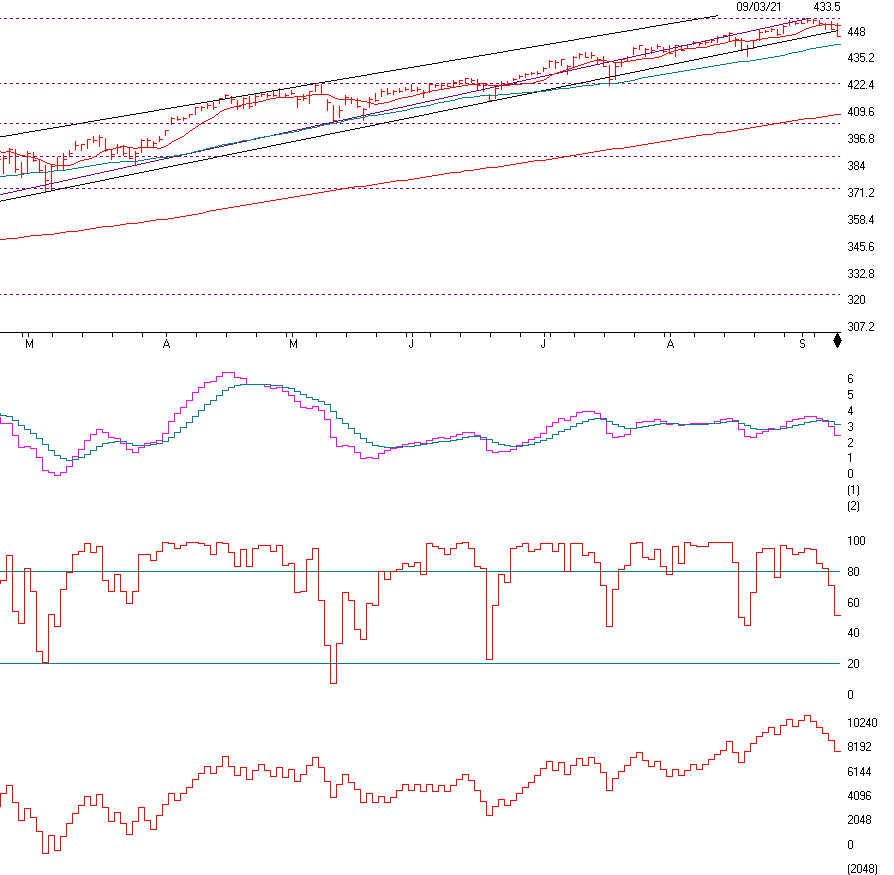
Money Flow; The Money Flow Index (MFI) is a momentum indicator that measures the flow of money into and out of a security over a specified period. It is related to the Relative Strength Index (RSI) but incorporates volume, whereas the RSI only considers SK-SD Stochastics. When an oversold stochastic moves up through its MA, a buy signal is produced. Furthermore, Lane recommends that the stochastic line be smoothed twice with three-period simple moving averages: SK is the three-period simple moving average of K, and SD is the three-period simple moving average of SK Rising Wedge; A rising wedge is a technical indicator, suggesting a reversal pattern frequently seen in bear markets. This pattern shows up in charts when the price moves upward with pivot highs and lows converging toward a single point known as the apex


The Rally in “Stuff” Rolls On

In this article, dated 7/10/2020, I noted that my “Stuff” Index was coming on strong and that its performance may be a “shot across the bow” that some changes may be coming to the financial markets.  Since then, the trend has accelerated.

STUFF vs. FANG vs. QQQ

Figure 1 displays the performance of STUFF components since 7/10

Figure 2 displays the performance of FANG components since 7/10

Figure 1 – Price performance of Jay’s STUFF Index components since 7/10

Figure 2 – Price performance of FANG stocks since 7/10

For the record, the “high-flying” Nasdaq 100 Index (using ticker QQQ as a proxy investment) is up +4.0% during the same time.

Is this a trend – or a blip?  Unfortunately, I can’t answer that question. But it certainly appears that there is something afoot in “Stuff”, particularly the metals.  Figure 3 displays the weekly charts for ETFs tracking Silver, Gold, Palladium and Platinum (clockwise from upper left). 

Figure 3 – The metals components of the Stuff Index (Courtesy AIQ TradingExpert)

When it comes bull markets in metals, the typical pattern historically goes something like this:

*Gold leads the way (check)

*Eventually silver comes on strong and often ends up outperforming gold (check)

*The other metals rise significantly “under the radar” as everyone focus on – literally in this case, ironically – the “shiny objects” (gold and silver)

Again, while I had inklings that a bull market in metals was forming (and have held positions in them for several years, and still hold them), I certainly did not “predict” the recent explosion in gold and silver prices. 

Two things to note:

*Gold and silver are obviously very “overbought”, so buying a large position here entails significant risk

*Still it should be noted that both SLV and PPLT would have to double in price from their current levels just to get back to their previous all-time highs of 2011

So, don’t be surprised if “Stuff” enjoys a continued resurgence.  Note in Figure 4 that a number of commodity related ETFs are way, way beaten down and could have a lot of upside potential if a resurgence actually does unfold.

Figure 4 – Four commodity ETFs weekly (Courtesy AIQ TradingExpert)

What is interesting – and almost not visible to the naked eye – is the action in the lower right hand corner of these four charts. To highlight what is “hiding in plain sight”, Figure 5 “zooms in” on the recent action of same four tickers as Figure 4, but in a daily price format rather than a monthly price format.

Figure 5 – Four commodity ETFs daily (Courtesy AIQ TradingExpert)

Despite the ugly pictures painted in Figure 4, it is interesting to note in Figure 5 that all four of these commodity related ETFs have rallied sharply of late.  There is of course, no guarantee this will continue.  But if the rally in “Stuff” – currently led by metals – spreads to the commodity sector as a whole, another glance in Figures 3 and 4 reveals a lot of potential upside opportunity.

Time will tell.  In the meantime, keep an eye on the “shiny objects” (gold and silver) for clues as to whether or not the rally in “Stuff” has staying power.

See also Jay Kaeppel Interviewin July 2020 issue of Technical Analysis of Stocks and Commodities magazine

See also Jay’s “A Strategy You Probably Haven’t Considered” Video

See also Video – The Long-Term…Now More Important Than Ever

Jay Kaeppel

Disclaimer: The information, opinions and ideas expressed herein are for informational and educational purposes only and are based on research conducted and presented solely by the author.  The information presented represents the views of the author only and does not constitute a complete description of any investment service.  In addition, nothing presented herein should be construed as investment advice, as an advertisement or offering of investment advisory services, or as an offer to sell or a solicitation to buy any security.  The data presented herein were obtained from various third-party sources.  While the data is believed to be reliable, no representation is made as to, and no responsibility, warranty or liability is accepted for the accuracy or completeness of such information.  International investments are subject to additional risks such as currency fluctuations, political instability and the potential for illiquid markets.  Past performance is no guarantee of future results.  There is risk of loss in all trading.  Back tested performance does not represent actual performance and should not be interpreted as an indication of such performance.  Also, back tested performance results have certain inherent limitations and differs from actual performance because it is achieved with the benefit of hindsight.

Vitali Apirine’s – The Compare Price Momentum Oscillator (CPMO)

The importable AIQ EDS file based on Vitali Apirine’s article in the August, 2020 issue of Stocks & Commodities magazine, “The Compare Price Momentum Oscillator (CPMO),” can be obtained on request via email to info@TradersEdgeSystems.com.

… Here is a way you can compare at a glance the momentum of two different market indexes or securities in the same chart. It could also be used to help generate trading signals. In this first part of a three-part series, we’ll look at comparing index momentums…

The code is also available here:

!Author: Vitali Aprine, TASC August 2020
!Coded by: Richard Denning, 6/20/20
!www.TradersEdgeSystems.com

!Custom smoothing multiplier: 2 / time period
!PMO line: 20-period custom EMA of (10 × 35-period
!custom EMA of ((Today’s price – Yesterday’s price) / !Yesterday’s price × 100))
!PMO signal line: 10-period EMA of the PMO line

Len1 is 20.
Len2 is 35.
Len3 is 10.
Ticker1 is “QQQ”.
Ticker2 is “SPY”.

C is [close].
C1 is valresult(C,1).
RC1 is (C/C1*100)-100.

custSmoLen1 is Len1 – 1.
custSmoLen2 is Len2 – 1.

CustEma is 10*expavg(RC1,custSmoLen2).
PMO is expavg(CustEma,custSmoLen1).
PMOsig is expavg(PMO,Len3).

Ticker1C is tickerUDF(Ticker1,C).
RC1ticker1 is (Ticker1C/valresult(Ticker1C,1)*100)-100.
CustEmaTicker1 is 10*expavg(RC1ticker1,custSmoLen2).
PMOticker1 is expavg(CustEmaTicker1,custSmoLen1).

Ticker2C is tickerUDF(Ticker2,C).
RC1ticker2 is (Ticker2C/valresult(Ticker2C,1)*100)-100.
CustEmaTicker2 is 10*expavg(RC1ticker2,custSmoLen2).
PMOticker2 is expavg(CustEmaTicker2,custSmoLen1).

CPMO is PMOTicker1 – PMOTicker2.
List if hasdatafor(1000) >= 900.

I coded the indicator described by the author. Figure 10 shows the indicator (QQQ,SPY,20,35) on chart of IWM. When the white line is above the red line on the CPMO indicator, this indicates that the QQQ is stronger than the SPY. Generally, it is considered bullish when the QQQ is leading in strength.

Sample Chart

FIGURE 10: AIQ. The CPMO indicator is shown on a chart of IWM with parameters (QQQ,SPY,20,35).

—Richard Denning
info@TradersEdgeSystems.com
for AIQ Systems

AIQ Market Timing update 7-29-20

Market volatility has stabilized some. In this update we’ll take a look at the current AI signals on the Dow Jones. For folks less familiar with our AI engine here’s a recap of what we do.

TradingExpert Pro uses two AI knowledge bases, one specifically designed to issue market timing signals and the other designed to issue stock timing signals.

Each contains approximately 400 rules, but only a few “fire” on any given day.  In the language of expert systems, those rules that are found to be valid on a particular day are described as having “fired”.  

Rules can fire in opposite directions.  When this happens, the bullish and bearish rules fight it out.  It’s only when bullish rules dominate that the Expert Rating signal is bullish, or when bearish rules dominate that the Expert Rating signal is bearish.

The Expert Rating consists of two values. 

The upside rating is the value on the left and the downside rating is on the right.  Expert Ratings are based on a scale of 0 to 100.  An Expert Rating of 95 to 100 is considered a strong signal that the Stock or market may change direction.  

An Expert Rating below 90 is considered meaningless.  A low rating means that there is not enough consistency in the rules that fired to translate to a signal.  The expert system has not found enough evidence to warrant a change from the last strong signal.

When “Perfection” Meets “The Real World”

In this article I wrote about a signal called “Bull Market Thrust”.  The upshot is that since 1991 it has identified 8 “bullish periods”.  The start and end dates of those periods – and the price performance of several indexes during each period – appear in Figure 1.

Figure 1 – “Bull Market Thrust” bullish periods

One key thing to note is that – focusing solely on the Nasdaq 100 Index – 100% of the “bullish periods” witnessed a gain, i.e., “perfection.”  The average gain was +40%.

So that looks pretty good and pretty darned encouraging going forward since there was a new buy signal on June 8th of this year.  And indeed, if history is a guide the outlook for the Nasdaq (and the stock market as a whole) is favorable in the next year.  But there is one thing to keep in mind….

Jay’s Trading Maxim #33: When you have actual money on the line, the chasm between theory and reality can be a mile wide.

The bottom line is that even during “bullish periods” the market fluctuates.  And if one is focused on “news” there is plenty of opportunity to feel angst no matter how strong the market “should be.”  So, in an effort to “mange expectations”, the charts below display the price action of the Nasdaq 100 during each “bullish period” displayed in Figure 1.

Nasdaq 100 during “Bullish Periods” based on Bull Market Thrust signals

*All charts below are (Courtesy AIQ TradingExpert)

*Each chart displays one of the “Bullish Periods” from Figure 1. 

*Each chart contains one or more red boxes highlighting a period of “market trouble”

THE POINT: the key thing to ponder is how easily it would be to allow yourself to get “shaken out” if you were focused on what the “news of the day” is telling you, rather than what the market itself is telling you.

Figure 2 – NDX: 1/29/91 – 2/28/93

Figure 3 – NDX: 6/5/2003-6/4/2004

Figure 4 – NDX: 3/23/2009-3/1/2011

Figure 5 – NDX: 7/7/2011-7/6/2012

Figure 6 – NDX: 7/9/13-7/15/2014

Figure 7 – NDX: 2/26/2016-11/17/2017

Figure 8 – NDX: 1/8/2019-1/17/2020

Figure 9 – 6/8/2020-?

The bottom line is that:

*Sometimes the market “took off” after the signal

*Sometime the market sold off shortly after the signal (see 2011 signal)

*In every case there was a drawdown of some significant somewhere along the way

The purpose of paying attention to things like “Bull Market Thrust” buy signals is not to “pick bottoms with uncanny accuracy.” 

In the real word, the purpose is to help strengthen our resolve in riding the exceptional opportunities.

See also Jay Kaeppel Interview in July 2020 issue of Technical Analysis of Stocks and Commodities magazine

See also Jay’s “A Strategy You Probably Haven’t Considered” Video

See also Video – The Long-Term…Now More Important Than Ever

Jay Kaeppel

Disclaimer: The information, opinions and ideas expressed herein are for informational and educational purposes only and are based on research conducted and presented solely by the author.  The information presented represents the views of the author only and does not constitute a complete description of any investment service.  In addition, nothing presented herein should be construed as investment advice, as an advertisement or offering of investment advisory services, or as an offer to sell or a solicitation to buy any security.  The data presented herein were obtained from various third-party sources.  While the data is believed to be reliable, no representation is made as to, and no responsibility, warranty or liability is accepted for the accuracy or completeness of such information.  International investments are subject to additional risks such as currency fluctuations, political instability and the potential for illiquid markets.  Past performance is no guarantee of future results.  There is risk of loss in all trading.  Back tested performance does not represent actual performance and should not be interpreted as an indication of such performance.  Also, back tested performance results have certain inherent limitations and differs from actual performance because it is achieved with the benefit of hindsight.