Zero In On The MACD

The AIQ code based on Barbara Star’s article in May issue of Stocks and Commodities “Zero In On The MACD,” is provided at www.TradersEdgeSystems.com/traderstips.htm, and is also shown below.
Sample Chart

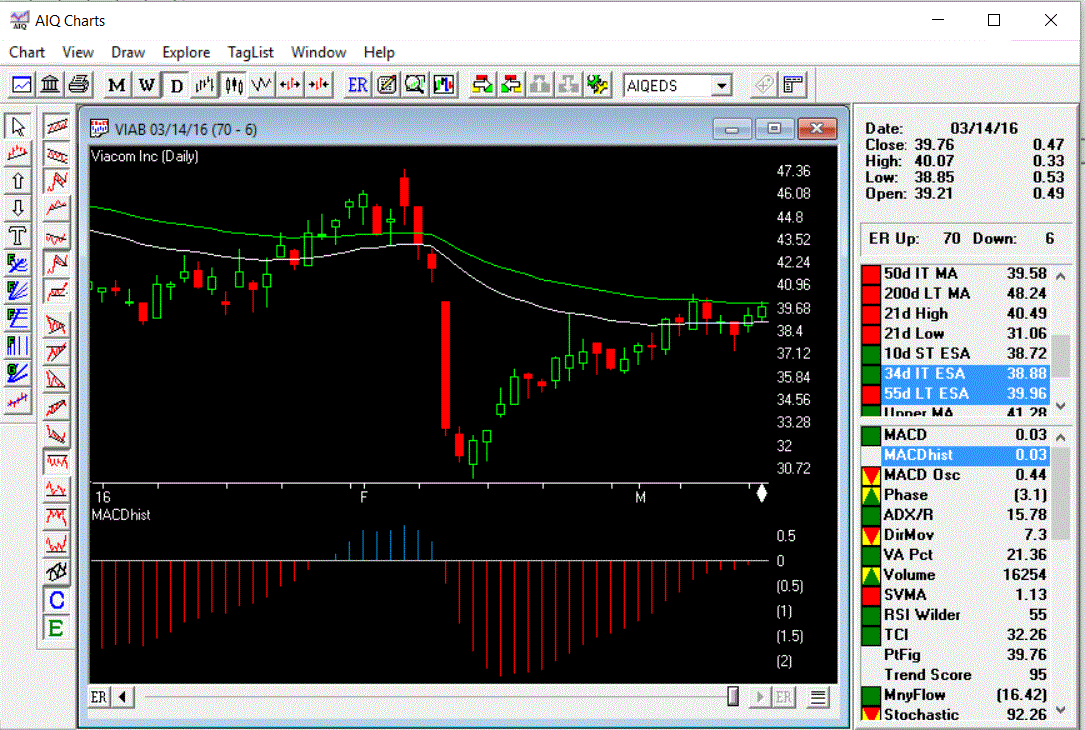
FIGURE 7: AIQ. Here is a sample chart of VIAB with MACDhist, the color bars, and the 34- and 55-bar EMAs.
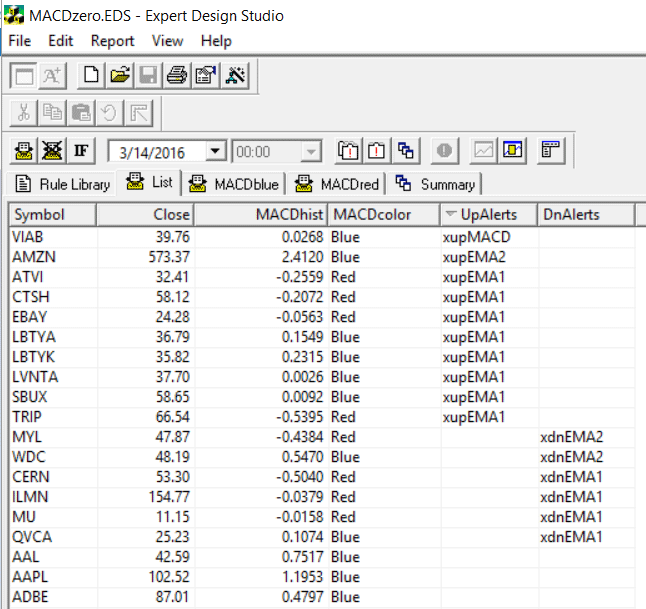
Figure 7 shows the MACD histogram on a chart of Viacom (VIAB) with the color bars and the 34- and 55-bar exponential moving averages (EMA). Note that I did not code the weighted moving average (WMA) but substituted the EMA for the WMA. I chose to view the chart of VIAB by running the EDS “Zero MACD.eds” on 3/14/2016 and examining the alert messages on the report “List.” VIAB is the only one on that date that showed a cross up on the MACDhist (see Figure 8 for a look at part of this report for 3/14/2016).
Sample Chart

FIGURE 8: AIQ. This shows part of the EDS custom report “List” that shows the MACDhist values on 3/14/2016, the color status, and any alerts that were generated for that day.
! ZERO IN ON THE MACD

! Author: Barbara Star, TASC May 2016

! Coded by: Richard Denning 3/14/16

! www.TradersEdgeSystems.com


! INPUTS:

macd1  is  12.

macd2  is  26.

macdSig is  1.


! INDICATORS:

emaST  is expavg([Close],macd1).

emaLT  is expavg([Close],macd2).

MACD  is emaST - emaLT.  ! MACD line

SigMACD is expavg(MACD,macdSig). ! MACD Signal line

MACDosc is MACD - SigMACD. ! MACD Oscillator


HD if hasdatafor(macd2) = macd2.

MACDhist is MACD.                                 ! plot as historigram

MACDblue if MACDhist > 0.  ! use these rules to color MACDhist

MACDred  if MACDhist < 0.  ! use these rules to color MACDhist

MACDcolor is iff(MACDblue and HD,"Blue",iff(MACDred and HD,"Red","White")). !for report list

List if 1.


!ALERTS:

EMA1 is expavg([close],34).

EMA2 is expavg([close],55).

xupEMA1 if [close] > EMA1 and valrule([close] < EMA1,1).

xdnEMA1 if [close] < EMA1 and valrule([close] > EMA1,1).

xupEMA2 if [close] > EMA2 and valrule([close] < EMA2,1).

xdnEMA2 if [close] < EMA2 and valrule([close] > EMA2,1).

xupMACD if MACDhist > 0 and valrule(MACDhist < 0,1).

xdnMACD if MACDhist < 0 and valrule(MACDhist > 0,1).

UpAlerts is iff(xupEMA1,"xupEMA1",iff(xupEMA2,"xupEMA2",iff(xupMACD,"xupMACD"," "))).

DnAlerts is iff(xdnEMA1,"xdnEMA1",iff(xdnEMA2,"xdnEMA2",iff(xdnMACD,"xdnMACD"," "))).

The code and EDS file can be downloaded from www.TradersEdgeSystems.com/traderstips.htm.
AIQ Market AI signals a 100 rating to the downside

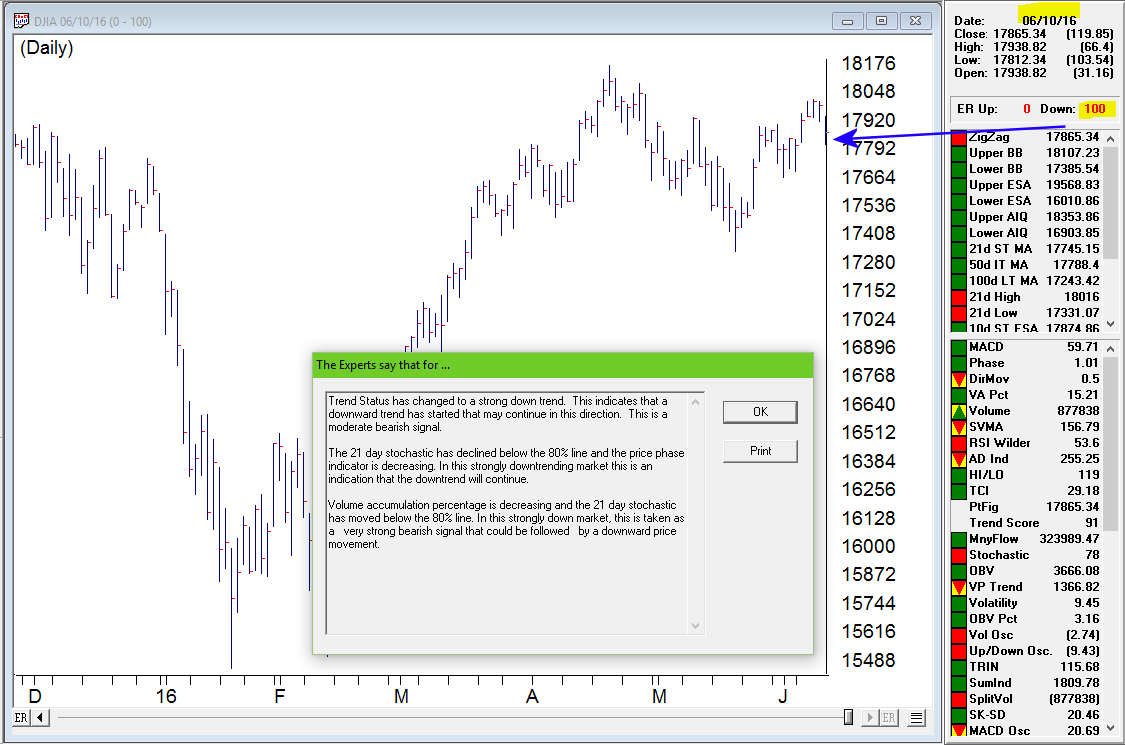
Artificial Intelligence Market Signal issues a 0-100 to the downside on June 10, 2016
AIQ TradingExpert AI signals are designed to anticipate changes in the direction of price movement.  Some are accurate and some are not.  However, more often than not, the Expert Rating signals are accurate.  The strongest level of confirmation for market timing signals like this 0-100 down on June 10, 2016 can be found by examining one of TradingExpert’s other market indication components. 

One possible confirmation of market timing signals (Expert Ratings of 95 or greater) is the the Up/Down Signal Ratio, on the Weighted Action List (WAL), an AIQ report.  A Signal Ratio of 85 or greater in the direction of the signal could be viewed as significant, as the AI system used for stocks is completely separate in terms of expert system knowledge base and data, and share no information or expert rules with the market timing system. 

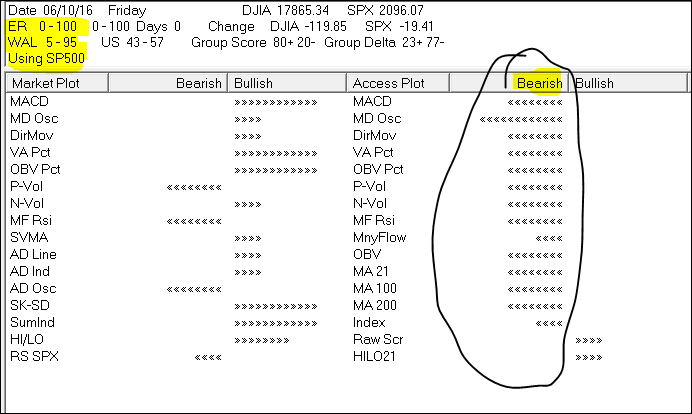
The image below is taken from the AIQ Reports Daily Market Log. This report pulls elements from various parts of TradingExpert. You’ll notice the 0-100 down signal  on DJIA on 6/10/2016. Just below that is WAL 5-95. This is the Up/Down Signal Ratio from the Weighted Action List (WAL) in this case using SP500 stocks. This 5-95 confirms that 95% of the SP500 stocks have down signals according to the stock expert system.

The Access Plot area on the right gives a bullish/bearish consensus for the SP 500 stocks using 16 technical indicators.

The two independent components of TradingExpert are in agreement calling for the market to move in the same direction. This is a very powerful type of validation, both the equity and market timing systems have signaled a change in market direction at the same time.

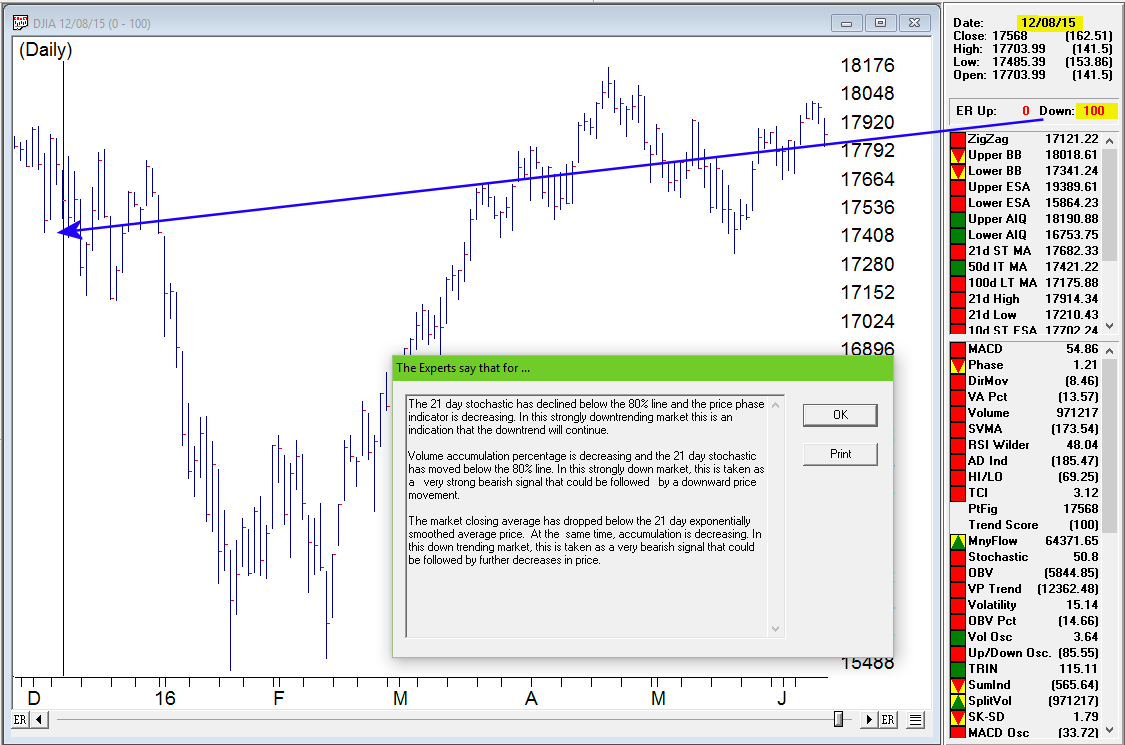
While no system is perfect, it is interesting to note the previous 0-100 market timing signal occurred December 8, 2015 prior to the correction at the start of 2016.

Inverse Head and Shoulders on the market?

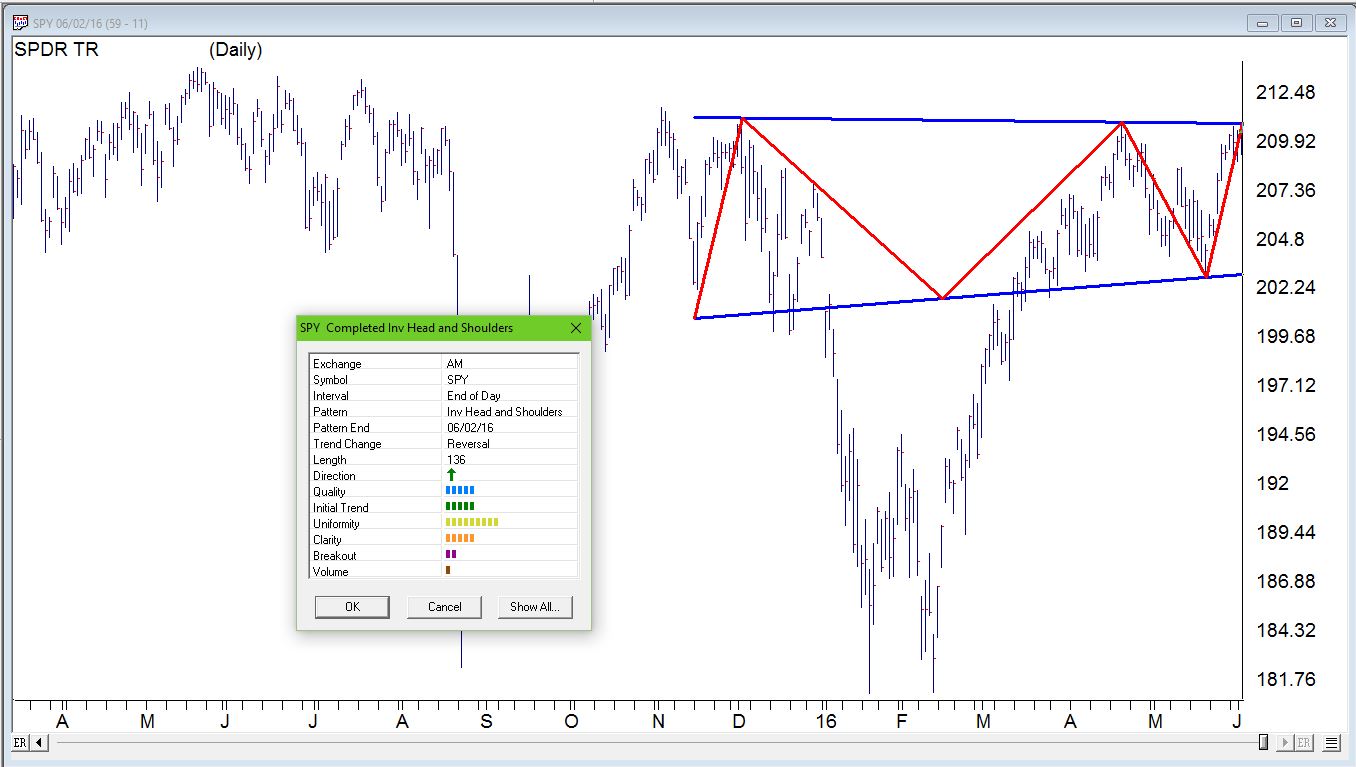
There was an interesting Inverse Head and Shoulders pattern completed last night on SPY. As SPY is the proxy ETF for the S&P500 index, it caught my attention. A closer look at the Chart attached shows this pattern usually breaks out to the upside.
Analysis of the supplementary information clearly shows that the uniformity of this inverse head and shoulders is good, however the overall quality of the pattern is only average. The biggest issue is the lack of volume and lack of power of the breakout. The volume is particularly low. More volume is needed before this pattern is confirmed, particularly on a strong up day.

Learn more about Chart Pattern Recognition for TradingExpert Pro  http://aiqsystems.com/chartpatterns.htm

Classic Flag Breakouts on CVX, NFG, TOT

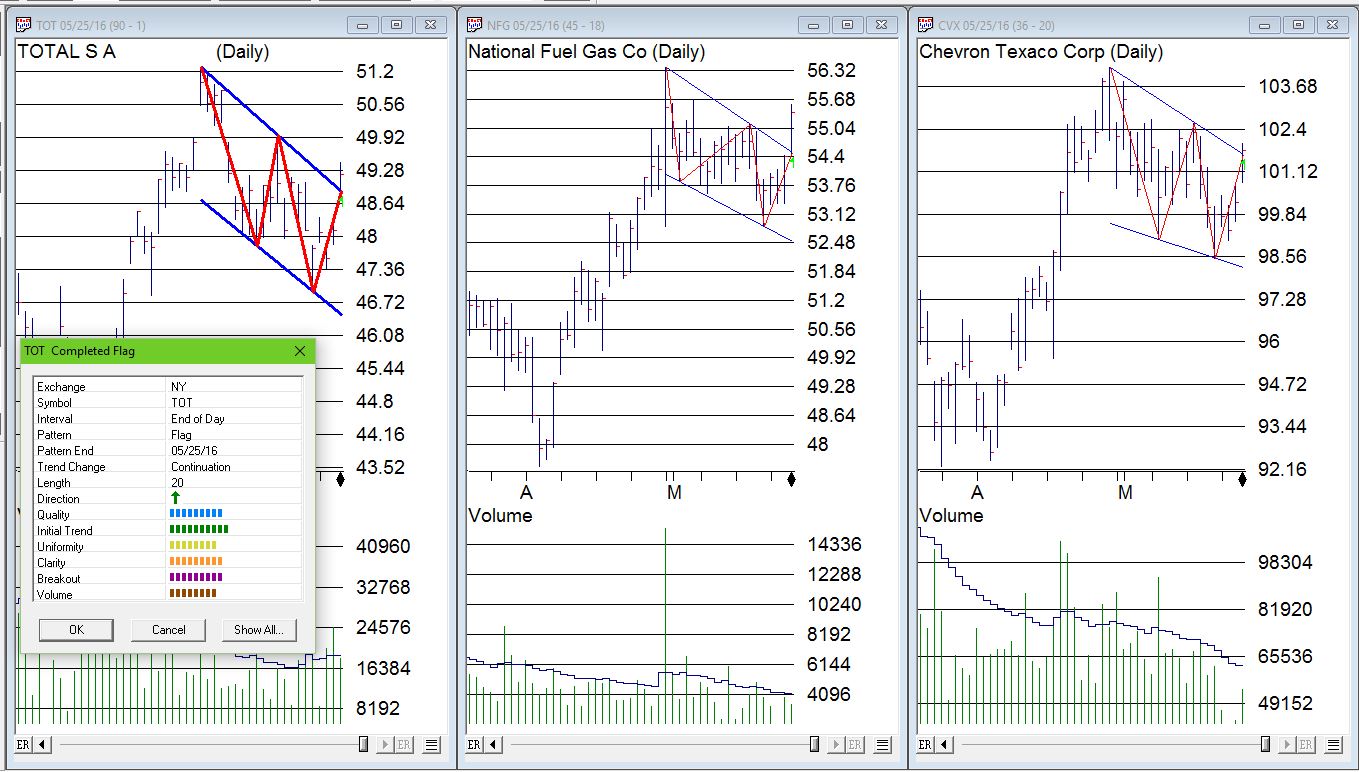
Our Chart pattern Recognition tool had a wealth of gasoline related stocks have breakouts yesterday. The classic flag breakout on good volume could be seen on CVX, NFG and TOT.

Quick reminder on what a flag pattern is.

The flag pattern is considered a continuation pattern after a consolidation period. The flag is a rectangular shape, similar to  the pennant, but the pennant looks more like a triangle.

Usually there’s a strong price movement followed by sideways price movement which is the flag. The pattern is complete when prices breakout in the same direction as the initial price movement. The following move will be in the same direction as the prior sharp move. The move prior to the flag is called the pole.

The flag pattern forms a rectangle with two parallel trendlines that act as support and resistance for the price until the price breaks out. Usually the flag will slope in the opposite direction to the trend.

The buy or sell signal occurs when the price breaks through the support or resistance level, with the trend continuing in the same direction as the pole. The breakthrough should occur on heavier volume.

I’ve put all three charts together and you can clearly see the pole, flag and breakout. As noted above the volume on the breakout on TOT was reasonable. The Quality of the pattern was also considered high.

Incidentally the volume on NFG and CVX was not as significant.

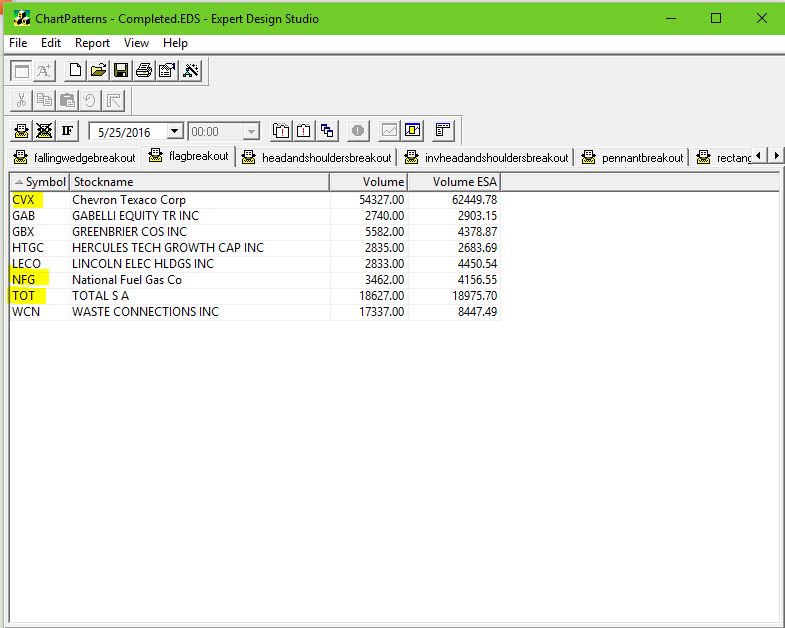
The entire list of stocks that generated completed flags in our nightly report on 5/25/16 is below.

and check out this new video that shows how we automate this reporting every night using the Chart Pattern recognition plug-in for TradingExpert.

Tired of staring at charts time and time again? We have an app for that

Tired of staring at charts time and time again, not certain what is setting up?
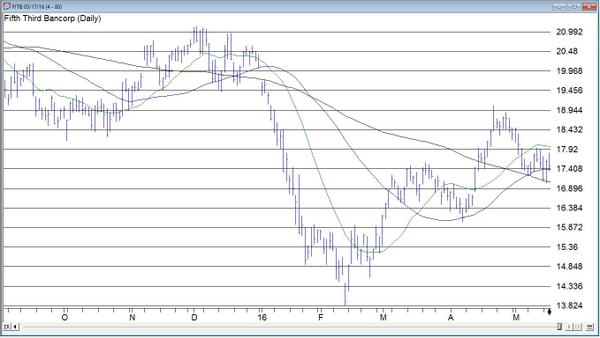
Check out this chart of FITB, Fifth Third Bancorp, How would you have traded this over the last 6 months?
Image
What if you had a tool that shows you the exact pattern that’s setup AND includes the direction the breakout is likely to be? A tool that generates a report every night of chart patterns that have completed and are breaking out. 
​​​​​​​
 Wouldn’t that simplify your trading?
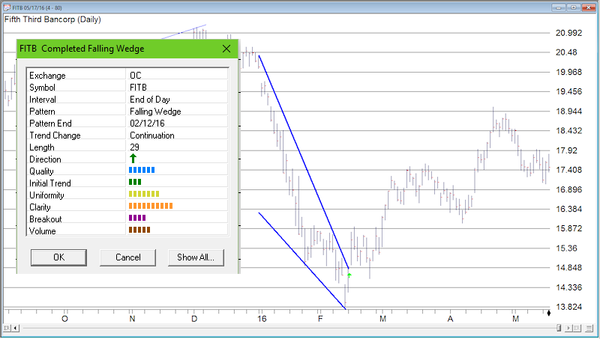
Check out this completed falling wedge pattern from 02/12/16. You would have been alerted to this breakout on 2/12/16, the direction indicator suggested that prices will rise and they did.
 
Image
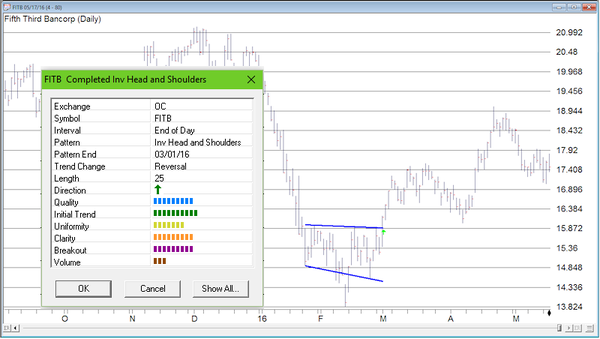
Or this inverse head and shoulders on 3/1/16, the direction indicator suggested prices would rise and they did.
Image
and check out this new video that shows the most recent price pattern we were alerted to on FITB on 5/13/16 AND how we automate this reporting every night.