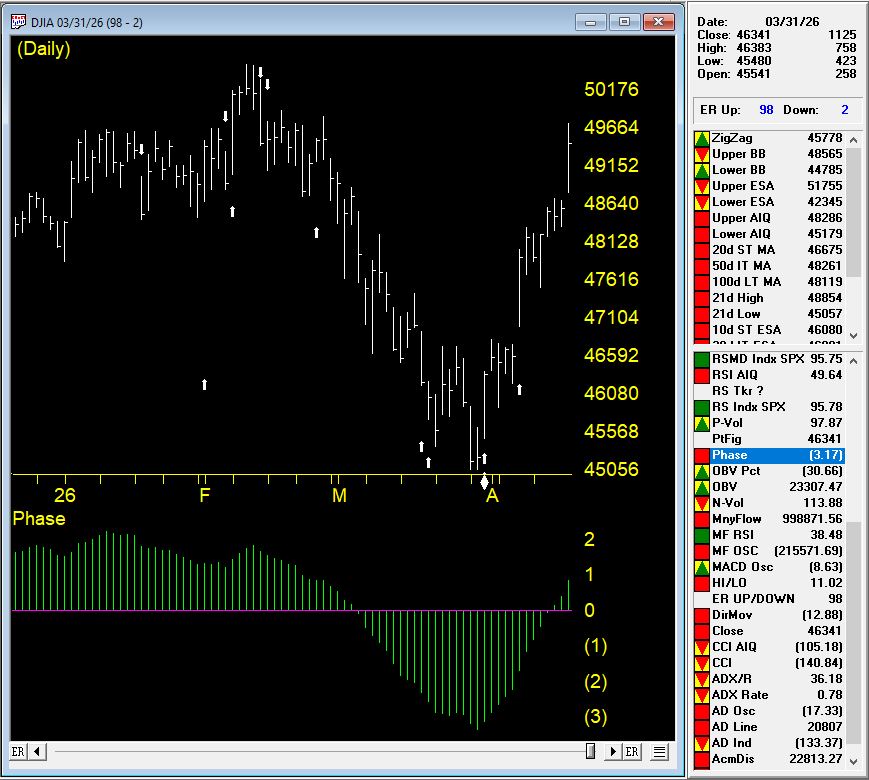
Markets in March 2026 were doing what markets do best — confusing people. Prices were pulling back. Headlines were negative. The majority of traders were uncertain, defensive, or on the sidelines.
But inside TradingExpert Pro, the market timing model was building a case. Not based on opinion. Not based on news. Based on the systematic, rule-by-rule analysis that AIQ has refined over three decades. And by the end of March, that case was overwhelming.
Here’s exactly what the system saw — and what it meant.
March 18 & 19 — The Opening Signal
On March 18, the AIQ market timing model issued an Expert Rating of 96 — Up. The following day, March 19, it fired again: another 96 — Up.
Back-to-back readings above 95 in consecutive sessions are not noise. An Expert Rating above 95 represents a high-conviction bullish technical condition — the system telling you, in its clearest language, that the weight of technical evidence favours higher prices. When that reading repeats on consecutive days, the model is reinforcing its own conclusion.
At this point, the disciplined AIQ trader is already paying close attention.
March 25 — Phase Analysis Confirms the Direction
4 days later, on March 25, Phase Analysis confirmed what the Expert Rating had been signalling.
The market Phase changed to Up.
This is a pivotal moment in any signal sequence. The Expert Rating identifies the condition; Phase Analysis identifies the trend cycle. When a high Expert Rating is followed by a Phase change in the same direction, the two most important components of the AIQ market timing model are in full agreement. The signal is no longer early — it is confirmed.
March 31 — The Full Picture
March 31 produced the most powerful single-day reading in the sequence — an Expert Rating of 98 — Up, arriving with Phase already turned upward. The individual timing rules that fired during this sequence tell a story that every AIQ trader should understand, because they illustrate precisely how the system thinks.
Rule 1: 21-Day Low Intraday Price with Positive Volume Accumulation
Intraday low prices declined to a 21-day low — a reading that, on the surface, looks bearish. But volume accumulation percentage was positive. In AIQ’s market timing logic, this non-confirmation is a weak bullish signal. Price is making new lows, but money is not leaving the market. That divergence matters.
Rule 2: 21-Day Low Closing Price with Rising Advance/Decline Breadth
Closing prices also reached a 21-day low. Again, superficially bearish. But market breadth — measured by advances versus declines — was increasing. When prices fall to new lows but more stocks are advancing than declining, the selling is not broad-based. This non-confirmation is a bullish signal indicating a possible upward price movement. The majority of the market is quietly holding up while the index prints a low.
Rule 3: 21-Day Low Closing Price with Rising Advance/Decline Oscillator
A third rule reinforced the same theme: closing prices at a 21-day low, but the advance/decline oscillator increasing. Another non-confirmation. Another bullish signal. Three separate breadth and price divergence rules all pointing the same direction — up.
Rule 4: 21-Day Stochastic Crossing the 20% Line with Rising Price Phase
The 21-day stochastic advanced and crossed the 20% line, while the price phase indicator was also increasing. In a weakly downtrending market, AIQ classifies this combination as a strong bullish signal suggesting an increase in prices. The stochastic crossing 20% from below is a classic oversold recovery signal — but paired with a rising price phase, it carries significantly more weight.
Rule 5: Rising Volume Accumulation with 21-Day Stochastic Above 20%
Volume accumulation percentage was increasing while the 21-day stochastic moved above the 20% line. In a downtrending market, AIQ rates this a strong bullish signal. Volume accumulation captures the relationship between buying and selling pressure over time. When it starts rising in a downtrend while momentum is recovering from oversold levels, the path of least resistance is shifting.
Rule 6: Negative Price Phase with Rising Volume Accumulation
Finally, even with the price phase still registering negative, volume accumulation had started to advance. In AIQ’s rules, this non-confirmation — volume diverging positively from a negative price phase — is a bullish signal regardless of market type. It doesn’t matter what the trend classification is. When volume accumulation turns up against a negative phase, the model says: the market is preparing to move higher.
What the Full Sequence Tells Us
Step back and look at this sequence as a whole.
March 18: Expert Rating 96 — Up. March 19: Expert Rating 96 — Up, confirmed. March 25: Phase changes to Up, validating both prior signals. March 31: Expert Rating 98 — Up, with six individual timing rules all firing bullish simultaneously, spanning price divergence, breadth divergence, volume accumulation, stochastic recovery, and phase analysis.
Every single component of the AIQ market timing model was in agreement. Rules that look at price. Rules that look at breadth. Rules that look at volume. Rules that look at momentum. All saying the same thing at the same time.
This is exactly the kind of multi-confirmation environment that the system is designed to identify — and that individual traders, relying on headlines or gut instinct, almost always miss. When prices are making 21-day lows and geopolitical news is negative, the human instinct is to step back. The AIQ system, by contrast, was reading below the surface and identifying that the internal structure of the market was quietly rebuilding.
The Lesson
Price can lie. Headlines always lie. But when multiple independent technical rules — breadth, volume, momentum, phase — all non-confirm a price low at the same time, the market is telling you something important: the selling is exhausted, and the buyers are already at work beneath the surface.
The March 2026 signal sequence is a textbook demonstration of why systematic, rule-based market timing produces results that emotional, discretionary trading cannot replicate. You don’t need to know whether the Iran conflict resolves or whether the Fed changes course. You need to know what the internals of the market are doing — and let a proven system tell you.
On March 18, the system said up. On March 19, it said it again. On March 25, Phase confirmed it. On March 31, rules piled on with a 98-rated exclamation mark.
The traders who followed the signals were on the right side of the move. That’s what systematic market timing is built for.