All posts by admin

Great Days for Real Estate

This title implies that perhaps I am talking about the fact that real estate stocks have been performing quite well of late.  As you can see in Figure 1, since bottoming in December 2013, the most heavily traded real estate ETF – ticker IYR – is up over 25%.  And that is a good thing.
iyr bar chart
Figure 1 – Real Estate ETF Ticker IYR (Courtesy: AIQ TradingExpert)

But the most recent rally is not what I am talking about.  I am referring more to what goes on “under the hood.”

As you may know if you (WARNING: Shameless Self-Serving Plug to follow) read my book “Seasonal Stock Market Trends”, I have a “thing” for seasonality in the financial markets.  And I also understand that this is also not everyone’s “cup of tea.”  Depending on one’s point of view seasonal trends can either be considered to be

a) Interesting and potentially useful, OR;
b) Data curve-fitting to the nth degree

Personally I choose a), but you may choose b).  And that’s OK because if we reach the point where we all trade and invest the same then there won’t be anybody left to take the other side of our trades.

The Gist of Seasonal Trends
For the record, the underlying reason that I look at seasonal trends is to attempt to find an “edge.”  I would guess that 90% of traders and investors look at fundamental and/or technical analysis.  I would guess that no more than 10% of traders and investors look at seasonal trends.  So my rhetorical question of the day is:

If you are looking for an edge in the markets does it make sense to look:


a) Where everyone else is looking, OR;
b) Where hardly anyone else is looking?


Again, the choice is yours.

The Best Days for Real Estate
For the following illustration of using seasonal trends we will use ticker REPIX, which is the Profunds Real Estate mutual fund.  For the record, this fund uses leverage of 1.5-to-1.  For those who want less risk – and are willing to settle for less return – there is the Rydex real estate mutual fund (ticker RYRIX) and many real estate ETFs – with ticker IYR being the most heavily traded.

The Strategy – We will hold ticker REPIX on the following trading days each month:

*The first two trading days of the month
*Trading day’s #8, 12 and 15
*The last four trading days of the month

Obviously this particular strategy is only for traders who are “hands on” and willing to hold positions for either 1 day (in the case of trading days 8, 12 and 15) or 6 days (the four end of month days plus the two start of the next month days).  Once again, this is obviously not everyone’s “cup of tea.”  Still, the results are fairly compelling.

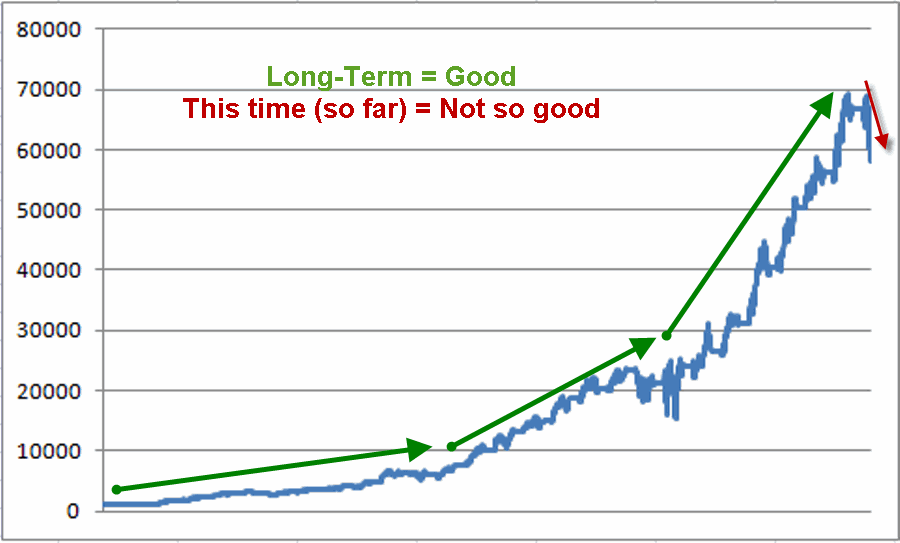
Figure 2 displays the growth of $1,000 invested in ticker REPIX only during the days listed above starting on the August 8, 2000 (when REPIX started trading).

repix 1
Figure 2 – Growth of $1,000 invested in REPIX during “Best Days” (Aug 2000-present)

For the record, $1,000 invested this way grew to $25,694.  Now some people will look at the return and say “hmm, that look pretty good.”  Others will look at the chart itself and say “Wow, that looks way to volatile.” But looking at a set of returns in a vacuum makes it hard to really judge things.
So to get a better feel for things, let’s compare the performance in Figure 2 to that of the S&P 500.  In Figure 2 the blue line represent the growth of $1,000 invested in REPIX as described above while the red line represents the growth of $1,000 invested in ticker SPY on a buy-and-hold basis over the same time period.

repix 2
Figure 3 – Growth of $1,000 invested in REPIX only on “Best Days” (blue line) versus SPY (red line) (Aug 2000-present)

For the record, $1,000 invested in REPIX during seasonally favorable days grew to $25,694 (+2,469%) while $1,000 invested in ticker SPY on a buy-and-hold basis grew to $1,390 (+39%).
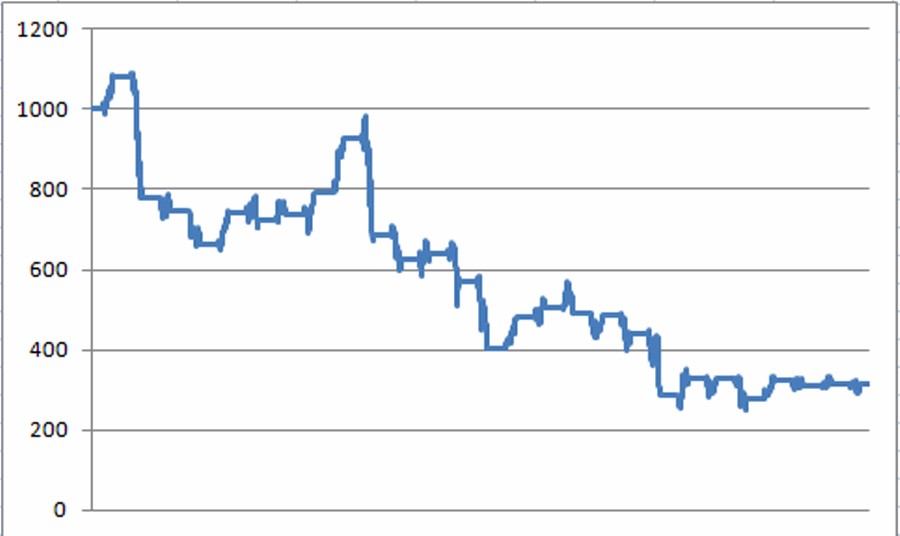
One last comparison to make is to compare the performance of REPI on “seasonally favorable” days versus “all other trading days.”  Figure 4 displays the growth of $1,000 invested in REPIX only during the trading days not listed above.

repix 3

Figure 4 – Growth of $1,000 invested in REPIX only on “non favorable” days (Aug 2000-present)

$1,000 invested in REPIX only on all non-favorable seasonal days actually declined in value to just $82 (-92%).

So let’s sum up the results from August 2000:

 SPY: +39%
REPIX non-seasonally favorable days: -92%
REPIX seasonally favorable days: +2,469%

For the record, the difference in the relative rates of return listed above are what we “quantitative analyst types” refer to as “statistically significant.”

Summary
So is everyone going to now resolve to trade real estate stocks on certain days of each and every single month going forward?  Surely not.  This strategy has serious risk and volatility involved.  So this is not a “hey let’s bet the ranch” type of idea.  Still, a roughly 30% a year average annual return typically does involve some risk.

So most people will shy away from anything even remotely resembling what I have just described.  But if you carefully reread the section above titled “The Gist of Seasonal Trends” then you may come to understand that that is exactly my point.

Jay Kaeppel  
Chief Market Analyst at JayOnTheMarkets.com and AIQ TradingExpert Pro (http://www.aiq.com) client
http://jayonthemarkets.com/

Jay has published four books on futures, option and stock trading. He was Head Trader for a CTA from 1995 through 2003. As a computer programmer, he co-developed trading software that was voted “Best Option Trading System” six consecutive years by readers of Technical Analysis of Stocks and Commodities magazine. A featured speaker and instructor at live and on-line trading seminars, he has authored over 30 articles in Technical Analysis of Stocks and Commodities magazine, Active Trader magazine, Futures & Options magazine and on-line at www.Investopedia.com.

December 23, 2014: Market Minute: A test for the NYSE

This post from Donald Dony (AIQ seminar speaker) posted on December 23, 2014 was right on the nail.

U.S. Equity markets continue to share one element that the rest
of the world’s markets largely failed to accomplish; they are still trending up

However, a significant test is coming for the benchmark NYSE. The index
needs to pass through the 11,100 resistance level to continue the uptrend.

For six months, this mark (11,100) has kept the U.S. index pinned.

Global stock markets normally trade together. Although separation can occur for
six to eight months, they will eventually move as one.

In the lower portion of the chart, is the MSCI World (ex USA) index.

It shows that the peak occurred in mid-year and a new downtrend has been
in-place for five months.

Bottom line: Separation has developed between the benchmark NYSE Composite and
the MSCI World (ex USA) index since August.

The expectation is that the two indexes will move back in sequence in Q1.

We believe that the NYSE will find crossing the 11,100 level a challenge in the
coming months and that the path of the MSCI World (ex USA) index will likely
dominate the NYSE.

Donald W. Dony, FCSI, CFTe, MFTA
D. W. Dony and Associates Inc.
4973 Old West Saanich Rd.
Victoria, BC  V9E 2B2
Ph. 250-479-9463
Fax. 250-479-9417

www.technicalspeculator.com

Sylvain Vervoort’s Price Projections

The AIQ code for this month is based on Sylvain Vervoort’s article in this issue, “Price Projections,” which is part 5 of his ongoing series on exploring charting techniques in Stocks & Commodities magazine. The AIQ code and EDS file can be downloaded from www.TradersEdgeSystems.com/traderstips.htm.

The code runs on daily bars only and computes the various support & resistance levels for the next day’s intraday trading. The levels cannot be plotted on the real-time alerts chart.

In Figure 6, I show a report that was run on the major indexes for 9/10/2014.

Sample Chart
 
FIGURE 6: AIQ. Support & resistance levels are calculated based on end-of-day data as of 9/10/2014 for the major indexes. The levels are for use in intraday trading for the next day (9/11/2014).

The code is as follows:

!PRICE PROJECTIONS
!Author: Sylvain Vervoort, TASC Nov 2014
!Coded by: Richard Denning 9/10/2014
!www.TradersEdgeSystems.com

C is [close].
H is [high].
L is [low].

!To get next day levels we will be running the report at the end of day
!so prior high will be the current H, etc. The report will give the values for 
!the next day but cannot be ploted on a real time chart since we are using
!daily end of day data to compute the levels.

!THIS CODE RUNS ON DAILY DATA:
P is (H+L+C)/3.
R1 is (2*P) - L.
R2 is P + (H - L).
R3 is (2*P) + (H - (2*L)).
S1 is (2*P) - H.
S2 is P - (H - L).
S3 is (2*P) - ((2*H) - L).

NextDayLevels if C > 0 and H > 0 
 and L > 0 and H - L > 0.
 
—Richard Denning
info@TradersEdgeSystems.com
for AIQ Systems

The Truth about the Year-End Stock Market Rally

Yes, it really is “the most wonderful time of the year” – at least in the stock market.  But not always.  But usually.  In my book “Seasonal Stock Market Trends” (which may well be the gift that the trading loved one in your life secretly desires but is too shy to ask for, hint, hint) I wrote about “Holidays.” Starting with works from Hirsch, Fosback, Zweig, Eliades and whoever else I could think of to steal, er, borrow from, I looked at the performance for the stock market on each of the three days before and after a market holiday.

While I personally found the results to be interesting, it strikes me as curve-fitting to say something like “you should be long the stock market the second trading day before Christmas, the day after Thanksgiving , the second trading day after the 4th if July”, etc.  Instead I prefer to look at “holiday trading season” as the three trading days before and the three trading days after a market holiday, in totality.  So this week let’s look at the three trading days before Christmas through the three trading days after New Year’s period.

The Year-End Seasonal Pattern
To define things, we are looking specifically at the period that:
*Starts at the close of trading four trading days before Christmas (in this case, Friday, Dec. 19th, 2014)
*Ends at the close of trading on the third trading day of January (i.e., the third trading day after New Years, in this case, Tuesday, Jan. 6, 2015)

This period during the 2013-2014 year-end period is highlighted in Figure 1.

DJIA year end 
 
Figure 1 – Bullish Year-End Period 2013-2014 (Courtesy: AIQ TradingExpert)


The Results
To get a true sense of the bullish bias during this period, Figure 2 displays the growth of $1,000 invested in the Dow Industrials ONLY during this “bullish year-end” period starting in December 1933.

DJ Year End
 
Figure 2- Growth of $1,000 invest in Dow only during bullish year-end period

The annual results using the Dow Jones Industrial Average appear in Figure 2.

Period End Date DJIA %+(-)
01/04/34 3.67
01/04/35 5.12
01/04/36 3.28
01/05/37 1.83
01/05/38 (4.09)
01/05/39 2.41
01/04/40 2.21
01/04/41 2.74
01/05/42 5.95
01/05/43 0.88
01/05/44 2.05
01/04/45 2.54
01/04/46 0.15
01/04/47 (0.52)
01/06/48 (1.07)
01/05/49 0.41
01/05/50 1.70
01/04/51 4.03
01/04/52 1.34
01/06/53 1.98
01/06/54 0.34
01/05/55 (0.02)
01/05/56 0.45
01/04/57 0.63
01/06/58 2.62
01/06/59 3.18
01/06/60 0.99
01/05/61 1.28
01/04/62 0.02
01/04/63 2.35
01/06/64 0.74
01/06/65 1.14
01/05/66 3.09
01/05/67 1.37
01/04/68 2.05
01/06/69 (3.95)
01/06/70 1.75
01/06/71 2.00
01/05/72 2.19
01/04/73 3.04
01/04/74 6.11
01/06/75 5.42
01/06/76 5.50
01/05/77 0.58
01/05/78 (0.16)
01/04/79 4.59
01/04/80 (1.20)
01/06/81 7.20
01/06/82 (1.38)
01/05/83 4.02
01/05/84 3.24
01/04/85 (1.91)
01/06/86 0.24
01/06/87 3.24
01/06/88 2.38
01/05/89 1.13
01/04/90 3.73
01/04/91 (2.31)
01/06/92 13.41
01/06/93 (0.22)
01/05/94 1.16
01/05/95 2.22
01/04/96 1.25
01/06/97 1.44
01/06/98 1.93
01/06/99 6.19
01/05/00 (0.19)
01/04/01 3.10
01/04/02 1.88
01/06/03 4.89
01/06/04 2.53
01/05/05 (0.60)
01/05/06 0.71
01/05/07 (0.59)
01/04/08 (3.08)
01/06/09 5.08
01/06/10 1.53
01/05/11 2.13
01/05/12 2.58
01/04/13 1.38
01/06/14 0.87
Average 1.88
Median 1.83
Maximum % 13.41
Minimum % (4.09)
# Times Up 66.00
# Times Down 15.00
% Times Up 81.48
% Times Down 18.52

Figure 2 – Year-by-Year Results; Year-End Rally

As you can see in Figure 2, there is some good news and some bad news, but mostly good news. To wit:

*This period has showed a gain 81.5% of the time.
*This period is in no way “guaranteed” to result in a profit as it has showed a loss 18.5% of the time
*The largest up period was +13.41% (1991-1992)
* The largest down period was -4.09% (1937-1938)
*The “average winning trade” and “median winning trade” was +2.62% and +2.16%, respectively.
*The “average losing trade” and “median losing trade” was (-1.42%) and (-1.07%), respectively.

Summary
So is the stock market “sure to rally” between now and 1/6/15? Of course not.  Nevertheless, the results displayed above suggest that traders are typically wise to give the bullish case the benefit of the doubt during the Christmas/New Year’s Holiday Seasonal.

Wishing all readers a “Very Merry Christmas and a Happy New Year” (unless of course, you are offended by this, in which case, wishing you “Whatever”.)

Jay Kaeppel  
Chief Market Analyst at JayOnTheMarkets.com and AIQ TradingExpert Pro (http://www.aiq.com) client
http://jayonthemarkets.com/

Jay has published four books on futures, option and stock trading. He was Head Trader for a CTA from 1995 through 2003. As a computer programmer, he co-developed trading software that was voted “Best Option Trading System” six consecutive years by readers of Technical Analysis of Stocks and Commodities magazine. A featured speaker and instructor at live and on-line trading seminars, he has authored over 30 articles in Technical Analysis of Stocks and Commodities magazine, Active Trader magazine, Futures & Options magazine and on-line at www.Investopedia.com.

If You Just Have to Pick a Bottom in Crude Oil…

OK, let’s be candid about this title.  The reality is that no one ever “has to pick a bottom.”  In fact, we are advised time and again to avoid this very activity as it is considered to be “dangerous”, “foolhardy” and/or “unlikely to succeed”, depending on the person dispensing the wisdom.
Still, if you are reading this article then chances are you are doing so because at some point in your (checkered?) trading past you have either been tempted to “pick a bottom (and/or top)” or you have actually tried to do so.

 So you know deep down that it is probably not a very good idea.  Still, it sure is tempting isn’t it?  I mean let’s be honest here.  Who doesn’t want to be able to say they “picked the bottom” in, well, something, whatever. And you sure can make a lot of money if you get in at exactly the right moment.

So let’s dispense with niceties and conventional wisdom and acknowledge the fact that we are in fact imperfect beings, complete with foibles, faults, bad habits and extremely subject to human nature (and isn’t that a pain in the rear).  So if you consider yourself to be a “trader” it may be hard to look at the recent free-fall in oil and perhaps gold prices and not say “Man, this thing is due to bounce.  I wonder if there is a way to play this?”  So let’s take a look at one way to play a potential bounce in crude oil.

A Few Important Caveats
1) I haven’t the slightest idea if crude oil will bounce soon or not.  In fact, if my gut told me that it was then my first reaction would likely be to ignore it (but enough about my own personal psychoses’).
2) Regardless of whatever the rest of this article says the cold hard reality is that this exact moment in time is probably not the moment that crude oil will bottom out.  In fact, it could continue to fall precipitously for some time to come.
3) Yes, trying to pick a bottom in anything is in fact analogous to attempting to catch a falling knife. It’s a really cool trick if it works, but it can get a little messy otherwise.

So I am NOT “predicting” that crude is about to bounce and I am NOT recommending that you take the trade I will discuss in a moment.

So what is the point?  The point is this: There is a right way and a wrong way to do everything, no matter how wise or foolish the current “thing” in question may be.  If you are going to pick a bottom then you want to do two things:

1) Understand going in that you are playing a long shot so prepare yourself mentally in advance to fail (in fact you might even want to go ahead and prepare yourself to kick yourself and say “What the heck was I thinking about?”).
2) Do everything possible to minimize your risk based on current circumstances.

One Way to Play a Bounce in Crude
OK, all caveats out of the way, let’s now go ahead and “take the plunge.”  A few key factors:

1) My own personal opinion is that any trade that attempts to pick a top or bottom should involve the use of options.  Why?  Simple – limited risk.  To better appreciate this, imagine the poor schlub who bought a January 2015 crude oil futures contract on 10/3 when the 2-day RSI (which I like by the way) dropped below 5, thus strongly suggesting that crude oil was “oversold”.  As you can see in Figure 1, since that time, Jan2015 CL has fallen from 87.87 to 55.91. At $1,000 a point, that works out to a loss of -$32,900 per contract.  Ouch.  And thanks for playing our game.

cl f1

Figure 1 – “Oversold” Crude Oil not such a Bargain (Courtesy: AIQ TradingExpert)

2) The current “waterfall” decline in crude is not without precedent.  In Figure 2 – which displays a continuation chart of crude oil futures – you can see several occasions when the bottom dropped out of crude oil, so to speak.  In the past these types of declines have typically lasted 3 to 8 months.  The current decline is in its 6 month. Likewise, as of 12/16, the monthly 2-month RSI was at its lowest reading in 30+ years of trading.  The point here is not to argue that a reversal is imminent, only that it isn’t entirely crazy to think that a bounce is possible.

cl f2
Figure 2 – Crude Oil “waterfall declines” past and present (Courtesy: AIQ TradingExpert)

The least expensive way to play a potential bounce in crude oil is via options on ticker USO, the ETF that tracks (more or less) the price of crude oil.  In Figure 3 you see the USO bar chart with the 90+ day implied option volatility plotted.

cl f3
Figure 3 – Implied Volatility for USO options has “spiked” (Courtesy: www.OptionsAnalysis.com)

IV has spiked to its highest level in years.  This has important implications for option traders. High implied volatility simply tells us that there is a lot of time premium built into the price of USO options.  As a result, traditional bullish strategies such as buying calls or bull call spreads may be poor choices for someone looking to play a bounce.  This is because implied volatility typically (albeit not always) declines when a security bounces higher off of a panic selling bottom.  Selling a bull put spread might make sense as an alternative.  However, I personally don’t advocate that strategy in the face of an ongoing waterfall decline.  A bull put spread is best used when there is some sort of support level that a trader can use as an “uncle” point.

So what to do?

What to Do
Well as I stated earlier, for the vast majority of traders the best course is to “do nothing” and NOT attempt to pick a bottom in crude.  However, we are talking about what actions a trader might consider if he or she has decided to “take a flyer”.  So here is one possibility – a “Reverse Call Calendar Spread.”

As long as we are breaking all the rules I think it is OK to point out that a reverse calendar spread is a strategy that most traders will never use, and in most cases should never use.  But every tool has its use.  What we are looking for in this case is:

1) Price movement between now and the first week of February, and;
2) A decline in implied volatility

So one way to play is:
*Buy 1 Feb 2015 21 Call @ 1.46
*Sell 1 Mar 2015 21 Call @ 1.77
The prospects for this trade appear in Figures 4 and 5.

cl f4
Figure 4 – Reverse call calendar spread for USO (Courtesy: www.OptionsAnalysis.com)
cl f5
Figure 5 – Reverse call calendar spread for USO (Courtesy: www.OptionsAnalysis.com)

A few key things to note for starters:

1) Assuming this trade is held until February expiration and implied volatility remains unchanged this trade (based on a 1-lot) has $31 of profit potential and $80 of risk.
2) “Vega” represents the amount that the trade will gain or lose if implied volatility rises by 1 percentage point.  This trade has a Vega of $-0.67.  This means that if volatility keeps rising lose potential may also increase.  However, if IV falls the profit potential for this trade will increase.  If IV falls 10 percentage points the profit on this trade will increase (roughly) $6.70.
3) Implied volatility for the options in this trade are extremely high (45% or more) on a historical basis.
4) From a risk management perspective the most important thing to note is that this trade should NOT be held until February option expiration.  By planning to be out no later than two weeks prior to expiration (i.e., by Feb. 6) we completely eliminate that potential of experiencing the maximum potential loss, and in fact reduce the worst case scenario significantly.

Let’s make the following assumptions to highlight exactly what this trade is designed to achieve.  The information in Figures 6 and 7 assume:

1) That the trade will be held no later than Feb. 6, and;
2) That implied volatility falls 40% from current level (i.e., current IV x 0.6)
In Figures 6 and 7 you clearly see the potentially positive implications for a meaningful decline in implied volatility.

cl f6
Figure 6 – USO reverse calendar if IV declines back under 30% (Courtesy: www.OptionsAnalysis.com)
cl f8
Figure 7 – USO reverse calendar if IV declines back under 30% (Courtesy: www.OptionsAnalysis.com)

In this scenario, the maximum risk declines to roughly -$5 on 1-lot and the break-even range is greatly compressed thus significantly raising the probability of a profitable trade.

Summary
So all in all, it is typically a bad idea to try to pick a top or bottom in the financial markets.  But all of us are human, and human nature can occasionally lead a trader to “feel the urge.”  If the urge is too great and you feel you must act, then remember to do everything in your power to limit your risk.
If your bottom picking trade works out, great (but don’t let it go to your head).  And if it does not, then at least you didn’t “bet the ranch.”

Jay Kaeppel  
Chief Market Analyst at JayOnTheMarkets.com and AIQ TradingExpert Pro (http://www.aiq.com) client
http://jayonthemarkets.com/

Jay has published four books on futures, option and stock trading. He was Head Trader for a CTA from 1995 through 2003. As a computer programmer, he co-developed trading software that was voted “Best Option Trading System” six consecutive years by readers of Technical Analysis of Stocks and Commodities magazine. A featured speaker and instructor at live and on-line trading seminars, he has authored over 30 articles in Technical Analysis of Stocks and Commodities magazine, Active Trader magazine, Futures & Options magazine and on-line at www.Investopedia.com.