All posts by admin

Seasonal E-mini Strategy – 42 Wins and 0 Losses?

Don’t you just hate titles like this one?  I mean if you are into the stock market you almost can’t help but to click on it – even if for no other reason than to seek the answer to that age old question, “What’s the catch?”

Now in this case the title is accurate, at least in the hypothetical sense.  But as you probably know, for any book, article or publication the name is everything.  For example, if the title of this article were “Would You Be Willing to Risk $3,000 on a Trade for the Chance of Making as Little as $25 on Said Trade?” (which would also be hypothetically accurate), you would be a lot less likely to click on the link, right?  I mean let’s be honest here.

So, yes, technically you can’t judge a book (article or publication) by its cover.  But in reality, we all do it all the time.  So just remember that  the people designing the covers have a vested interest in getting you to open the cover, so be forewarned.

Hence the title of this article.  But since you’ve already “cracked open the cover”, why not read on a little further?  (Insidious, no?)

A Seasonal Oversold “Idea”
Note the use of the word “Idea” in the section title.  And also please remember that the word “idea” is quite different from the words “sure” and/or “thing” and way different from the phrase “you can’t lose.”  So again, be forewarned.  In the interest of full disclosure I am not attempting to urge you to use the “idea” spelled out below – only to be “aware” of it and to consider whether or not it might “fit your style.”

So what’s this all about?  Simple.  Awhile back I wrote a piece titled “Happy Days are Here, Um, Next Monday?” that in a nutshell highlighted the fact that the stock market tends to perform well between the close of trading on the Friday before Thanksgiving and the close of the third trading day of the following January.  The “idea” in this article builds from that trend.

Entry Rules
Here are the “rules” (to paraphrase the immortal words of Bill Murray, they are really “guidelines” more than “rules”, but here goes):

*If today is between (and including) the Friday before Thanksgiving and the third trading day of the New Year, AND;
*The 2-day RSI is below 30, a “buy alert” is signaled.
*After a “buy alert” occurs, a “buy signal” occurs when the E-mini S&P 500 exceeds a previous day’s high price (however, a “buy signal” cannot occur after the third trading day of January).

Exit Rules (OK, again – Guidelines):
*Sell if the E-mini S&P declines 60 (i.e., $3,000 per contract) points from the buy trigger price (i.e., the previous day’s high + 0.25 points), OR
*On the first profitable close.

Results
Starting in November 2004 there have been 42 trades.  During this time there have been no post buy declines of 60 points (although a few have come close), hence the reason no losing trades.
Figure 1 displays the most recent signal using the December 2014 E-mini S&P 500 contract.

es-ss 1 
Figure 1 – Seasonal Oversold Trade for 2014-2015 (so far); Source: AIQ TradingExpert

Figure 2 displays the trades from the 2013-2014 periods.

es-ss2
Figure 2 – Seasonal Oversold Trade for 2013-2014 (Source: AIQ TradingExpert)

Figure 3 displays the trades from the 2012-2013 periods.

es-ss3

Figure 3 – Seasonal Oversold Trade for 2012-2013 (Source: AIQ TradingExpert)

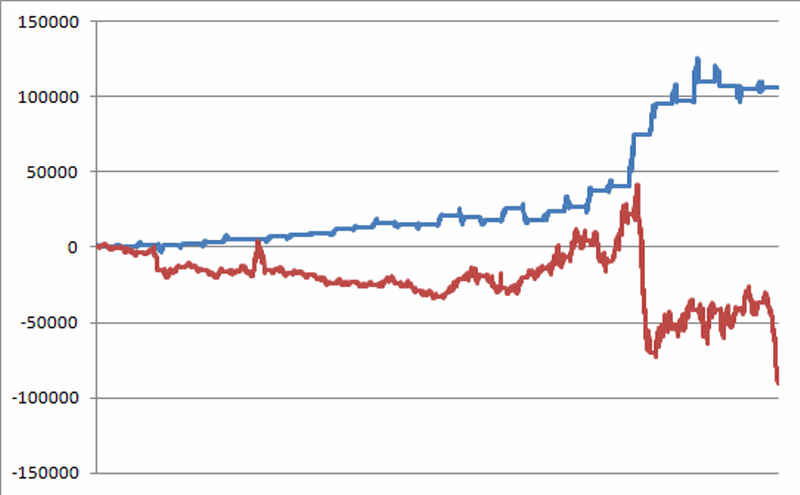
Figure 4 displays the trades signaled each year during the bullish seasonal period (assuming a 1-lot per trade).

Trade # Entry Date Exit Date Buy Price Sell Price Points +(-) per Trade $ +(-) per Trade MaxDD Pts. per Trade MaxDD $ per Trade
1 11/23/04 11/24/04 1179.25 1182.00 2.75 $137.50 (7.75) ($388)
2 12/01/04 12/01/04 1179.75 1189.75 10.00 $500.00 (4.75) ($238)
3 12/09/04 12/09/04 1187.00 1190.75 3.75 $187.50 (11.25) ($563)
4 12/20/04 12/21/14 1203.75 1208.00 4.25 $212.50 (8.50) ($425)
5 12/01/05 12/01/05 1263.25 1264.50 1.25 $62.50 (11.50) ($575)
6 12/12/05 12/13/05 1272.75 1277.00 4.25 $212.50 (9.00) ($450)
7 12/21/05 12/22/05 1272.25 1275.50 3.25 $162.50 (5.50) ($275)
8 01/03/06 01/03/06 1259.25 1274.75 15.50 $775.00 (7.75) ($388)
9 11/29/06 11/29/06 1392.75 1402.25 9.50 $475.00 (0.50) ($25)
10 12/11/06 12/14/07 1428.00 1438.25 10.25 $512.50 (11.00) ($550)
11 12/27/06 12/27/06 1431.25 1437.00 5.75 $287.50 (0.25) ($13)
12 11/23/07 11/28/07 1440.00 1442.00 2.00 $100.00 (33.25) ($1,663)
13 11/26/07 11/28/07 1444.25 1470.50 26.25 $1,312.50 (37.50) ($1,875)
14 11/28/07 11/28/07 1441.25 1470.50 29.25 $1,462.50 (0.25) ($13)
15 12/05/07 12/05/07 1478.00 1487.00 9.00 $450.00 (1.25) ($63)
16 12/19/07 12/20/07 1471.75 1474.75 3.00 $150.00 (16.00) ($800)
17 11/24/08 11/24/08 814.50 848.00 33.50 $1,675.00 (7.25) ($363)
18 12/03/08 12/03/08 851.00 868.50 17.50 $875.00 (24.75) ($1,238)
19 12/16/08 12/16/08 885.50 912.75 27.25 $1,362.50 (9.75) ($488)
20 12/26/08 12/29/08 870.00 870.50 0.50 $25.00 (16.75) ($838)
21 11/23/09 11/23/09 1102.50 1103.75 1.25 $62.50 (1.25) ($63)
22 12/01/09 12/01/09 1104.75 1108.50 3.75 $187.50 (2.50) ($125)
23 12/04/09 12/22/09 1112.25 1113.50 1.25 $62.50 (3.75) ($188)
24 12/10/09 12/11/09 1097.75 1103.25 5.50 $275.00 (5.25) ($263)
25 12/21/09 12/22/09 1107.75 1108.25 0.50 $25.00 (11.25) ($563)
26 01/04/10 01/04/10 1124.25 1128.75 4.50 $225.00 (4.75) ($238)
27 11/24/10 12/01/10 1187.75 1196.50 8.75 $437.50 (11.50) ($575)
28 12/01/10 12/01/10 1197.50 1204.50 7.00 $350.00 (0.50) ($25)
29 12/16/10 12/21/10 1244.50 1250.75 6.25 $312.50 (12.00) ($600)
30 01/03/11 01/03/11 1258.50 1265.25 6.75 $337.50 (3.25) ($163)
31 11/28/11 11/28/11 1174.50 1191.00 16.50 $825.00 (5.25) ($263)
32 12/09/11 12/09/11 1250.50 1253.00 2.50 $125.00 (17.75) ($888)
33 12/15/11 12/20/11 1218.75 1236.00 17.25 $862.50 (23.25) ($1,163)
34 12/20/11 12/20/11 1218.75 1236.00 17.25 $862.50 (20.00) ($1,000)
35 12/30/11 01/03/12 1258.75 1272.00 13.25 $662.50 (8.00) ($400)
36 12/05/12 12/06/12 1412.00 1413.00 1.00 $50.00 (15.25) ($763)
37 12/17/12 12/17/12 1419.50 1427.00 7.50 $375.00 (10.25) ($513)
38 12/26/12 01/02/13 1424.75 1457.00 32.25 $1,612.50 (42.50) ($2,125)
39 12/31/12 12/31/12 1417.00 1420.00 3.00 $150.00 (33.50) ($1,675)
40 12/06/13 12/06/13 1794.50 1803.75 9.25 $462.50 (8.75) ($438)
41 12/16/13 12/16/13 1783.25 1786.00 2.75 $137.50 (17.75) ($888)
42 12/02/14 12/02/14 2061.25 2066.00 4.75 $237.50 (10.50) ($525)
Points $ Points $
Average 9.32 $466 (11.74) ($587)
Median 6.00 $300 (9.38) ($469)
Max 33.50 $1,675 (0.25) ($13)
Min 0.50 $25 (42.50) ($2,125)

Figure 4 – Hypothetical Trade-by-Trade Results

A few things to note:

*42 winners, 0 losers
*Maximum drawdown per 1-lot = -$2,125
*Average winner in points (dollars) = +9.32 (+$466)
*Median winner in points (dollars) = +6.00 ($300)
*Average Maximum drawdown per trade in points (dollars) = -11.74 (-$587)
*Median Maximum drawdown per trade in points (dollars) = -9.38 (-$469)

Summary
So on the face of it, anything that is capable of generating 42 consecutive winning trades would seem to have some merit to it.  On the other hand, with any trading method it is critically important to look “under the hood” and make some realistic assessments regarding the actual usefulness of said method.

The system rules include a 60 point stop-loss for the E-mini S&P 500 futures contract.  At $50 a point, this equates to a potential loss of $3,000 per contract per trade.  The average dollar profit was only $466 and the median dollar profit per trade was $300.

The key elements of risk in this method then are:

1) One losing trade of $3,000 could require a number of trades to come back from.
2) Using a tight stop-loss will result in a number of losing trades that would ultimately have ended up winners.

So the question for a trader to ask is – can we judge this book by its cover?

Jay Kaeppel  
Chief Market Analyst at JayOnTheMarkets.com and AIQ TradingExpert Pro (http://www.aiq.com) client
http://jayonthemarkets.com/

Jay has published four books on futures, option and stock trading. He was Head Trader for a CTA from 1995 through 2003. As a computer programmer, he co-developed trading software that was voted “Best Option Trading System” six consecutive years by readers of Technical Analysis of Stocks and Commodities magazine. A featured speaker and instructor at live and on-line trading seminars, he has authored over 30 articles in Technical Analysis of Stocks and Commodities magazine, Active Trader magazine, Futures & Options magazine and on-line at www.Investopedia.com.
Three Sector Funds for December

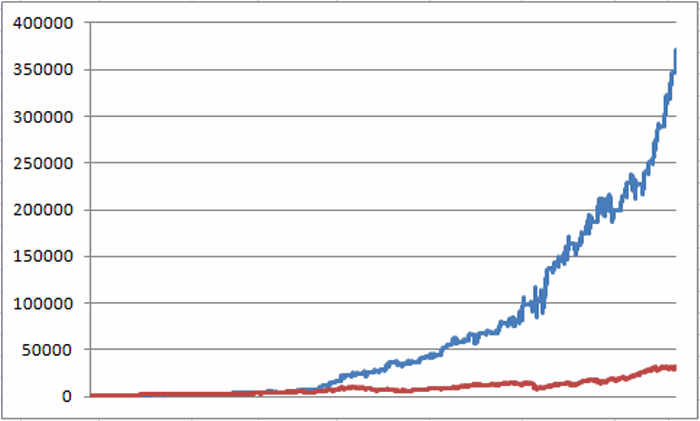
December has historically been a bullish month for the stock market. In fact, over the past 24 years, buying and holding an S&P 500 Index fund during the month of December would have netted a gain 20 times, or 83.3% of the time, with an average gain of almost +2% (+1.93% actually).  A lot of investors might be tempted to say “That’s good enough for me”, and who could blame them?
But there might be a way to do even better.

Certain sectors show historical tendencies to perform well during certain times of the year.  So let’s look at a simple 3 fund portfolio that has performed quite a bit better than the S&P 500 over the past 24 years.

The “December Three”
The three sectors are Biotech, Software and Home Construction.  Figure 1 displays some potential trading vehicles.

Sector Fidelity ETF
Biotech FBIOX IBB
Software FSCSX VGT
Home Construction FSHOX XHB

Figure 1 – Fidelity and ETFs


Results
For testing purposes we will use the Fidelity funds listed in Figure 1 as they have historical data going back much further than the ETFs listed.

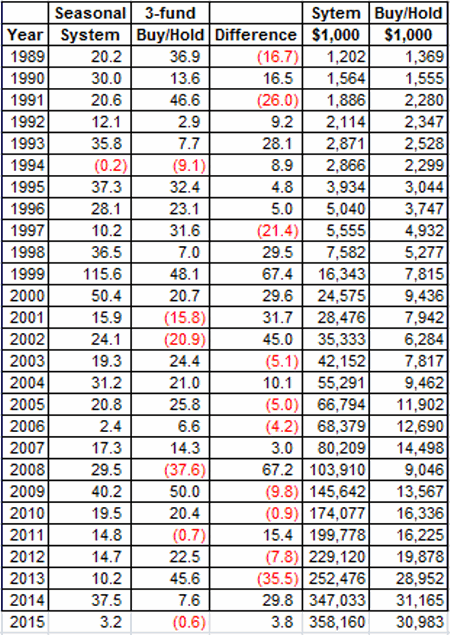
Figure 2 displays the annual result of a portfolio split evenly between the three funds versus the S&P 500 Index.

Fid 3

Figure 2 – Annual Results: 3 Fidelity Sector Funds vs. SPX

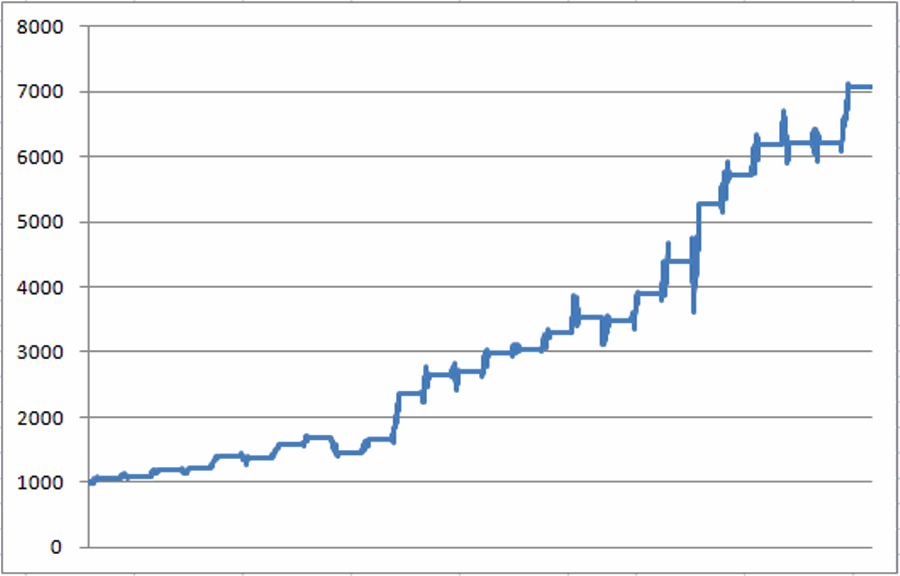
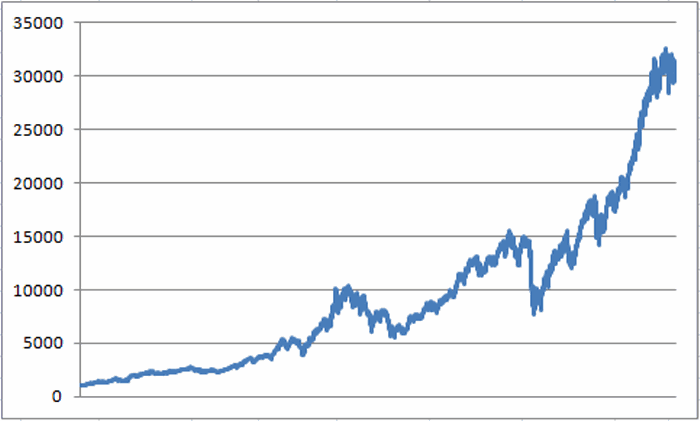
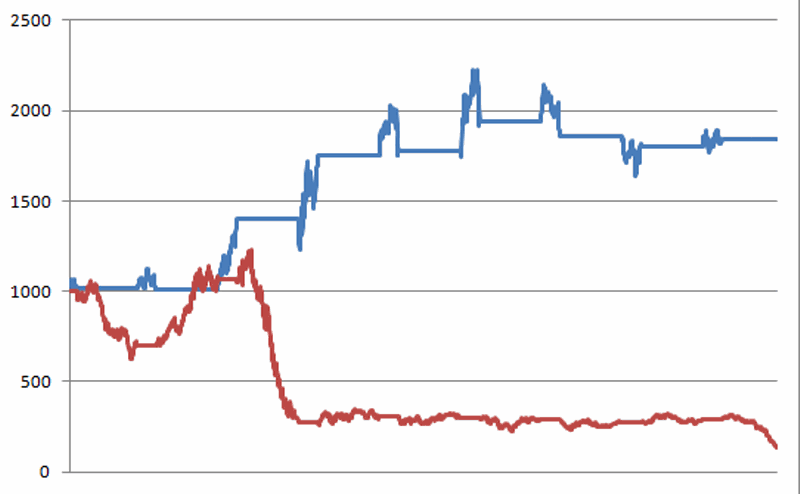
Figure 3 displays the growth of $1,000 invested only during the month of December in the “Fidelity 3” versus the S&P 500 Index.

 Fid 3 chart

 
Figure 3 – Growth of $1,000 invested in Fidelity 3 versus SPX (1990-2013)

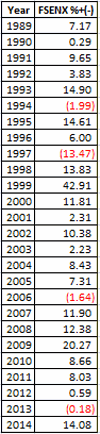
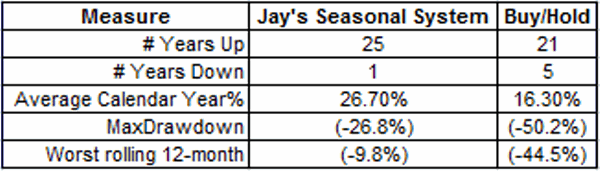
Figure 4 displays the relevant comparative figures.

 fid 3 results

 
Figure 4 – Comparative Results

A few things to note:

*The Fidelity 3 has gained an average of +4.21% versus +1.93% for SPX.
*The Fidelity 3 median gain was +2.52% versus +1.25% for SPX.
*The Fidelity 3 has showed a higher standard deviation, but also a *higher Average/Standard Deviation.
*The worst December for the Fidelity 3 was -4.99% versus -6.03% for SPX.
*Interestingly, the Fidelity 3 has been up 19 times and down 5, versus up 20 and down 4 for SPX. 

However – and most importantly – the Fidelity 3 has outperformed SPX in 18 of the past 24 years.

Summary
So are biotech, software and home construction guaranteed to show a gain and outperform the S&P 500 this December.  Not at all. But for an investor looking to “beat the market”, it certainly is “food for thought.”

Jay Kaeppel  
Chief Market Analyst at JayOnTheMarkets.com and AIQ TradingExpert Pro (http://www.aiq.com) client
http://jayonthemarkets.com/

Jay has published four books on futures, option and stock trading. He was Head Trader for a CTA from 1995 through 2003. As a computer programmer, he co-developed trading software that was voted “Best Option Trading System” six consecutive years by readers of Technical Analysis of Stocks and Commodities magazine. A featured speaker and instructor at live and on-line trading seminars, he has authored over 30 articles in Technical Analysis of Stocks and Commodities magazine, Active Trader magazine, Futures & Options magazine and on-line at www.Investopedia.com.
It’s a bullish time of year

Some call it a “Santa Claus Rally” or
“Year-End Rally.”  Others call
it an early “January Effect.”  Whatever
the name, we just entered a bullish seasonal period for equities.  Jay Kaeppel, author of Seasonal Stock Market Trends, crunched the numbers to demonstrate
the bullish market tendencies surrounding the Thanksgiving to New Year’s
holiday season.  Here are the results:

            The bullish
period starts the Monday before Thanksgiving and ends the third trading day in January.  Since 1949, the Dow Jones Industrial Average
was up on 54 occasions, or 83 percent of the time during the this period.  Even more bullish, the trading period
witnessed a gain in 27 of the last 29 years! 
The average gain was 3.2 percent while the median gain was 3.1
percent.  The largest gain was 13.9
percent in 1991-92.  The worst period was
-3.7 percent in 1977-78.         

            What does
this mean for portfolio returns?  If you
invested $1000 in the Dow only during the bullish period (Monday before Thanksgiving
to third trading day in January) the portfolio would now be $7400.  That’s very good, especially since this
assumes you make no money from January to mid-November of every year.

            Does this
mean stocks will rally in the seasonal period we just entered?  Investing in seasonal patterns is a bet on
odds or probabilities and this year stocks entered the period right after a
monster rally.  While history shows
losses can occur, the statistics point toward higher stock prices between now
and early January.  That’s fine by me!


 — David Vomund is an Incline Village-based fee-only money
manager.  Information is found at www.ETFportfolios.net or by calling 775-832-8555.  Clients hold the positions mentioned in this
article.  Past performance does not
guarantee future results.  Consult your
financial advisor before purchasing any security. 

Happy Days Are Here, Um, Monday?

It is not a little known fact that historically the action of the stock market has been relatively favorable both around holidays and towards the end of the year.  But some question remains as to just how favorable things have been during these periods and how often.  So let’s address it.

The Year-End (or “Santa Claus”) Rally
Different analysts will look at historical data and draw different conclusions.  This is actually a good thing, otherwise everyone would be trying to buy or sell at the same time.

But in the opinion one analyst (“Hi, my name is Jay”) the “year-end rally” period (or as I like to call it the “Santa Claus Rally”):

*Starts on the Monday before Thanksgiving
*Ends at the close of the third trading day of the following January

Have I mentioned lately that this stuff doesn’t need to be rocket science?

So how has this period performed?  We will start our test at the close of trading on Saturday (yes, Saturday) November 19, 1949 and examine what would have happened to a hypothetical $1,000 investment in the Dow Jones Industrials Average that was in the market only during the bullish year-end period described above (in other words, the trader would buy the Dow Industrials Average at the close on the last trading day prior to the Monday before Thanksgiving and would hold through the close of the third trading day of the following January.  The rest of the time the “system” is out of the market.  For our purposes, no interest is earned so as to reflect only the gains made during the bullish year-end period).

The results appear in chart form in Figure 1.santa rally
Figure 1 – Growth of $1,000 invested in the Dow Industrial Average only during the bullish year-end period described in text

Figure 2 displays the annual year-by-year results in table form.

Exit Date
% +(-)
1/5/50
3.6
1/4/51
4.0
1/4/52
3.9
1/6/53
4.6
1/6/54
2.9
1/5/55
5.1
1/5/56
0.2
1/4/57
3.7
1/6/58
(0.0)
1/6/59
5.7
1/6/60
5.8
1/5/61
3.2
1/4/62
(1.0)
1/4/63
5.0
1/6/64
8.2
1/6/65
(1.2)
1/5/66
3.0
1/5/67
(0.5)
1/4/68
4.3
1/6/69
(3.1)
1/6/70
(2.4)
1/6/71
10.0
1/5/72
11.6
1/4/73
3.4
1/4/74
(1.2)
1/6/75
3.6
1/6/76
6.0
1/5/77
3.1
1/5/78
(3.7)
1/4/79
3.6
1/4/80
1.6
1/6/81
1.5
1/6/82
0.9
1/5/83
2.3
1/5/84
2.5
1/4/85
(0.3)
1/6/86
5.7
1/6/87
4.3
1/6/88
6.5
1/5/89
6.2
1/4/90
5.4
1/4/91
0.6
1/6/92
13.9
1/6/93
2.4
1/5/94
2.8
1/5/95
0.9
1/4/96
3.7
1/6/97
1.5
1/6/98
0.3
1/6/99
4.2
1/5/00
1.1
1/4/01
2.7
1/4/02
4.0
1/6/03
(0.4)
1/6/04
9.5
1/5/05
1.3
1/5/06
1.1
1/5/07
0.4
1/4/08
(2.9)
1/6/09
12.0
1/6/10
2.5
1/5/11
4.6
1/5/12
5.3
1/4/13
6.7
1/6/14
1.6
Figure 2 – Year-by-Year “Santa Claus Rally” % +(-)


A few performance notes:
# times UP = 54 (83% of the time)
# times DOWN = 11 (17% of the time)
Average% +(-) = +3.19%
Median % +(-) = +3.08%
Largest % Gain = +13.87% (1991-92)
Largest % Loss = (-3.69%) (1977-78)

It is also worth noting that the year-end rally period has witnessed a gain for the Dow in 27 of the last 29 years and 33 of the last 36 years.

Summary
So do the results displayed in Figures 1 and 2 guarantee that the stock market is destined to rally in the near future?  Ah there’s the rub.  For the answer is “not necessarily”.  Still, investing is in many ways a game of odds and probabilities.  While one always needs to be prepared to act defensively if things start to go south, history suggests that traders and investors might do well to give the bullish case the benefit of the doubt between Thanksgiving Week and early January 2015.

Or to put it more succinctly:
Jay’s Trading Maxim #215: Santa Claus is real (approximately 83% of the time).

Jay Kaeppel  
Chief Market Analyst at JayOnTheMarkets.com and AIQ TradingExpert Pro (http://www.aiq.com) client
http://jayonthemarkets.com/

Jay has published four books on futures, option and stock trading. He was Head Trader for a CTA from 1995 through 2003. As a computer programmer, he co-developed trading software that was voted “Best Option Trading System” six consecutive years by readers of Technical Analysis of Stocks and Commodities magazine. A featured speaker and instructor at live and on-line trading seminars, he has authored over 30 articles in Technical Analysis of Stocks and Commodities magazine, Active Trader magazine, Futures & Options magazine and on-line at www.Investopedia.com.
Holiday Sale up to 75% off selected Books, DVDs and Courses

this is dynamite

Holiday Sale up to 75% off selected Books, DVDs and Courses
New Money-Making Trading Systems: Advanced Results from 6 Simple, Proven Strategies 

One of the more important questions that traders face periodically is to determine when a stock or a market is reversing.

Image
Over the past 20 years, Steve Palmquist has done just that – backtested countless market adaptive trading techniques. In this brand-new, six-hour DVD course, Steve reveals the results of his tests on Bollinger bands, declining volume pullbacks and retracements, as well as volume accumulation and distribution to bring you six proven trading strategies. 

Each system was developed, tested, and analyzed for maximum profits

Steve will provide you with complete rules and exit strategies that have been back tested in various market conditions and time frames. Steve will also show you how to analyze the current market conditions and select the trading strategy that will make you the most money in a bear, bull, or trading range market. As Steve guides you through his six proven strategies, you will learn:

  • How to use time stops, price targets, and money management techniques to improve results,
  • Specific techniques for selecting among multiple trading candidates based on extensive testing and analysis, and 
  • To understand market behavior and to position yourself to profit from different market characteristics.


Don’t make costly mistakes by following the latest trading system blindly. Let Steve’s experience and expertise work for you. In this DVD course, he will not only provide you with six new powerful trading strategies, but he will show you exactly how to use each one to maximize profits. 

Six-hour DVD course
List Price: $995.00
Our Price: $795.00 
NOW $89 
11/26 thru 12/5 while supplies last
Image
“Someone has finally determined which candlesticks are the most effective”
Proven Candlestick Patterns
By: Steve Palmquist
Image
Currently one of the the most widely used chart types, candles have the potential to be an effective tool for extracting profits from the market. But with all of the information out now about candles, how can you tell which ones work and which don’t? After testing every known candlestick pattern, Steve Palmquist has determined which candlesticks are the most effective and gives you extensive data and techniques for how to best incorporate them into your trading strategy. 
Palmquist’s extensive back testing has revealed : 

  • How effective popular candlestick patterns such as Bullish Engulfing, Bearish Engulfing, Hammers, Hanging Man, Evening Star, and Morning Star really are.
  • Actual data on these popular candlestick patterns in different market environments to confirm when they are most effective at predicting winning trades.
  • Which of the three major market environments to successfully use specific candlestick patterns — and which environments to avoid.
  • How to use the massive information collected to truly confirm various candle patterns and eliminate the guess work.Steve Palmquist’s new 90-minute course arms you with what you need to know about candlestick patterns and shows you the candlesticks you should be using and which ones you should avoid. Don’t spend years collecting this powerful information and definitely don’t let another day go by without using the proven power of these candlestick patterns!
Our Price: $89.00 
NOW $49 
11/26 thru 12/5 while supplies last
Image