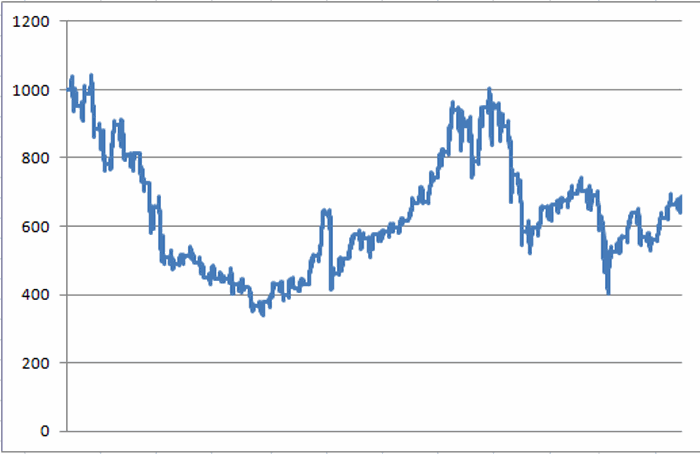
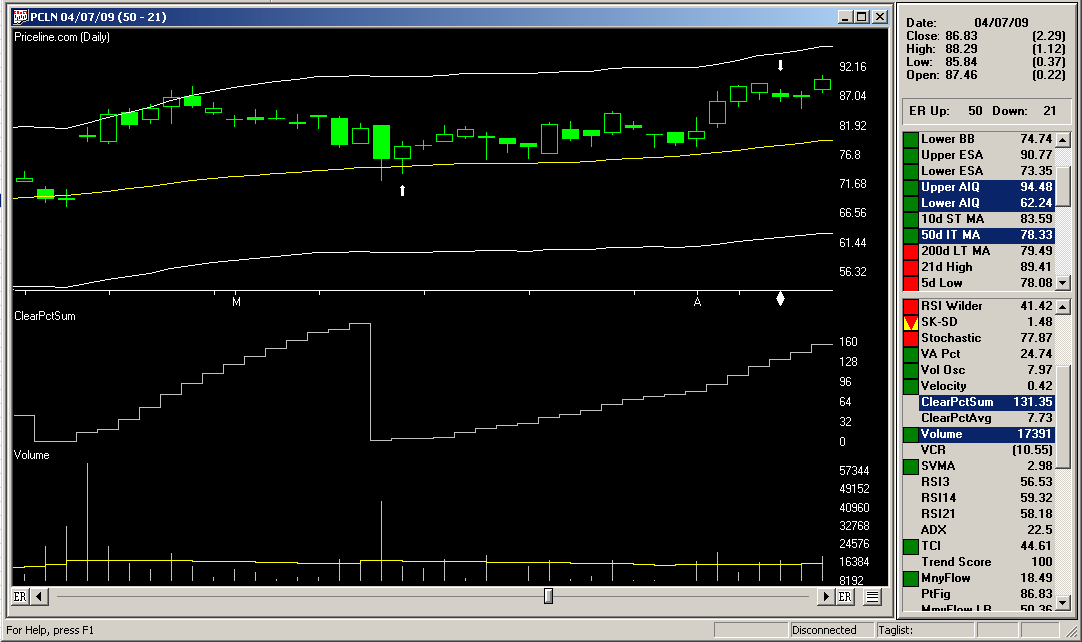
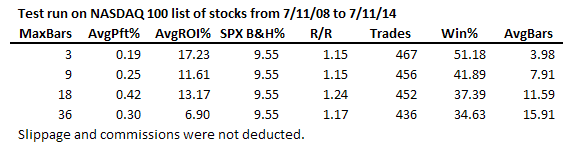
Light at the End of the Tunnel? (or do I hear a Train Whistle?)

Wow, does Murphy hate my guts, or what?

So I write an article all about how the stock market gets all bullish during the middle 18 months of the decade (September 30th – Mark Your Calendar) – i.e., starting at the close on September 30th of the mid-term election year – and what does Murphy go and do?  He (She? Hmmm, that might explain a few things) invokes his (her?) dreaded Law and the market gets hammered right out of the box in early October.

Fortunately for me I have made enough mistakes in the market over the years that I don’t even bother to feel stupid anymore when things go exactly the opposite of what I might have anticipated.  This leads me to invoke a maxim I adopted (after a long, painful process) a long time ago:

Jay’s Trading Maxim #412: Murphy hates you.  Plan accordingly.

To put it into other terms, it essential for any trader or investor to give some thought as to  what might go wrong before taking any particular action and to come up with an answer to the following question:

“What is my worst case scenario and what specific action will I take to mitigate the damage should this scenario unfold?”

Sounds like such an obvious question to ask and answer doesn’t it?  But here is another question that will likely make a lot of readers squirm:

“Do you have an answer to the question above?  Every time you make a trade?”
OK granted that’s two questions, but you get my drift.

Where to From Here?
So here is the part of the article where most “highly trained professional market analysts” tell you why the market is almost certain to rise (or fall) from here. Unfortunately, the bad news for me is that I am not very good at predicting the future (plus let’s face it, I can’t risk pissing Murphy off again).  So while it “feels” like the market could melt down at any moment, I have little choice but to simply follow my plan and give the bullish case the benefit of the doubt.  So two things to note:

#1. October through December in Mid-Term Election Years
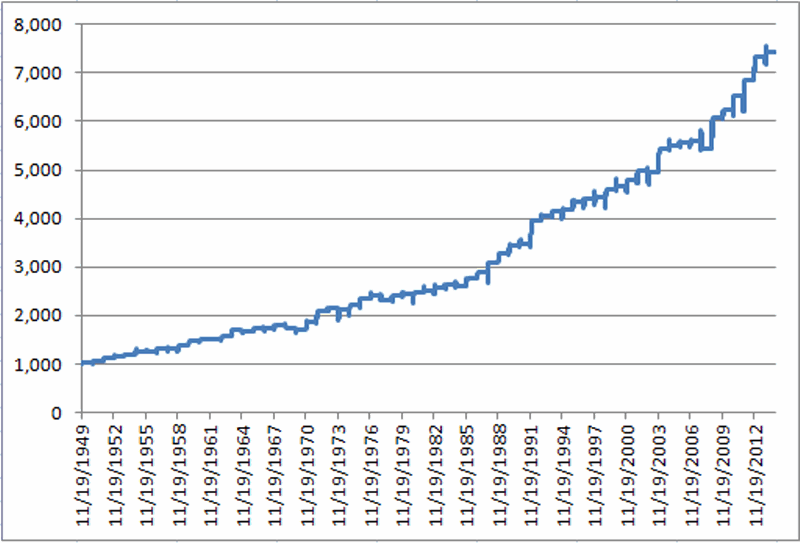
In Figure 1 you can see the growth of $1,000 invested in the Dow Jones Industrials Average only during the months of October, November and December during mid-term election years, starting in 1934 (i.e., 1934, 1938, 1942, etc.)

oct-dec midterm 1 Figure 1 – Growth of $1,000 invested in DJIA Oct-Nov-Dec of Mid-Term Election Year (1934-present)

Figure 2 shows the year-by-year results

oct-dec midterm 2

Figure 2 – DJIA performance Oct through Dec of Mid-Term Election Years

As you can see, this period has showed a gain 90% of the time.  Granted a few were pretty miniscule, still the median gain was in excess of 8% and the worst previous performance was -7%.

#2. Short-Term Oversold
Well I could hardly refer to myself as a highly trained professional market analyst if I didn’t have my own proprietary  overbought/oversold indicator, so, voila, surprise, surprise, my own proprietary overbought/oversold indicator (cleverly named JKOBOS) appears in Figure 3.

jkobos Figure 3 – Jay’s Overbought/Oversold Indicator is flashing an oversold (i.e., theoretically bullish) signal at the moment (Chart courtesy of AIQ TradingExpert)

A close look at the chart in Figure 3 reveals that JKOBOS readings below 25 tend to highlight decent buying opportunities.  With the indicator presently standing at 21.8, this qualifies as at least a “bullish alert”.

Summary
So is the combination of a bullish seasonal trend (i.e., October through December of Mid-Term election years) and an oversold market (based on a reading from my own overbought/oversold indicator) telling us that another rally is in the near future? 

The honest answer is “not necessarily”.  The optimistic answer however, is that despite the fear and loathing that seems to permeate the market these day (or maybe partly because of it), there is a chance that the market could surprise to the upside.  As a dutiful trend follower I personally have little choice but to continue to give the bullish case the benefit of the doubt

Just don’t anyone tell Murphy I said that………sssshhhh!

Jay Kaeppel  
Chief Market Analyst at JayOnTheMarkets.com and AIQ TradingExpert Pro (http://www.aiq.com) client
http://jayonthemarkets.com/

Jay has published four books on futures, option and stock trading. He was Head Trader for a CTA from 1995 through 2003. As a computer programmer, he co-developed trading software that was voted “Best Option Trading System” six consecutive years by readers of Technical Analysis of Stocks and Commodities magazine. A featured speaker and instructor at live and on-line trading seminars, he has authored over 30 articles in Technical Analysis of Stocks and Commodities magazine, Active Trader magazine, Futures & Options magazine and on-line at www.Investopedia.com.

Seasonality – monthly patterns for October

With the beginning of October a couple of days away, here’s our seasonal analysis for the month. We’ve also embedded a table with the scan results that will make it easier to see the results.

A refresher on this scan and some notes about changes.

We have noted on several occasions that we are using 7 years of historical data in the Comparison charts and that is true, however the scan actually looks at 8 years, so in future charts we’ll add the eighth year.

Our study looks at 8 years of historical data and looks at the returns for all optionable stocks 2006 to 2013.

We filter to find two sets of criteria

– Stocks with gains in all 8 years during October
– Stocks with losses in all 8 years in October

We do make an assumption that the month is 21 trading days and work our way back from the last day of the month. If the last day of the month falls on a weekend, then we use the first trading day prior to that date.

We make no assumptions for drawdown, nor do we look at the fundamentals behind such a pattern. We do compare the stock to the market during the same period and look at the average SPY gain/loss vs. the average stock gain/loss. This helps filter out market influence. We are now including group information to identify particular segments that might display a seasonal bias.

Finally we look at the median gain/loss and look for statistical anomalies, like meteoric gains/loss in one year.

WLT - Walter Energy seasonality through October 2013 - 7 year average in black

WLT – Walter Energy seasonality through October 2013 – 7 year average in black

SWN – Swan Energy seasonality through October 2013

DV – Devry seasonality through October 2013

August 2014 seasonality update

At the beginning of September I ran the seasonality scan as usual and was disappointed to find very little that looked attractive. 2 stocks met the scan to the upside, but with very poor consistency. September can be a tough month. It was only later in the month I realized I’d made an error and had scanned only the S&P500 stocks! Live and learn.

So, rather than do the September analysis as an exercise now we’re at the 23rd, instead here’s an update on how the scan on August seasonal players panned out. At the end of this week we’ll do the October run.

First a refresher on this scan

First off some background.

Our study looks at 7 years of historical data and looks at the returns for all optionable stocks for the month of August from 2006 to 2013.

We filter to find two sets of criteria

 – Stocks with gains in all 7 years during August
 – Stocks with losses in all 7 years in August

We do make an assumption that the month is 21 trading days and work our way back from the last day of the month. If the last day of the month falls on a weekend, then we use the first trading day prior to that date.

We make no assumptions for drawdown, nor do we look at the fundamentals behind such a pattern. We do compare the stock to the market during the same period and look at the average SPY gain/loss vs. the average stock gain/loss. This helps filter out market influence. We are now including group information to identify particular segments that might display a seasonal bias.

Finally we look at the median gain/loss and look for statistical anomalies, like meteoric gains/loss in one year.

In the Seasonality – monthly patterns for August 2014 article published on July 31, 2014 http://aiqsystems.blogspot.com/2014/07/seasonality-monthly-patterns-for-august.html

there were 2 stocks that had the most consistent patterns. They were UPL and DNR

DNR is Denbury Resources and it opened at $16.89 before dropping to around $16.13 into the middle of August. By the last trading day in August DNR closed at $17.22 for a modest gain of 1.95%.

UPL is Ultra Pete Corp and it opened at $22.97 and was relatively unchanged for the first half of August before rallying to close the month at $26.53 for a gain of 15.5%.

Before we leap off the cliff, I must point out that the market return in August over the 7 years is a paltry average of -0.06, as measured by SPY. However this August SPY gained 4.2%.

Here’s the charts for the 2 stocks.

See you again later this week with October’s seasonals.

The RSI 3 Strikes and You’re Out Play (Part II)

In my last article (http://tinyurl.com/mzhstm2) I wrote about a simple entry method I have dubbed “The RSI 3 Strikes and You’re Out Play” or TSYO, for short.

The RSI 3 Strikes and You’re Out Method is a good candidate for option traders as it offers the potential to “make a few bucks” when the market experiences a pullback.  So this week I want to offer a few examples.
In the interest of full disclosure I had planned to do it last week, but once my family and I arrived in Aruba I quickly settled into the “Sleep Late, Run on the Beach, Lay on the Beach, Swim in the Ocean and the Pool, Shower, Go to Dinner, Repeat” routine.  And in the midst of that “busy” schedule I found little time to write.

TSYO Examples
I have a list of stocks and ETFs that I follow for option trading purposes.  Not necessarily the “definitive” list but a good mix of tickers that trade lots of option volume.  The list in Figure 1 displays some recent TSYO signals for some of the stocks on my list. 

*The first column shows the stock ticker. 
*The second column shows the date of the “Alert” signal (i.e., the 2nd non confirmation by RSI). 
*The third column shows the date that the stock or ETF takes out the low of the previous three days. 

Ticker
Alert
3-Day Low
AMGN
7/3
7/8
AMZN
7/22
7/25
EEM
7/28
7/30
F
7/24
7/25
GM
7/3
7/17
IBM
7/18
7/21
IBM
7/24
7/30
IWM
7/1
7/7
JPM
7/28
7/29
SLV
7/2
7/7
SMH
7/22
7/24
TXN
7/11
7/17

Figure 1 – TSYO Alerts and Triggers

For the purposes of this article we will assume that a put option is bought at the close of the “3-Day Low” day.  For deciding which put option to buy we will use the “Percent to Double” routine found at www.Optionsanlysis.com.

One note, while I will highlight the profit potential for each trade reviewed, I will not detail any specific “exit criteria”.  My goal is to highlight the entry signal and not necessarily create a mechanical “system”.  I also think that each trader should do some thinking and consider their own criteria for when to take a profit or cut a loss.

Ticker AMGN
As you can see in Figures 1 and 2, AMGN triggered an “Alert” on 7/3 and made a new 3-day low on 7/8.

amgn tsyo bc
 Figure 2 – AMGN (Courtesy: AIQ TradingExpert)

What followed was little more than a modest short-term pullback.  Still, as you can see in Figure 3, if a trader bought the October 120 put option on 7/8, by 7/17 he or she would have had an open profit of +40.5%.

amgn tsyo

Figure 3 – AMGN Sep Oct 120 put option (Courtesy: www.OptionsAnalysis.com)


Ticker AMZN
In this example waiting for a 3-day low before entering actually worked against a trader because on 7/25 AMZN gapped significantly lower as you can see in Figure 4.

amzntsyo bc 
Figure 4 – AMZN (Courtesy: AIQ TradingExpert)

Nevertheless, if a trader had bought the September 320 put option at the close on 7/25, by 8/1 he or she would have had an open profit of +69.4%.

amzn tsyo

Figure 5 – AMZN September 320 put option (Courtesy: www.OptionsAnalysis.com)


Ticker F
The example that follows for Ford (ticker F) highlights two things:
1. The ability to essentially “bet” on a short-term pullback while risking a relatively small amount of capital
2. The above average profit potential associated with trading options.
Ticker F triggered an “Alert” on 7/24 and made a new 3-day low on 7/25.

f tysobc
Figure 6 – F (Courtesy: AIQ TradingExpert)

If a trader had bought the September 17 put option at the close on 7/25, by 8/1 he or she would have had an open profit of +103.6%.

f tsyo 
Figure 7 – F September 17 put option (Courtesy: www.OptionsAnalysis.com)


Summary
So once again, the point of all of this is not to attempt to promote the “be all, end all” of trading.  Because the TSYO method is most certainly not that.  But it can do a pretty decent job of identifying opportunities (especially after the overall market has experienced an extended run up and may be running out of team near term).  For traders who are willing to consider alternative (though simple) strategies such as buying put options, a method such as this can offer the potential to make money even as the overall market pulls back.
No one should go out and start making trades using the method I have detailed here without doing some further study/analysis/etc.  But the real point of all of this is that it is possible to use relatively simple ideas and relatively little capital to achieve trading success.

Jay Kaeppel  
Chief Market Analyst at JayOnTheMarkets.com and AIQ TradingExpert Pro (http://www.aiq.com) client

Jay has published four books on futures, option and stock trading. He was Head Trader for a CTA from 1995 through 2003. As a computer programmer, he co-developed trading software that was voted “Best Option Trading System” six consecutive years by readers of Technical Analysis of Stocks and Commodities magazine. A featured speaker and instructor at live and on-line trading seminars, he has authored over 30 articles in Technical Analysis of Stocks and Commodities magazine, Active Trader magazine, Futures & Options magazine and on-line at www.Investopedia.com.

Seasonality – monthly patterns for August 2014

It’s the beginning of the month and time to check the seasonal patterns for August 2014. First off some background.

Our study looks at 7 years of historical data and looks at the returns for all optionable stocks for the month of August from 2006 to 2013.

We filter to find two sets of criteria

 – Stocks with gains in all 7 years during August
 – Stocks with losses in all 7 years in August

We do make an assumption that the month is 21 trading days and work our way back from the last day of the month. If the last day of the month falls on a weekend, then we use the first trading day prior to that date.

We make no assumptions for drawdown, nor do we look at the fundamentals behind such a pattern. We do compare the stock to the market during the same period and look at the average SPY gain/loss vs. the average stock gain/loss. This helps filter out market influence. We are now including group information to identify particular segments that might display a seasonal bias.

Finally we look at the median gain/loss and look for statistical anomalies, like meteoric gains/loss in one year.

So here are the tickers that met the scan on the loss side, There was only 1 stock on the gainers side. So we’ll look at the down plays only.

Figure 1 shows the stocks that have had losses in August, 7 years in row.
It’s almost immediately apparent that 4 of the 6 losers are in the Oil & Gas sector, one in the Drilling group, and 3 in Exploration and Production (2 US) groups. Not looking like a good month to be long this sector. The biggest loser is UPL, UltraPete Corp with an average -9.66% in August. A couple of years have seen significant losses in August, but the median is still -7.42%. Not being one to speculate on why the Oil & Gas sector has so many stocks taking a hit in August, but there it is. Here’s the seasonal chart of UPL through 8/31/2013, the prominent black line is the average of the 7 years in the study.
Figure 2 seasonal for UPL for last 7 years, average line in black
During the same period the market, as measured by SPY declined an average of -0.06, so there was no overriding market influence during this period. 

Figure 3 shows SPY for the same period.


Interestingly a quick check of the Oil & Gas US Explorations and Production group for the same period revealed an average decline of -3.67% in August. The entire group was down 6 of the last 7 years in August. I have 38 stocks in this group in my database.

Figure 4 seasonal average for Oil & Gas US Explorations and Production group
We’ll keep track of the top 2 stocks in the August analysis. UPL and DNR and let you know how they preform.
In July, GLNG was the seasonal star with an average of +8.41% for the 7 years through July 30, 2013. Tracking how it performed this July, GLNG opened at 60.73 on July 1, 2014 and reached a high of 65 on July 30, 2014. Some pullback occurring on July 31, 2014 with the entire market down, but still a gain for the month.
Figure 5 shows the stocks that have had gains in July, 7 years in row.
With seasonality you have to figure out what timeframe you want to analyze before anything else. Logic would seem to dictate that one week; comparing this week to the same period over X years would be the smallest time period you might consider. However there are events that seem to be seasonally predictable that occur at the end of a month or the beginning of the month. We’ll look at some these in a future article. 
 We don’t draw conclusions here, just mine for information.