The Slow Volume Strength Index

The AIQ code based on Vitali Apirine’s article in S&C, “The Slow Volume Strength Index,” is provided for download from the following website:
!THE SLOW VOLUME STRENGTH INDEX
!Author: Vitali Aiprine, TASC April 2015
!Coded by: Richard Denning 6/10/2015
!www.TradersEdgeSystems.com

!INPUTS FOR INDICATOR:
emaLen is 6.
wilderLen is 14.

!INDICATOR FORMULAS:
ema is expavg([close],emaLen).
pDif is iff([close] - ema > 0,[volume],0).
nDif is iff([close] - ema < 0,[volume],0).

rsiLen is 2 * wilderLen - 1.
AvgU  is expavg(pDif,rsiLen).
AvgD  is expavg(nDif,rsiLen).
svsi is 100-(100/(1+(AvgU/AvgD))). !PLOT 
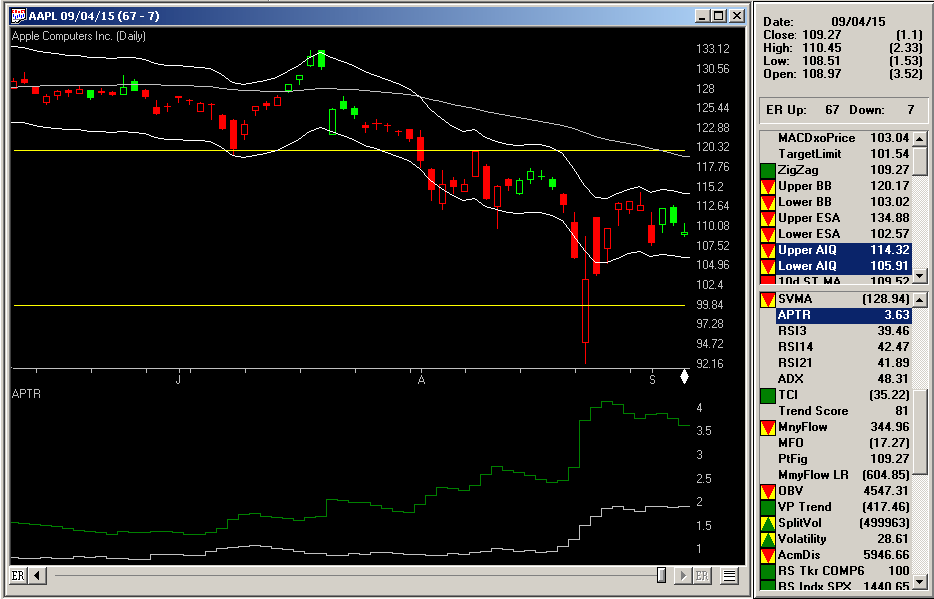
The code provided for the slow volume strength index (SVSI) may be plotted as an indicator, as shown in Figure 6.
Sample Chart

FIGURE 6: AIQ. Here is the SVSI (6,14) indicator compared to the classic RSI (14).
—Richard Denning
info@TradersEdgeSystems.com
for AIQ Systems

The Slow Relative Strength Index

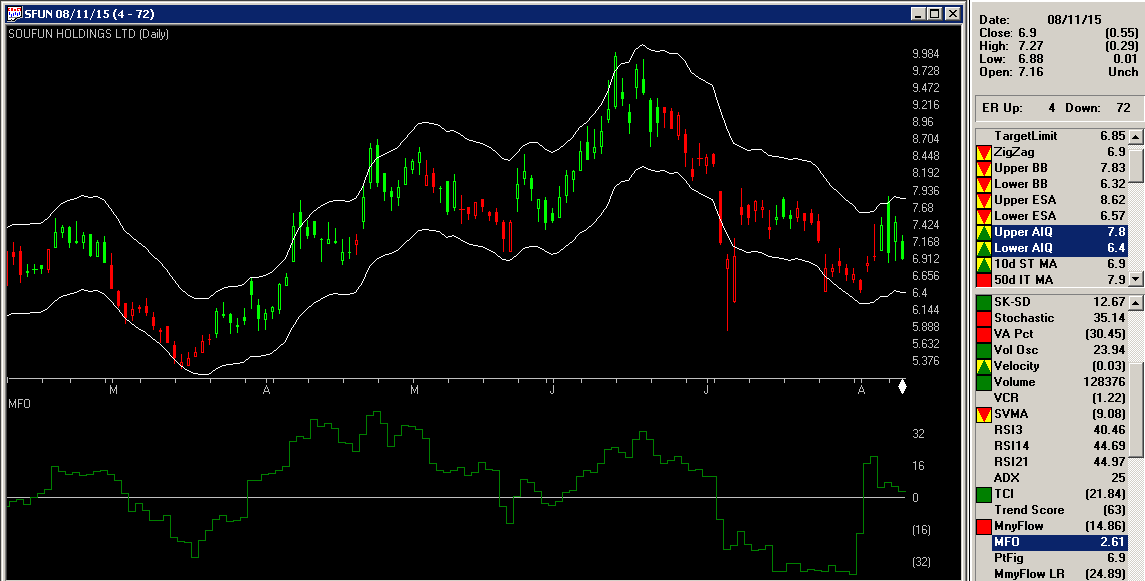
The AIQ code based on Vitali Apirine’s article in STOCKS & COMMODITIES, “The Slow Relative Strength Index,” is shown here. This code for the slow RSI (SRSI) is for use as an indicator. A sample chart illustrating the SRSI is shown in Figure 7.
Sample Chart

FIGURE 7: AIQ. This example chart shows the slow RSI (6,14) compared to the classic RSI (14).
!THE SLOW RELATIVE STRENGTH INDEX
!Author: Vitali Aprine, TASC April 2015
!Coded by: Richard Denning 5/3/2015
!www.TradersEdgeSystems.com

!INPUTS FOR INDICATOR:
emaLen is 6.
wilderLen is 14.

!INDICATOR FORMULAS:
ema is expavg([close],emaLen).
pDif is iff([close] - ema > 0,[close] - ema,0).
nDif is iff([close] - ema < 0,ema - [close],0).

rsiLen is 2 * wilderLen - 1.
AvgU  is expavg(pDif,rsiLen).
AvgD  is expavg(nDif,rsiLen).
srsi is 100-(100/(1+(AvgU/AvgD))). !PLOT
The code and EDS file can be downloaded from www.TradersEdgeSystems.com/traderstips.htm.
—Richard Denning
info@TradersEdgeSystems.com
for AIQ Systems

Professor’s Comments July 15, 2015

The Dow rose 75 points, closing at 18,054. Volume was low again, coming in at 87 percent of the 10-day average. There were 115 new highs and 45 new lows.
Not much changed yesterday. The low volume rally appeared to be part of the final portion of a retracement wave, which means that the current rally could end at any time now.
Because of this, I am starting to look for shorting opportunities now.
Like I said yesterday, I will be watching the shorter term bars now on inverse index ETFs like DXD and QID. IF they turn positive, I will start buying a ‘trial’ position.
I tried to do this late yesterday when the Dow was near its highs, but the indicators didn’t cooperate. So my strategy going into today remains the same.
I’m going to start with DXD on the 30s. If the indicators turn positive, I’m a buyer. I plan to hold these ‘trial’ positions and then watch for The Tide to turn negative. When it does, I’ll start getting aggressive.
Gold continues to show signs of trying to put in a bottom. Yesterday’s low on GLD stayed within the previous day’s Hammer low, so IF it can rally today, it would be a positive. The Money Flow indicator on GLD continues to show positive divergence.
Watching.
That’s what I’m doing,
The Professor
All of the commentary expressed in this site and any attachments are opinions of the author, subject to change, and provided for educational purposes only. Nothing in this commentary or any attachments should be considered as trading advice. Trading any financial instrument is RISKY and may result in loss of capital including loss of principal. Past performance is not indicative of future results. Always understand the RISK before you trade.
Not sure of the terminology we use? Check out these
articles
All of the commentary expressed in this site and
any attachments are opinions of the author, subject to change, and provided for
educational purposes only. Nothing in this commentary or any attachments should
be considered as trading advice. Trading any financial instrument is RISKY and
may result in loss of capital including loss of principal. Past performance is
not indicative of future results. Always understand the RISK before you trade.

AIQ Systems is now AIQ Systems LLC

As
of May 31, 2015 AIQ Systems is no longer a division of Track Data Corp.
AIQ
is now operating as an independent company AIQ Systems LLC. The management
team of AIQ Systems will continue to run the business under the AIQ Systems LLC
organization.
Thank
you again for your patience during our transition to an independent
organization and throughout the on boarding process with our new data vendor,
Interactive Data Corp.
Please
update your records with our new contact address
AIQ Systems LLC
1580 Grand Point Way
#34764
Reno, NV 89523
Technical
Support:
(775) 747-8404
Sales:
(800) 332-2999
(001) 775-832-2798
Interactive
Data Corp.
510.264.1700
           
Regards
AIQ systems
LLC

____________________________________________
THE WORLD LEADER IN
INTELLIGENT TRADING SOFTWARE
     

Ominous Energy

There is a lot of Good News and Bad News in the energy stock sector these days.  To wit:
First the Bad News:
Between June 2014 and January 2015, energy stocks (using ETF ticker XLE as a proxy) suffered a roughly 30% decline.
Then the Good News:
As you can see in Figure 1, XLE gave all the signs of a classic “bottoming out”, including:
1) A head-and-shoulders bottom formation and
2) A break above the neckline
3) A pullback and successful downside retest, followed by;
4) A breakout above a down trending trend line drawn during the previous decline.
So, #5) time to pop the champagne corks, pile into energy stocks and enjoy the new energy stock bull market, right?  Right?
2
Figure 1 – The “Classic” Bottom (or Not) in XLE
Then More Bad News:
Er, well, #6) as you can also see on the right hand side of Figure 1, the “classic” upside bull run lasted for about a month and about 8% from the point of the “classic” upside trend line breakout. Since then, XLE – oops – has fallen a little over 11% in a pretty straight line decline.
The (Potential) Good News:
Energy stocks are very oversold and are now near the support area created by the head-and-shoulders formation that formed in December and January.  So we could be setting up for an important bottom.  Um, or not.
The (Potential) Bad News:
In Figure 2 we see that a fairly significant long-term upward trend line (if you’re into that sort of thing) was broken during the recent decline.  If you believe in chart patterns this is an ominous – and potentially significant – occurrence.
1a
Figure 2 – A potentially ominous trend line break for XLE
The Bottom Line
The price level of $71.70 for ticker XLE represents a critical support level.  If it holds we could have something of a “mega bottom” in place.  If it fails, the next meaningful support level for XLE is $67.77 and from there $61.11.
My advice: Grab an “energy” drink (har, good one) because you’ll want to stay awake on this one.  Keep a close eye on XLE in the days and weeks ahead for an important long-term clue.
Jay Kaeppel
Chief Market Analyst at JayOnTheMarkets.com and AIQ TradingExpert Pro (http://www.aiq.com) client