Did you know

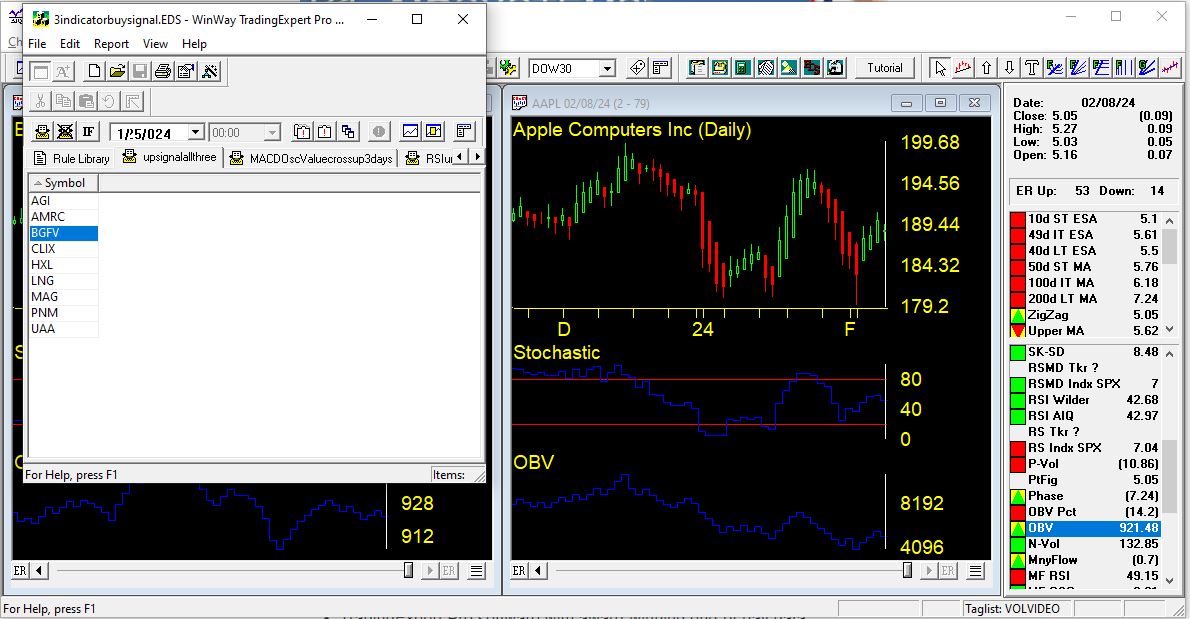
AIQ TradingExpert Pro includes a Portfolio Manager that allows you to apply exit strategies to your open position, manage and balance your portfolio, and run analysis against benchmark indices.

Included in the Portfolio Manager is the Simulator tool where you can take a trading strategy and test it in real-life simulation. Once you’ve found a strategy that meets your goals, the Pick-of-the-day tool will tell you each day which stocks meet your strategy rule for trading.

“AIQ offers the ability to do a quick review of portfolios on demand is extremely helpful in managing stock portfolio’s – getting trading signals each day provides a great tool to get in front of opportunities or future problems. AIQ provides an ideal tracking system to manage assets; and that is why I have been a subscriber for 25 years. “Patrick Buffa

Bartometer

July 11, 2021

Hello Everyone,

On my Bartometer in December, I thought the S&P 500 would reach 4200 to 4400 this year. The S&P is now at 4369. Am I worried that we are getting close to my target? Yes and no. Yes, if the Covid 19 Delta Variant starts to progress and yes IF the market breaks below a 10-month trend-line. Otherwise, I am still relatively bullish on the market that can continue higher as earnings continue to come in better than expectations. One Caution, my computer models again flashed a Daily, Short term SELL signal that is not confirmed. That means to watch the trendlines for a break to see if it confirms on the downside.

The stock markets continue to edge higher, confounding many analysts, and logically the market should not be higher now than it was when the economy was booming in 2019. The markets are defying logic and normal metrics of price to earnings and other metrics of valuation as it sees more growth ahead. The market usually rises over the long term based on Earnings and Interest Rates and now Earnings are great, and Interest Rates are low. This is a perfect scenario for the stock market. The valuation of the stock market is that it is 25% over valued, but earnings are coming in better than expectations, so targets are being raised higher. The Federal Reserve is also injecting liquidity and keeping rates low.

The fundamentals of the economy are good, although slowing slightly. I am still relatively positive unless 4200 to 4224 on the S&P doesn’t hold and we have a decisive Selloff. See the graph and explanation on third page.

House prices continue to inch higher. In my opinion, the real estate market will inch higher until the economy slows, or interest rates go over 3.5% on the 15 year and 3.9% on the 30 year. Right now, it still is a Sellers’ market, this soon will slow.

The energy market still looks good, as noticed by the gas prices and if interest rates rise soon then the financial sector which sold off over the last couple of weeks should turn around to the upside. If the stock market sells off from here, you may want to add more to your stock portfolio, if you have a longer-term horizon. Please call me for guidance in the allocation of your 401(k) and a strategy meeting with me if you have not spoken to me in 6 months. I have been liking the Value sector over the last 7 months, now the growth sector, is starting to look better for purchase.

Some of the INDEXES of the markets both equities and interest rates are below.

Dow Jones +14.99%
S&P 500 +17.1%
EQUAL WEIGHTED S&P 500 +16%
NASDAQ Aggressive growth +15%
Large Cap Value +14%
I Shares Russell 2000 ETF (IWM) Small cap +15%
Midcap stock funds +15%
International Index (MSCI – EAFE ex USA +9.4%
International Emerging Markets +7.5%
Financial stocks +25%
Energy stocks +42%
Healthcare Stocks +14%
High Yield Merrill Lynch High Yield Index +2.1%

Floating Rate Bond Funds +2.61%
Short Term Bond +.6%
Multi sector bond funds +1.9% Gold -5.2%

10 year Bond Yield 1.3 Moderate Fund +8.7%

Average Disruptor Fund Aggressive growth -2%

Moderate Mutual Fund Investment Grade Bonds (AAA) Long duration -1.86%

Classicalprinciples.com and Robert Genetskis Excerpts

Market Outlook

Stock prices were mixed this past week. The Nasdaq 100 hit an all-time high Wednesday, fell 1⁄2% yesterday and ended the week up just over 1%. The Nasdaq was up slightly and the S&P500 and Dow were down slightly. Small caps lost 4%.

Good news on the economy continued. June business surveys show both manufacturing and service companies growing rapidly. Weekly employment data show the job market improving.

Monetary policy remains expansive. Monthly data from the Fed show the central bank purchased $172 billion in securities in June. How expansive will depend on how much of the new money banks have left at the Fed. That bank data won’t be released until later this month.

The economy has a lot of momentum. Strong surveys for new orders indicate rapid growth will continue at least through the summer and fall. Longer-term interest rates continue to behave as if inflation will not be a problem. The 10-year Treasury Note is down to 1.29%. In real terms, bonds provide significant negative returns.

Long-term interest rates remain well below their fundamental levels. As inflation becomes more apparent, the risk of holding longer-term bonds will also become more apparent.

A Look Back

The ISM business survey for service companies followed the Markit survey. Both surveys show service company activity remained strong in June, but not as strong as May’s hectic readings. With service business activity at 60 and new orders at 62, the service sector remains healthy.

As with manufacturing companies, the indicator for employment in the service sector was close to breakeven. The weakness in job growth from the business surveys is not consistent with the large increase in jobs from the payroll data.

Stock Valuation: S&P 500 25% Overvalued
Economic Fundamentals: Positive
Monetary Policy; Highly Expansive
.
Source: Classical Principles.com

The S&P 500

The S&P 500 is above. As you can see the index continues to rise in a nice channel pattern. Some may say it is a Rising Wedge as well. If you notice, the Trend-line and the 50 day moving average is supporting the upward trend. This means that the longer the trend holds, the more it falls if it breaks the trend. So, in this instance the 4200 to 4224 area or the trendline better hold on a close of the market. I do not want to see the S&P sell off and break the 50 day moving average or the Trend-line decisively. That could cause sellers to finally start selling the rallies and not buy the dips or sell offs.

The next indicator is the MACD or momentum indicator. When the pink line breaks to the upside above the blue line it is positive like now.

The SK-SD Stochastics line is overbought when it is over the 96 like it is now.

The indicator below is the RSI wilder Index. When it is over 70 it is considered overvalued and overbought. It is now.

On Balance Volume is an indicator showing volume and conviction of the move higher. It is not breaking out to new highs, showing me that the market is going up on lower volume.

Overall, the markets are getting flash Sells not confirmed, it means to reduce a little equity and to rebalance and watch the support levels so they are not broken.

Support levels on the S&P 500 area are 4250, 4200, 4050, and 3950. These may be safer areas to get into the equity markets on support levels slowly on the accumulation areas.

THE BOTTOM LINE:

I am still relatively Bullish on the market, but as you can see above, the market is getting overvalued. My target of 4400 on the S&P 500 is quickly approaching. The Value sector of the market and the mid and large value sectors are now fairly valued. Over the longer-term, technology, up about 15% should perform the best. Trendlines are very important. At this point, I would not want to see the 4200 to 4224 level broken convincingly on a close. That would make me get very cautious.

Best to all of you,

Joe Bartosiewicz, CFP®
Investment Advisor Representative

92 High Street
Thomaston, CT 06787

Securities and advisory services offered through SagePoint Financial, Inc. (SPF), member FINRA/SIPC. SPF is separately owned and other entities and/or marketing names, products or services referenced here are independent of SPF. 800-552-3319 20 East Thomas Road Ste 2000 Phoenix AZ 85012

Disclaimer: The views expressed are not necessarily the view of Sage Point Financial, Inc. and should not be interpreted directly or indirectly as an offer to buy or sell any securities mentioned herein. Securities and Advisory services offered through Sage Point Financial Inc., Member FINRA/SIPC, an SEC-registered investment advisor.
Past performance cannot guarantee future results. Investing involves risk, including the potential loss of principal. No investment strategy can guarantee a profit or protect against loss in periods of declining values. Please note that individual situations can vary. Therefore, the information presented in this letter should only be relied upon when coordinated with individual professional advice. *There is no guarantee that a diversified portfolio will outperform a non-diversified portfolio in any given market environment. No investment strategy, such as asset allocation, can guarantee a profit or protect against loss in periods of declining values.
It is our goal to help investors by identifying changing market conditions. However, investors should be aware that no investment advisor can accurately predict all of the changes that may occur in the market.

The price of commodities is subject to substantial price fluctuations of short periods and may be affected by unpredictable international monetary and political policies. The market for commodities is widely unregulated, and concentrated investing may lead to Sector investing may involve a greater degree of risk than investments with broader diversification.
Indexes cannot be invested indirectly, are unmanaged, and do not incur management fees, costs, and expenses.
Dow Jones Industrial Average: A weighted price average of 30 significant stocks traded on the New York Stock Exchange and the NASDAQ.
S&P 500: The S&P 500 is an unmanaged indexed comprised of 500 widely held securities considered to be representative of the stock market in general.
NASDAQ: the NASDAQ Composite Index is an unmanaged, market-weighted index of all over the counter common stocks traded on the National Association of Securities Dealers Automated Quotation System
(IWM) I Shares Russell 2000 ETF: Which tracks the Russell 2000 index: which measures the performance of the small capitalization sector of the U.S. equity market.
A Moderate Mutual Fund risk mutual has approximately 50-70% of its portfolio in different equities, from growth, income stocks, international and emerging markets stocks to 30-50% of its portfolio in different categories of bonds and cash. It seeks capital appreciation with a low to moderate level of current income.
The Merrill Lynch High Yield Master Index: A broad-based measure of the performance of non-investment grade US Bonds
MSCI EAFE: the MSCI EAFE Index (Morgan Stanley Capital International Europe, Australia, and Far East Index) is a widely recognized benchmark of non-US markets. It is an unmanaged index composed of a sample of companies’ representative of the market structure of 20 European and Pacific Basin countries and includes reinvestment of all dividends.
Investment grade bond index: The S&P 500 Investment-grade corporate bond index, a sub-index of the S&P 500 Bond Index, seeks to measure the performance of the US corporate debt issued by constituents in the S&P 500 with an investment-grade rating. The S&P 500 Bond index is designed to be a corporate-bond counterpart to the S&P 500, which is widely regarded as the best single gauge of large-cap US equities.
Floating Rate Bond Index is a rule-based, market-value weighted index engineered to measure the performance and characteristics of floating-rate coupon U.S. Treasuries, which have a maturity greater than 12 months.

Buy & Hold, Or Buy & Sell?


The importable AIQ EDS file based on Markos Katsanos’ article in July issue of Stocks & Commodities magazine, “Buy & Hold, Or Buy & Sell?” can be obtained on request via email to info@TradersEdgeSystems.com. The code is also available below:

Synopsis….Here is a system that with a few simple rules will reduce drawdown and improve the profitability of your portfolio without having to go short or use put options…

!Buy & Hold, Or Buy & Sell?
!Author: Markos Katsanos, TASC July 2021
!Coded by: Richard Denning, 5/17/2021

C is [close].
C1 is valresult(C,1).
H is [high].
L is [low].
LL3 is lowresult(L,3).
HH3 is highresult(H,3).
LL14 is lowresult(l,14).
HH14 is highresult(H,14).
LL40 is lowresult(L,40).
HH40 is highresult(H,40).
V is [volume].
WilderLen is 2.
ATRlen is WilderLen*2-1.
VIX is TickerUDF("VIX",C).
VIXDN is (VIX/highresult(VIX,15,1)-1)*100.
VIXUP is (VIX/lowresult(VIX,15,1)-1)*100.
VIXDNMIN is -30.
VIXUPMIN is 100.

! AVERAGE TRUE RANGE
HD if hasdatafor(ATRlen+20) >= ATRlen.
TR is Max(H - L,max(abs(C1 - L),abs(C1 - H))). 
ATR is iff(HD,expavg(TR,ATRlen),0).

ATRDN is (ATR/highresult(ATR,15,1)-1)*100.
ATRUP is (ATR/lowresult(ATR,15,1)-1)*100.
UP is (highresult(C,2)/lowresult(C,4)-1)*100.
DN is (lowresult(C,2)/highresult(C,4)-1)*100.
CCH is (lowresult(C,10)/highresult(C,100)-1)*100.
HHB is scanany(C=^highresult(C,4),4) then offsettodate(month(),day(),year()).
VOLUP is V/simpleavg(V,50,HHB-1)*100.
LLB is scanany(C=^lowresult(C,4),4) then offsettodate(month(),day(),year()).
SMA10 is simpleavg(C,10).
BUYINITIAL if SMA10 >= valresult(SMA10,1) 
   AND StochK3 < 40 
   AND hasdatafor(20)>=10.
B2 if UP > 6
  AND (VIXDN<VIXDNMIN OR ATRDN<2*VIXDNMIN) 
  AND CCH<-15 
  AND lowresult(StochK40,^LLB)<25 
  AND lowresult(StochK14,^LLB)<25 
  AND StochK14>=StochK40.
Buy if BUYINITIAL or B2.

SELL if C<simpleavg(C,20) 
  AND DN<-6 
  AND (VIXUP>VIXUPMIN OR ATRUP>2*VIXUPMIN) 
  AND VOLUP>80 AND highresult(StochK40,^HHB)>85 
  AND highresult(StochK14,^HHB)>85 
  AND StochK40>=StochK14.

Stoch3 is (C - LL3) / (HH3 - LL3) * 100.
StochK3 is simpleavg(Stoch3,3).
Stoch14 is (C - LL14) / (HH14 - LL14) * 100.
StochK14 is simpleavg(Stoch14,3).
Stoch40 is (C - LL40) / (HH40 - LL40) * 100.
StochK40 is simpleavg(Stoch40,3).

ShowData if 1.

Figure 7 shows a backtest of the weekly system using the Nasdaq 100 list of stocks from 5/17/1999 to 5/17/2021.

Sample Chart

FIGURE 7: AIQ. Shown here is a summary of the EDS weekly backtest using the Nasdaq 100 list of stocks from 5/17/1999 to 5/17/2021.

—Richard Denning
info@TradersEdgeSystems.com
for AIQ Systems

Bartometer

June 11, 2021

Hello Everyone,

On my Bartometer in December, I thought the S&P 500 would reach 4200 to 4400 this year. The S&P is now at 4247. My computer models are still relatively positive, but I am starting to show cracks in the dam. The stocks that were big winners last year, like the electric vehicles, the new internet of things, the super advanced genomics, innovation stocks that were up 120% or more are down for the year about 5-20%. The Value stocks continue their winning pattern, however, over the last couple of weeks the aggressive stocks are starting to turn as the Value stocks are now fairly valued. If you have disrupter stocks in your portfolio and are great companies then it is important to keep the fund or ETFs if they are good, as these are the companies that are the next big winners over the long term.

My Computer models are still on a longer term Buy-Hold, but now some are giving early warning Sell signals on the weekly chart that are not confirmed, but need to be watched. See page 3 on the S&P to keep your eye on the exit door when the market starts to look like it is topping out. Currently, the market is 27% overvalued.

As you know house prices are soaring and could continue for a little while longer as copper prices, lumber prices rise. But when interest rates start to rise and there is more supply on the market as the eviction and foreclosure moratorium is about over, then real estate prices should wain somewhat.

If the stock market sells off from here, you may want to add more to your stock portfolio, if you have a longer-term horizon. Please call me for guidance in the allocation of your 401(k) and a strategy meeting with me if you have not spoken to me in 6 months.

I have been liking the Value sector over the last 7 months, now the growth sector, is starting to look better for purchase.

Some of the INDEXES of the markets both equities and interest rates are below.

Dow Jones +13.63%
S&P 500 +13.88%
EQUAL WEIGHTED S&P 500 +19.87%
NASDAQ Aggressive growth +8.9%
Large Cap Value +15%
I Shares Russell 2000 ETF (IWM) Small cap +18%
Midcap stock funds +18.1%
International Index (MSCI – EAFE ex USA +11.7%
International Emerging Markets +7.4%
Financial stocks +28%
Energy stocks +47%
Healthcare Stocks +10%

Moderate Mutual Fund Investment Grade Bonds (AAA) Long duration -1.86%
High Yield Merrill Lynch High Yield Index +2.1%

Floating Rate Bond Funds +2.61%
Short Term Bond +.6%
Multi sector bond funds +1.9%

Gold -1.47%

10 year Bond Yield 1.47%

Moderate Fund +8%

Average Disruptor Fund Aggressive growth -5%

Classicalprinciples.com and Robert Genetskis Excerpts

Market Outlook

Stocks were mostly higher this past week. The S&P 500 gained 1% moving to a new all-time high. The Nasdaq and QQQs rose 3% to within a fraction of their all-time highs while the Dow was down slightly and small caps were mixed.

Overall, stocks continue to show strong upward momentum. At 4239, the S&P500 is 27% above its fundamental value. Stocks clearly are overvalued. In spite of this overvaluation, the outlook for the market remains positive. After a bit of tapering in March and April, the Fed purchased $125 billion in securities in May. The Fed’s policy last year has led to double-digit increases in spending and wages during the first half of this year.

As the Fed pumps a significant amount of money into the economy, the impact on financial markets is immediate. In spite of the market’s overvaluation, the odds still favor higher rather than lower stock prices. The flood of new money into the economy has also depressed interest rates. Although the Fed’s target rate remains 0%, US interest rates are higher than in Europe and Japan. Foreign investors are ignoring US inflation and seeking out higher relative interest rates. This provides still another force driving interest rates temporarily lower.

As a result, rates for longer-term bonds have moved sharply lower. The Fed is settling up both the economy and financial markets for a dramatic and damaging correction.

For now, since the Fed insists on refilling a punch bowl that is already overflowing, all we can do is—Party on! A Look Back The explosive increases in consumer prices for May brought year-over-year inflation to 5% for the total index and 4% after eliminating food and energy prices. This was the highest yearly inflation in over a decade.

Stock Valuation: S&P 500 27% Overvalued
Economic Fundamentals: Positive
Monetary Policy; Highly Expansive
.
Source: Classical Principles.com

Above is the S&P 500, the long-term WEEKLY chart is shown. You can see the upward channel on the chart. AIQ is giving a SELL signal that I not confirmed but is flashing Sell signals. I do not want it to break 410 on a close. Because this channel has been a long-term Bullish channel since the bottom of the market last March. I am keeping my eyes on the 410 area of the SPY or about the 4100 level on the S&P. This is long term support, but remember, it is rising weekly, so next week it goes to 414 on the Spy, etc,

The Momentum chart is next. This market is extended, and I do not want to see the pink line break the blue line. That would be negative.

The next graph is the SK-SD Stochastics graph. It shows when the market is very over bought. Anything over 88 is overbought and it is at 96. When the red breaks the green line, it is on a sell. It is almost there.

The bottom chart is volume. When the market is going up you want it to go up on heavy volume. The volume is actually sub normal, another negative sign.

So what am I saying? I am saying that even though I am still Bullish long term, there are storm clouds out there. Watch the trend line break of 410 to 415 to see if it holds or not as there may be trouble. Not yet, but it is a Watch for the reduce.

Source: AIQsystems.com

Support levels on the S&P 500 area are 4100, 3700 3070. These may be safer areas to get into the equity markets on support levels slowly on the accumulation areas.

THE BOTTOM LINE:

I am still relatively Bullish on the market, but as you can see above, the market is getting overvalued. My target of 4400 on the S&P 500 is quickly approaching. The Value sector of the market and the mid and large value sectors are now fairly valued. Over the longer-term, technology, up about 8.90% should perform the best. Keep a disciplined approach to investing and do not chase the performers, you may get hurt. I like inflationary protection investments for a percentage of money.

Joe Bartosiewicz, CFP®
92 High Street
Thomaston, CT 06787 and
7501 East MCDowell RD

7501 East McDowll Rd #2172 Scottsdale, AZ 85257

Securities and advisory services offered through SagePoint Financial, Inc. (SPF), member FINRA/SIPC. SPF is separately owned and other entities and/or marketing names, products or services referenced here are independent of SPF. 800-552-3319 20 East Thomas Road Ste 2000 Phoenix AZ 85012

Disclaimer: The views expressed are not necessarily the view of Sage Point Financial, Inc. and should not be interpreted directly or indirectly as an offer to buy or sell any securities mentioned herein. Securities and Advisory services offered through Sage Point Financial Inc., Member FINRA/SIPC, an SEC-registered investment advisor.
Past performance cannot guarantee future results. Investing involves risk, including the potential loss of principal. No investment strategy can guarantee a profit or protect against loss in periods of declining values. Please note that individual situations can vary. Therefore, the information presented in this letter should only be relied upon when coordinated with individual professional advice. *There is no guarantee that a diversified portfolio will outperform a non-diversified portfolio in any given market environment. No investment strategy, such as asset allocation, can guarantee a profit or protect against loss in periods of declining values.
It is our goal to help investors by identifying changing market conditions. However, investors should be aware that no investment advisor can accurately predict all of the changes that may occur in the market.

The price of commodities is subject to substantial price fluctuations of short periods and may be affected by unpredictable international monetary and political policies. The market for commodities is widely unregulated, and concentrated investing may lead to Sector investing may involve a greater degree of risk than investments with broader diversification.
Indexes cannot be invested indirectly, are unmanaged, and do not incur management fees, costs, and expenses.
Dow Jones Industrial Average: A weighted price average of 30 significant stocks traded on the New York Stock Exchange and the NASDAQ.
S&P 500: The S&P 500 is an unmanaged indexed comprised of 500 widely held securities considered to be representative of the stock market in general.
NASDAQ: the NASDAQ Composite Index is an unmanaged, market-weighted index of all over the counter common stocks traded on the National Association of Securities Dealers Automated Quotation System
(IWM) I Shares Russell 2000 ETF: Which tracks the Russell 2000 index: which measures the performance of the small capitalization sector of the U.S. equity market.
A Moderate Mutual Fund risk mutual has approximately 50-70% of its portfolio in different equities, from growth, income stocks, international and emerging markets stocks to 30-50% of its portfolio in different categories of bonds and cash. It seeks capital appreciation with a low to moderate level of current income.
The Merrill Lynch High Yield Master Index: A broad-based measure of the performance of non-investment grade US Bonds
MSCI EAFE: the MSCI EAFE Index (Morgan Stanley Capital International Europe, Australia, and Far East Index) is a widely recognized benchmark of non-US markets. It is an unmanaged index composed of a sample of companies’ representative of the market structure of 20 European and Pacific Basin countries and includes reinvestment of all dividends.
Investment grade bond index: The S&P 500 Investment-grade corporate bond index, a sub-index of the S&P 500 Bond Index, seeks to measure the performance of the US corporate debt issued by constituents in the S&P 500 with an investment-grade rating. The S&P 500 Bond index is designed to be a corporate-bond counterpart to the S&P 500, which is widely regarded as the best single gauge of large-cap US equities.
Floating Rate Bond Index is a rule-based, market-value weighted index engineered to measure the performance and characteristics of floating-rate coupon U.S. Treasuries, which have a maturity greater than 12 months.

Bartometer

May 8, 2021

Hello Everyone,

Over the last month the stock markets continue to rise. The Value sector, consisting of energy, financial, metals manufacturing and more are leading the way higher. These are the stocks that benefit from people and the companies in the economy that are benefiting from the recovery. Technology on the other hand continues to languish somewhat as they do not benefit as much as when people were confined to their homes using technology. On my Bartometer in December I thought the S&P 500 would reach 4200 to 4400 this year and the S&P is now nicely over 4200. Short term the markets are still relatively Bullish, but it is now 26% over valued. I feel that there is dramatic inflationary pressure in the economy as Copper, lumber, energy, wages and commodities in general are rising. This will put upward pressure on inflation but because the Federal Reserve will be somewhat restrained in raising interest rates because they cannot afford to pay higher rates to service the debt themselves. If, however, inflationary pressures continue to manifest themselves month after month then the Federal Reserve will have no choice but to raise interest rates sometime over the next year.

My Computer models are still on longer term Buy-Hold in the market and there are some worries, but the market technicals are still relatively ok, Albeit very overbought. This means to enjoy the ride, but we need to keep our hand on the exit door anytime I get long Term SELL signals. The NASDAQ is weak compared to the overall market.

As you know house prices are soaring and could continue for a little while longer as copper prices, lumber prices skyrocket. But if interest rates start to rise and the economy slows then houses prices should level off or even decline slightly, but house prices are still projected to go higher over the next year. If the stock market sells off from here, you may want to add more to your stock portfolio, if you have a longer-term horizon.

I still like the growth sector longer term, but the sector that should outperform going forward and as the economy rebounds, should be VALUE stocks.

Some of the INDEXES of the markets both equities and interest rates are below. The source is Morningstar.com up until May 07, 2021. These are passive indexes. YTD

Dow Jones +14.3%
S&P 500 +13.2%
EQUAL WEIGHTED S&P 500 +19.2%
NASDAQ Aggressive growth +6.6%
Large Cap Value +13.1%
I Shares Russell 2000 ETF (IWM) Small cap +15.1%
Midcap stock funds +18.1%
International Index (MSCI – EAFE ex USA +13.7%
International Emerging Markets +5.6%
Financial stocks +28%
Energy stocks +43%
Healthcare Stocks +9.0%
Moderate Mutual Fund Investment Grade Bonds (AAA) Long duration -3.86%
High Yield Merrill Lynch High Yield Index +2.3%
Floating Rate Bond Funds +2.01%
Short Term Bond +.2%
Multi sector bond funds +1.7%
Gold -3.8%
10 year Bond Yield 1.60%

Classicalprinciples.com and Robert Genetskis Excerpts

Market Outlook

Stocks were mixed this past week. The Dow was up 1½% to a new all-time high. Other key indexes were flat to down. The S&P500 was unchanged while the Nasdaq and QQQs fell 2%- 3%. Amid signs of an economic boom, foreign Central Bank heads are talking about tapering monetary stimulus. Some Fed officials have also referred to a need for adjusting policy. The Fed is lagging the rest of the world in recognizing the likely damage from current policy.

Expect more hints from the Fed about the slowing its purchases of securities. Stocks will continue to take hits whenever there are signs of a change in Fed policy. Stocks will take another hit when the Fed begins to raise interest rates. These hits to the market are likely to be temporary setbacks. The real hit to stocks will come when the Fed makes a move to significantly slow the growth in the money supply. It’s likely we are still a long way from that move. Although the S&P500 remains 26% above its fundamental value, the Fed’s ongoing purchases of securities should keep stock prices elevated. For now, stay bullish and enjoy the ride. The recent drop in longer-term interest rates is a temporary development. If you are considering borrowing money, do it now. As inflationary pressures continue to build, look for interest rates to head higher.

A Look Back

The economy soared going into the first quarter with current dollar spending (GDP) up at an 11% annual rate. Recent data indicate business continues to increase rapidly this quarter. Today’s job report shows private payroll jobs increased by 218,000 in April. This was well below expectations. The latest numbers show employment levels remain about 5% below its prior peak. Government payments have encouraged people not to work. This keeps employment down and adds to a shortage of workers.

Stock Valuation: S&P 500 26% Overvalued
Economic Fundamentals: Positive
Monetary Policy; Highly Expansive

.
Source: Classical Principles.com

Above is the S&P 500 and the tracking stock with the symbol the SPY. It is currently up 13.27% for the year. Notice the resistance level of 422.12. If the SPY closes below 411, I will get Cautious, but a drop below 410 and I would get even more Cautious. But if on Monday the Spy closes above 422.5, then we continue to look for higher highs!

402 on the S&P is major support and I wouldn’t want it to close below that level. Any close below 402 would make me Very Cautious.
Over all, I am still relatively Bullish, but I need to be concerned that this market is going up too fast and should revert to the mean.

Momentum is still relatively good, but if it closes below the 410 level on the SPY, it will get me to reduce equities somewhat.

Support levels on the S&P 500 area are 4110, 4100, 4020, 3650.

▪ These may be safer areas to get into the equity markets on support levels slowly on the accumulation areas.

THE BOTTOM LINE:

I am still relatively Bullish on the market, but my total target of 4400 on the S&P 500 is quickly approaching. The Value sector of the market and mid and large value still look good over the short term, but over the longer-term technology which is only up about 6% should perform the best. Keep a disciplined approach to investing and don’t chase the performers, you may get hurt. I like inflationary protection investments for a percentage of money.

Best to all of you,

Joe Bartosiewicz, CFP®
Investment Advisor Representative
Contact information:


860-940-7020.
Joe Bartosiewicz, CFP®
92 High Street
Thomaston, CT 06787 and
7501 East MCDowell RD 2172
Scottsdale, AZ 85257

Securities and advisory services offered through SagePoint Financial, Inc. (SPF), member FINRA/SIPC. SPF is separately owned and other entities and/or marketing names, products or services referenced here are independent of SPF. 800-552-3319 20 East Thomas Road Ste 2000 Phoenix AZ 85012

Disclaimer: The views expressed are not necessarily the view of Sage Point Financial, Inc. and should not be interpreted directly or indirectly as an offer to buy or sell any securities mentioned herein. Securities and Advisory services offered through Sage Point Financial Inc., Member FINRA/SIPC, an SEC-registered investment advisor.
Past performance cannot guarantee future results. Investing involves risk, including the potential loss of principal. No investment strategy can guarantee a profit or protect against loss in periods of declining values. Please note that individual situations can vary. Therefore, the information presented in this letter should only be relied upon when coordinated with individual professional advice. *There is no guarantee that a diversified portfolio will outperform a non-diversified portfolio in any given market environment. No investment strategy, such as asset allocation, can guarantee a profit or protect against loss in periods of declining values.
It is our goal to help investors by identifying changing market conditions. However, investors should be aware that no investment advisor can accurately predict all of the changes that may occur in the market.

The price of commodities is subject to substantial price fluctuations of short periods and may be affected by unpredictable international monetary and political policies. The market for commodities is widely unregulated, and concentrated investing may lead to Sector investing may involve a greater degree of risk than investments with broader diversification.
Indexes cannot be invested indirectly, are unmanaged, and do not incur management fees, costs, and expenses.
Dow Jones Industrial Average: A weighted price average of 30 significant stocks traded on the New York Stock Exchange and the NASDAQ.
S&P 500: The S&P 500 is an unmanaged indexed comprised of 500 widely held securities considered to be representative of the stock market in general.
NASDAQ: the NASDAQ Composite Index is an unmanaged, market-weighted index of all over the counter common stocks traded on the National Association of Securities Dealers Automated Quotation System
(IWM) I Shares Russell 2000 ETF: Which tracks the Russell 2000 index: which measures the performance of the small capitalization sector of the U.S. equity market.
A Moderate Mutual Fund risk mutual has approximately 50-70% of its portfolio in different equities, from growth, income stocks, international and emerging markets stocks to 30-50% of its portfolio in different categories of bonds and cash. It seeks capital appreciation with a low to moderate level of current income.
The Merrill Lynch High Yield Master Index: A broad-based measure of the performance of non-investment grade US Bonds
MSCI EAFE: the MSCI EAFE Index (Morgan Stanley Capital International Europe, Australia, and Far East Index) is a widely recognized benchmark of non-US markets. It is an unmanaged index composed of a sample of companies’ representative of the market structure of 20 European and Pacific Basin countries and includes reinvestment of all dividends.
Investment grade bond index: The S&P 500 Investment-grade corporate bond index, a sub-index of the S&P 500 Bond Index, seeks to measure the performance of the US corporate debt issued by constituents in the S&P 500 with an investment-grade rating. The S&P 500 Bond index is designed to be a corporate-bond counterpart to the S&P 500, which is widely regarded as the best single gauge of large-cap US equities.
Floating Rate Bond Index is a rule-based, market-value weighted index engineered to measure the performance and characteristics of floating-rate coupon U.S. Treasuries, which have a maturity greater than 12 months.