Steve Palmquist.Author of ‘The Timely Trades Letter’. ‘How to Take Money from the Markets’, and Money-Making Candlestick Patterns. A number of traders use chart indicators to determine when to enter and exit trades. Most charting programs include dozens of different indicators that can be displayed on the charts. Popular indicators such as the Stochastic, and MACD, are frequently discussed when traders get together. I have listened to a number of these discussions, the interesting thing is that people typically explain why they use a particular indicator by citing an number of examples of when it has worked for them. When they do, another trader will typically say something like, ‘well it did not work for me, so I use the XYZ indicator which is much more reliable’. When I ask the second trader why his XYZ indicator is more reliable, the explanation usually involves a few more examples of good trades. Examples do not prove anything. It is possible to flip a coin and have it come up heads five times in a row. Few traders would observe this and then think that when you flip a coin it always comes up heads. Yet for some reason people will read an article about an indicator that shows four or five examples of good trades it produced, and then they will go and risk their money trading the technique. They typically trade the new technique until it produces several losses in a row, and then they start looking for another article that describes a ‘better’ technique, and the process repeats itself in an endless search for a better trading system. Adopting a trading technique because it was recommended by someone, or written about in an article that showed a few working examples, is a high risk endeavor. Trading is a statistical business. Traders need to understand how a potential system has performed over hundreds, or thousands, of trades. If you flip a coin three times there is a one in eight chance of it coming up heads three times in a row. If you observed this example and drew conclusions about the probability of heads coming up you would be wrong, just like seeing three examples of when an indicator produced favorable results could also be wrong. Trading should be data driven, not based on emotion, whishful thinking, or hot tips from TV hosts. To be data driven one needs to test and analyze trading tools and find out what really works, and when each tool should be used. Traders must understand which tool to use for a specific task, and have a clear understanding of how the tool works, and what can and cannot be done with it. I have extensively tested several trading systems, the results of this testing on specific trading trading tools are outlined in ‘How to Take Money from the Markets’, and Money-Making Candlestick Patterns. The testing process helps us understand how stocks usually behave after forming a specific pattern such as being outside the Bollinger Bands, showing strong distribution or accumulation, or pulling back or retracing during a trend. Understanding what a stock is most likely to do forms the beginning of a trading strategy. Trading without this information is taking unknown risks.
All posts by admin
Market Review, Group Analysis and Stock selection week of February 6, 2012
I’m Exhausted – Signs of exhaustion in a stock
In this live hour long recording from a live seminar, Steve Hil, President of AIQ Systems explains how to tell when an up move in a stock is over and it’s time to exit poisitions or go short. Steve discusses exhaustion gaps, rising channel breakdowns, doji candlestick, volatility fade, volume exhaustion and more
AIQ: TREND, MOMENTUM, VOLATILITY, AND VOLUME (TMV)
A Series Of Indicators Used As One
Making good trading decisions involves finding indicators that cut through the market noise. But how do you do it without collapsing under the weight of information?
Chart analysis is a multidimensional affair; no single indicator can tell the entire story. After spending years cluttering my screen with multiple indicators, I discovered that more is not necessarily better because they sometimes present conflicting information. Often, it takes longer to analyze the information needed to make decisions.
The goal is to integrate the knowledge that indicators provide in order to evaluate the situation that leads to making good trading decisions. That means each trader needs to find those indicators that cut through the market news (and noise) in a way that makes most sense to him or her without collapsing from information overload. Here’s a method I have found useful.
The first step is to determine the categories from which to draw the indicators. For me, that includes trend, momentum, volatility, and volume (TMV). These present a multi-dimensional view of price behavior to supply a more complete picture…..excerpt of Barbara Star’s article in Stocks & Commodities, “Trade Breakouts And Retracements With TMV,”
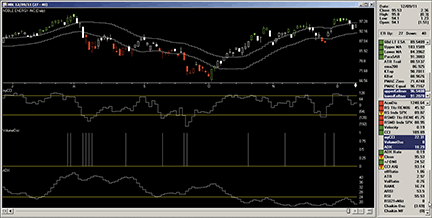
AIQ SYSTEMS, KELTNER CHANNELS, CCI, AND COLOR-CODED PRICE BARS. Here’s a sample chart of Noble Energy with the TMV indicators.
The AIQ code and EDS file based on is provided at www.TradersEdgeSystems.com/traderstips.htm. The code is also shown below
!TRADE BREAKOUTS AND RETRACEMENTS WITH TMV
!Author: Barbara Star,PhD, TASC February 2012
!Coded by: Richard Denning 12/9/2011
!www.TradersEdgeSystems.com
!CODING ABREVIATIONS:
C is [close].
C1 is valresult(C,1).
O is [open].
H is [high].
L is [low].
H1 is valresult(H,1).
L1 is valresult(L,1).
V is [volume].
!KELTNER CHANNEL
!INPUT:
keltLen is 20.
!KELTNER CHANNEL UDFs:
typ is (H+L+C)/3.
rangeAvg is simpleavg(H-L,keltLen).
!Plot the following three functions on price chart
!as three separte indicators:
midKelt is simpleavg(typ,keltLen).
upperKelt is midKelt + rangeAvg.
lowerKelt is midKelt – rangeAvg.
!ADX
!INPUT:
WilderLen is 10.
!NOTE: Wilder to expontential averaging the formula is:
!Wilder length * 2 -1 = exponential averaging length
!USED FOR DMI, ATR, ADX, ADX RATE
avgLen is WilderLen * 2 – 1.
!AVERAGE TRUE RANGE:
TR is Max(H-L,max(abs(C1-L),abs(C1-H))).
ATR is expAvg(TR,avgLen).
ATRpct is expavg(TR / C,avgLen) * 100.
!+DM -DM CODE:
rhigh is (H-H1).
rlow is (L1-L).
DMplus is iff(rhigh > 0 and rhigh > rlow, rhigh, 0).
DMminus is iff(rlow > 0 and rlow >= rhigh, rlow, 0).
AvgPlusDM is expAvg(DMplus,avgLen).
AvgMinusDM is expavg(DMminus,avgLen).
!DMI CODE:
PlusDMI is (AvgPlusDM/ATR)*100. !PLOT (2 lines)
MinusDMI is AvgMinusDM/ATR*100. !PLOT (2 lines).
DirMov is PlusDMI – MinusDMI.
DirMovAIQ is [dirMov].
!ADX INDICATOR as defined by Wells Wilder
!PLOT DIdiff as historigram is same as DirMov (AIQ built in indicator):
DIdiff is PlusDMI-MinusDMI.
ZERO if PlusDMI = 0 and MinusDMI =0.
DIsum is PlusDMI+MinusDMI.
DX is iff(ZERO,100,abs(DIdiff)/DIsum*100).
!PLOT ADX as single line indicator with support at 24:
ADX is expavg(DX,avgLen).
!VOLUME OSCILLATOR:
!INPUTS:
volLen1 is 1.
volLen2 is 20.
pctChgLvl is 50.
!VOLUME OSCILLATOR UDFs:
volAvg1 is simpleavg(V,volLen1).
volAvg2 is simpleavg(V,volLen2).
pctChgV is (volAvg1 / volAvg2 -1) * 100.
volOsc is iff(abs(pctChgV)>pctChgLvl,1,0). !PLOT
!CCI INDICATOR:
!INPUTS:
cciLen is 13.
!CCI UDFs:
typAvg is simpleavg(typ,cciLen).
absdiff is abs(typ-typAvg).
sumD is sum(absdiff,cciLen)/ cciLen.
CCI is (typ – typAvg) / (0.015 * sumD). !PLOT WITH +100 -100 LINES
!COLOR BAR RULES:
!INPUT:
trndLen is 8.
Green if ADX > valresult(ADX,1) and C > simpleavg(C,trndLen).
Red if ADX > valresult(ADX,1) and C < simpleavg(C,trndLen).
This e-mail address is being protected from spambots. You need JavaScript enabled to view it.
for AIQ Systems
January 20, 2012 US Market Review – with Richard Muller, Reuters Equity Analyst and TradingExpert Pro user
Richard Muller has posted a video update on The Trading Prism website on the major market support and reisitance levels.