All posts by admin

Time Tested Trading Tips, May 15…

Steve Palmquist.Author of ‘The Timely Trades Letter’. ‘How to Take Money from the Markets’, and Money-Making Candlestick Patterns. Successful traders examine the current market conditions to determine if they are bullish, bearish, or a trading range environment. Traders can determine which of the three modes the market is currently in by looking at a daily chart of the market action over the last year, using the 5X20 moving average filter, or through trend line analysis. I use each of these techniques for my own trading, and publish the analyses and trading setups in the Timely Trades Letter. After determining the current market environment, traders can select the tools from the their trading tool box that perform best in the current conditions. Having multiple trading tools that have been carefully tested and analyzed in each of the major market conditions is a key part of successful trading. If you trade the same tool all the time, or do not adapt to changing market conditions, you may get a lot of practice exercising stops. Pullbacks are one of the bread and butter techniques of trading because they occur frequently and can be found in most market conditions. Most traders should have more than one pullback system in their trading tool box. There are interesting pullback systems based on the percentage of retracement, pullbacks to key moving averages, pullbacks for a specific number of days, and pullbacks with specific volume patterns. Specific pullback techniques and information on how they perform in different market conditions is covered in ‘How to Take Money from the Markets’. The book also shows specific techniques for adapting trading strategies and techniques to the current market conditions.In addition to adapting to the current market conditions by using the appropriate tools from the trading tool box there are several practical aspects of trading that traders need to master. Never enter a position without having a plan for exiting the position. If you Do not know where to get out of a position you should not enter it in the first place. In swing trading time frames stocks often run to the next resistance or Support level and then stall. Stocks rarely remain outside the Bollinger bands for long, so when a position reaches the Bands it is often a good place to look at profit taking, especially in trading range environments. There is usually no need to rush in when the markets trend changes. Any trend worth trading does not require you to be in on the first day, by definition. Make sure that your position sizing is such that if all your current positions were stopped out that the total loss is something that is still comfortable. This happens from time to time, wishing it did not will not change it. Be prepared by using sensible position sizes.

How do you know when the move up is over for a ticker?

FREE webinar Thursday May 19th, 4:30pm eastern

How do you know when the move up is over for a ticker? In this first of two FREE webinars, we’ll discuss several key signs that it’s all over including:

• Exhaustion Gap – how to identify it’s an exhaustion and not a runaway parabola.

• Rising Channel breakdown – you’ve ridden the channel riding out the pullbacks. We’ll cover the key elements that indicate this is not a pullback but a breakdown.

• Doji Candlestick – when it’s identified correctly it really means the move is over.

Sound interesting? Join me for this FREE webinar on ‘How to identify signs of exhaustion in an up move’

Thursday May 19th, 4:30pm eastern

Visit http://aiqsystems.com/webinarexhaustion.html to register.

Steve Hill
AIQ Systems

Time Tested Trading Tips….

Steve Palmquist.Author of ‘The Timely Trades Letter’. ‘How to Take Money from the Markets’, and Money-Making Candlestick Patterns.

Trading is about risk management. Traders learn how to manage risk by testing different trading strategies to see how they have performed in different market conditions. Testing trading strategies also helps to identify various volume and price patterns that may improve trading results in each of the three key market conditions. Volume patterns improve the statistics for many trading patterns. Strong volume and price patterns do not guarantee a result, nothing does, but they may improve the odds as demonstrated by the research presented in ‘How to Take Money From the Markets’. Using well researched price and volume patterns can be ways to manage risk. The research can also be helpful in determine which of several trading systems or tools may be the most appropriate for the current market conditions. One way to know what may or may not improve the results for a given technique is to understand how different price and volume parameters, along with different market conditions effect trading results. That is why I wrote ‘How to Take Money From the Markets’. When the market is rocking I generally just enter strong setups without worrying much about the volume on the entry day. When the market is moving strongly then pullbacks, flags, and some of the other patterns I have tested generally mark pauses in the trend. If the pattern is generally a pause in the trend, then the odds are with me; and I do not need the confirmation provided by strong volume on the day of the trigger. When the market is more uncertain then I want to use additional tools to increase the odds of a favorable result, and I select the most appropriate tools based on the research presented in ‘How to Take Money From the Markets’.

How stocks and the market behave around the Bollinger Bands is very important to understand. Based on extensive testing I have learned to take profits in uncertain markets when my position becomes extended above the upper Bollinger Band. If you want a good lesson on risk management and why I exit positions that become extended above the upper Band take a look at the recent action in SLV. I did not get all the profit from the run up because the extension above the upper band had me out a week before the peak. However I still have my profits, and anyone holding last week took a thirty percent hit. I trade the charts and manage risk based on what I have learned from extensive testing.

VOLUME ZONE OSCILLATOR – Traders Tips

May’s Stocks & Commodities magazine article “In The Volume Zone” by Walid Khalil and David Steckler

has been coded by Rich Denning.

I have coded both the volume zone oscillator (Vzo) and the system that uses the Vzo indicator. I used my own interpretation of what the rules of their system mean since the exact code for the system is not given in the article. The divergence sell/cover rules were especially troublesome to interpret, so my version may not be what the authors intended. In addition, note that the nontrending case is not provided or tested.

I ran a backtest using the Portfolio Manager module from 1/1/1998 to 3/11/2011 using the Nasdaq 100 and also the Russell 1000 list of stocks. In Figure 8, I show the test results of simulated trading on the Nasdaq 100 list of stocks using the following parameters for capitalization:

  • Maximum positions per day = 3
  • Maximum total positions allowed = 1
  • Choose candidates using ADX values in descending order
  • Size each position at 10% of total account equity, recomputed daily.

Figure Above: AIQ SYSTEMS, volume zone oscillator AND SYSTEM. This shows the equity curve for the VZO system trading long only using the NASDAQ 100 list of stocks compared to the SPX index for the test period 1/1/98 to 3/11/11.

For the test period, the average annual return was 13.5% with a maximum drawdown of 49.9% on 12/31/2002.

The short side test was unsuccessful, as the system lost all its capital during the early years of the test. (Results not shown.) I tried adding an index trend filter, but this did not save the short side from total loss.

The code and Eds file can be found at below or can be downloaded from http://tradersedgesystems.com/aiq/traderstips/traders-tips-may-2011.htm

Interview with Dan Kamhis, AIQ client and ASAP founder

What does ASAP™ stand for?
 
ASAP is an abbreviation for Affluence Squared Automation Project™.
 
I found in my research that the probability of correctly predicting a stock price movement increases as one extends one’s time horizon, so I decided early on that I wasn’t interested in day trading. What I was looking for was not just stocks that would go up, but stocks that would go way up and stay up. Hence “Affluence Squared”. 

What exactly is ASAP?
 
It is well established that changes in earnings drives stock prices in the direction of the change. Thus if one could ascertain future ramps or declines in earnings, or more generally a coming change in a company’s financial condition, one would have a leg up. To assist a trader in this effort, I created a trading strategy using AIQ TradingExpert Pro.

Specifically, ASAP is a computer-based data collection, analysis and reporting algorithm designed to assist a knowledgeable and qualified investor in uncovering future organizational conditions with precision and understanding which are optimal in quality and timing. ASAP includes both long and short strategies which have been backtested through bull and bear markets.

How does ASAP help the user make stock selections?
 
It is well-established that the markets are discounting mechanisms. Some traders rely exclusively on technicals, some exclusively on fundamentals, and others some combination of the two. But all these have pitfalls.

Proper entry and exit points can often be mistimed with too heavy a reliance on backward-looking fundamental data. Indeed, retail investors are always mostly wrong at tops and bottoms.

Chart patterns and analysis of price and volume and pivot points can often clue an investor that a company’s condition has turned or remains favorable, often before the fundamentals even show it. Some very basic price and volume rules can do a decent job of picking up breakouts. However, the same exact technical parameters can work in one company’s case and fail in another, or can work for the same company at one time and fail at another.

Therefore, a fundamental data statistic that is “forward looking” would be useful as a differentiator. There does happen to be a legal, broadly available, readily quantifiable, and forward-looking fundamental statistic proven to beat the market indexes – insider buy/sell transactions. This forward-looking data is definable and comparable statistically, automatable over a universe of stocks, and is integrated with our technical strategy. Insider transactions, filtered by a special set of rules designed to maximize their predictive value, elegantly meet the requirements for a successful fundamental differentiator.

ASAP reports and displays on a price chart the actual insider transactions, but more importantly, provides and uses an insider score estimating probabilistic performance relative to the market based on statistical analysis of past similar transactions.

ASAP mostly ignores past fundamental information, except for information that statistically enhances the insider transactions, such as seasonality, market cap, and earnings surprises.

Further, insider information is aggregated for display and strategy use, providing a series of concentrically expanding macroeconomic forward-looking fundamental information.

ASAP includes both long and short strategies which have been backtested through bull and bear markets. Comparisons wherein the only change was the use of insider scores to further differentiate technical entry and exit points show a material improvement in backtest performance.

Who created ASAP and what is their background?
 
Here’s my brief bio. Mr. Dan Kamhis developed the ASAP mathematical models, proprietary indicators and strategy algorithms. He received a bachelor’s in mathematics from the University of California, San Diego, Magna Cum Laude in 1978. He has over 30 years of software development experience in aerospace simulation and real-time graphics, systems software for Windows and Unix platforms, and over 10 years’ experience in integrated stock strategy and indicator development. He is a patented inventor and published author.

Mr. Kamhis was assisted by Mr. Joe Osgood who programmed an assortment of data collection and database routines. Mr. Osgood received a B. S. in Computer Science from Worcester Polytechnic University in 1973. He has over 30 years of software development experience and is currently a senior software engineer at a rapidly growing medical device company. He is a published author.

Who can benefit from ASAP?
 
ASAP models real-world phenomena, is empirically tested, and is based on rigorous statistical analysis. Thus, the ASAP solution is scalable, providing tools to assist an investor trading a personal account, or the manager of a large institutional fund.

Can you give actual ASAP backtest results?


Chart 1 shows a six-year backtest covering two bull markets, and a bear.

The stock sample included approximately 5500 stocks which had insider transactions.

A key point is that the strategy is fully invested during the bull market, exits and remains out for the duration of the secular bear, and then leverages back in at the start of the bull, then exits for the correction.

Chart 2 shows the strategy beat the S&P by 35% a year [Gain/Loss (IRR)% Annualized] vs. 1.67% for the S&P for the six-year period.

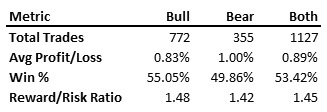
The round-trip transactions over the six-year period, average three every two weeks (Number of trades: 465).

While the ratio of winners to losers is only 54% / 46% (Probability), the average gain for the winners is 66%, while the average loss is 16% (Average Profit/Loss), leading to a Reward/Risk ratio of over 5.

The annualized ROI (Average Annual ROI) is an astounding 75% a year, due to the fact that the strategy exits the market during bear phases.

Is ASAP versatile enough to allow the user to create new indicators or stock analysis procedures?
 
Yes. One can adjust the ASAP color strategy and indicators in use. One can also create user-defined indicators and strategies. In fact, a user could wrap the ASAP lists in their own strategy filter and further refine the culling process.

With a source license, one could obtain the strategy itself which gives further flexibility in creating and modifying the ASAP indicators and procedures. And certainly the ASAP developers would be interested in hearing from anyone with any ideas for improvements in the strategy, or if someone was interested in a proprietary custom modification.

How is ASAP different from other programs on the market?
 
ASAP provides a unique color strategy which applies the notion of gradient changes in condition. Stock and market charts show subtle improvements and deteriorations and this over time provides enhanced understanding of the overall condition and scene, and can prepare for entry and exit.

ASAP is not a repetitive day trading or churn strategy, but is designed to leverage in and out of the market based on the market and stock stage.

The ASAP strategy takes into account the affinities in the market between individual stocks, and their groups and sectors and the market indexes themselves.

ASAP reports and displays the actual insider transactions on a price chart, but more importantly, computes, displays and uses an insider score estimating probabilistic performance relative to the market based on statistical analysis of past similar transactions.

ASAP provides customizable daily and weekly reports indicating stocks which have surpassed their technical pivot points (breakouts or breakdowns) and have qualified insider scores. While ASAP attempts to capture the earliest breakouts in a long-term uptrend, continuation signals are provided for focus on a particular ticker.

A general “Breakout Rank” score is provided ranking all stocks relative to their combined technical and insider score.

Stocks can also be ranked strictly by insider criteria, such as a weighting consisting of insider score and a measure of recent changes to the insider transaction patterns.

ASAP provides a range of selectable stops designed to minimize whipsaws, including investing, trading and climax stops.

Is there an ASAP community?

 
ASAP is a relatively new package, but there is a growing body of users and proponents.

What are the computer and operating system requirements for ASAP?
 

Even five-year-old computers can run it pretty well, but ASAP is customizable in this sense. Some indicators are more compute intensive than others. On an older or slower machine, one can limit the use of the more compute intensive indicators to only when the trader is specifically interested in them.

If someone is interested in finding out more about ASAP, what should they do?
 
They can drop me (Dan Kamhis) a line at trade.asap@yahoo.com, and I’ll be glad to set up a web demo.

Thank you for spending time with us Dan.