Category Archives: Uncategorized

17 stocks have had positive returns in the last 20 trading days of the year, 8 years in a row.

Seasonality is always on a traders radar in December. The Santa Claus rally and all.

In this seasonal vein, I ran a scan of a decent database of liquid stocks with the following idea in mind.

1) The percentage return for the last 20 trading days of the year.
2) Look back the last 8 years
3) Only show me stocks that have either all positive or all negative returns in those 8 years

As the Santa Claus rally is a seasonal feature of the markets it made
sense to me to find stocks that do the same thing. Might as well get as
many odds in my favor as I can.

So here’s what I found.

17 stocks have had positive returns in the last 20 trading days of the year, 8 years in a row.

The top performer was AAR Corp – symbol AIR. It’s average return over
the last 8 years was a whopping 13.98%. Pretty impressive for 20 days.
More impressive was the consistency. The range of returns was between 7%
and 23%, so no 98% wild card distorting the pattern.

Of course there’s never any guarantee this will continue, but it’s impressive to see.

AIQ TradingExpert Pro’s Expert Design Studio was used to create the scan. FREE trial at
http://aiqsystems.com/PLSbrochure2.htm

Gettin’ Stupid In Gold Stocks(?)

A long time ago I evolved into something of a “go with the flow” kind of guy – at least when it comes to the financial markets.  Sure, in my youth I spent a fair amount of time staring into my crystal ball and trying to “pick tops and bottoms with uncanny accuracy.”  Unfortunately, it took me a long time to figure out that my crystal ball was not actually functioning.

So I have long understood the benefit of simply using some objective method to define the trend is either “up” or “down”, and just kind of seeing where it leads.  This approach came in pretty handy in 2013 when the “news” was essentially uniformly bad from start to finish.  But did the stock market care – oh contraire!

Updating the old adage “Don’t Fight the Fed” into today’s jargon:

“If the Fed is pumpin’, the stock market’s jumpin’. ”

And at the moment, there appears to be no end in sight (at least regarding QE2IB, or “Quantitative Easing to Infinity and Beyond”). So why do I all of a sudden have a foolish hankering to buy gold stocks?  This makes no sense at all.  In Figure 1 you see four different gold stock related investment vehicles.  Can you say “well established downtrend?”  Sure, I knew you could.  Some have broken down to new lows others are still holding out hope of establishing a double bottom.  And for some inexplicable reason, I feel this urge to play the long side. 
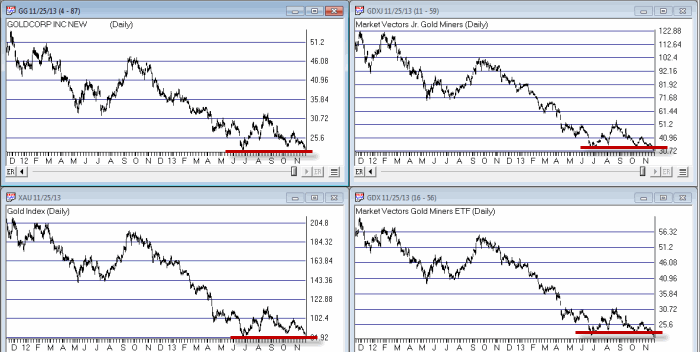
jotm1128-01Figure 1 – Gold Stock Double Bottom; In the Making or Wishful Thinking? (Courtesy AIQ TradingExpert)

The key hesitation here is the simple fact that on the approximately last 57 times it “looked” like a potential bottom in gold stocks…….it wasn’t.  Will this time around be any different?  Probably not.  Still……….in the immortal words of Glenn Frey, “the lure of easy money, it’s got a very strong appeal.”

 To Give In Or To Fight the Urge?

Investing and trading is a game best played by establishing certain rules (for example, “go with the trend”, “cut your losses”, etc.) and then sticking to them.  But human nature is, well let’s be blunt here, a pain in the butt.  The urge to “pick a bottom” is one of the stronger, more compelling urges that any trader feels. What a coup if you pull it off (which of course you probably won’t)!
So here is the question?  If you feel the urge to “pick a bottom”, should you:

a) Fight the urge in every case?
b) Give into the urge and bet the ranch?
c) Give into the urge and risk a small, acceptable amount of capital?

If you picked answer, b) my frank advice is to let someone else handle your money.
If you picked answer a), more power to you and I greatly respect your discipline.
If you picked answer c) yo, what up dog!?  (Sorry, I inadvertently walked in on some video my kids were watching)

I personally can live with answer c).  For a couple of reasons.  First of let’s establish the fact that choosing answer c will probably lead to your losing money more often than not.  Sorry, that’s just the reality.  However, it can also serve as something of a “release valve”, whereby the occasional small mistake reminds us not to make a big huge mistake (i.e., answer b, somewhere down the line)
So let take a look at one possibility.

Finding a Trade (for better or worse)

I used www.OptionsAnalysis.com to look for long call trades on tickers GDX, GDXJ, XAU, NEM and GG.  Sorting for Bullish percent to double and then among the top trades chose the one with the highest Gamma (long story short, high gamma in my book equals more “bang for the buck”)
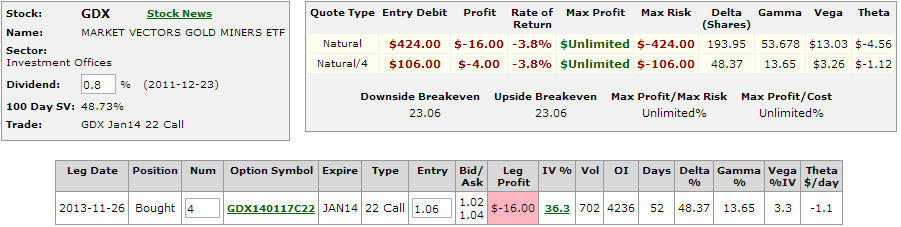
The trade I came up with was buying the GDX January14 22 call at $1.06 as shown in Figures 2 and 3.

So is this a good idea?  In all candor, probably not.  But let me just explain what I am looking at.
Let’s say I am a trader with a $25,000 trading account and are willing to risk (throw away?) 2% of our trading capital on a foolhardy attempt to pick a bottom (hey, it’s my account, I can do what I want).

This means I can risk $500 ($25K x .02).  So if the option trades at $1.06, this means I can buy up to 4 contracts and risk $424.

jotm1128-02Figure 2 – GDX Call Trade (Courtesy: www.Optionsanalysis.com)
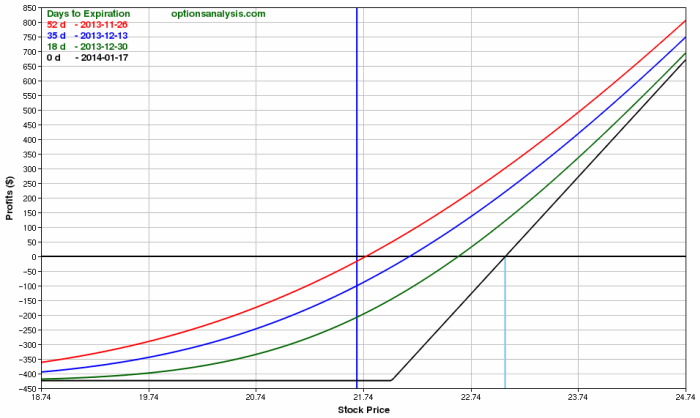
jotm1128-03Figure 3 – GDX Call Trade Risk Curves (Courtesy: www.Optionsanalysis.com)

So what are the likely (or at least possible) outcomes?

#1) Murphy’s Law being what it is, if I take this trade gold stocks will almost certainly continue to sink.  In this case the worst case scenario is that I hold the calls until January expiration and lose $424.

#2) if somehow, the market gods smile, let’s assume that GDX bounces back up to its early November high near $24.70.  In this case, the trade will generate a profit of $660 to $880 or more, depending on how soon GDX bounces.

Summary

As a rule I would never advocate for someone else to “pick a bottom”.  But let’s face, every once in awhile, the urge strikes.   So if you decide to give into the urge, make sure:

a) You don’t risk very much money.
b) You have enough upside potential to at least make it worth your while to do something that you may well look back upon and say, “Why the heck did I do that?”

As long as you employ a) and b) above, I view it as sort of a win-win situation (depending of course on how you define “win”).

If the underlying security in question does bounce to higher ground, you have the opportunity to generate a nice profit.

On the other hand, if the underlying security continues its current trend, you are served a powerful reminder of why you don’t try very often to “pick tops and bottoms with uncanny accuracy.”

So the bottom line is this: I am NOT telling you that I think gold stocks are about to bounce and that you should buy gold stocks (or options on gold stocks).  What I am telling you is that sometimes the urge to speculate will rise to the surface.

When that urge strikes there is a right way and a wrong way to react.

Jay Kaeppel

Chief Market Analyst at JayOnTheMarkets.com and AIQ TradingExpert Pro (http://aiq.com) client
 
Jay has published four books
on futures, option and stock trading. He was Head Trader for a CTA from
1995 through 2003. As a computer programmer, he co-developed trading
software that was voted “Best Option Trading System” six consecutive
years by readers of Technical Analysis of Stocks and Commodities
magazine. A featured speaker and instructor at live and on-line trading
seminars, he has authored over 30 articles in Technical Analysis of
Stocks and Commodities magazine, Active Trader magazine, Futures &
Options magazine and on-line at www.Investopedia.com.

Swing Trading With Three Indicators

The AIQ code based on Donald Pendergast’s article in the December 2013 issue of Stocks & Commodities, “Swing Trading With Three Indicators,” is provided at the following website: www.TradersEdgeSystems.com/traderstips.htm.

In addition to coding the author’s system as described in his article — which uses the following rules: buy to enter long and sell to exit the longs; short to enter shorts and cover to exit shorts — I created a second system that uses average true range
to get the breakout amount. I also added some additional trend filters
that use the NASDAQ 100 index.

All trading was simulated using closing
prices to determine whether an entry/exit had occurred, and then the
trades are entered/exited the next day at the open. My modified system
uses rules to “BuyATR,” “SellATR,” “ShortATR,” and “CoverATR.” A
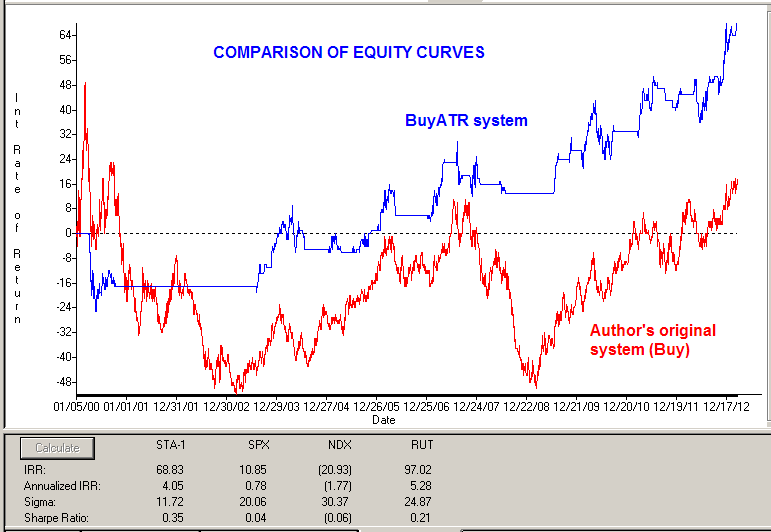
comparison of equity curves is shown in Figure 7. In testing the short
side, neither the author’s original system nor my modified system was
able to produce profitable results, although my modified system has a
smaller total loss than the author’s original system.

Image 1

FIGURE 7: AIQ, EQUITY CURVE. Here is a comparison of the equity curves
for Donald Pendergast’s original system and my modified system trading
the NASDAQ 100 list of stocks for the period 1/5/2000 to 10/9/2013.

The code and EDS file can be downloaded from www.TradersEdgeSystems.com/traderstips.htm.

!SWING TRADING WITH THREE INDICATORS
!Author: Donald Pendergast, TASC December 2013
!Coded by: Richard Denning 10/10/2013
!www.TradersEdgeSystems.com
!INPUTS:
emaLen is 50.
smaLen is 5.
breakAmt is 0.05.
atrLen is 10.
atrMult is 0.04.
H is [high].
L is [low].
C is [close].
C1 is valresult(C,1).
price is C.
emaLenLT is 200.
!UDFs:
maH is simpleavg(H,smaLen).
maL is simpleavg(L,smaLen).
ema is expavg(C,emaLen).
emaLT is expavg(C,emaLenLT).
TR is Max(H - L,max(abs(C1 - L),abs(C1- H))). 
ATR is simpleavg(TR,atrLen).
ATRpct is simpleavg(TR/C,atrLen).
ndxC is tickerUDF("NDX",C).
emaNDX is tickerUDF("NDX",ema).
emaNDXlt is tickerUDF("NDX",emaLT).
!SYSTEM RULES:
!Author's system:
Buy if price > maH+breakAmt and C > ema.
Sell if price < maL.
Short if price < maL-breakAmt and C < ema.
Cover if price > maH.
!Modified system using average true range:
BuyATR if price > maH+atrMult*ATR and C > ema and ndxC < emaNDX and ndxC > emaNDXlt .
SellATR if price < maL-atrMult*ATR.
ShortATR if price < maL-atrMult*ATR and C < ema and ndxC > emaNDX. 
CoverATR if price > maH+atrMult*ATR.
—Richard Denning
info@TradersEdgeSystems.com
for AIQ Systems

Finding Exceptional Opportunities with ETFs, Options, & Seasonal Trends

AIQ Opening bell contributor and TradingExpert Pro client, jay Kaeppel has a FREE webinar in association with the Market Technicians Association. details are below

On Wednesday, November 20th, 2013, the MTA’s Educational Web Series continues with another free educational webcast event at 12 PM Eastern / 9 AM Pacific. This week, we will feature…

“Finding Exceptional Opportunities with ETFs, Options, & Seasonal Trends”
with Jay Kaeppel

With all of the trading vehicles and great opportunities now available, there has never been a better time to be a trader.  The key to success is to identify and take advantage of exceptional opportunities.  In this fast-paced session, market veteran and author Jay Kaeppel reveals a handful of unique trading methods that you have likely never considered.  Each method details a simple, objective and highly effective plan of action.  Take a journey off the beaten path and discover simple trading strategies designed to succeed in the long run.

You can access the event at http://go.mta.org/lobby112013 

the link howver will not be live until 11/20/2013

Santa Claus Is Coming to Town

OK I’ll admit I am a little early with this one.  But maybe not as early as you might think.  In fact, as I was out driving I saw the first house in my neighborhood to have Christmas lights up…and lit.  Hey, desperate times I guess.

While the stock market continues to push to new highs, “morale” is not quite what one might expect.  This may be due in part to the fact that it is near impossible to peruse the financial media these days and not come away with a sense of foreboding, given all of the warnings and admonitions and liberal use of word like “frothy” and “bubble.”  And make no mistake, I have voiced a few concerns recently myself and have gone so far as to suggest that investors consider hedging with VXX call options (http://jayonthemarkets.com/2013/10/30/is-vxx-issuing-a-warning/) from time to time.

Still, as a person who has been involved in the financial markets for a while I understand the power of the trend.  So despite all of my personal concerns about the economy, debt, etc., etc., 2013 has been good to “go with the flow” kind of people.   In the short-term, the stock market does appear to be a bit “overbought” and perhaps “due for a correction.”  But while anything can happen, history suggests that people who are looking for a stock market collapse before the end of the year may be disappointed.  Cue the Christmas music.

The Santa Claus Rally

As I define it, the Santa Claus rally time period:

-Begins at the close of trading on the Friday before Thanksgiving.
-Extends through the close of the third trading day of January.

And that’s all there is to it.

So how has the stock market performed during this period in the past?  I am so glad you asked.
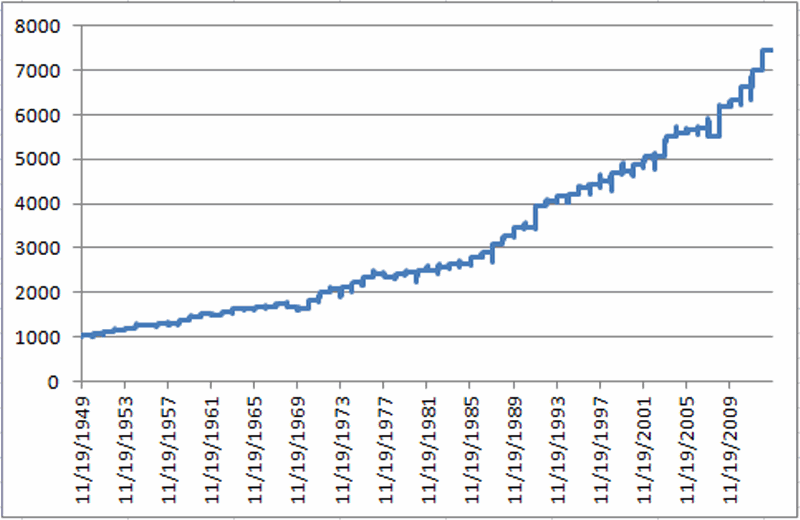
Figure 1 displays the growth of $1,000 invested in the Dow Jones Industrials Average only during the pre-Thanksgiving through post-New Year’s period I just described, starting in November 1949.

jotm20131104-01

Figure 1 – Growth of $1,000 invested in Dow Jones Industrials during Santa Claus Rally period (1949-2012)

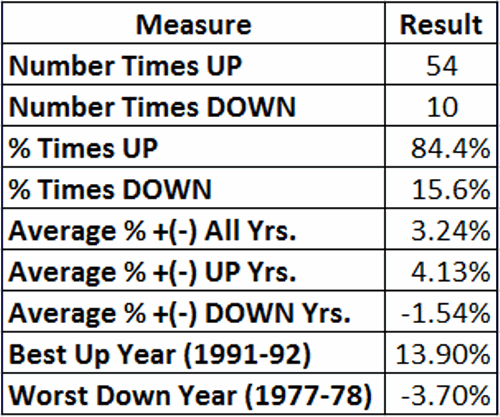
Figure 2 displays some important figures regarding this performance.

jotm20131104-02
 
Figure 2 – Stock Market Performance during Santa Claus Rally Time Period

One other thing to note is that this Santa Claus Rally time period has witnessed an advance by the Dow during 26 of the last 28 and 32 of the last 35 years.   It’s tough to the beat that kind of consistency.

Summary

So does all of this mean that “you can’t lose” trading stocks during this “sure thing” time period guaranteed to generate “above average, risk free” returns?  Ah, if only.  All any of this really means is that stocks have performed well during this time period in the past.  What will happen this year remains to be seen.

Still, the real point is that investors may be wise to give the bullish case every benefit of the doubt starting in late November.

Jay Kaeppel
Chief Market Analyst at JayOnTheMarkets.com and AIQ TradingExpert Pro (http://aiq.com) client

 
Jay has published four books on futures, option and stock trading. He was Head Trader for a CTA from 1995 through 2003. As a computer programmer, he co-developed trading software that was voted “Best Option Trading System” six consecutive years by readers of Technical Analysis of Stocks and Commodities magazine. A featured speaker and instructor at live and on-line trading seminars, he has authored over 30 articles in Technical Analysis of Stocks and Commodities magazine, Active Trader magazine, Futures & Options magazine and on-line at www.Investopedia.com.
P.S.  For all of you “numbers geeks” out there, the annual performance during the Santa Claus Rally Time period appears below

Period Ending DJIA % +(-)
1/5/50
3.6
1/4/51
4.0
1/4/52
3.9
1/6/53
4.6
1/6/54
2.9
1/5/55
5.1
1/5/56
0.2
1/4/57
3.7
1/6/58
(0.0)
1/6/59
5.7
1/6/60
5.8
1/5/61
3.2
1/4/62
(1.0)
1/4/63
5.0
1/6/64
5.0
1/6/65
(1.2)
1/5/66
3.0
1/5/67
(0.5)
1/4/68
4.3
1/6/69
(3.1)
1/6/70
(2.4)
1/6/71
10.0
1/5/72
11.6
1/4/73
3.4
1/4/74
2.0
1/6/75
3.6
1/6/76
6.0
1/5/77
3.1
1/5/78
(3.7)
1/4/79
3.6
1/4/80
1.6
1/6/81
1.5
1/6/82
0.9
1/5/83
2.3
1/5/84
2.5
1/4/85
(0.3)
1/6/86
5.7
1/6/87
4.3
1/6/88
6.5
1/5/89
6.2
1/4/90
5.4
1/4/91
0.6
1/6/92
13.9
1/6/93
2.4
1/5/94
2.8
1/5/95
0.9
1/4/96
3.7
1/6/97
1.5
1/6/98
1.8
1/6/99
4.2
1/5/00
1.1
1/4/01
2.7
1/4/02
4.0
1/6/03
(0.4)
1/6/04
9.5
1/5/05
1.3
1/5/06
1.1
1/5/07
0.4
1/4/08
(2.9)
1/6/09
12.0
1/6/10
2.5
1/5/11
4.6
1/5/12
5.3
1/4/13
6.7