Category Archives: Uncategorized

Weekend Strategy Review 01-20-13

by Hank Swiencinski, AIQ
TradingExpert Pro client fro over 20 years, founder of ‘The Professor’s One
Minute Guide to Stock Management’. Later this month Hank will be presenting an
AIQ webinar covering some of the techniques he teaches, like cycles and stick patterns.
Hank will be presenting this free AIQ webinar entitled The Professor’s
One Minute Guide: The Basics,
January 24th, 2013, 4:30 – 5:15pm
eastern,
Click on this link to register. Here’s a sample of his Weekend Strategy Review 01-20-13
The Dow rose 53 points on Friday, closing at 13,650. It was up 161 points for the week. The Nasdaq was down 1 point on Friday, but was up 9 points for the week. The Nasdaq is having a tough go of it lately, mostly because of Apple. The characteristics of the company have changed radically in the past month. Apple went into a sustained up trend almost four years ago, on 11 May 2009, at a price of 129.49. During that time, the 50 NEVER once fell below the 200. Pretty amazing! But that is no longer the case. On 2 October of last year, the PT indicators turned negative and then on 19 December, the 50 dropped below the 200. So now, any rally in Apple must be viewed with suspicion. That’s because any rally could be the development of the Blade of a negative Hockey Stick pattern, which could lead to significantly lower prices. And it’s not often that you see a stock that has a potential ‘Stick” of over 200 points, so we need to be careful. Remember, Apple represents a significant portion of the Nasdaq100. And IF Apple continues its downtrend; the Nasdaq will likely continue to experience problems. But let’s not focus on Apple for now. Let’s look at the Big Picture instead.
Big Picture Strategy: The Dean’s List remains strong and the cockpit indicators are positive. I will remain Bullish as long as my Lists and indicators stay positive. The strategy is very simple now. Once we get closer to the 14,000 level, I will re-evaluate the strategy. Not now.
OK, we’re at 13,650, just 450 points from our target of 14,000+. What now? Just a few weeks ago, we were trading under 12,900 and some of the folks on CNBC thought the world was coming to an end. We didn’t. We saw that the Dean’s List was much too strong for Armageddon. We also saw that the decline that occurred since the middle of December looked more like the Blade of a Hockey Stick Pattern than the beginning of any end of the world scenario. Pullbacks after rallies are normal. They are positive, not negative, no matter how the world looks to the folks on CNBC. We also saw that the 50 was still comfortably above the 200, and that the pullback only caused the price to drop back to the 200. The Dow was taking a break. It was resting.
So why am I writing about this today? Well, I want you to take a quick look at the Dow. I want you to once become familiar with the pattern. Get it burned into memory. Specifically, I want you to look at the stick that started on 15 November and completed on 18 December. Note that the November low was 12,472, and the high was 13,366. or a rally of 894 points. So if we add 894 to low of the Blade that completed on 31 December, 12,884, when Congress was trying to keep us from falling off the ‘fiscal cliff’, we get 13,778. Only 222 points from 14,000.
In the Classroom, we talk about how the market moves in waves. We also talk about Ending Diagonals and termination patterns. And the one thing we know about them is that the final waves of these larger patterns should consist of 5 waves. And because the most recent ‘Rope Jump’ that occurred in early December told us that the move was likely a wave 1, which was followed by a retracement, it’s even more likely that what we are seeing now is the impulse wave, or wave 3 of the 5 wave sequence that will eventually complete the Ending Diagonal Pattern.
So assuming that we are in the impulse wave, then we also know that it too should consist of 5 waves, So odds are that the move that started on 31 December still has a lot more to go. We know that the move probably won’t be straight up. That there will be pullbacks along the way, and each of these pullbacks should be viewed as a buying opportunity.
Buying opportunity as in Buy the Cake, Eat the Cake (BTC-ETC). That’s what we’re looking for now.
One of the stocks that I’m currently watching is Green Mountain Coffee Roasters, GMCR. Before you look at Green Mountain on a Daily Chart, I suggest that you take a look at it on a Weekly Chart. That way you’ll have a better feeling for the kind of stock we’re dealing with.
Green Mountain had an incredible ride once the market turned positive in March 09. It rose from relative obscurity to being a 115 stock in 2 ½ years. Then the coffee tree came crashing down and GMCR fell back to earth, once again trading in the teens. Hey…GMCR is a coffee grower not a purveyor of magic potions. Anyhow, for the past few months, GMCR has been appearing on the Member’s Watch List. We saw it jump the ropes in late November, an indication of a possible wave 1. Since then, it has spent the last 6 weeks forming what appears to be a wave 2. The stock is currently in a well defined up trend, and is on MWL with positive PT indicators. More importantly, the Bands are narrowing, which could be telling us that its K-cups could be ready for some serious brewing. If the stock starts to move above 43.79 and push its Bands, it could be headed significantly higher.
On the other hand, on Friday, Bank of America reported fourth-quarter earnings that were 63 percent lower than last year but slightly above expectations. A decrease in revenue and a few costly blunders from their 2008 acquisition of Countrywide and Merrill Lynch were the reasons cited for the decline.
Now, most of you know that I’m not a big fan of bank stocks. I’m not. But I also know that many of you are. But when it comes to stock ownership, the only thing I really care about is patterns, indicators, and Lists. Being a fan of something is for sports, not stocks. And right now, the events leading to BAC’s earnings announcement have created a very interesting situation on its Daily chart.
BAC is currently in a well defined up trend, and when the stock pulled back on Friday, it caused the 2-period RSI Wilder to become oversold. Now I know that a few of you might be looking at BAC and thinking about using the BTC-ETC strategy. But as we know, to use this strategy, the stock must be in an up trend, and have positive indicators. During Friday’s pullback, the DMI and P-vol on BAC turned negative. So right now, BAC is NOT a candidate for my BTC-ETC strategy. The stock was on the MWL recently, but dropped off during the pullback. That’s OK. But to use BTC-ETC Strategy, we still need to see an Up trend, an oversold 2-period RSI Wilder and POSITIVE indicators. So I still say…. NO Banks! Besides, take a look at BAC’s weekly Chart since 2009. It’s been almost 4 years since the stock bottomed, and the chart still looks horrible! Give me Free Willy stocks anytime! I can’t get interested in BAC until I see it ‘Jump the Ropes’ on the Weekly.
Another stock I’m watching is American Express. AXP. It’s on the MWL and has pulled back on the Daily’s. The stock is in a well-defined up trend with positive PT indicators and is a candidate for my BTC-ETC strategy
Also, on Friday, we saw Schlumberger, SLB, pop 3.13 points to 76.50, after being highlighted by Emeritus and placed on the Honor Roll at 73.22 two days before.
After jumping the ropes in mid-September for its wave 1, SLB formed a 2 wave pullback into mid-November. Since that time, it jumped the ropes again for wave 3.1, that was followed by another 2-wave pullback or wave 3.2. The PT indicators turned positive on 4 January at 72, and Friday’s jump appears to confirm that the impulse wave is underway. Take a look at the HS/w Blade Pattern on the Weekly’s.
While you’re at it, you might want to compare SLB to our energy rabbit, GPOR, which continues on its tear. Do you see the massive HSw/Blade pattern that formed on the Weekly chart of GPOR since 2009? That’s what is propelling the stock higher now. Now go back to SLB. See the similarities? For comparison purposes, you might want to look at the chart of Petrobras, PBR. GPOR is Green, having fun in an Up trend, and is now in the Free Willy Mode. PBR is in Jail, constrained by its moving averages, RED indicators, and fighting a downtrend. What’s more fun? Free Willy or Jail?
Remember, it’s mid-January, and March is right around the corner. I always want to look at energy going into March.
So reviewing my Big Picture Strategy, I’m positive and looking to buy stocks from my Lists that have patterns and are either starting an Up trend or are pulling back and resting from a recent move up. For stocks that appear to be completing a wave 2, I’m looking to buy them when the indicators turn positive, especially if they have tight Bands. On those stocks that are already in up trends, I’m looking to buy them if the 2-period RSI Wilder becomes oversold. We’re going higher.
Also, continue to pay attention to Emeritus and the Honor Roll. Remember how he signaled ‘RALLY’ on 2 January by placing a world record 38 new stocks on the Honor Roll? Then added RCL, GILD and CNI. He highlighted SLB on 8 January, then again on 16 January. And PEP on 10 January, just to name a few. Pay attention :>)
Continue to be patient with gold and silver. On Friday, the PT indicators turned positive on SLV after a nice 2-wave pullback since mid-September. The ETF is starting to ‘Jump the Ropes’again. Hmmm? Could Major Wave 3 Up be starting? We’ll see.
I’m also watching the Major Hockey Stick Pattern on physical gold shares, GLD. Gold is also playing with a ‘Rope Jump’on the Daily’s. The DMI and P-vol turned positive on Friday. Now all I need to see is a positive MACD and I’ll go looking for my pick and wheelbarrow.
That’s what I’m doing,
h
All of the commentary expressed in this site and any attachments are opinions of the author, subject to change, and provided for educational purposes only. Nothing in this commentary or any attachments should be considered as trading advice. Trading any financial instrument is RISKY and may result in loss of capital including loss of principal. Past performance is not indicative of future results. Always understand the RISK before you trade.

The Volatility (Regime) Switch Indicator

The AIQ code based on Ron McEwan’s article in February issue of Stocks & Commodities, “The Volatility (Regime) Switch Indicator,” is provided at the website www.TradersEdgeSystems.com/traderstips.htm.

To test the author’s volatility switch indicator, I used the NASDAQ 100 list of stocks and AIQ’s Portfolio Manager. A long-only trading simulation was run with the following capitalization, cost, and exit settings:

  • Maximum of 10 open positions
  • Size each position at 10% of mark-to-market total capital
  • Take no more than three new positions per day
  • Compute the mark-to-market capital each day
  • Three cents per share was deducted for each round-turn trade
  • Select trades based on the lowest three-bar RSI reading
  • Exit trades only with a system exit; no stop-loss or profit target stop used.

I coded four similar test systems. All systems enter & exit on the next bar at open after the respective entry or exit rule becomes true at the close of the bar:

System 1: A basic trend-following system that buys when the close of a stock is above its moving average and the moving average is higher than it was 10 bars ago. Exit when the close is below the moving average.

System 2: The same as System 1 with the volatility switch filter added to the entry and exit rules for the stock.

System 3: The same as System 2 with System 2 rules also added to the market using the NASDAQ 100 index (NDX) to represent the market conditions.

System 4: The same as System 1 but with the volatility switch filter and the trend-following rules added to the market index (NDX).

I used the author’s parameters of 21 days for the volatility length and 50 for the volatility switch level. Note that my coding of the indicator is multiplied by 100. To determine the trend, I used a 50-bar moving average. For the period 12/30/1994 to 12/12/2012, the systems returned the results shown in the table in Figure 7.

 Figure 7: AIQ, SYSTEM BACKTEST RESULTS. For the period 12/30/1994 to 12/12/2012, the four system variations returned these results.
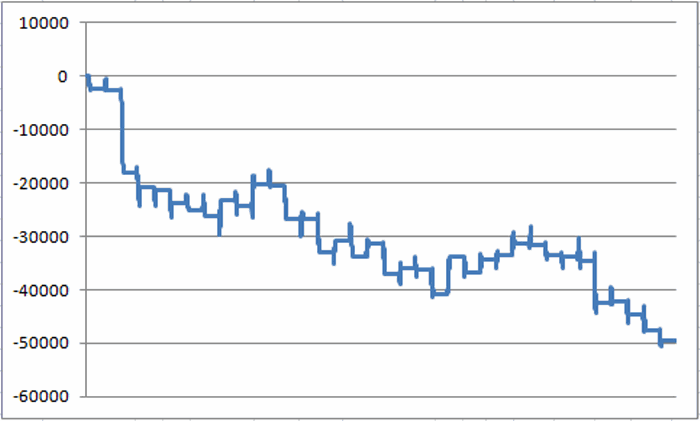
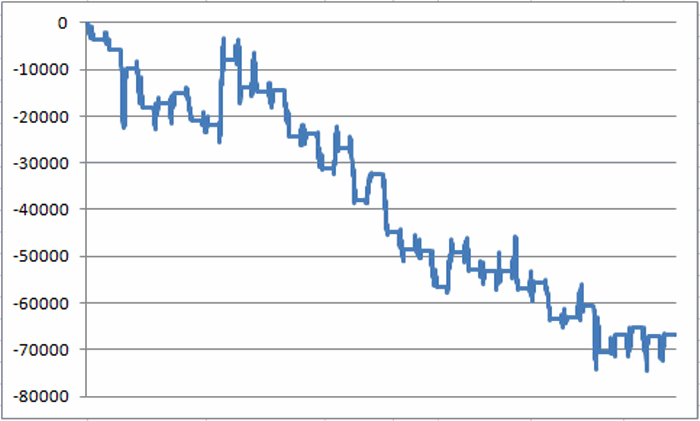
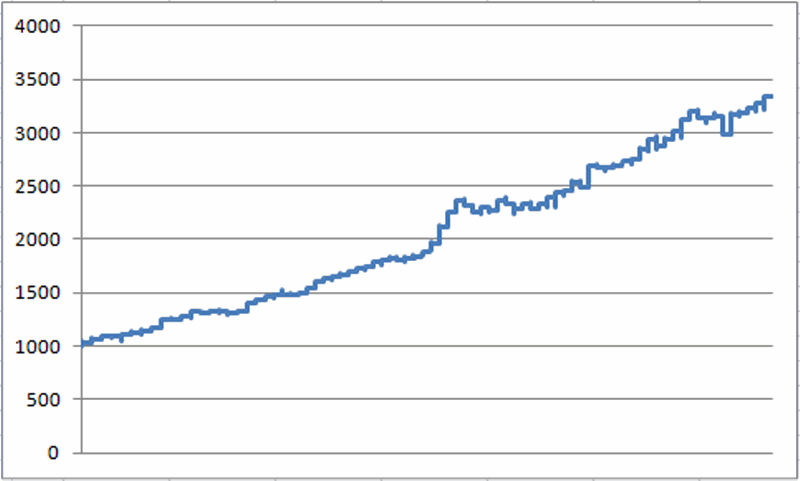
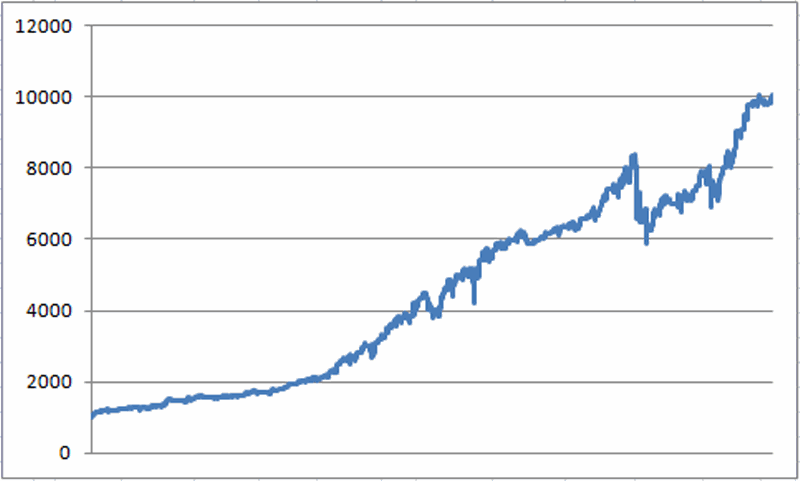
In Figure 8, I show the equity curves for all four systems, with the largest graph showing the equity curve for System 4, which is the one I prefer due to the relatively low drawdown and the highest Sharpe ratio. Adding the volatility switch filter only to the stocks (System 2) did not reduce the drawdown but the return increased very slightly and the Sharpe ratio was one of the highest. Adding the filter to both the stock and the market (System 3) dramatically reduced the drawdown, but the return and Sharpe ratio also were significantly reduced. Adding the filter only to the market index thus seems the best compromise. The tests tend to show that the filter can be used to reduce drawdown and increase reward-to-risk ratios.
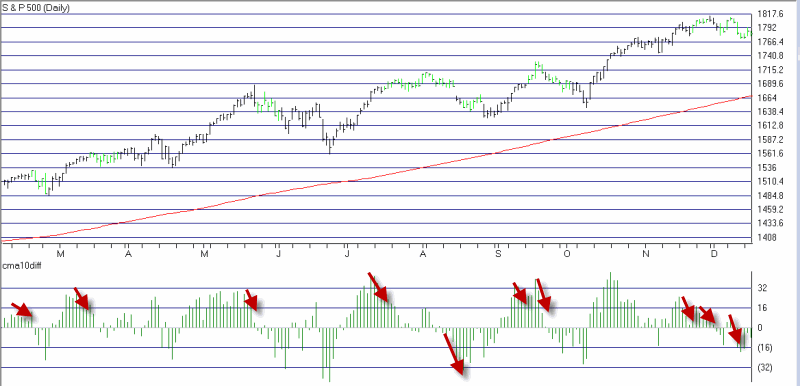
FIGURE 8: AIQ. Long-only equity curves (blue) compared to the S&P 500 (red) for the test period 12/30/1994 to 12/12/2012 trading the NASDAQ 100 list of stocks.

The code and EDS file can be downloaded from www.TradersEdgeSystems.com/traderstips.htm. The code is also shown below.

!THE VOLATILITY (REGIME) SWITCH INDICATOR
!Author: Ron McEwan
!Coded by: Richard Denning 12/7/12
!www.TradersEdgeSystems.com
!INPUTS:
volaLen is 21.
maLen  is 50.
volaLvl is 50.
rsiExitLvl is 90.
!ABREVIATIONS:
C is [close].
C1 is valresult(C,1).
!INDICATOR FUNCTIONS:
MA  is simpleavg(C,maLen).
RC1  is (C-C1)/((C+C1)/2).
SD  is sqrt(variance(RC1,volaLen)).
Count  is countof(SD <= ∧SD,volaLen).
VolaSwitch is Count / volaLen * 100.
!TRADING SYSTEM RULES:
!SYSTEM 1: TREND FOLLOWING WITHOUT VOLASWITCH FILTER:
Buy if C > MA and MA > valresult(MA,10).
ExitBuy if C < MA.
!SYSTEM 2: TREND FOLLOWING WITH VOLASWITCH FILTER:
BuyVS if VolaSwitch < volaLvl and C > MA and MA > valresult(MA,10).
ExitBuyVS if (VolaSwitch > volaLvl and C < MA)
or (VolaSwitch > volaLvl and rsi3 > rsiExitLvl).
!SYSTEM 3: TREND FOLLOWING WITH VOLASWITCH & MARKET TIMING:
BuyVSM if BuyVS and TickerRule("NDX",BuyVS).
ExitBuyVSM if ExitBuyVS or TickerRule("NDX",ExitBuyVS).
!SYSTEM 4: TREND FOLLOWING WITH VOLASWITCH MARKET TIMING APPLIED ONLY TO NDX:
BuyMvs if Buy and TickerRule("NDX",BuyVS).
ExitBuyMvs if ExitBuy or TickerRule("NDX",ExitBuyVS).
!RSI WILDER (FOR SYSTEM 2 EXIT):
U  is [close]-val([close],1).
D  is val([close],1)-[close].
W1 is 3.
rsiLen1 is 2 * W1 - 1.
AvgU  is ExpAvg(iff(U>0,U,0),rsiLen1).
AvgD  is ExpAvg(iff(D>=0,D,0),rsiLen1).
rsi3  is 100-(100/(1+(AvgU/AvgD))).
—Richard Denning
info@TradersEdgeSystems.com
for AIQ Systems
 

Weekend Strategy Review – Sat, Jan 12th, 2013

by
Hank Swiencinski, AIQ TradingExpert Pro client fro over 20 years, founder of
‘The Professor’s One Minute Guide to Stock Management’. Later this month Hank
will be presenting an AIQ webinar covering some of the techniques he teaches,
like cycles and
stick patterns. Hank will be presenting this free AIQ webinar entitled The Professor’s One Minute Guide: The
Basics,
January 24th, 2013, 4:30 – 5:15pm eastern,
Click
on this link
to register. Here’s a sample of his analysis

 
The Dow rose 17 points on Friday, closing at 13,488. It was up 53 points on the week. The Nasdaq was up 3 points on Friday and up 23 points on the week. The rally continues. 
 
The Dean’s List remains strong, and all of the cockpit indicators remain positive.
 
Big Picture Strategy: I’m Bullish and will remain so until the Dean’s List starts to weaken. I’m expecting the ride to end near the 14,000 level, possibly higher. When the ride ends this time, it will be time to change the strategy. Not now.
 
CNI was up 0.75 points on Friday, closing at 94.25. It reached a high of 94.65 during the day. Earlier in the week, I mentioned that the first target for CNI was ‘just under 95’, so we got very close. My next target is 97, then 105. The reason I’m focusing on CNI today is because I want you to have an idea about what to expect next. CNI is currently in a trend mode. It has moved higher as a result of the Band squeeze….just like we expected. Money Flow remains strong, pushing prices higher.
 
If you bought CNI after it was highlighted by Emeritus and placed on the Honor Roll, you’re probably up close to 3 points now. And 3 points times 300 shares is $900, a nice profit. I bet that many of you are starting to get antsy, thinking it might be time to take some money off the table. Hmmm? So what are you going to do with your CNI?
 
Are you going to hang on for the higher prices projected by the smaller Hockey Stick pattern? Or are you going to wait to see if CNI reaches the projected target of 105 suggested by the larger Hockey Stick pattern? What to do, what to do???
 
I mention this today because this question comes up all the time. And it’s important that you think about what to do in situations like this.
 
Here’s the deal: Remember last summer, when we were having fun with Royal Gold? Remember how we saw a Hockey Stick pattern form between May and August, and how we saw the Bands start to narrow? If you don’t remember, I suggest that you take a quick look at Royal’s chart. Remember too how we measured the stick, and made projections to the 94-96 level? We did this when the stock was trading in the mid-70s.
OK, now I want you to think back and remember how you felt when the stock started to advance. It was pretty cool, wasn’t it? I remember all the emails I received when the stock hit 85. Many of you were starting to get nervous. You had 10 points of profit.
 
But the pattern said Royal still had another 10 points to go…at least. A lot of you sold at 85. But then a few days later, many of you were wondering why you sold. The indicators were still positive. Remember my story about checking the roots? You planted the seeds, you gave the plant plenty of fertilizer and water, but as soon as the plant started to shows signs of blooming, you sold. You had to check the roots even though the flower was telling you that it was OK. Hmmm?
 
No. In the Professor’s Methodology, we don’t check the roots! We let the plants grow to become flowers. We only sell IF there is something obviously wrong with the plant. Then we might do a little pruning. There needs to be a reason.
 
So now after reading this, and looking at how Royal Gold went on to move 5 points ABOVE its target, reaching the 100 level….now I want you to take a closer look at CNI.
 
Is the stock doing what you expected? Is it healthy? Do we need to check the roots?
 
Now I want you to go back and look at Royal again. But now I want you to take a close look at the stock on 10 October. That’s when both the DMI and P-vol turned negative. Hmmm? That was the time to check the roots. The stock closed at 95.26 that day. Two months later, on 20 December, the stock hit a low of 76.17.
So let me see if any of this hits home? You spend all sorts of time doing research on a stock, and then finally get the nerve to pull the trigger. But then as soon as it starts to move up, doing exactly what you expected it to do, you sell. Hmmm? Or if you did have the discipline to hang on until the stock reached its projected target, you failed to sell when the indicators told you the move was over. And for the past 3 months you’ve either given back all your profit or worse…are now experiencing a loss. 
 
So now go take another look at the chart of CNI. Then think about Royal Gold. Knowing what to do and having the discipline to do it is what trading is all about.
 
Have a great weekend.
That’s what I’m doing.
h
 
BTW, several gold and silver stocks have re-appeared on the Dean’s List. Royal Gold was among them. So once again, we have DL and Pattern. And 2 of the 3 PT indicators are now positive, at a time when the Bands have really tightened. What to do, what to do?
All of the commentary expressed in this site and any attachments are opinions of the author, subject to change, and provided for educational purposes only. Nothing in this commentary or any attachments should be considered as trading advice. Trading any financial instrument is RISKY and may result in loss of capital including loss of principal. Past performance is not indicative of future results. Always understand the RISK before you trade.

FREE webinar – The Professor’s One Minute Guide: The Basics

Thursday January 24, 2013 4:30 – 5:15pm eastern

Hank Swiencinski has 30+ years trading experience, 6
years as a professional. He was also Director Marine Corps Research &
Development and Technical Director Navy International Policy.

The
Professor
, as he is known to his clients, has educated hundreds of
individual traders and investors in his hallmark strategies; strategies that
encompass using moving averages, Wells Wilder’s DMI and what The Professor calls
his ‘Hockey Stick’ patterns together with wave and trend analysis.

We encourage you to join us in welcoming Hank for a 45 minute FREE webinar on January 24th from 4:30 – 5:15pm eastern. During this session, The Professor will reveal some of his hallmark strategies that have helped create many successful traders and investors.

“Hank has been an AIQ client for over 25 years. We met over lunch late last year, and I was immediately struck by his erudite approach to trading and investing.

His knowledge of technical analysis and the practical application of wave theory, moving averages, and DMI is impressive.”      Stephen Hill, President ,AIQ Systems


limited seats!

limited seats available