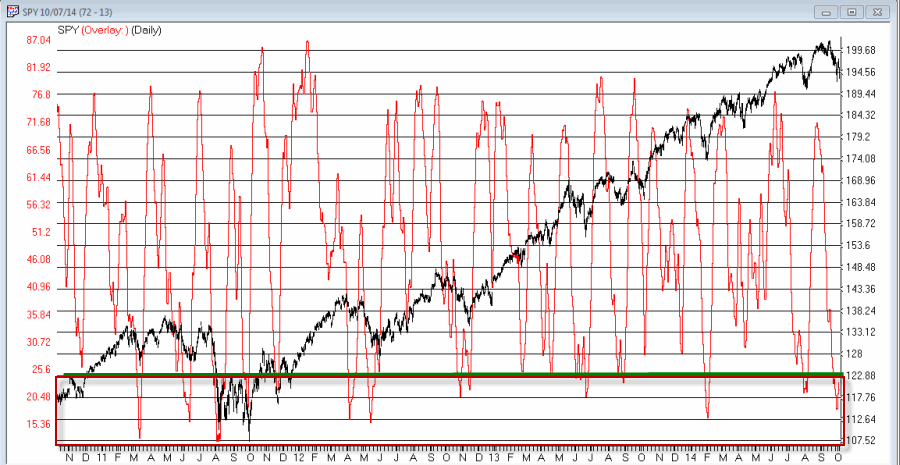
The RSI 3 Strikes and You’re Out Play

Please note the use of the word “Play” in the title.  Note also that it does NOT say “System” or “Method”, nor does it include anywhere the words “you”, “can’t” or “lose.”  So what is the distinction in all of this?

The use of the word “Play” is meant to denote that this should not be considered an “investment strategy”, nor even as a “trading method”.  In all candor it should basically be considered as a potential trigger or alert for traders who are willing to speculate in the market.  A few relevant notes:

1. Contrary to what many will tell you, there is nothing wrong with “speculating” in the financial markets.  There is a lot of money that can be made by doing so.

2. The key is in limiting the amount – and/or percentage – of capital allocated to each such trade.

3. Call and put options offer a great way to engage in this type of trading, because by their nature they allow you to “play” while using only limited sums of money.

Think about it this way.  Let’s say you “get a hankerin” to take flyer on say a rally in the bond market.  Sure you could go out and buy t-bond futures contracts.  As I write they are presently trading north of 138.  At $1,000 a point, that means that the contract value is roughly $138,000.  You only need to put up margin money of about $3,000 in order to enter the trade.  Of course, if t-bonds decline from 138 to 135 then you have lost $3,000.  Good times, good times.

As an alternative you might have bought a call option on the ETF ticker TLT, which tracks the long-term bond.  As I write TLT is trading at $115.51, so to buy 100 shares would cost $11,551.  However, a trader looking to “play” could buy say a September 115 call option for all of $182.  If TLT rallied to say $118 by September expiration the 115 call would be worth $300, which would represent roughly a 65% gain.  And just as importantly, on the flip side, if TLT falls apart the most the option trader could lose would be $182. 

Which reminds me of:

Jay’s Trading Maxim #312: If losing $182 on a trade is too much for you to bear – or will cause you great angst or to lose sleep or to beat yourself up – the “trading thing” might not be for you.

The RSI Three Strikes and You’re Out Play

So we will use the 3-day RSI indicator as a trigger to alert of a potential top.  Note the use of the phrase “potential top.”  Note also that nowhere do the words, “pinpoint”, “market” or “timing” appear.  So here is how it works:

1. (Day x) Price and 3-day RSI make a new high for a given move.
2. (Day y) After at least one intervening down day, price makes a higher close than on Day x BUT 3-day RSI stands below its level on Day x.
3. (Day z) After at least one intervening down, price makes a higher close than on Day y, BUT 3-day RSI stands below its level on Day y.
4. After Day z the entry trigger occurs the next time price drops below the 3 day low.

To put it another way, after Day x price makes to higher closing peaks (with at least one down day between these peaks), while RSI on Day y is below RSI on Day x and RSI on Day z is below RSI on Day y.  OK, that’s as clear as mud.  So let’s go the “a picture is worth 1,000 words” route.

In Figure 1 you can see two examples of this “play” using ticker IWM, the ETF that tracks the Russell 2000 small cap index.

iwm rsi3

Figure 1 – The RSI 3 Strikes and You’re Out Play using IWM (Source: AIQ TradingExpert)

In both cases the same scenario plays out.  Price makes two subsequent higher highs while RSI registers two subsequent lower highs.  The signal to buy put options comes when price takes out the three day low.

In the second example a trader could have bought a September 116 IWM put for $2.96 (or $296).  Eight trading days later that put was trading at $5.43 for a profit of $83%.

iwm out

Figure 2 – IWM put option using the RSI 3 Strikes and You’re Out play on IWM (Courtesy: www.OptionsAnalysis.com)


Summary

No one should get the idea that this simple “play” is the “be all, end all” of trading.  I specifically have not included any dies on when to exit this type of trade so that no one gets the idea of trying to use this as a mechanical trading system.  Some traders may use a profit target, some may use an indicator, some may adjust the trade or take partial profits if a certain level of profit is reached, etc.
Like virtually any other trading idea, sometimes things will work out as hoped and sometimes they won’t.  The bigger lesson is that it is OK to speculate in the markets provided you do not expose yourself to large risks.  Which seems like good time to invoke:

Jay’s Trading Maxim #1: Your most important job as a trader is to make sure you are able to come back and be a trader again tomorrow.

Jay Kaeppel  
Chief Market Analyst at JayOnTheMarkets.com and AIQ TradingExpert Pro (http://www.aiq.com) client

Jay has published four books on futures, option and stock trading. He was Head Trader for a CTA from 1995 through 2003. As a computer programmer, he co-developed trading software that was voted “Best Option Trading System” six consecutive years by readers of Technical Analysis of Stocks and Commodities magazine. A featured speaker and instructor at live and on-line trading seminars, he has authored over 30 articles in Technical Analysis of Stocks and Commodities magazine, Active Trader magazine, Futures & Options magazine and on-line at www.Investopedia.com.

Wilder’s RSI: Extending the Time Horizon (substitute for Exploring Charting Technique)

Original article by Mike B. Siroky
 
For this June’s Stocks & Commodities Tips, I substituted the article by Mike B. Siroky, “Wilder’s RSI: Extending the Time Horizon” for the article by Sylvain Vervoort.

I provide a system that uses the author’s adjustable RSI bands that automatically adjust to the appropriate level for the input RSI length. The system is very simple:

  • Buy next bar at market open when the RSI is less than the lower confidence interval band (RSI_CILOW).
  • Exit the long position next bar at market open when the RSI is greater than the upper confidence interval band (RSI_CIUP).
  • Reverse rules for shorting.
  • I have a parameter that allows testing long only, short only or both long and short.
  • The system lost when the short side was allowed to trade.

Figure 1 shows the AIQ EDS Summary long only back-test report using the NASDAQ 100 list of stocks over the period 5/11/2000 to 5/12/2014. Neither commission nor slippage have been subtracted from these results. In running this test, I used a capital protect of 98% which is equivalent to a 2% stop loss using the close. All entries and exits are at the next open. I could not get the short side to show a profit even with added market timing filters for trend on the NASDAQ 100 index.


AIQ EDS Summary long only back-test report using the NASDAQ 100 list of stocks over the period 5/11/2000 to 5/12/2014.


!WILDER’S RSI: EXTENDING THE TIME HORIZON
!Author: Mike B. Siroky, TASC May 2014
!Coded by: Richard Denning 5/10/2014
!www.TradersEdgeSystems.com
!INPUTS:
W1 is 55. !RSI length for going long
W2 is 5. !RSI length for going short
numSD is 1.645.
!CONSTANT:
EXPECTED_VALUE is 50.
!USER DEFINED FUNCTIONS
!RSI BANDS:
RSI_CIUP1 is (EXPECTED_VALUE/100 + Sqrt(EXPECTED_VALUE/100/2/W1)*numSD)*100.
RSI_CILOW1 is (EXPECTED_VALUE/100 – Sqrt(EXPECTED_VALUE/100/2/W1)*numSD)*100.
RSI_CIUP2 is (EXPECTED_VALUE/100 + Sqrt(EXPECTED_VALUE/100/2/W2)*numSD)*100.
RSI_CILOW2 is (EXPECTED_VALUE/100 – Sqrt(EXPECTED_VALUE/100/2/W2)*numSD)*100.
!RSI WILDER:
U is [close]-val([close],1).
D is val([close],1)-[close].
rsiLen1 is 2 * W1 – 1.
AvgU  is ExpAvg(iff(U>0,U,0),rsiLen1).
AvgD  is ExpAvg(iff(D>=0,D,0),rsiLen1).
RSI_1  is 100-(100/(1+(AvgU/AvgD))).
rsiLen2 is 2 * W2 – 1.
AvgU2  is ExpAvg(iff(U>0,U,0),rsiLen2).
AvgD2  is ExpAvg(iff(D>=0,D,0),rsiLen2).
RSI_2  is 100-(100/(1+(AvgU2/AvgD2))).
!RULES:
HD if hasdatafor(210) >= 200.
Buy if RSI_1 < RSI_CILOW1 and HD.
Exit if RSI_1 > RSI_CIUP1 and HD.
NDXc is TickerUDF(“NDX”,[close]).
Sell if RSI_2 > RSI_CIUP2 and NDXc < simpleavg(NDXc,200) and HD.
Cover if RSI_2 < RSI_CILOW2 and HD.
 
—Richard Denning
info@TradersEdgeSystems.com
for AIQ Systems


Everything You Need To Know About the Stock Market in 2 Charts

I have been a little “quiet” lately.  Kind of unusual for me, granted.  But what can I say really that’s new?  The stock market’s moving higher – blah, blah, blah.  The bond market keeps trying to creep higher – sure, interest rates are basically 0%, so why not?  Gold stocks keep trying to grind their way higher after putting in an apparent base.  But who the heck ever knows about something as flighty as gold stocks?

So like I said, not much new to report. 

So for the record – one more time – let me repeat where I am at:

  • As a trend-follower there isn’t much choice but to say that the trend of the stock market is still “up”.  So as a result, I have continued to grit my teeth and “ride”.  And let’s give trend-following its due – it’s been a good ride. 
  • As a market “veteran” I have to say that this entire multi-year rally has just never felt “right”.  In my “early years” in the market (also known as the “Hair Era” of my life) when the stock market would start to rally in the face of bad economic times I would think, “Ha, stupid market, that can’t be right.”  Eventually I came to learn that the stock market knows way more than I do.  And so for many years I forced myself to accept that if the stock market is moving higher in a meaningful way, then a pickup in the economy is 6 to 12 months off.  As difficult as that was at times to accept, it sure worked. 

Today, things seem “different”.  By my calculation the stock market has now been advancing for roughly 5 years and 4 months.  And the economy?  Well, depending on your political leanings it is somewhere between “awful” and “doing just fine.”  But in no way has the “old calculus” of “high market, booming economy 6-12 months later” applied.

Again depending on your politics leanings the reason for this lies somewhere between “it is entirely Barack Obama’s fault” to “it is entirely George Bush’s fault.” (I warned you there was nothing new to report).

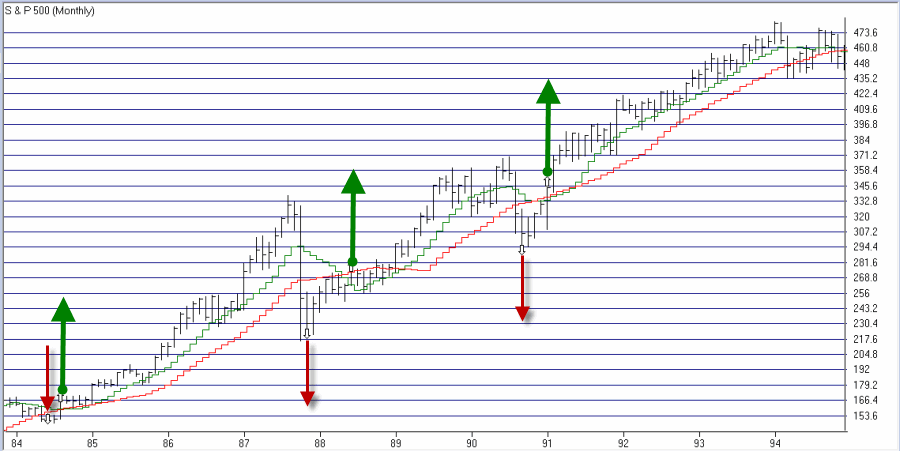
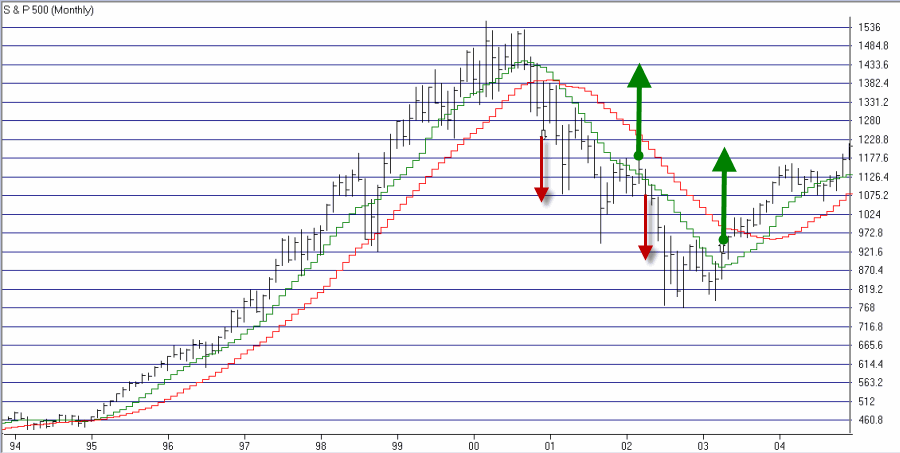
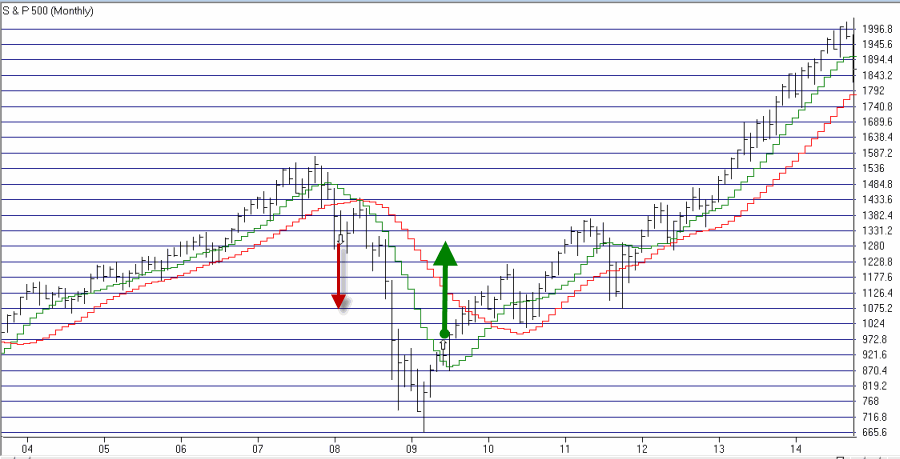
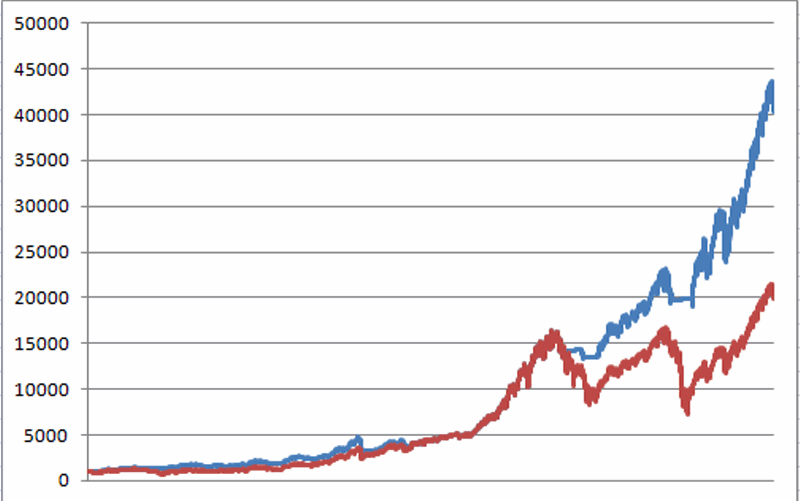
From my perspective, I think that the charts below – the second one of which I first saw presented by Tom McClellan, Editor of “The McClellan Oscillator” (which he presciently labeled at the time, “The only chart that matters right now”) – explains just about everything we need to know about the stock market actions vis a vis any economic numbers.

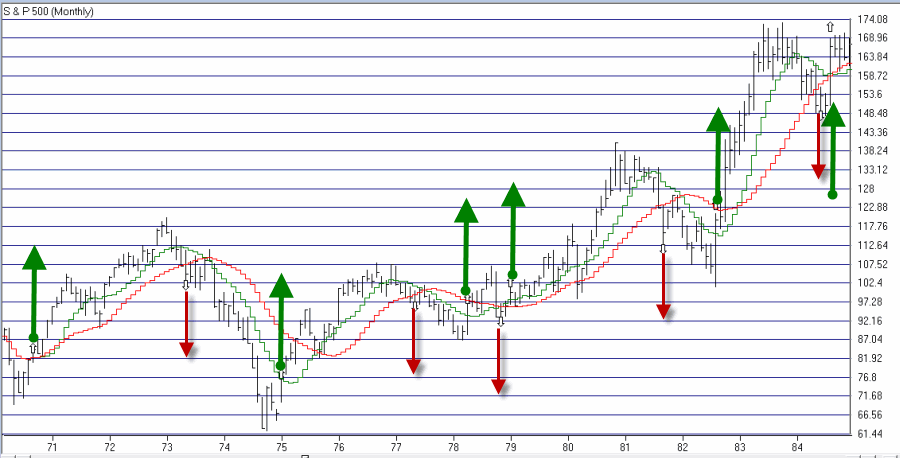
So take a look at the two charts below and see if anything at all jumps out at you.

 
spx mnthly
 
Figure 1 – S&P 500 Monthly (Source: AIQ TradingExpert)
 

qe

Figure 2 – Fed Pumping (Quantitiatve Easing “to Infinity and Beyond”) propelling the stock market

I am not a fan of using the word “manipulation” when it comes to the stock market.  But I am a strong believer in the phrase “money moves the market.”  The unprecedented printing of – I don’t know, is it billions of trillions of dollars – has clearly (at least in my mind) overwhelmed any “economic realities” and allowed the stock market to march endlessly – if not necessarily happily – to higher ground.

Thus my rhetorical questions for the day are:

“What would the stock market have looked like the past 5 years without this orgy of money?”
“What happens to the stock market when the Fed cannot or will not print money in this fashion?”

Because this is all unprecedented in my lifetime (as far as I can tell) I don’t have any pat answers to these questions.  But I some pretty strong hunches.

My bottom line: Err on the side of caution at this time.

Jay Kaeppel  
Chief Market Analyst at JayOnTheMarkets.com and AIQ TradingExpert Pro (http://www.aiq.com) client

Jay has published four books on futures, option and stock trading. He was Head Trader for a CTA from 1995 through 2003. As a computer programmer, he co-developed trading software that was voted “Best Option Trading System” six consecutive years by readers of Technical Analysis of Stocks and Commodities magazine. A featured speaker and instructor at live and on-line trading seminars, he has authored over 30 articles in Technical Analysis of Stocks and Commodities magazine, Active Trader magazine, Futures & Options magazine and on-line at www.Investopedia.com.

Perry Kaufman’s “Slope Divergence: Capitalizing On Uncertainty”

The AIQ code based on Perry Kaufman’s article in the June 2014 Stocks & Commodities magazine, “Slope Divergence: Capitalizing On Uncertainty,” is provided at

www.TradersEdgeSystems.com/traderstips.htm.

I have modified the implementation somewhat from the author’s descriptions. I did not find that the system was exiting in an average of six days but was holding for a longer period. My exits might be the issue so I added a time exit that can be used to force an exit after the “maxBars” input number of bars. I liked the results when my time exit was set to hold for a maximum of nine bars.

Figure 7 shows the AIQ EDS summary long-only backtest report using the NASDAQ 100 list of stocks over the prior four years ending 4/10/2014. Neither commission nor slippage have been subtracted from these results. To get the short side of the system to show a profit, I added slope filters on the NASDAQ 100 index. Note that my parameter settings differ from those suggested by the author.

Sample Chart

 
FIGURE 7: AIQ, SAMPLE RESULTS. Here is a sample AIQ EDS summary long-only backtest report using the NASDAQ 100 list of stocks over the prior four years ending 4/10/2014.
 

The code and EDS file can be downloaded from www.TradersEdgeSystems.com/traderstips.htm. The code is also shown here:

!SLOPE DIVERGENCE: CAPITALIZING ON UNCERTAINTY
!Author: Perry Kaufman, TASC June 2014
!Coded by: Richard Denning 4/7/2014
!www.TradersEdgeSystems.com
!INPUTS:
momLen is 10.
dvgLen1 is 5.
dvgLen2 is 7.
dvgLen3 is 10.
entryNum is 3.
maxDiverg is 3.
minPrice is 10.
maxBars is 3.
!USER DEFINED FORMULAS:
C is [close].
L is [low].
H is [high].
HH is highresult(H,momLen).
LL is lowresult(L,momLen).
stoch is (C - LL) / (HH - LL).
momSlope1 is slope2(stoch,dvgLen1).
momSlope2 is slope2(stoch,dvgLen2).
momSlope3 is slope2(stoch,dvgLen3).
priceSlope1 is slope2(C,dvgLen1).
priceSlope2 is slope2(C,dvgLen2).
priceSlope3 is slope2(C,dvgLen3).
dvgBuy1 if priceSlope1 > 0 and momslope1 < 0.
dvgBuy2 if priceSlope1 > 0 and momslope2 < 0.
dvgBuy3 if priceSlope1 > 0 and momslope3 < 0.
dvgSell1 if priceSlope1 < 0 and momslope1 > 0.
dvgSell2 if priceSlope1 < 0 and momslope2 > 0.
dvgSell3 if priceSlope1 < 0 and momslope3 > 0.
nPriceSUp is priceSlope1 > 0 + priceSlope2 > 0 + priceSlope3 > 0.
nMomSUp is momSlope1 > 0 + momSlope2 > 0 + momSlope3 > 0.
nPriceSDown is priceSlope1 < 0 + priceSlope2 < 0 + priceSlope3 < 0.
nMomSDown is momSlope1 < 0 + momSlope2 < 0 + momSlope3 < 0.
dvgBuySum is dvgBuy1 + dvgBuy2 + dvgBuy3.
dvgSellSum is dvgSell1 + dvgSell2 +dvgSell3. 
Buy if dvgBuySum >= entryNum and C > minPrice.
AllComboExit if (nPriceSDown = maxDiverg and nMomSDown = maxDiverg)
or (nPriceSUp = maxDiverg and nMomSUp = maxDiverg).
Time if {position days} >= maxBars.
ExitBuy if AllComboExit or Sell or Time.
Sell if dvgSellSum >= entryNum.
ExitSell if AllComboExit or Buy or Time.
—Richard Denning
info@TradersEdgeSystems.com
for AIQ Systems

Groups with seasonal trending in July

While looking through the seasonal trends in stocks and currencies, we decided to start running the seasonality scans on the S & P 500 groups. As a reminder here are the criteria we consider when running this.

Our study looks at 7 years of historical data and looks at the returns for all groups in the S & P 500 for the month of July from 2006 to 2013.

We do make an assumption that the month is 21 trading days and work our way back from the last day of the month. July also has the July 4th holiday and a half day trading on July 3rd. if the last day of the month falls on a weekend, then we use the first trading day prior to that date.

We make no assumptions for drawdown, nor do we look at the fundamentals behind such a pattern. We do compare the group to the market during the same period and look at the average SPY gain/loss vs. the average group gain/loss. This helps filter out market influence.

Finally we look at the median gain/loss and look for statistical anomalies, like meteoric gains/loss in one year. Here are top 5 performing groups based on average return.

Average return alone is misleading. In the seasonal analysis we need consistent patterns in the price action throughout the periods we are testing, in this case 7 years. While The S & P 500 Motorcycle manufacturers group (MTRCYCLE) looks good on average, it includes one stellar July of 37.50% back in 2010, and has 2 July’s that were negative returns. NOTE: there’s only one stock in the group (guess which one that is!).

The office REITs group (REITOFC) is more consistent. It has an average return for the last 7 years in July of 6.50%, with the last 6 years Julys all positive. There are no stellar months skewing the average. The group also contains only one stock, Boston Properties [BXP].

Here’s the seasonal chart for BXP

Interestingly the other consistent group in July is another REIT, the Diversified REITs (REITDIV). It has an average return for the last 7 years in July of 6.06%, with the last 6 years Julys all positive. There are no stellar months skewing the average. The group also contains only one stock, Vonando Realty Trust [VNO].

A quick check on what the market did during the same period reveals an average return of 1.83% with 4 gaining Julys and 3 losing Julys.


The Oil & gas Equipment group (OILGASEQ) also had a decent average, but is more volatile over the past years, however the last 5 years have all been gainers.
 
Remember, we don’t draw conclusions here, just mine for information.