Finding The Golden Triangle

The AIQ code and EDS file based on Charlotte Hudgin’s article in the September 2014 Stocks & Commodities issue, “Finding The Golden Triangle,” is provided at www.TradersEdgeSystems.com/traderstips.htm, and is shown below.

I created an indicator I named the clear value indicator (“ClearValueSum” and “ClearValueAvg”) that might be used to rank signals. The “ClearValueSum” indicator sums the daily percentages that the close is above the simple moving average (SMA). The summing starts at the last cross up and goes to the current bar. If the close is below the SMA, then the value of the indicator is zero.

In Figure 7, I show a chart of Priceline (PCLN) with the ClearVauleSum indicator in the subgraph. In addition, I provide the code for the golden triangle setup and confirmation.

The author did not discuss exits, so I provided one based on a cross under the SMA or an exit after a maximum-bars-to-hold input (“maxBarsToHold”).

Sample Chart
 
FIGURE 7: AIQ, sample trade. Here is a chart of Priceline (PCLN) with the ClearValueSum indicator and a sample trade marked with white up and down arrows.
 
Sample Chart
 
FIGURE 8: AIQ, SAMPLE PERFORMANCE RESULTS. Here are the EDS summary results compared with varying the maxBarsToHold input trading the NASDAQ 100 list of stocks over the last six years.
 

I ran a short optimization on the “maxBarsToHold” input, the results of which are shown in the table in Figure 8. Most of the metrics are best at the 18-bar setting. In Figure 7, I also show a sample trade from the system from 2009 with the 18-bar setting.

!FINDING THE GOLDEN TRIANGLE
!Author: Charlotte Hudgin, TASC Sept 2014
!Coded by: Richard Denning 7/10/2014
!www.TradersEdgeSystems.com

!INPUTS:
 smaLen is 50.        !moving average length
 periods is 252.      !Total look back period
 strength is 4.       !Number of bars on each side of pivot
 maxBarsToHold is 18. !max bars to hold position

!VARIABLES:
 C is [close].
 L is [low].
 V is [volume].
 OTD is offsettodate(month(),day(),year()).
 
!CLEAR VALUE INDICATOR:
 SMA is simpleavg(C,smaLen).
 Xup if C>SMA and (valrule(C<=SMA,1) or countof(L=1).
 XupDte is scanany(Xup,periods).
 XupOS is scanany(Xup,periods) then OTD.
 ClearPct is (C/SMA -1) * 100.
 ClearPctSum is iff(C>SMA,sum(ClearPct,^XupOS),0).
 ClearPctAvg is iff(C>SMA and ^XupOS>1,simpleavg(ClearPct,^XupOS),iff(ClearPct>0,ClearPct,0)).
 
!CODE TO FIND PIVOTS:
 LowR is LoVal([low],(2*strength)+1).
 LowM is Val([low],strength).
 LS if LowR = LowM.
 HighR is HiVal([high],(2*strength)+1).
 HighM is Val([high],strength).
 HS if  HighR = HighM.

   !FIND FIRST PIVOT LOW 
      LT1 is scanany(LS,periods) then OTD .
       LO1 is ^LT1 + Strength.
     LO1dte is SetDate(LO1).    
 LowLO1 is val([low],^LO1).
 
   !FIND FIRST PIVOT HIGH
      HT1 is scanany(HS,periods,0) then OTD .
       HO1 is ^HT1 + Strength.
 HO1dte is SetDate(HO1).    
 HighHO1 is val([high],HO1).

!SYSTEM CODE: 
 Xdn if [low]=SMA,1).
 XdnDte is scanany(Xdn,periods).
 XdnOS is scanany(Xdn,periods) then OTD.

 ShowValues if C > 5. 
 HHVpivot if HighHO1 = hival([high],smaLen) and C > 5.
 Setup if Xdn and HHVpivot.
 PriceCnf if C>SMA.
 SetupOS is scanany(Setup,periods) then OTD.
 PriceCnfOS is scanany(PriceCnf,periods) then OTD.
 AvgV is simpleavg(V,smaLen).
 VolumeCnf if ^SetupOSavgV and V=highresult(V,^PriceCnfOS).

    !BUY & EXIT RULES (LONG ONLY):
 Buy if VolumeCnf and countof(Setup,15)=1 and countof(PriceCnf,15)>=1 
  and countof(C>SMA,SetupOS+1)=SetupOS+1.
 Exit if C=maxBarsToHold.

—Richard Denning
info@TradersEdgeSystems.com
for AIQ Systems

Is Gold “Waving” Goodbye?

Typically, I don’t like to rain on other people’s parades – you know, karma being what it is and all.  And when it comes to analyzing the financial markets and trading, I am a proud graduate of “The School of Whatever Works.”  So if someone tells me that the key to their success comes from analyzing the ratio between the VIX Index and the price of arugula, I say “more power to ‘em.”  (OK, this is a made up example.  Please DO NOT email me and ask me if I have back data for the price of arugula.  I do not.  At least not that I am aware of.  Maybe I do.  I should look. Wait, no!).

So anyway, what follows is not meant to denigrate anybody else’s analysis.  But one thing that has always bugged me is when people arbitrarily draw all kinds of things on a price bar chart and then say “Aha!” One notorious example is a guy I used to know who was a big believer in Gann and Fibonacci (not that there is anything wrong with that).  So if we were to talk (assuming we were still talking) about the gold market he might send me a chart that sort of resembles the one that appears in Figure 1.  This is a weekly bar chart for ticker GLD – an ETF that tracks the price of gold bullion – with a Gann fan and Fibonacci Retracement lines drawn.

 gld w gann and fib

Figure 1 – Ticker GLD with a Gann Fan and Fibonacci Retracements (Courtesy: ProfitSource by HUBB)

As you can see in Figure 1 there is in fact a point where the 61.8% “Fib line” (as we “professional market analysts” like to refer to them) will intersect with the, well, one of the Gann Fan lines.  Is this actually significant in any way?  [Insert your answer here].  But I would likely respond to him by saying something constructive like, “Interesting analysis.  Hey what about the other 50 lines you’ve drawn on this chart?”  To which he would likely respond by saying something equally constructive like “$%^ you.” (You kind of get the idea why we don’t talk much anymore). 

For the record please note that at no time did I denigrate his analysis (well, maybe in a sneaky, snarky sort of way – sorry, it’s just my nature).  But if it works for him, that’s great.  But seriously, what about the other 50 lines?  And please remember that for the sake of clarity I did not include the 4 to 6 “key” moving averages that he would normally include on a typical bar chart.  Anyway, in the end it seems like an appropriate time to invoke:

Jay’s Trading Maxim #102: If you draw enough lines on a bar chart, price will eventually touch one.  This may or may not signify diddly squat.
or the addendum:

Jay’s Trading Maxim #102a: The market may not care that you’ve drawn a particular line on a particular chart.  Just saying.

So with this in mind, let’s turn to the price of gold and Elliott Wave Analysis.

Gold and the Elliott Wave
I always feel compelled to point out that I am not now, nor have I ever been a true “Elliotthead.”  But I know enough traders whom I respect who are serious users of Elliott Wave analysis that I do try to pay attention.  So let’s take a look at a recent example, in this case using the ticker GLD.
The biggest problem I always had with Elliott Wave is figure out when one wave is – um, waving goodbye and another wave is about to crest.  So I rely on ProfitSouce from HUBB to do the work for me.  In Figure 2 you see a bar chart for ticker GLD with ProfitSource’s version of the latest Elliott Wave count drawn.  As you can see in Figure 2, the indicated wave count just crossed down into a bearish Wave 5 (although most of the people I know who follow Elliott Wave refer to this as a “Wave 4 Sell”.  Go figure).

gld ew
 
Figure 2 – GLD and Elliott Wave w/Wave 4 Sell signal (Courtesy: ProfitSource by HUBB)

So let’s assume that a person wanted to play the short sort of gold based on this one signal (for now we will ignore the question of whether or not this is wise).  One avenue would be to sell short 100 shares of GLD at $119.34.  This transaction would involve putting up margin money of roughly $6,000 and assuming unlimited risk to the upside (Remember that if you sell short shares of GLD and gold decides for some reason to open $20 higher tomorrow your stop-loss to buy back your short GLD shares at $125 is not necessarily going to limit your risk).

My preferred play would be to use put options on ticker GLD.  Of course, with options there is always “more than one way to play.”  So let’s look at two.

Strategy #1: The “I Want to be Short Gold” Strategy (Buy a Deep-in-the-Money Put)
The objective with this strategy is to get as close to point-for-point movement with the underlying security (i.e., shares of GLD) as possible, at a fraction of the cost.  In this example, the trade in Figures 3 and 4 involves buying the December 127 put at $8.40.

 gld put1

Figure 3 – Buying Deep-in-the-money GLD Put (Source: www.OptionsAnalysis.com)

gld put2

 Figure 4 – Buying Deep-in-the-money GLD Put (Source: www.OptionsAnalysis.com)

This trade costs $840 – which represents the maximum risk on the trade and has a delta of -79.77.  This means that this trade will act roughly the same as if you had sold short 80 shares of ticker GLD (which would entail putting up margin money of roughly $4,800 and the assumption of unlimited risk. 

If GLD falls to the upper price target range indicated in Figure 2 (112.20) this trade will generate a profit of roughly $700.  As this is written, GLD has fallen from    119.34 to 115.76 a share and the December 127 put is up from $8.40 to $11.40 (+36%).

Strategy #2: The “I’m Willing to Risk a Couple of Bucks in Case the Bottom Drops Out of Gold” Strategy (buy an OTM Put Butterfly)
This strategy is for people who are willing to speculate and risk a few dollars here in there in hopes of a big payoff.  Now that phraseology probably turns a few people off, but risking a few bucks in hopes of a big payoff is essentially the definition of intelligent speculation.  
So for this I turn to www.OptionsAnalysis.com which helpfully has an OTM Butterfly Finder routine built in.

This trade involves:
Buying 1 December 118 put
Selling 2 December 108 puts
Buying 1 December 98 put
The cost of this trade is only $170.

 gld put 3

Figure 5 – Buying OTM Butterfly spread in GLD (Source: www.OptionsAnalysis.com)

gld x

Figure 6 – Buying OTM Butterfly spread in GLD (Source: www.OptionsAnalysis.com)

As you can see, if GLD does fall into the price range projected by the Elliott Wave count shown in Figure 2, this trade can make anywhere from $250 to $700 or more based on $170 of risk.
As I write, GLD is trading at $115.76 and this open position shows a profit of $94 (+55%).

Summary
There sure are a lot of ways to analyze and play the financial markets.  As a proud graduate of “The School of Whatever Works” (our school motto is “Whatever!”) I am not here to tell you what tools you should use (nor how many lines you should draw on a bar chart) or what type of trading strategies you should use to act on any particular trading strategies.  My only purpose in this blog is to provide food for thought.

Whether or not a single particular Elliott Wave count constitutes a valid trading signal is up to each trader to decide.  But whatever the indicator, once a signal to play the short side is given, more choices arise.  In this example, three choices are to:

1) Sell short shares of GLD (putting up margin money and assuming significant risk),
2) Buy an in-the-money put option to track the price of GLD without as much cost and with limited risk
3) Risk less than $200 to gain exposure to the downside in GLD
Food for thought.  Feel free to “chew on that” for awhile.

Jay Kaeppel  
Chief Market Analyst at JayOnTheMarkets.com and AIQ TradingExpert Pro (http://www.aiq.com) client
http://jayonthemarkets.com/

Jay has published four books on futures, option and stock trading. He was Head Trader for a CTA from 1995 through 2003. As a computer programmer, he co-developed trading software that was voted “Best Option Trading System” six consecutive years by readers of Technical Analysis of Stocks and Commodities magazine. A featured speaker and instructor at live and on-line trading seminars, he has authored over 30 articles in Technical Analysis of Stocks and Commodities magazine, Active Trader magazine, Futures & Options magazine and on-line at www.Investopedia.com.
It Doesn’t Have to be Rocket Science (Part 312)

Seems like I have used this title before.  That’s probably because I have.  It’s also because every once in awhile I lift my head up from “crunching numbers” – in pursuit of that “one great market timing method” – and remember that there really is no such thing and that having a general sense of the overall trend of the markets and adding a touch of common sense can get you pretty far as an investor and trader.

Of course, that’s been easier said than done of late.  At times its seems that common sense would dictate doning a Hazmat suit and curling up in the fetal position in a corner until – you know, whatever – passes.  With an election coming up we have been informed by both sides that if the other side wins then that will pretty much be the end of humanity as we know it.  Which leaves us exactly where?  But I need to watch my blood pressure so I will steer clear of politics.

My Writing (or Lack Thereof) of Late
I have been writing very little of late.  The good news for me is that JayOnTheMarkets.com is not a paid site and there are no deadlines and no one is waiting for me to tell them what to do next in the markets.  Which is probably a good thing since the truth is that I have never been more unsure of exactly what the h?$% is going on in the markets (or the world around us, come to think of it) than I have been of late.   Hence the lack of more frequent updates.  As the saying goes, “If you don’t have something intelligent to say, don’t…” – well come to think of it I have never really adhered to that rule in the past.  Never to late to start, I guess.  In any event, thank goodness I am a systematic trader.
In trying to make sense of things, on one hand a perusal of the evidence in recent months led me to think that a major top was forming.  On the other hand, the trend (except for a recent short-lived dip by some of the major averages below their 200-day moving averages) has remained “up” and we are now in what has historically been a very bullish seasonal period (also the standard most bullish 6 months of the year starts on November 1st).  

So the bottom line is that if you want to be bullish you can make a pretty good case.  On the other hand, if you want to be bearish you can also make a pretty good case. 

What’s a guy or gal to do? 

Well hopefully your answer is the same as mine: Continue to follow your objective, well thought out trading plan – one that incorporates some risk controls in case things don’t go the way you planned. 

Sounds so simply when its put that way, doesn’t it?  Towards that end, let me offer a simple “Non Rocket Science” method for identifying the long-term trend of the stock market.

Jay’s Non-Rocket Science Stock Market Trend Identification Method (JTIM)
Notice that this ridiculously long title (hence JTIM for short) includes the phrase “Trend Identification” and not the phrase “Market Timing”.  If I were truly interested in full disclosure the title would actually be something like “Jay’s Non-Rocket Science Let’s Not Ride the Bear Market All the Way to the Bottom for Crying Out Loud” Method.  But that one was really long winded. 
The purpose of this method is simply this, nothing more, nothing less: to avoid riding an extended bear market all the way to the bottom all the while hoping that one day it will bounce back.  When this method gives a sell signal it simply means that it “may be” time to play defense.  That might mean selling a few stock market related holdings, that might mean selling everything related to the stock market, or it might mean hedging and existing portfolio.

It also means that there is a chance that you may take defensive action and later end up wishing that you had not.  Sorry folks, that just kind of the nature of trend following.  But one thing I have learned since, well, the time I had a lot of hair until now, is that selling now and buying back in at a slightly higher price is typically preferable to riding a 20%, 30% or 40% or more drawdown.
Now some people may respectfully disagree with that opinion.  But these types of drawdowns can scar an investor’s psyche – and adversely affect their judgment in the future – for  a long time – even after their portfolio eventually bounces back.  In addition, riding a massive drawdown like DiCaprio and Winslet riding the final plunge of the Titanic opens an investor to one of the most devastating mistakes of all – i.e., selling at or near the bottom (Though fortunately not to hypothermia like DiCaprio – and just for the record, seriously, couldn’t Winslet have just schooched over a little bit and made enough room for both on that door or whatever it was she was floating on? But I digress).
This reminds me to remind you of:

Jay’s Trading Maxim #78: Drawdowns make people act stupid (the more the drawdown, the more the stupid).

So here are the (granted, imperfect) JTIM rules:

*If the S&P 500 Index closes for two consecutive months below its 21-month moving average AND also closes below its 10-month moving average, the trend is deemed “Bearish”.
*While the trend is deemed “Bearish”, if the SPX 500 Index closes one month above its 10-month moving average then the trend is deemed “Bullish.”
That’s it.

JTIM Results
The results must be measured based on what the method is trying to achieve – i.e., avoiding massive, long term drawdowns – so as to avoid “acting stupid” (and to avoid ending up like DiCaprio, but I repeat myself).  Over the course of time the results look pretty good.  Of course, it also depends to some extent on how you define “good”, because from time to time – and over certain extended periods of time between the beginning and end – the results don’t look so good.  Allow me to explain.
In general terms, it goes like this:

Good: This method avoided most of the 1973-1974 bear market.
Not So Good: Between 1977 and 1991 there were 5 “sell” signals.  In all 5 cases an investor who “sold everything” based on these signals would have bought back in at a higher price.  An investor would have missed drawdowns of -9.6% in 1977-78 and -12.7% in 1981-82.  But all other sell signals during the great bull market of the 80’s and 90’s witnessed drawdowns of no more than -4.0%. 
Good: The last three sell signals (2000, 2002, and 2008) were followed by drawdowns of -28%, -29% and -50%, respectively.   

Figure 1 displays the results in tabular form:

spx timing

Figure 1 – Jay’s Trend Identification Method Signals

The key thing to note is that over the past 40+ years this method outperformed buy-and-hold (by almost 2-to-1 if interest earned while out of the market is added in; See Figure 6).
Figures 2 through 5 display the signals on SPX monthly bar charts.

 SPX Timing 1

Figure 2 – SPX with JTIM Signals 1970-1984 (Courtesy: AIQ TradingExpert)
 

SPX 2

Figure 3 – SPX with JTIM Signals 1984-1994 (Courtesy: AIQ TradingExpert)

SPX 3 

Figure 4 – SPX with JTIM Signals 1994-2004 (Courtesy: AIQ TradingExpert)

SPX 4 

Figure 5 – SPX with JTIM Signals 2004-2014 (Courtesy: AIQ TradingExpert)

Figure 6 displays the growth of $1,000 using JTIM (adding 1% of interest per year while out of the market) versus buy-and-hold since 1970.

Figure 6

Figure 6 – Growth of $1,000 using JTIM (blue line) versus buy-and-hold (red line) since 1970

And just to complete the picture Figure 7 displays the growth of $1,000 invested in SPX only when the system is bearish.

  Figure 7

Figure 7 – Growth of $1,000 when JTIM is bearish (1970-present)

For the record, had an investor bought an held the S&P 500 only during those period when JITM was bearish since 1970, an intitial $1,000 investment would now be worth only $540 (i.e., a loss of -46%).  Or as we “professional market analysts” refer to it – Not So Good.

Summary
So is this the “be all, end all” of market timing?  Clearly not.  During most of the 80′s and 90′s, getting out of the market for any length of time typically cost you money.  Still, since nothing of the “be all, end all” variety actually exists  some investors may find it useful to note the status of this simple model, at the very least as an alert that:

a) a lot of bad news can typically be ignored if the model says the trend is “up”, and,
b) some defensive action may be wise if the  model says the trend is “down.”
Alright, excuse me, I have to get back into my Hazmat suit.

Jay Kaeppel  
Chief Market Analyst at JayOnTheMarkets.com and AIQ TradingExpert Pro (http://www.aiq.com) client
http://jayonthemarkets.com/

Jay has published four books on futures, option and stock trading. He was Head Trader for a CTA from 1995 through 2003. As a computer programmer, he co-developed trading software that was voted “Best Option Trading System” six consecutive years by readers of Technical Analysis of Stocks and Commodities magazine. A featured speaker and instructor at live and on-line trading seminars, he has authored over 30 articles in Technical Analysis of Stocks and Commodities magazine, Active Trader magazine, Futures & Options magazine and on-line at www.Investopedia.com.
The Professor’s Commentary October 15, 2014

The Dow rose 140 points early in the yesterday’s session only to give it all back by the close. It finished down 6 points at 16,315.

Volume was on the heavy side, coming in at 123 percent of its 10-day average. There were 38 new highs and… 378 new lows.

In yesterday’s comments I talked about how the market would likely stair-step its way lower and how rallies would likely turn into shorting opportunities. We saw this occur yesterday.

                       FREE Weekend strategy review delivered to inbox every week 

 
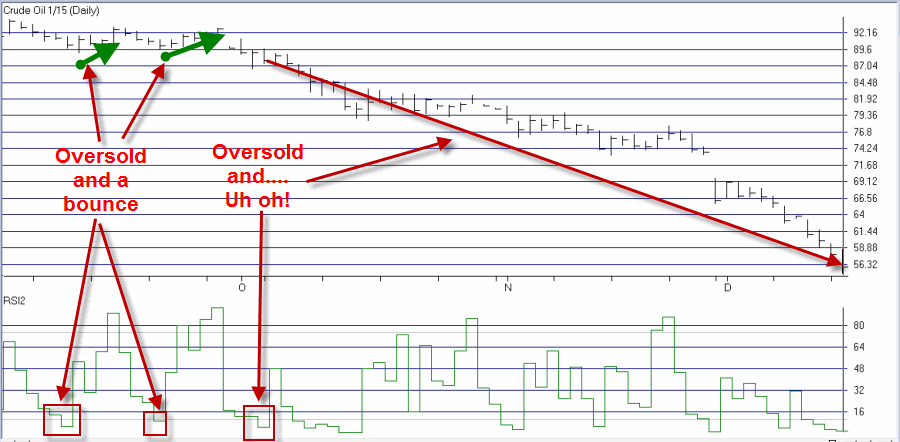
If you were paying attention to the 2-period RSI Wilder during the day, you saw that when the Dow was up 140 points, it was extremely overbought. Inverse positions established during that time were big winners by the end of the day.

The Dean’s List remains negative and the Tide continues to go out. Do not attempt to fight the Tide.

The reason I say this is because I’m seeing a lot of institutional selling now.

The Big Boys are dumping stock!

How do I know?

Well, there’s a dead giveaway. If you have been watching the market action for the past week, you have seen that most of the selling is taking place late in the day. That’s when the institutions sell stocks. Most of their selling usually takes place during the last hour of trading.

As a matter of fact, some technicians have even developed an indicator to monitor this selling. It’s called the Last Hour Indicator. It breaks breaks down the selling into hourly increments so institutional trading can be monitored. But you don’t need a fancy indicator to do this. Just watch the trading in the last hour. If the Dow is falling into the close, then you know the institutions are likely behind it.

And why is this important? Hmmm?

Well, it’s one thing if the retail investors are selling a declining market. This is what usually causes the ‘dips’ to form in a Bull Market. Retail selling usually creates buying opportunities for the Big Boys.

But when it’s the Big Boys who are selling stock in a declining market, it’s almost always a sign that there is BIG trouble ahead. The fact that they are selling and not buying now means the market will likely have trouble finding bids. And without bids, small declines can turn into BIG ones very quickly!

So we need to be extremely careful now.

Now that prices have broken out of the Major Ending Diagonal Pattern, it is likely that the Dow will continue to decline into the end of October.

The next major support level for the Dow, which is the February 2014 low of 15,340, is still over 1,000 points away. You might want to look at the chart of the Dow I posted last weekend to review the ‘target zones’. The 15,340 level is the upper level of the zone. Prices could go a lot lower!


 As long as the Dean and the Tide stay negative, the institutional selling will likely continue to drop the market to lower levels. The decline won’t be straight down, but the rallies will be brief…like the one we saw yesterday.

During yesterday’s rally, I bought an initial position in SKF, the inverse financial ETF. The ETF has a classic TLB pattern and is on the Dean’s List with positive PT indicators. It satisfies all of the elements of the SIGN.

The thing that caused me to add SKF to the mix was the positive and diverging P-volume.

Once again, I’m not in love with SKF. It’s just a ‘date’. And when I buy something with a TLB pattern, I am now committed to hold it until one of two things happens. Either the ETF ‘Jumps the Ropes’ and starts the reversal process, or the PT indicators turn negative. One or the other. That’s it.

If the ETF makes a ‘Rope Jump’, I’ll start managing my money in anticipation of a wave 2 pullback. If the PT indicators turn negative, the ‘date’ is over.

BTW, I also bought back a few shares of TWM during yesterday’s rally. The P-volume continues to impress, but once again the ETF appears overbought. If the rally in TWM continues today, I’ll likely take a few bucks off the table. The 50 still has not crossed above the 200 and I never like to be holding a full position when the ETF is technically still in a down trend.

Holding inverse ETFs from the Dean’s List.

That’s what I’m doing.

Hank Swiencinski, aka The Professor, is founder of http://OneMinuteStock.com and teaches the One Minute Stock course at UNF in Jacksonville, FL. Hank uses TradingExpert Pro extensively in his analysis.

                         FREE Weekend strategy review delivered to inbox every week 

All of the commentary expressed in this site and any attachments are opinions of the author, subject to change, and provided for educational purposes only. Nothing in this commentary or any attachments should be considered as trading advice. Trading any financial instrument is RISKY and may result in loss of capital including loss of principal. Past performance is not indicative of future results. Always understand the RISK before you trade.

Trading the SPY with MACD

The MACD indicator is a useful addition to any stock trading strategy. It is a good measure of momentum, trend direction and can also be a good guide to the relative strength of the market, indicating whether the market is overbought or oversold.

However, like all technical indicators there are a number of advantages and disadvantages that any trader should know before incorporating it into their strategy.

Disadvantages

The main disadvantage of the MACD indicator is that it is subjective to the user. Like many technical indicators, the MACD has settings that can be changed to give almost limitless numbers of variations which means results will always differ from person to person.

A trader must decide for example what moving averages to choose. The suggested settings are the 12 day moving average, 26 day and 9, however, these can easily be changed. Secondly, a trader must know what time frame the MACD works best on and there are no easy answers, since the MACD will tend to work differently across different markets. Generally, however, the MACD works best when it is confirmed across several different time frames – especially further out time frames such as the weekly chart.

Lagging indicator

Unless using the divergence strategy (more on this later) which seeks to pick tops and bottoms before they occur, the MACD has an inherent disadvantage that occurs with all technical indicators that concern price history such as moving averages. Since moving averages are lagging indicators, in that they measure the change in a stock price over a period of time (in the past), they tend to be late at giving signals. Often, when a fast moving average crosses over a slower one, the market will have already turned upwards some days ago. When the MACD crossover finally gives a buy signal, it will have already missed some of the gains, and in the worst case scenario it will get whipsawed when the market turns back the other way. The best way to get around this problem is to use longer term charts such as hourly or daily charts (since these tend to have fewer whipsaws). It is also a good idea to use other indicators or time frames to confirm the signals.

The chart below of the Spyders (SPY) clearly shows the lagging nature of the MACD.


spy02-11-14latebuy

Early signals

While the crossover strategy has the limitation of being a lagging indicator, the divergence strategy has the opposite problem. Namely, it can signal a reversal too early causing the trader to have a number of small losing trades before hitting the big one. The problem arises since a converging or diverging trend does not always lead to a reversal. Indeed, often a market will converge for just a bar or two catching its breath before it picks up momentum again and continues its trend.


ivergence options trading strategy

MACD divergence and multiple time frames

Actually this is a useful feature of the MACD. Bear in mind the lagging nature of the indicator, looking for divergences between price action and the indicator over multiple time frames makes more sense. In the chart of the SPY above the multiple daily MACD divergences are evident, but prices kept moving higher nevertheless. Prices didn’t break down until 07/25/14 and then corrected for about 5%.

Looking at a weekly chart over the same period, the MACD divergence is evident but only one occurrence is apparent and that occurs at the week ending 07/25/14.


weekly MACd divergence options trading strategy

MACD divergence and double tops and bottoms

The multiple timeframe divergence does alleviate some of the whipsaws when using MACD. If we then look at only double tops or bottoms with MACD divergence and multiple time frames, we are effectively using multiple confirmation techniques.

Take the recent top in the market 09/18/14. Prices had reached a new high 09/4/14 then retraced for 7 days before reaching the same peak on 09/18/14. A double top. The chart below shows the MACD indicator clearly diverging as the double top occurs. Prices have corrected over 5% from the peak.

spy10-3-14diverge MACD daily divergence options trading strategy


No indicator is foolproof, but combining multiple techniques and time frames does provide greater insight.