Weekend Strategy Review 6-21-2015 with The Professor

This morning I want to do something different.  For the past few weeks, I have been talking a lot about how I have mostly been scalp-trading stocks from the Honor Roll.

I have been doing more and more of this type of trading while I wait for the Ending Diagonal Pattern to complete and the market to top.  I’ve been doing this because of the choppy nature of the Ending Diagonal, and also because I believe that there is way too much risk in the market now to be holding a lot of stock overnight.  Scalp trading allows me to make a profit during the day, and then not have to worry about it evaporating overnight.  I never hold positions overnight when I scalp. 
********    Try us for $9.99 http://bit.ly/1GvhXbz *********
So the first thing I want to show you this morning is my trading screen.  The first slide shows you exactly what my trading screen looks like.  It depicts the ThinkorSwim Trading Platform from TD Ameritrade.  This platform is also available from several other brokers, so you don’t have to use Ameritrade.  I’ve been using this trading platform for the past month because my AIQ Alerts Platform has been down temporarily as AIQ makes the change to its data provider. 
Anyhow, as you can see from the first slide, all I do is set up my trading screen with a list of stocks that I’m interested in trading.  I always have a few of the index ETF in the List, a few gold stocks and ETFs, and all of the recent stocks from the Honor Roll.  This is my go to List.  In other words, I don’t put a stock on the List if I’m not interested in trading it.  I need to have a compelling reason for a stock to be on my List, and if there’s no compelling reason, the stock doesn’t make the cut. This is very important, because once the market opens and the battle begins, I know that every stock on my List is eligible to trade.  I don’t have to think about any of these stocks or ETFs.  I already decided that all are potential trades. So once the battle begins, all I need to make my buy or sell decision is for the indicators to line up. 
OK, so now let’s look at the indicators I use to trigger the trades.  I’m showing them on a 15 minute chart.  The 15s and the 5s are the time periods I mostly use when I’m scalping. 
On Wednesday, right after the Fed announcement, I was looking to scalp gold. So at 2pm, I had my trading platform set up to trade GDX.  I figured that gold was poised to make a Big Move one way or the other.  I just needed the indicators to tell me the direction. The Fed announcement was the compelling reason.
I also knew a Big Move was coming because the Bollinger Bands had narrowed going into the announcement.  This is one of the first things I look for when I trade any stock.  I ALWAYS want to see narrow Bands.  I love to see them on a stock highlighted by Emeritus for the Honor Roll, because this tells me that the move can last for days or weeks.  But even when I’m scalping, and don’t plan to hold the stock overnight, I still look for tight Bands.   Remember, I’m not in this business just to hold stocks.  NO, I only want to hold stocks when they are moving so I can make money.  And when the Bands are tight, they tell me the stock is going to make a Big Move.
********    Try us for $9.99 http://bit.ly/1GvhXbz *********
I’m not going to tell you how you should set-up your trading screen.  Every trader has individual preferences.  And depending on which platform you use, several of the indicators that I use are not available or calculated differently.
But basically, I ALWAYS have a DMI, a fast momentum indicator, a Money Flow indicator and a trend indicator on my trading screen. I only use indicators to trigger a trade. They are not used to identify potential trades. This is what I use my Lists for. By using Lists, I always know that there is a reason behind the stock or ETF. If it’s on the Dean’s List or Member’s Watch List, I know that it’s strong. If it’s on the Honor Roll, I know that it’s trending.
To trigger the trade I use a standard 14-period DMI, and a either a fast MACD (10-20-1) or a 10-period Momentum.  The charts I’m showing today use a 10-period Momentum instead of the usual MACD.  Both work well.
Same for the Money Flow.  On my AIQ screen, I use my custom money flow indicator, but because this indicator is not available on the ThinkorSwim Platform, I use a 14-period Chaikin Money Flow.
I also put up a 35 period CCI.  I use the CCI as a dual indicator.  When I first enter long trade, I want to see it move above zero.  Then once I’m in, I use it to tell me when the trend is over.  So when I’m scalping, I usually start to manage money once the CCI moves below 100.
Anyhow, that’s pretty much it.  So with this information, you might now want to look at the final two charts for NOC and TSCO.  You also might want to look at several of the other stocks that have appeared recently on the Honor Roll.  Almost all have the same characteristics. 
One other thing you should pay attention to while you’re scalping is the overall direction of the market.  In other words, pay attention to the cockpit indicators, like The Tide and both Coaches.  If all of these indicators are positive, pay close attention to any stock highlighted as a long on the Honor Roll.  After I see a stock highlighted, I look at it on a Daily Chart and try to determine why Emeritus put it on the Honor Roll. Does it have a recent Hockey Stick or TLB Pattern?   Are the Bands narrow?  If it does, I put it on my List. Same for the shorts. I need to see a pattern or tight Bands. 
Then once the market opens, all I do is wait for the indicators to line-up.  Once I’m in and have a profit, I start looking to protect it.  Don’t be a hog!  When you scalp, always remember that Bulls make money, Bears make money, and the Hogs get slaughtered! 
The market pulled back on Friday in what appeared to be a move to form the Blade of a Hockey Stick that will be needed to push prices higher toward 18,350+.   So if the market continues to pull back next week, look for the Bands to narrow as the Blade forms. 
Then look for Emeritus to highlight stocks for the Honor Roll and scalp them on the shorter-term bars.  Remember, this is NOT the time to be holding a lot of stock.  There is way too much risk in the market now. 
Have a great weekend.
That’s what I’m doing,
h
BTW, please let me know if you like this type of ‘Tactical Strategy’ in the WSR. I’m always interested in knowing what you want and need to help you learn. Remember, I only do this for you.
********    Try us for $9.99 http://bit.ly/1GvhXbz *********
Market Signals for 
06-22-2015
DMI (DIA) NEG
DMI (QQQ) NEG
COACH (DIA) NEG
COACH (QQQ) POS
A/D OSC
DEANs LIST NEU
THE TIDE NEU
SUM IND NEG
All of the commentary expressed in this site and any attachments are opinions of the author, subject to change, and provided for educational purposes only. Nothing in this commentary or any attachments should be considered as trading advice. Trading any financial instrument is RISKY and may result in loss of capital including loss of principal. Past performance is not indicative of future results. Always understand the RISK before you trade.

The professor’s Weekend Strategy Review June 6, 2015

The Dow fell 128 points, closing at 17,849.  The Dow got a low as 17,822, only 22 points from my critical support level of 17,800. 
So the Dow is still in No Man’s Land.  And because of this, I want to talk about something else this weekend.  I want to talk about the importance of having a well thought out strategy. 
Most of you know that I’m not a big fan of the commentators or guests on CNBC.  I believe that they give you way too much sizzle and not enough steak.  As entertainers, they always have one guy saying something, only to have the next guest saying just the opposite.  The pattern for the show creates confusion, which is something I don’t need when I’m trying to find a stock to trade.  No, I don’t need one guy telling me the stock is a great only to have the next guy telling me to sell it.  Besides, they almost never tell why they believe a stock is either good or bad. They just offer their opinion. What good is that?
But I have to tell you that even though I don’t have a lot of positive things to say about the commentators on CNBC, I do like the new app they developed for my iPhone.  It’s a terrific and convenient way to get financial news and updated stock quotes.  It’s always in my pocket so I can tell what my stocks are doing.
I recently noticed that a new feature has been added to the app called ‘Pro’.  I think you might need to subscribe to get some of the information provided by the app, but I did notice that a feature called ‘Squawk Box Portfolio was free.  Hmmm?   I got curious and decided to investigate its performance.
Well it turns out that the ‘Squawk Box Portfolio’ was actually the picks of 14 different commentators, including two Big Names.  Of the 14 stock pickers, there were 8 winners and 5 were losers.  The average gain was 5.12 percent.  However if you threw out the top two pickers which had gains over 20 percent, the average gain for the rest of the field was only 1.32 percent.  And the odds of getting a positive return were only slightly higher than 50-50.
Anyhow, after looking at the results, I decided to look deeper into the portfolios of the two pickers with gains of 20+ percent.  I wondered which stocks they picked.  Well, as things turned out, I was not surprised.  These two pickers had stocks like NFLX, GILD, and APPL in their portfolio.  Hmmm?  The names sounded familiar.  Where have I seen these stocks before? 
Of course!  All of them had been ranked high on the Member’s Watch List (MWL) during the past few months.  NFLX started to move back onto the List in early April.  It has remained near the top of the List.  Emeritus highlighted the stock for the Honor Roll on 13 April at 474.68.  On Friday, NFLX closed at 633.22 for a 33 percent gain!   So if you stayed in the stocks on the MWL, you likely beat the pants off of all of the CNBC commentators. Go take a look.
Back in late March – early April, when I was looking to trade energy, stocks like NBR, CLR, CJES, PBR, and ATW were consistently near the top of the MWL.  On 6 April, beaten down PetroBras (PBR) was ranked #2 behind ALTR which was on a tear of its own.  At the time, PRB was trading at 6.8.  It rose to 9.71 over the next month for a 42 percent gain!
But let’s suppose it was 9 April, and you thought you missed the move in energy.  On that date, C&J Energy Services (CJES) moved into the top spot on the MWL.  It was trading at 13.4.  A month later it was trading at 17.3 for a gain of 29 percent!   No, you wouldn’t have missed the energy train.  You didn’t need to follow the Pros on CNBC.  I didn’t see too many energy stocks in their portfolios. If you wanted winners, all you needed to do was be in the top stocks on the MWL.
BTW, whenever I see DIG on the List, I like to trade the energy rabbits…the energy stocks ranked high on the MWL.  Remember, most ETFs contain a lot of junk along with a few good performers.  So I look for times when one of my sector ‘Sticks in the Sand’, like DIG, is on the List and then trade the individual stocks in that sector from the MWL.  This keeps me in the rabbits when the environment is favorable.
So this weekend, while the market is still in No Man’s Land and testing the low of its range, I want you to think more about your long term strategy than what the market is currently doing.  Sometimes with all of the hype on CNBC, we tend to get caught up in the events of the day, worrying about what will happen in Greece, or the Jobs Report or what Janet Yellen and the Fed are going to do about interest rates.  None of this matters!  It’s all fluff and filler in the grand scheme of things.  There will always be things in the news to worry about.  But these things should NEVER effect your trading decisions.
If you were worried about interest rates, you would NEVER be trading Bonds.  So you probably did not noticed when TBT replaced TMF on the Dean’s List and missed its recent move from 43 to 50.  BTW, this simple switching strategy has trounced 12 of 14  the stock pickers on CNBC.  The model is on track for yet another 50 percent yearly gain.
Here’s what matters:  Have a strategy and follow it. When a stock or ETF is ranked high on one of my Lists, it’s ranked high for a reason.  It’s very STRONG! So then look at its pattern. Do you see a Hockey Stick? For example, in late April, when TBT moved onto the Dean’s List, it had a nice Hockey Stick Pattern with NARROW Bands.  Then when the ETF turned GREEN on 23 April, it was off to the races. 
Same for most of the energy stocks in late March.  They all had nice HS Patterns with narrow Bollinger bands. As as we learrned from ‘Squeezing the Toothpaste’ , narrow Bollinger Bands are a sign that a Big Move is coming.
So the next time you look at one of the stocks or ETFs on one of the Lists, look for the NARROW Bands.  This is especially true if the historical seasonality trends suggest that a Big Move is coming.
If you have a strategy and stick to it, you won’t have to rely on the opinions of other people.  You will learn to ignore the fluff from the commentators on CNBC and focus on what matters.
This weekend, take some take some time to go back and look at the performance of the top stocks on the MWL.  All of the market leaders were there.  Then take some time to think about the strategy you plan to use to be in them going forward.  Will it be a rotation strategy, replacing the top stocks whenever they fall off the List?  Or will you use my ‘Sticks in the Sand’ approach to trade energy depending on whether DIG or DUG is on the Dean’s List.  This is what we did in March.  When DIG moved onto the Dean’s List, it was time to look for energy stocks to trade form the Member’s Watch List.
Or will you use the ‘Sticks in the Sand” to trade Bonds, the Dollar or Gold?
This is what matters!  And as I’ve pointed out above, listening to the opinions of the commentators on CNBC gets you a 1.32 percent return.   It also causes you to be concerned about a lot of things that have nothing to do with making money. 
So this weekend, I want you to focus on your strategy.  If you don’t have one, and you continue to flip-flop from one strategy to another, and continue to miss big moves, maybe you should think about what you’re doing.  Even if you just want to pick stocks to trade, maybe you say to yourself that you’re only going to trade top stocks from the MWL or the Honor Roll whenever The Tide is positive.
But whatever your strategy is, write it down.  Post it near your computer.  Know all of the conditions of the strategy that need to line up before you decide to enter a trade.  Then after you make several trades, evaluate your performance.  Be honest with yourself.  Did you make or lose money?  Did you follow your own rules?  Was your strategy too hard or complicated to follow?
Because I believe we’re going to see a lot of volatility in the markets during the next few months, it will be extremely important to have your strategy in place BEFORE things start to become hectic.  If the market starts to rally back to 18,350+ and sets up the Major decline I expect, the folks on CNBC will NOT protect you.  The time for developing and reviewing your strategy is NOW.   Not when the market is testing 18,350 or below 17,800.  Now!
You don’t want to be thinking about your strategy once the battle starts.  Know what you’re going to do before the panic starts to develop.  In the weeks ahead,  start testing your strategy.  Get comfortable with it. Then believe in it.  You’re gonna need it.
BTW, there was another small change in the A-D oscillator on Friday.  So we need to be on the lookout for another Big Move within the next 1-2 days.  Now that the Dow is near the 17,800 support level I have been talking about for weeks, if it starts to break down the move could be violent.  On the other hand, the market is very oversold now, so it’s possible that Friday’s decline was the end of wave ‘b’ of the a-b-c pattern.  So let the market tell you what to do on Monday.  If it starts to move higher, it would tell me that 17,800 is holding and a move back to 18,350+ is likely.  On the other hand, IF 17,800 does not hold, I’m gonna get short real quick.
Have a great weekend.
That’s what I’m doing,
h
Market Signals for 
06-08-2015
DMI (DIA) NEG
DMI (QQQ) NEG
COACH (DIA) NEG
COACH (QQQ) NEG
A/D OSC SM CHG
DEANs LIST NEU
THE TIDE NEG
SUM IND NEG
All of the commentary expressed in this site and any attachments are opinions of the author, subject to change, and provided for educational purposes only. Nothing in this commentary or any attachments should be considered as trading advice. Trading any financial instrument is RISKY and may result in loss of capital including loss of principal. Past performance is not indicative of future results. Always understand the RISK before you trade.

Something Old, Something New A new way to trade moneyflow

Something Old, Something New
A new way to trade moneyflow
join us June 11. 2015 at 4:30pm eastern for
this exclusive 45 minute webinar with course manual
Hank Swiencinski, aka ‘The Professor’, has been teaching trading at the University of North Florida since the spring of 2009.  His courses have been the subject of much acclaim in Jacksonville’s news media, the Florida Times Union, and two major network TV stations.  He is the co-author of The Professor’s One Minute Guide to Stock Management, a highly informative book that addresses his straight forward, easy to learn methodology.  
He has conducted numerous seminars and webinars on trading for AIQ Systems and is currently the principal contributor to AIQ’s OneMinuteStock web site.
To date, Hank has developed and presented six webinars for AIQ Systems. Last year in ‘Trading with the Tide, Hank showed his students how to use breadth indicator to predict major market turns.  Students who attended the webinar were able to use The Tide to catch the 1,590 point move in the Dow that started on 20 October 2014. 
Then in late February, he once again showed students how he uses his “Sticks in the Sand” strategy to tell when conditions are turning favorable for various sectors. Students who attended this webinar were alerted to the favorable conditions for trading energy during late March-April. If you do not understand ‘Trading with the Tide, or how to use “Sticks in the Sand”, you’re missing the boat!
The results are simply amazing!  
During the past few months, Hank has been researching yet another new strategy for trading the markets.
The Professor is becoming increasingly concerned with the ‘churning’ that is apparent in the current market
A market that trades in a very narrow zone for months on end is usually in a distribution phase, which is often associated with a Major Top.  But because not all stocks top at the same time, some have already topped and are now starting to move lower. On the other hand, even when the overall market is moving lower, there will always be several stocks and sectors that will buck the tide.  It will be EXTREMELY important in the months ahead to know which sectors and stocks will be declining and which ones will move higher. 
This new strategy supplements The Professor’s primary strategy for trading stocks and ETFS.  It also allows students to enter specific high probability trades before the overall market starts to turn.
On average, trades placed with this new strategy allow traders to enter both long and short positions in stocks anywhere from 3 to 10 days before the overall market turns
This strategy can also be used with the shorter term bars to generate significant profits in non-trending or topping markets very similar to what is occurring now.
In the past, when the Professor’s indicators tell him that a Major Market turn is approaching, he conducts a seminar for his students at UNF.  During his most recent seminar, he showed students the results of research he has been conducting to identify specific times enter stocks that his trend algorithms have been highlighting. The results have been fantastic.
Hank will show you an entirely new way to use two indicators that you probably have ignored in the past
When used to trigger buy or sell signals from his Lists of stocks, they are extremely effective. Once you see how effective these indicators are when used with the Honor Roll, you will NEVER trade without them again. That’s why Hank calls this webinar ‘Something Old, Something New.’ 
Added Bonus
Image
As an added bonus, The Professor will also review how he uses The Tide and his ‘Sticks in the Sand’ to trade specific sector ETFs when the seasonal environment is friendly to trade these sectors. 
Using this approach, he was able to successfully trade energy related stocks and ETFs early in 2014, then again in 2015. 
​There was no uncertainty about any of this
The ‘Sticks in the Sand’ tells you when you should be looking to trade various sectors including energy, healthcare, retail, gold, bonds and currencies.  If you trade any of these sectors, you need to know how to identify when the environment is favorable for these sectors and how to enter specific trades. But now with the two indicators of ‘Something Old, Something New’, you will know which specific stocks to trade when the environment is friendly.
It doesn’t get any better than this!
With the Professor’s Methodology, you don’t get a list of 400+ stocks or ETFs to buy like you do with most other newsletters.  Large lists are of limited value, especially when you only have a limited amount of money to invest.  No, you want to know which stocks and ETFs are the best ones to invest in.
When you use a newsletter, the information is usually over a month to six weeks old.  It’s stale by the time you get it.  The Professor bakes his own Lists fresh every day!   In addition to showing you how to determine which specific stocks and ETFs are the strongest, he also shows you which ones are ready to move. 
And you’ll learn how to do this by yourself, without listening to the opinions of biased analysts on CNBC or in financial publications
Also, IF you use a Financial Advisor, you will be able to use the information in this webinar to monitor what your advisor doing.  Is he putting you into the right mix of equities, bonds, commodities, or real estate?  Is he doing it at the right time, when the environment is favorable? Or is he just watching your portfolio go up and down with the market?  Watching is not managing.  You pay your financial advisor to manage.  And if he’s not putting you into the strongest stocks and ETFs at the right time, maybe it’s time for you to make a change. 
With The Professor’s key indicators, like The Tide and Dean’s List, you will know when the conditions are favorable or unfavorable for equities, bonds, and commodities.  Then, if your advisor’s view of these markets is different from what you see for yourself, you will be able to discuss your information with him.   ​
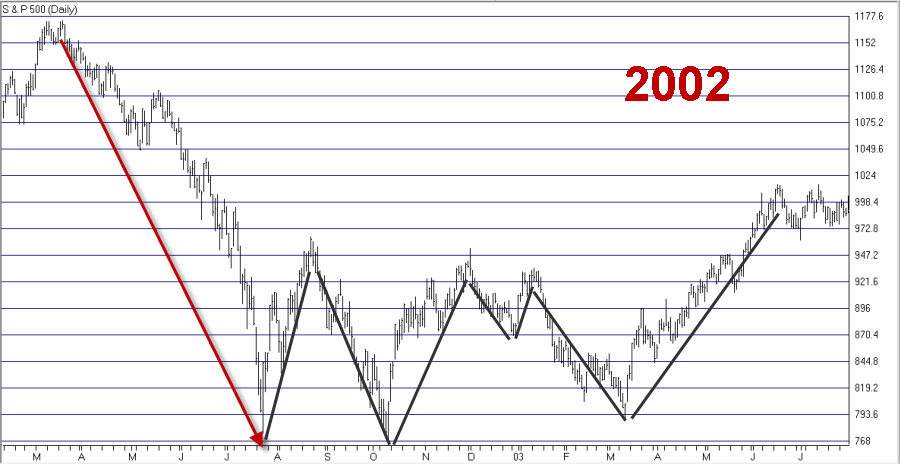
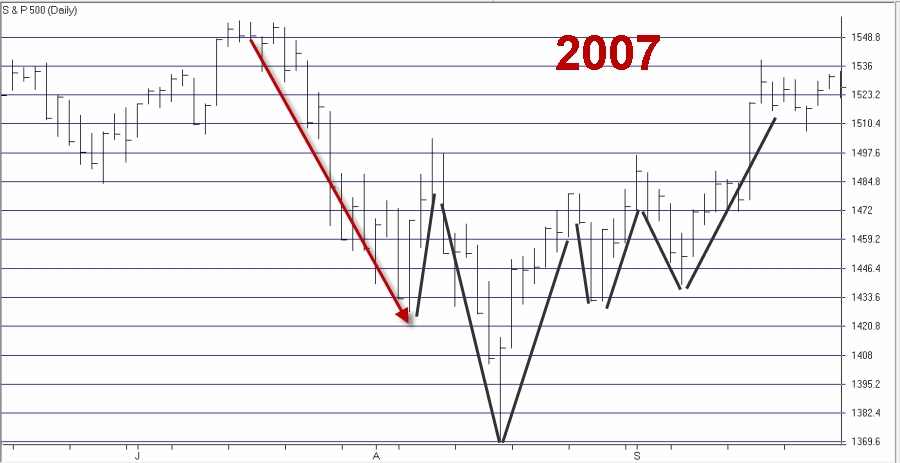
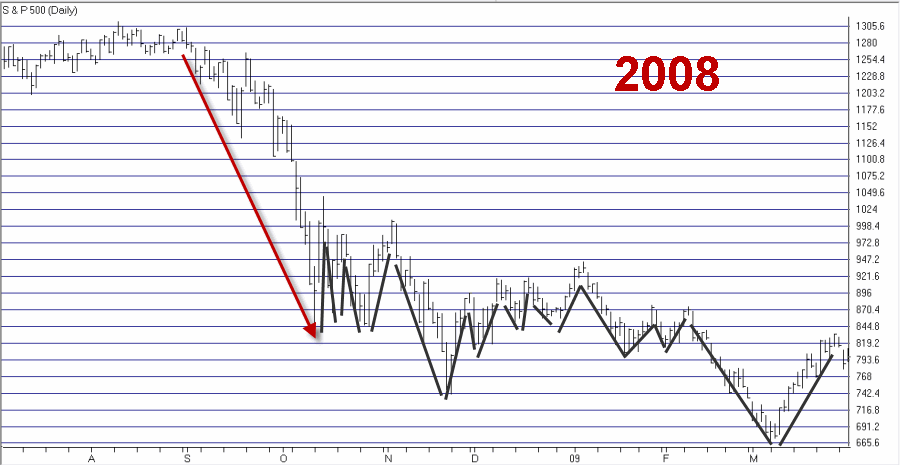
Remember what happened in the market crashes of 2002 and 2007-2008?
Most financial advisors stood by watching the markets and the value of your portfolio decline.
Do NOT let this happen again
Sign up for the webinar!
Includes seminar handouts and access to the recording
Amazing discount
ONLY $99
Image
or call  1-800-332-2999 or 775-832-2798 
More about The Professor
For the last few years, traders and investors in Jacksonville, Florida have had legendary trader Hank Swiencinski, the professor, all to themselves. No longer. The Professor, as he is known by his clients, has already presented his ‘The Professor’s One Minute Guide to Stock Management’ to a selected audience in the spring.
He is the co-author of The Professor’s One Minute Guide to Stock Management, a highly informative book that addresses his straight forward, easy to learn methodology.  He has conducted numerous seminars and webinars on trading for AIQ Systems and is currently the principal contributor to AIQ’s OneMinuteStock web site.
The success stories and testimonial we’ve received from clients, show how effective and profitable the ‘Professor’s’ strategies really are. Whether you’re already trading or relatively new to investing, this is a once in a life time chance to learn one of the best investment techniques in the World…
Sign up for the webinar!
Includes seminar handouts and access to the recording
Amazing discount
ONLY $99
Image
or call  1-800-332-2999 or 775-832-2798   

Updating My Seasonal Trends Trading Strategy (Part 1)

In my book “Seasonal Stock Market Trends” I pulled a variety of well known (and not so well known) seasonal stock market trends (what else?) into a composite index referred to as the Known Trends Index”, or KTI for short.  Sure, if I was a marketing guy I would’ve opted for something more along the lines of “Jay’s Hidden Order in the Stock Market Revealed” Index.  Alas, the marketing gene apparently skips a generation in the Kaeppel Family.
No matter. The gist is this:
The KTI is comprised of 13 indicators (including The Election Cycle, Trading Days of The Month, Sell In May and Go Away, the Summer Rally, the 40-Week Cycle, the 212-Week Cycle, Trading around Holidays and 6 others, each with specific bullish, bearish or neutral criteria) and has historically ranged from a high reading of +8 to a low reading of -1.
Using the KTI to Trade
The more seasonal trends that are favorable at a given point in time the higher the KTI and vice versa.  The theory is that higher KTI readings suggest more favorable conditions for the stock market than do lower KTI readings.
Does this theory hold true in reality?  Take a look at Figures 1 and 2 and decide for yourself.
Figure 1 displays the growth of $1,000 invested in the Dow Jones Industrials Average (price only, no dividends included) only on those days when the KTI reads +5 or higher, starting on December 1st, 1933.
1
Figure 1 – Growth of $1,000 invested in Dow Industrials only when KTI >= +5; 12/1/1933 through 5/22/2015
Compare and contrast the results displayed in Figure 1 to the results that appear in Figure 2.  Figure 2 displays the growth of $1,000 invested in the Dow Jones Industrials Average (price only, no dividends included) only on those days when the KTI reads +1 or less, starting on December 1st, 1933.
2
Figure 2 – Growth of $1,000 invested in Dow Industrials only when KTI <= +1; 12/1/1933 through 5/22/2015
For the record:
*$1,000 invested in the Dow only when the KTI >= +5 grew +5,470%
*$1,000 invested in the Dow only when the KTI <= +1 declined (-96.1%)
This dichotomy in performance is what we quantitative analyst types refer to in our highly technical terms as “statistically significant.”
Under the category of “What have you done for me lately”, Figure 3 displays the results generated from holding the Dow Industrials when KTI >= +5 versus KTI <= +1 since 12/31/1994.
1a
Figure 4 – Growth of $1,000 invested in Dow  Industrials when KTI>= +5 (red line) versus $1,000 invested in Dow Industrials when KTI<= +1 (blue line); 12/31/1994-5/22/2015
One problem with all of this information (going back to 1934) is that:
*The days for which the KTI >=5 represents only 14.65% of all trading days
*The days for which the KTI <=1 represents only 21.56% of all trading days
So what about all the other days?  Figure 3 displays the performance of the Dow during all days since 12/1/1933 when the KTI was between +2 and +4.
3
Figure 3 – Growth of $1,000 invested in Dow Industrials only when KTI = +2 or +3 or +4; 12/1/1933 through 5/22/2015
*The good news is that the net gain was +8,500%. Which is what we quantitative analyst types refer to in our highly technical terms as “not too shabby.”
*The bad news is that investing only on days when the KTI read +2, +3 or +4 witnessed a drawdown of -38% in 1938 and a massive drawdown of -57% in 2008 (i.e., “Shabby”).
So how to put it altogether and actually trade?
Simple. Stay tuned for Part 2.
Jay Kaeppel
Chief Market Analyst at JayOnTheMarkets.com and AIQ TradingExpert Pro (http://www.aiq.com) client
Basket Trading Using A Directed Acyclic Graph

The AIQ code based on Dave Cline’s article in this issue, “Basket Trading Using A Directed Acyclic Graph,” is provided at www.TradersEdgeSystems.com/traderstips.htm, and is also shown here. Acyclic graphs is a means of using a type of network graph called a directed acyclic graph or DAG in choosing a basket of securities for trading a continuously rebalanced portfolio.

!BASKET TRADING USING A DIRECTED ACYCLIC GRAPH

!Author: Dave Cline, TASC April 2015

!Coded by: Richard Denning 2/10/2015

!www.TradersEdgeSystems.com


!Len is the number of lookback days.

!L1 is the first ticker in the list that you want to compare your list to.

!L2 is the second ticker in the list that you want to compare your list to etc

!You must create a list of 20 or less symbols of interest then type in the same 

!symbols in the same alpha order as your list. If there are less than 20 just use " "

!but do not delete the input as there must be L1 through L20 inputs defined:


!INPUTS: 

Len is 250.

L1 is "ADBE".

L2 is "ADI".

L3 is "ADP".

L4 is "AKAM".

L5 is "ALTR".

L6 is "AMAT".

L7 is "FOX".

L8 is "INTU".

L9 is "LLTC".

L10 is "LMCA".

L11 is "LRCX".

L12 is "LVNTA".

L13 is "NTAP".

L14 is "NVDA".

L15 is "NXPI".

L16 is "PAYX".

L17 is "SIRI".

L18 is "TRIP".

L19 is "TXN".

L20 is "VIAB".


!CODE TO CALCULATE PEARSONS r AND r SQUARED:

ChgOC is (([close]-[open])/[open]) * 100.

SumY is Sum(ChgOC, Len).

SumYsq is Sum(ChgOC*ChgOC, Len).

SSy is SumYsq - ( (SumY * SumY) / Len ).


ChgOCL1 is TickerUDF(L1, ChgOC).

SumXsq1 is Sum(ChgOCL1*ChgOCL1, Len).

SumX1 is Sum(ChgOCL1, Len).

SumXY1 is Sum(ChgOC*ChgOCL1, Len).

SP1 is SumXY1 - ( (SumX1 * SumY) / Len ).

SSx1 is SumXsq1 - ( (SumX1 * SumX1) / Len ).

PearR1 is SP1/SQRT(SSx1*SSy).

PearRsq1 is ( PearR1 * PearR1 ).


ChgOCL2 is TickerUDF(L2, ChgOC).

SumXsq2 is Sum(ChgOCL2*ChgOCL2, Len).

SumX2 is Sum(ChgOCL2, Len).

SumXY2 is Sum(ChgOC*ChgOCL2, Len).

SP2 is SumXY2 - ( (SumX2 * SumY) / Len ).

SSx2 is SumXsq2 - ( (SumX2 * SumX2) / Len ).

PearR2 is SP2/SQRT(SSx2*SSy).

PearRsq2 is ( PearR2 * PearR2 ).


ChgOCL3 is TickerUDF(L3, ChgOC).

SumXsq3 is Sum(ChgOCL3*ChgOCL3, Len).

SumX3 is Sum(ChgOCL3, Len).

SumXY3 is Sum(ChgOC*ChgOCL3, Len).

SP3 is SumXY3 - ( (SumX3 * SumY) / Len ).

SSx3 is SumXsq3 - ( (SumX3 * SumX3) / Len ).

PearR3 is SP3/SQRT(SSx3*SSy).

PearRsq3 is ( PearR3 * PearR3 ).


ChgOCL4 is TickerUDF(L4, ChgOC).

SumXsq4 is Sum(ChgOCL4*ChgOCL4, Len).

SumX4 is Sum(ChgOCL4, Len).

SumXY4 is Sum(ChgOC*ChgOCL4, Len).

SP4 is SumXY4 - ( (SumX4 * SumY) / Len ).

SSx4 is SumXsq4 - ( (SumX4 * SumX4) / Len ).

PearR4 is SP4/SQRT(SSx4*SSy).

PearRsq4 is ( PearR4 * PearR4 ).


ChgOCL5 is TickerUDF(L5, ChgOC).

SumXsq5 is Sum(ChgOCL5*ChgOCL5, Len).

SumX5 is Sum(ChgOCL5, Len).

SumXY5 is Sum(ChgOC*ChgOCL5, Len).

SP5 is SumXY5 - ( (SumX5 * SumY) / Len ).
—Richard Denning info@TradersEdgeSystems.com for AIQ Systems