Category Archives: Uncategorized

Bartometer

May 8, 2021

Hello Everyone,

Over the last month the stock markets continue to rise. The Value sector, consisting of energy, financial, metals manufacturing and more are leading the way higher. These are the stocks that benefit from people and the companies in the economy that are benefiting from the recovery. Technology on the other hand continues to languish somewhat as they do not benefit as much as when people were confined to their homes using technology. On my Bartometer in December I thought the S&P 500 would reach 4200 to 4400 this year and the S&P is now nicely over 4200. Short term the markets are still relatively Bullish, but it is now 26% over valued. I feel that there is dramatic inflationary pressure in the economy as Copper, lumber, energy, wages and commodities in general are rising. This will put upward pressure on inflation but because the Federal Reserve will be somewhat restrained in raising interest rates because they cannot afford to pay higher rates to service the debt themselves. If, however, inflationary pressures continue to manifest themselves month after month then the Federal Reserve will have no choice but to raise interest rates sometime over the next year.

My Computer models are still on longer term Buy-Hold in the market and there are some worries, but the market technicals are still relatively ok, Albeit very overbought. This means to enjoy the ride, but we need to keep our hand on the exit door anytime I get long Term SELL signals. The NASDAQ is weak compared to the overall market.

As you know house prices are soaring and could continue for a little while longer as copper prices, lumber prices skyrocket. But if interest rates start to rise and the economy slows then houses prices should level off or even decline slightly, but house prices are still projected to go higher over the next year. If the stock market sells off from here, you may want to add more to your stock portfolio, if you have a longer-term horizon.

I still like the growth sector longer term, but the sector that should outperform going forward and as the economy rebounds, should be VALUE stocks.

Some of the INDEXES of the markets both equities and interest rates are below. The source is Morningstar.com up until May 07, 2021. These are passive indexes. YTD

Dow Jones +14.3%
S&P 500 +13.2%
EQUAL WEIGHTED S&P 500 +19.2%
NASDAQ Aggressive growth +6.6%
Large Cap Value +13.1%
I Shares Russell 2000 ETF (IWM) Small cap +15.1%
Midcap stock funds +18.1%
International Index (MSCI – EAFE ex USA +13.7%
International Emerging Markets +5.6%
Financial stocks +28%
Energy stocks +43%
Healthcare Stocks +9.0%
Moderate Mutual Fund Investment Grade Bonds (AAA) Long duration -3.86%
High Yield Merrill Lynch High Yield Index +2.3%
Floating Rate Bond Funds +2.01%
Short Term Bond +.2%
Multi sector bond funds +1.7%
Gold -3.8%
10 year Bond Yield 1.60%

Classicalprinciples.com and Robert Genetskis Excerpts

Market Outlook

Stocks were mixed this past week. The Dow was up 1½% to a new all-time high. Other key indexes were flat to down. The S&P500 was unchanged while the Nasdaq and QQQs fell 2%- 3%. Amid signs of an economic boom, foreign Central Bank heads are talking about tapering monetary stimulus. Some Fed officials have also referred to a need for adjusting policy. The Fed is lagging the rest of the world in recognizing the likely damage from current policy.

Expect more hints from the Fed about the slowing its purchases of securities. Stocks will continue to take hits whenever there are signs of a change in Fed policy. Stocks will take another hit when the Fed begins to raise interest rates. These hits to the market are likely to be temporary setbacks. The real hit to stocks will come when the Fed makes a move to significantly slow the growth in the money supply. It’s likely we are still a long way from that move. Although the S&P500 remains 26% above its fundamental value, the Fed’s ongoing purchases of securities should keep stock prices elevated. For now, stay bullish and enjoy the ride. The recent drop in longer-term interest rates is a temporary development. If you are considering borrowing money, do it now. As inflationary pressures continue to build, look for interest rates to head higher.

A Look Back

The economy soared going into the first quarter with current dollar spending (GDP) up at an 11% annual rate. Recent data indicate business continues to increase rapidly this quarter. Today’s job report shows private payroll jobs increased by 218,000 in April. This was well below expectations. The latest numbers show employment levels remain about 5% below its prior peak. Government payments have encouraged people not to work. This keeps employment down and adds to a shortage of workers.

Stock Valuation: S&P 500 26% Overvalued
Economic Fundamentals: Positive
Monetary Policy; Highly Expansive

.
Source: Classical Principles.com

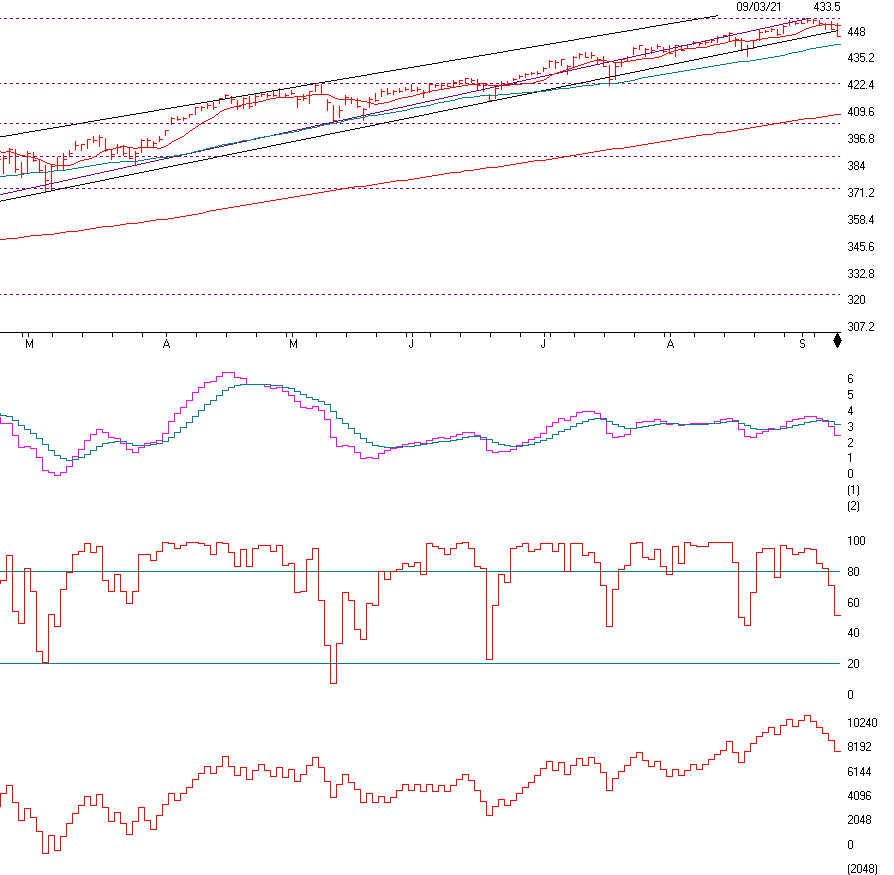
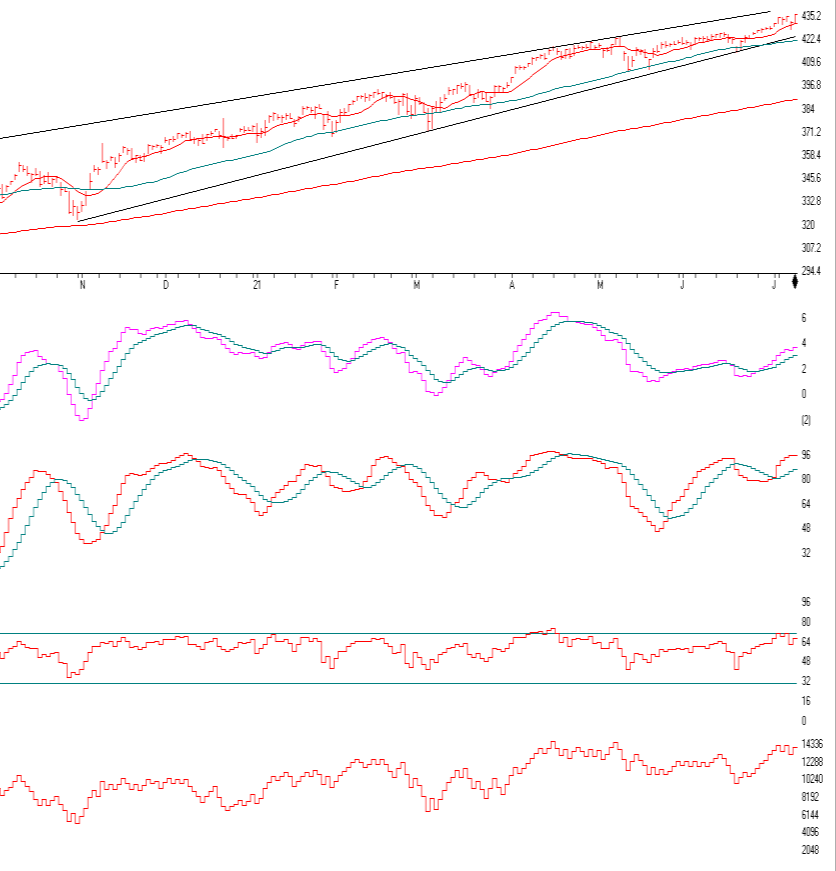
Above is the S&P 500 and the tracking stock with the symbol the SPY. It is currently up 13.27% for the year. Notice the resistance level of 422.12. If the SPY closes below 411, I will get Cautious, but a drop below 410 and I would get even more Cautious. But if on Monday the Spy closes above 422.5, then we continue to look for higher highs!

402 on the S&P is major support and I wouldn’t want it to close below that level. Any close below 402 would make me Very Cautious.
Over all, I am still relatively Bullish, but I need to be concerned that this market is going up too fast and should revert to the mean.

Momentum is still relatively good, but if it closes below the 410 level on the SPY, it will get me to reduce equities somewhat.

Support levels on the S&P 500 area are 4110, 4100, 4020, 3650.

▪ These may be safer areas to get into the equity markets on support levels slowly on the accumulation areas.

THE BOTTOM LINE:

I am still relatively Bullish on the market, but my total target of 4400 on the S&P 500 is quickly approaching. The Value sector of the market and mid and large value still look good over the short term, but over the longer-term technology which is only up about 6% should perform the best. Keep a disciplined approach to investing and don’t chase the performers, you may get hurt. I like inflationary protection investments for a percentage of money.

Best to all of you,

Joe Bartosiewicz, CFP®
Investment Advisor Representative
Contact information:


860-940-7020.
Joe Bartosiewicz, CFP®
92 High Street
Thomaston, CT 06787 and
7501 East MCDowell RD 2172
Scottsdale, AZ 85257

Securities and advisory services offered through SagePoint Financial, Inc. (SPF), member FINRA/SIPC. SPF is separately owned and other entities and/or marketing names, products or services referenced here are independent of SPF. 800-552-3319 20 East Thomas Road Ste 2000 Phoenix AZ 85012

Disclaimer: The views expressed are not necessarily the view of Sage Point Financial, Inc. and should not be interpreted directly or indirectly as an offer to buy or sell any securities mentioned herein. Securities and Advisory services offered through Sage Point Financial Inc., Member FINRA/SIPC, an SEC-registered investment advisor.
Past performance cannot guarantee future results. Investing involves risk, including the potential loss of principal. No investment strategy can guarantee a profit or protect against loss in periods of declining values. Please note that individual situations can vary. Therefore, the information presented in this letter should only be relied upon when coordinated with individual professional advice. *There is no guarantee that a diversified portfolio will outperform a non-diversified portfolio in any given market environment. No investment strategy, such as asset allocation, can guarantee a profit or protect against loss in periods of declining values.
It is our goal to help investors by identifying changing market conditions. However, investors should be aware that no investment advisor can accurately predict all of the changes that may occur in the market.

The price of commodities is subject to substantial price fluctuations of short periods and may be affected by unpredictable international monetary and political policies. The market for commodities is widely unregulated, and concentrated investing may lead to Sector investing may involve a greater degree of risk than investments with broader diversification.
Indexes cannot be invested indirectly, are unmanaged, and do not incur management fees, costs, and expenses.
Dow Jones Industrial Average: A weighted price average of 30 significant stocks traded on the New York Stock Exchange and the NASDAQ.
S&P 500: The S&P 500 is an unmanaged indexed comprised of 500 widely held securities considered to be representative of the stock market in general.
NASDAQ: the NASDAQ Composite Index is an unmanaged, market-weighted index of all over the counter common stocks traded on the National Association of Securities Dealers Automated Quotation System
(IWM) I Shares Russell 2000 ETF: Which tracks the Russell 2000 index: which measures the performance of the small capitalization sector of the U.S. equity market.
A Moderate Mutual Fund risk mutual has approximately 50-70% of its portfolio in different equities, from growth, income stocks, international and emerging markets stocks to 30-50% of its portfolio in different categories of bonds and cash. It seeks capital appreciation with a low to moderate level of current income.
The Merrill Lynch High Yield Master Index: A broad-based measure of the performance of non-investment grade US Bonds
MSCI EAFE: the MSCI EAFE Index (Morgan Stanley Capital International Europe, Australia, and Far East Index) is a widely recognized benchmark of non-US markets. It is an unmanaged index composed of a sample of companies’ representative of the market structure of 20 European and Pacific Basin countries and includes reinvestment of all dividends.
Investment grade bond index: The S&P 500 Investment-grade corporate bond index, a sub-index of the S&P 500 Bond Index, seeks to measure the performance of the US corporate debt issued by constituents in the S&P 500 with an investment-grade rating. The S&P 500 Bond index is designed to be a corporate-bond counterpart to the S&P 500, which is widely regarded as the best single gauge of large-cap US equities.
Floating Rate Bond Index is a rule-based, market-value weighted index engineered to measure the performance and characteristics of floating-rate coupon U.S. Treasuries, which have a maturity greater than 12 months.
Rate Of Change With Bands

The importable AIQ EDS file based on Vitali Apirine’s article in this issue,of Stocks & Commodities magazine “Rate Of Change With Bands,” can be obtained on request via email to info@TradersEdgeSystems.com. The code is also shown here:

!Rate Of Change With Bands 
!Author: Vitali Aprine, TASC Mar 2021
!Coded by: Rich Denning, 01/11/2021
!INPUTS:
rocLen is 12.
emaLen is 3.
smaLen is 12.
C is [close].
ROC is (C - valresult(C,rocLen)) / valresult(C,rocLen)*100.
smaSqr is simpleavg(ROC*ROC,smaLen).
ROCdev is sqrt(smaSqr).
emaROC is expavg(ROC,emaLen).
upROCB is ROCdev.
dnROCB is - ROCdev.

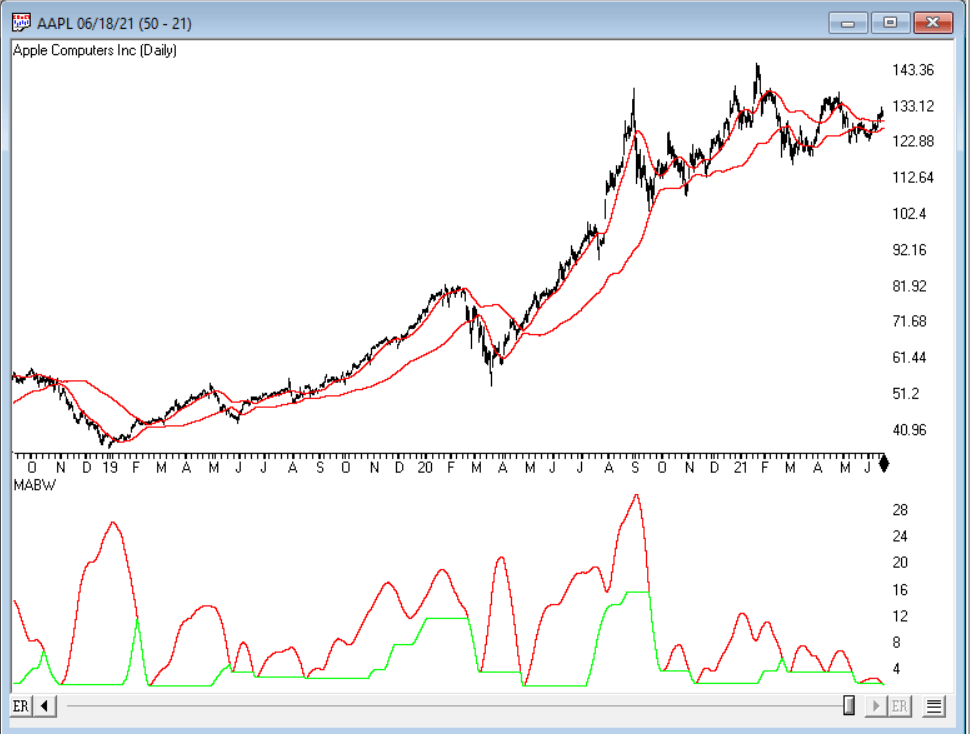
Code for the ROCB indicator is set up in the AIQ code file. Figure 10 shows the indicators on a chart of Apple Inc. (AAPL). The red line in the first panel is the upper ROC band and the green line is the smoothed ROC. In the lower panel, the red line is the lower ROC band and the green line is the smoothed ROC.

Sample Chart

FIGURE 10: AIQ. The ROCB indicators are shown on a chart of Apple Inc. (AAPL). The red line in the first panel is the upper ROC band and the green line is the smoothed ROC. In the lower panel, the red line is the lower ROC band and the green line is the smoothed ROC.

—Richard Denning
info@TradersEdgeSystems.com
for AIQ Systems

New updated Market Chart Ticker

With the price of the Dow Jones 30 (ticker INDU) in your AIQ reaching beyond 32760,  your Market Chart may be experiencing a spike in Charts. A new updated file for INDU is now available for you at www.aiqsystems.com/INDU.dta

Close all open AIQ programs.  Click the link above and Save INDU.dta to c:\wintes32\tdata, say yes when asked to overwrite.  Once done, open Data Manager, click on Utilities, Rebuild Master Ticker List.

If have any questions please contact Support support@aiqsystems.com

TECH NOTE

The error is due to the theoretical maximum length of an environment variable is around 32,760 characters.

The Bartometer

March 8, 2021

Hello Everyone,

Over the last few weeks the markets have drifted lower with the NASDAQ actually negative for the year. The rest of the non tech sectors have performed relatively well as seen on the chart below. As investors are looking for continual growth in the overall economy—the sectors impacted hardest by Covid have started to bounce back. Cruise ships, manufacturing, and airline stocks are all seeing short term gains strengthened by the stimulus plan, increase in Covid vaccination distribution, and hope of future increased earnings. The large cap growth stocks like Apple, Amazon, Tesla, and Microsoft have flattened over the last 8 months. The small to mid-cap stocks, energy, and financials have kept the market upright and are still reasonable to be invested in with proper allocation. Energy stocks however, may continue to perform relatively well over the short term, longer term I don’t see a lot of growth as President Biden and the other nations strive to eliminate the need for fossil fuels replacing them with electric, solar, and alternate ways of generating power. In addition, financial stocks also have been doing well and should continue to perform as long as the economy is doing well and interest rates are rising. Even though the market is about 13% overvalued and in the short term could fall; the economy should rise throughout the rest of the year giving us a decent buying opportunity if the market falls. Interest rates should still push higher over the longer term, but short term the interest rate rise may stall growth.

Some of the INDEXES of the markets both equities and interest rates are below. The source is Morningstar.com up until March 07, 2021.

YTD
Dow Jones +3.33%
S&P 500 +2.61%
EQUAL WEIGHTED S&P 500 +4.7%
NASDAQ Aggressive growth -1.61%
Large Cap Value +7.0%
I Shares Russell 2000 ETF (IWM) Small cap +11.05%
Midcap stock funds +7.52%
International Index (MSCI – EAFE ex USA +2.5%
International Emerging Markets +4%
Financial stocks +14%
Energy stocks +39%
Healthcare Stocks -1.0%

Moderate Mutual Fund Investment Grade Bonds (AAA) Long duration +.5%
High Yield Merrill Lynch High Yield Index +0.2%

Floating Rate Bond Funds +1.4%
Short Term Bond +.2%
Multi sector bond funds -.4%

Gold -11%

10 year Bond Yield 1.62%

As you can see above, the NASDAQ and the tech stocks, the leader over the last year is down for the year. They may be down, but don’t count them out. That sector is the growth engine of the world. They just need a rest short term.

Classicalprinciples.com and Robert Genetskis Excerpts

Market Outlook

Stock prices moved decisively lower this past week as all 5 key indexes lost ground. The Nasdaq and QQQs fell 3% bringing both indexes to 10% below their recent highs. Other indexes fell 1%-2½%.

In his analysis a month ago, my technical guru, Joe Bartosiewicz CFP, warned of potential problems due to a technical formation. Stocks have already gone through some of Joe’s support areas with the S&P500 below its 50-day average. His latest key levels for support are the 12,500 vicinity for the Nasdaq and 3671 for the S&P500.

Economic news remains mostly positive. Investors now appear concerned over too strong a recovery, higher inflation and increases in longer-term interest rates.

Current policies aren’t helping. Both Fed Chairman Powell’s insistence on further monetary ease and the pork-loaded $1.9 trillion “stimulus” bill are feeding concerns over higher inflation.

At yesterday’s close, the S&P500 was overvalued by 13%. As a result, stocks are still vulnerable to further declines. I continue to expect the Fed’s monetary ease to provide a tailwind for stocks to keep the S&P500 above its fundamental value. However, when psychology turns negative, there is no way to know how far a correction will go.

As for longer-term interest rates, they remain well below their fundamental level. We are at the beginning of what I expect will be a major upward move in long-term rates. Fixed-income portfolios should remain very defensive.

A Look Back

Today’s job report shows a gain of 465,000 private jobs in February, 355,000 of these were in leisure and hospitality. In spite of the gains, the number of jobs remains 6% below its peak of a year ago. The good news for jobs is also evident in initial unemployment claims. They averaged 791,000 in February, 50,000 less than the previous two months.

Stock Valuation: S&P 500 13% Overvalued
Economic Fundamentals: Positive
Monetary Policy; Highly Expansive
.
Source: Classical Principles.com

NASDAQ

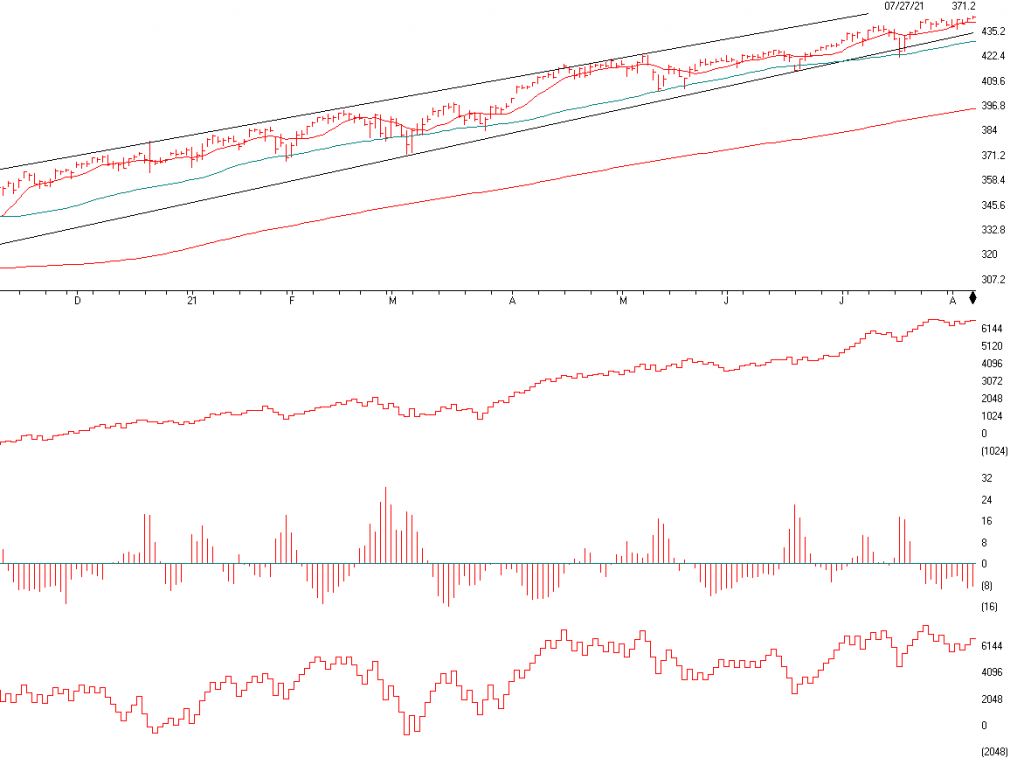
This is the index that contains Apple, Microsoft, Google, Tesla, and the aggressive tech stocks in general. Last month I said that the markets were overbought and that we had a Rising Wedge pattern. Not only a rising wedge but a Head and Shoulders top, with the neckline at 13015. If the NASDAQ closes above 13315 and stays there for 2 plus days, I will get more positive. Friday, AIQ gave a short term Buy signal on the daily charts. I am not totally convinced yet. I want to see it close above the 50 day moving average, 13315, for a day or two. There is support on the NASDAQ at 12,316(area), 12,104, 11,900, 11,743, 11,618, and 10,801

SK-SD stochastics is now somewhat Oversold, so long term investors may want to nibble here but there could be a lot more on the downside to come as it’s not very oversold.

The Advance Decline line is the number of stocks going up compared to the number of stocks going down on a running total. As you can see to the left, there are a lot of stocks in the NASDAQ that are falling. This year’s rally has been powered by the energy stocks, value and financials. This is why we diversify.

As I see it, interest rates have a lot of internal pressure to rise, meaning long term bonds can continue to get hit, but the economy should continue to get better and that should help stocks in general.

Support levels on the S&P 500 area are 3723, 3694, 3671, 3594, RESISTANCE on the S&P is 3887

NASDAQ Support, 12,214, 11,900, 11,618, and 10,801

Dow Jones 30310, 29782, 29217, and 29017

These may be safer areas to get into the equity markets on support levels slowly on the accumulation areas.

THE BOTTOM LINE:

The market has sold off over the last month, especially the aggressive tech and NASDAQ stocks. Value, energy, and financial stocks continue to rally this year. I still like financial and energy stocks, but not for long term holds as fossil fuels are reduced and even eliminated. Technology should do well over the long term and if the tech sector continues to sell, I will start to buy them myself as long term they are in the sweet spot. The Small Stocks have performed great this year and I think the Covid stocks that were hurt last year, like the restaurants, parks, cruise ships and more will come back as the economy gets stronger. Diversification is now important as the first 10 months of the recovery has been all large growth.

Best to all of you,

Joe Bartosiewicz, CFP®
Investment Advisor Representative

Securities and advisory services offered through SagePoint Financial, Inc. (SPF), member FINRA/SIPC. SPF is separately owned and other entities and/or marketing names, products or services referenced here are independent of SPF. 800-552-3319 20 East Thomas Road Ste 2000 Phoenix AZ 85012

Technical Analysis is based on a study of historical price movements and past trend patterns. There is no assurance that these market changes or trends can or will be duplicated shortly. It logically follows that historical precedent does not guarantee future results. Conclusions expressed in the Technical Analysis section are personal opinions: and may not be construed as recommendations to buy or sell anything.

Disclaimer: The views expressed are not necessarily the view of Sage Point Financial, Inc. and should not be interpreted directly or indirectly as an offer to buy or sell any securities mentioned herein. Securities and Advisory services offered through Sage Point Financial Inc., Member FINRA/SIPC, an SEC-registered investment advisor.

Past performance cannot guarantee future results. Investing involves risk, including the potential loss of principal. No investment strategy can guarantee a profit or protect against loss in periods of declining values. Please note that individual situations can vary. Therefore, the information presented in this letter should only be relied upon when coordinated with individual professional advice. *There is no guarantee that a diversified portfolio will outperform a non-diversified portfolio in any given market environment. No investment strategy, such as asset allocation, can guarantee a profit or protect against loss in periods of declining values.
It is our goal to help investors by identifying changing market conditions. However, investors should be aware that no investment advisor can accurately predict all of the changes that may occur in the market.

The price of commodities is subject to substantial price fluctuations of short periods and may be affected by unpredictable international monetary and political policies. The market for commodities is widely unregulated, and concentrated investing may lead to Sector investing may involve a greater degree of risk than investments with broader diversification.

Indexes cannot be invested indirectly, are unmanaged, and do not incur management fees, costs, and expenses.

Dow Jones Industrial Average: A weighted price average of 30 significant stocks traded on the New York Stock Exchange and the NASDAQ.

S&P 500: The S&P 500 is an unmanaged indexed comprised of 500 widely held securities considered to be representative of the stock market in general.

NASDAQ: the NASDAQ Composite Index is an unmanaged, market-weighted index of all over the counter common stocks traded on the National Association of Securities Dealers Automated Quotation System

(IWM) I Shares Russell 2000 ETF: Which tracks the Russell 2000 index: which measures the performance of the small capitalization sector of the U.S. equity market.

A Moderate Mutual Fund risk mutual has approximately 50-70% of its portfolio in different equities, from growth, income stocks, international and emerging markets stocks to 30-50% of its portfolio in different categories of bonds and cash. It seeks capital appreciation with a low to moderate level of current income.

The Merrill Lynch High Yield Master Index: A broad-based measure of the performance of non-investment grade US Bonds

MSCI EAFE: the MSCI EAFE Index (Morgan Stanley Capital International Europe, Australia, and Far East Index) is a widely recognized benchmark of non-US markets. It is an unmanaged index composed of a sample of companies’ representative of the market structure of 20 European and Pacific Basin countries and includes reinvestment of all dividends.
Investment grade bond index: The S&P 500 Investment-grade corporate bond index, a sub-index of the S&P 500 Bond Index, seeks to measure the performance of the US corporate debt issued by constituents in the S&P 500 with an investment-grade rating. The S&P 500 Bond index is designed to be a corporate-bond counterpart to the S&P 500, which is widely regarded as the best single gauge of large-cap US equities.

Floating Rate Bond Index is a rule-based, market-value weighted index engineered to measure the performance and characteristics of floating-rate coupon U.S. Treasuries, which have a maturity greater than 12 months.